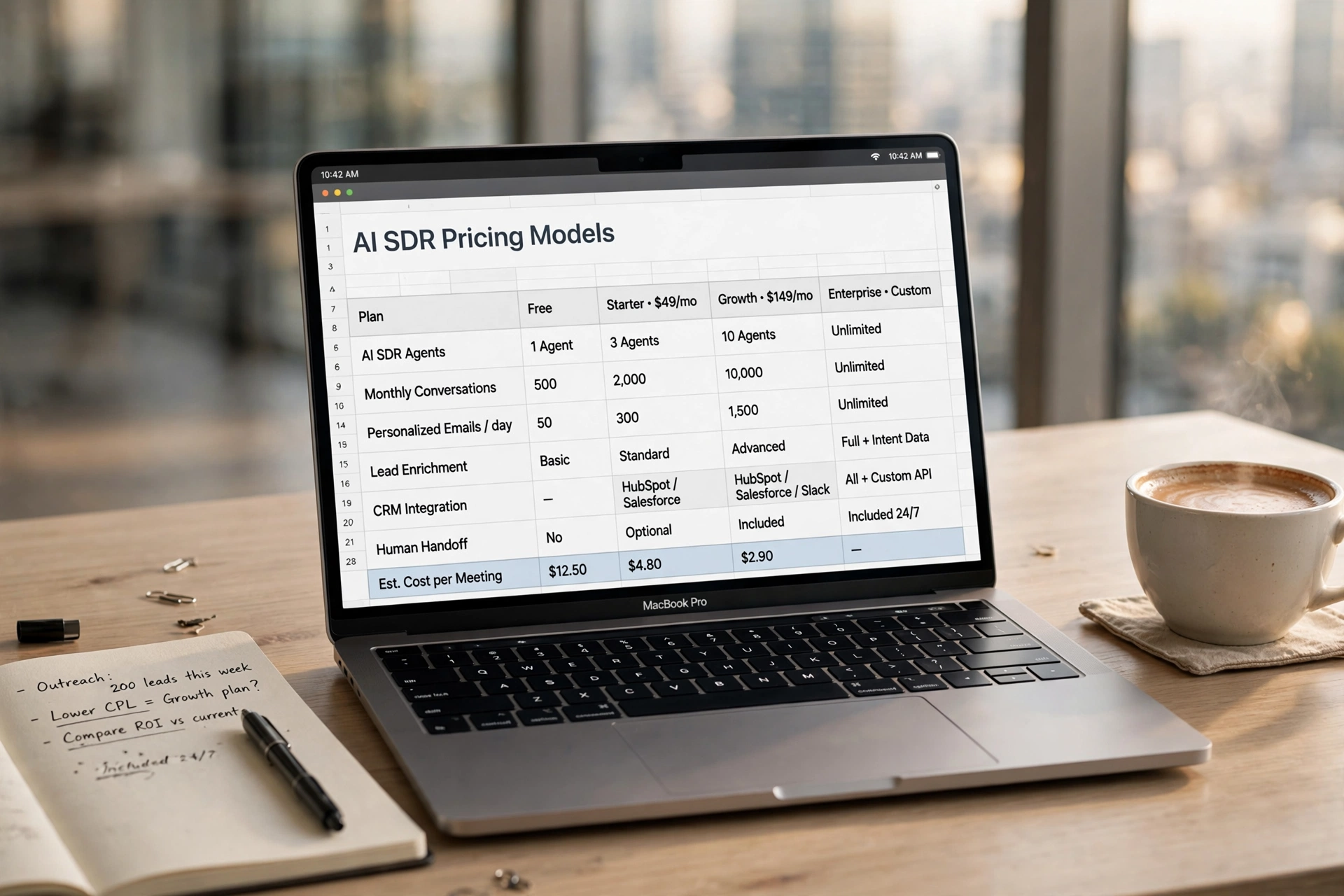
📖This article is part of the complete guide to The Ultimate Guide to SaaS Lead Qualification.
Hiring a single human SDR costs $50,000–$80,000 per year in salary alone. Add software, training, and churn, and you're looking at six figures before that rep books a single qualified meeting. Enter AI SDRs: autonomous agents that prospect, qualify, and even book meetings without sleep or commission. But the pricing landscape is a mess. Some charge per lead, others per meeting, and a few want a monthly subscription regardless of output. Which model actually saves you money, and which one hides the real cost?
In my experience working with dozens of B2B sales teams, the biggest mistake is focusing solely on per-lead cost while ignoring lead quality. A tool that charges $2 per lead but delivers unqualified contacts is more expensive than one charging $20 per lead that converts at 8%. To make an informed decision, you need a structured comparison. For a broader look at how AI SDRs fit into your tech stack, explore our guide on AI SDRs and autonomous appointment setters.
What Is AI SDR Pricing and How Does It Work?
📚
Definition
AI SDR pricing refers to the cost structures used by software platforms that automate the sales development process—prospecting, outreach, lead qualification, and meeting scheduling. Unlike traditional human SDRs, these tools operate 24/7 and scale linearly.
AI SDR pricing is the fee you pay to an AI-powered system to perform the tasks of a human sales development representative. The core logic behind these costs usually revolves around data access, the complexity of the Large Language Model (LLM) used for outreach, and the guaranteed outcome (like a booked meeting). Because these systems replace manual labor, the pricing shifts from hourly wages to software-as-a-service (SaaS) metrics.
There are several primary ways these tools are billed. Some utilize a strict subscription model where you pay a flat fee for a set of features. Others use an AI SDR tool with performance based pricing per meeting or per reply, shifting the risk from the buyer to the vendor. In 2026, we are seeing a massive shift toward hybrid models that combine a base platform fee with usage-based credits for data enrichment.
💡
Key Takeaway
AI SDR pricing varies wildly. The cheapest per-lead model might cost less upfront but often leads to lower quality, while the most expensive flat-fee models typically deliver higher conversion rates due to better filtering.
Why Does AI SDR Pricing Matter for Your Business?
Choosing the wrong pricing model can kill your ROI by inflating your Customer Acquisition Cost (CAC). A human SDR costs roughly $65,000 annually plus 20% overhead. An AI SDR at a flat $1,000/month saves $50,000/year, but only if it actually books meetings. If you choose per-meeting pricing at $150/meeting and your AI SDR books only 10 meetings a month, the cost jumps to $1,500, which is still far cheaper than a human but higher than a subscription.
According to a 2025 Forrester study, companies using AI SDRs see 40% lower cost per qualified lead compared to human-led teams. This efficiency is compounded when you integrate AI SDRs with a programmatic approach to traffic. For example, when you automate organic traffic and lead capture with AI, your AI SDR isn't just cold-calling; it's qualifying inbound intent from high-authority pages. This synergy reduces the cost per meeting because the leads are already pre-warmed by your content.
Furthermore, the scalability of AI pricing allows B2B firms to experiment with new markets without hiring a full team. In my experience, the most successful companies don't just buy a tool; they build a revenue engine. This often involves using AI search engine optimization and GEO to ensure that when an AI SDR reaches out, the prospect has already seen the brand cited as an authority in Google Search or Perplexity.
How Much Does an SDR Cost? Comparing Human vs. AI
To understand if the pricing is fair, you must compare the "fully loaded" cost of a human versus the software cost. A fully loaded human SDR (salary, benefits, laptop, CRM seat, and training) costs between $70,000 and $90,000 per year. An AI SDR system typically runs from $200 to $5,000 per month.
| Cost Factor | Human SDR (Traditional) | Generic AI Tool (Cheap) | BizAI Intelligence (Modern) |
|---|---|---|---|
| Annual Base Cost | $70,000–$90,000 | $2,400–$12,000 | $24,000–$60,000 |
| Lead Quality | Variable (Human Error) | Low (AI Slop) | High (Context-Aware) |
| Scaling Speed | Slow (Hiring Cycle) | Instant | Instant + Organic Growth |
| Meeting Volume | 10–15 / month | High (often unqualified) | 20–50 / month (Qualified) |
| Cost Per Meeting | $400–$750 | $40–$250 | $100–$300 (High Intent) |
As the table shows, while generic tools are the cheapest, they often lack the qualification rigor needed for high-ticket B2B. The modern approach—combining AI SDRs with a programmatic SEO engine—creates a compounding asset. Instead of paying for every lead, you build a machine that generates them for free. This is why comparing the ROI of an AI SDR vs human SDR requires looking at the long-term pipeline value, not just the monthly bill.
What Is the Typical Pricing for an AI SDR That Books Meetings Per Month?
For B2B teams, the most critical metric is the cost of a confirmed appointment. For an AI SDR that books meetings per month, typical rates range from $50 to $200 per confirmed meeting. If a tool charges $100 per meeting and books 20 meetings per month, your monthly spend is $2,000. This is a result-oriented model that minimizes waste but can become expensive as you scale.
If you are operating at a high volume, per-meeting pricing can become a liability. For instance, if your AI SDR is incredibly successful and books 100 meetings a month, a $100/meeting fee results in a $10,000 monthly bill. In this scenario, a flat-fee subscription of $2,000/month would be significantly more profitable. This is where companies often pivot their strategy to optimize their internal margins.
To accurately project these costs, you should ask vendors for their "booked-to-qualified" ratio. If the tool books 20 meetings but only 5 are actually qualified for your sales team, your true cost per qualified meeting is 4x higher than the sticker price. To avoid this, I recommend using AI appointment setters for B2B demo booking that utilize deep qualification screens before the meeting even hits the calendar.
AI SDR Agent Pricing: What Should I Expect Per Month Per Seat?
Per-seat pricing is the standard for tools designed for human-AI collaboration, where a human rep manages a set of AI agents. You should expect to pay between $100 and $500 per seat per month for a fully featured AI SDR agent. Lower-tier tools might charge $50/seat for basic lead sourcing, while advanced platforms with multi-channel outreach (Email, LinkedIn, Phone) reach the $200+ mark.
When evaluating seat costs, it is essential to determine if the "seat" refers to a human user or a virtual agent. Some platforms limit the number of active "AI personalities" you can deploy. For example, if you want one AI agent for the US market and another for the UK market, you may be forced to buy two seats.
High-end enterprise platforms often bundle these seats into larger contracts. In my experience, these contracts often include intent data, which allows the AI to prioritize leads who are actively searching for your solution. This is the same logic we use in our PSEO architecture guide for SaaS, where we target specific buyer intent keywords to ensure the AI SDR is reaching out to people who are already in the decision phase.
AI SDR Pricing: What Do These Tools Usually Cost Per Month?
To provide a concrete benchmark for 2026, the market is currently divided into four distinct tiers of monthly expenditure:
- Basic AI SDR Tools (e.g., Apollo.io, LeadIQ): These typically cost $50–$200/month. They are essentially database tools with basic automation. They are great for volume but lack the sophisticated "brain" required for autonomous qualification.
- Mid-Market Platforms (e.g., Outreach, Salesloft): These range from $500–$1,500/month. They offer better sequencing and integration but often require a human to spend several hours a week managing the AI.
- Enterprise AI SDR Suites (e.g., 6sense, Clari): These can cost $2,500–$10,000/month. They provide deep account-based marketing (ABM) data and revenue intelligence, targeting a very small number of high-value accounts.
- Managed AI SDR & Growth Systems (e.g., BizAI Intelligence): These are usually custom investments, often $2,000–$5,000/month. Unlike the others, these systems combine the AI SDR with a programmatic organic traffic engine, meaning you aren't just paying for a tool, but for a lead-generation asset.
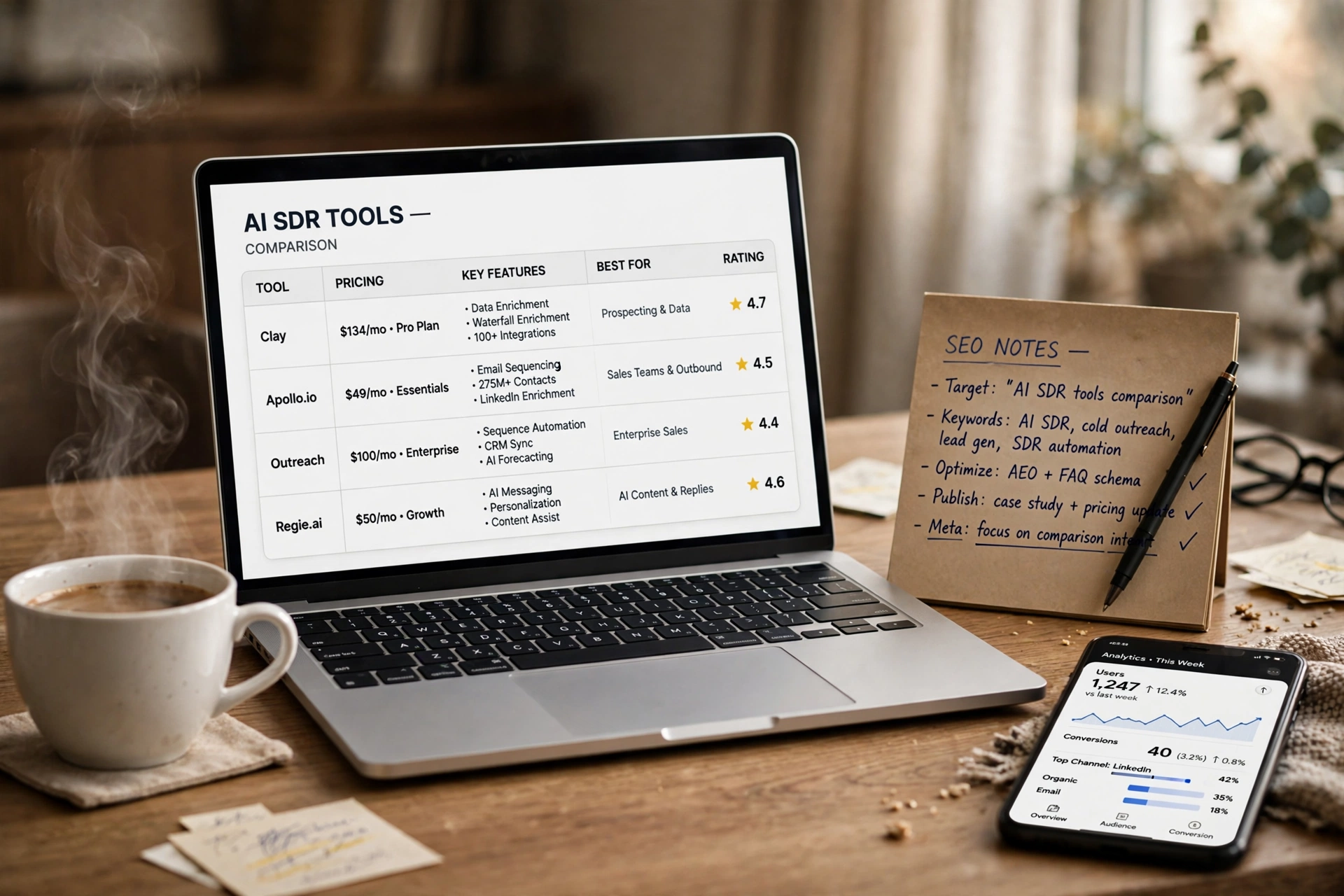
How to Compare AI SDR Pricing: A Practical Guide
Comparing these tools requires more than just looking at a pricing page. You need to calculate the Total Cost of Ownership (TCO). Start by defining your required output: how many qualified leads do you need per month to hit your revenue targets? If you need 60 qualified leads and your target cost per acquisition (CPA) is $20, your monthly budget is $1,200. Any tool with a fixed fee above this is only viable if it significantly increases your conversion rate.
Next, model the total cost including hidden fees. Many platforms charge extra for:
- Data Enrichment: Credits for finding verified emails or direct phone lines.
- CRM Sync: Native HubSpot or Salesforce integration often lives behind an "Enterprise" wall.
- Onboarding: Setup fees can range from $500 to $5,000 for enterprise configurations.
Finally, evaluate the lead-to-meeting conversion rate. A vendor charging $5/lead with a 2% conversion to meeting is actually more expensive than one charging $10/lead with an 8% conversion.
- Vendor A: 100 leads × $5 = $500 $\rightarrow$ 2 meetings $\rightarrow$ $250/meeting
- Vendor B: 100 leads × $10 = $1,000 $\rightarrow$ 8 meetings $\rightarrow$ $125/meeting
Vendor B delivers four times the meetings at half the cost per meeting. This is why I always advise clients to connect AI sales agents to CRM and webhooks to track these metrics in real-time. Without a closed-loop feedback system, you are guessing your ROI.
Top AI SDR Platforms and Their Pricing (2026)
Apollo.io
- Model: Subscription + pay-per-lead (overages).
- Price: Basic plans start around $49/month for 1,000 credits. Enterprise plans are custom.
- Best for: SMBs who need a massive database of contacts and basic AI sequencing.
LeadIQ
- Model: Subscription per seat.
- Price: Starter plans around $36/seat/month (billed annually). Pro tiers reach $90/seat.
- Best for: Teams that prefer a "human-in-the-loop" approach to prospecting.
6sense
- Model: Annual Enterprise Subscription.
- Price: Typically $15,000–$60,000/year depending on the ABM tier.
- Best for: Large corporations with a complex, multi-stakeholder buying process.
BizAI Intelligence
- Model: Outcome-based integrated growth system.
- Price: Custom investments typically $2,000–$5,000/month.
- Best for: High-ticket B2B service providers who want to stop renting traffic and start owning their niche through programmatic SEO and autonomous AI qualification.
Common Mistakes in AI SDR Pricing
Mistake 1: Focusing on the Per-Lead Cost
Per-lead cost is a vanity metric. In the world of B2B, a $2 lead that never answers the phone is a waste of money. A $20 lead that schedules a demo is a profit center. You must shift your focus to the cost per qualified meeting.
Mistake 2: Ignoring the Integration Friction
If a tool costs $200/month but takes 10 hours of a developer's time to sync with your CRM, the true cost is much higher. Look for tools with native integrations or those that use standardized webhooks for seamless data flow.
Mistake 3: Over-provisioning Seats
Many companies buy 10 seats to "be safe" but only 3 reps actually use the tool. This is wasted capital. I recommend usage-based billing or platforms that allow you to scale seats up and down monthly.
Mistake 4: Choosing Non-Scalable Models
Per-lead pricing is great for a pilot. However, if you scale from 100 to 5,000 leads per month, a per-lead model can bankrupt your marketing budget. Always negotiate a volume cap or a transition to a flat-fee subscription once you hit a certain threshold.
Mistake 5: Skipping the Side-by-Side Trial
Never commit to an annual contract without a 14-day trial. Use this time to run a split test: give two different AI tools the same ICP (Ideal Customer Profile) and see which one generates a higher response rate. In my experience, the trial is the only way to discover if the AI actually understands your value proposition or if it's just sending generic "AI slop."
Frequently Asked Questions
What is the average cost of an AI SDR tool per month?
Average monthly costs vary by tier. Basic tools like Apollo start around $49/month, while mid-market platforms cost between $500 and $1,500. Enterprise-grade solutions or managed services like BizAI Intelligence typically range from $2,000 to $10,000 per month depending on the volume of organic traffic and leads generated. For most SMBs, a budget of $200–$1,000 is sufficient for a starting tool.
How do I calculate ROI of an AI SDR compared to a human SDR?
Start with the total cost of a human SDR (salary, benefits, and tools), which is often $70,000+/year. Compare this to the annual cost of an AI SDR (e.g., $12,000/year). Then, divide the total cost by the number of qualified meetings. If a human books 15 meetings/month at a cost of $400 each, and the AI books 20 meetings/month at $50 each, the AI provides a significantly higher ROI and a lower CAC.
Are there any hidden fees in AI SDR pricing?
Yes, several. The most common are data enrichment fees (paying for verified emails), outbound call credits, and CRM integration premiums. Some enterprise tools also charge an onboarding fee of $500–$5,000. Always request a full price sheet and ask specifically about overage penalties if you exceed your monthly lead or credit quota.
Which pricing model is best for small businesses?
Small businesses should generally start with per-lead or low-cost subscription models ($50–$200/month). This allows for low-risk experimentation. Once the process is validated and you know your conversion rates, transitioning to a per-meeting or a flat-fee model can help stabilize the budget and increase margins as you scale.
Can I negotiate AI SDR pricing for enterprise plans?
Absolutely. Enterprise pricing is almost always a starting point for negotiation. You can often secure a 15–25% discount by committing to an annual contract or by providing a competitive quote from another vendor. Volume discounts are also common if you are purchasing a high number of seats or data credits.
What is the typical AI SDR pricing per seat per month?
Expect to pay between $100 and $500 per seat per month for a fully featured AI agent. Basic lead sourcing tools may be as low as $50/seat, while high-end platforms that include multi-channel automation and intent data typically hover around the $200–$300 range.
How does per-meeting pricing compare to subscription pricing?
Per-meeting pricing is a result-based model that lowers the initial risk for the buyer, as you only pay for success. However, it can be more expensive at scale. Subscription pricing provides predictability and a lower cost-per-unit once you hit high volumes, but it carries the risk of paying for the tool even if it fails to book meetings in a given month.
Can I use AI SDR without a subscription? Are there free trials?
While pure pay-per-use models without any base fee are rare, most platforms offer 7–14 day free trials. Some provide a "freemium" tier with a very limited number of leads (e.g., 50 credits per month) to let you test the interface. However, for professional B2B growth, a paid plan is almost always required to access the necessary data enrichment and CRM integrations.
Recommended Readings
To deepen your understanding of these topics, we recommend reading the following articles:
- The Ultimate Guide to SaaS Lead Qualification
- Automate High-Ticket Consultation Bookings
- How to Automate Inbound BB SDR Operations in
- How to Eliminate Spam Leads in Web Forms
Conclusion
Choosing the right AI SDR pricing model is a strategic decision that directly impacts your company's growth velocity. You should never be lured by the lowest per-lead price; instead, model your total cost against the expected quality of the meetings. A few high-intent appointments are always more valuable than a flood of unqualified leads.
To truly dominate your niche, you cannot rely on outreach alone. The most efficient way to lower your cost per meeting is to combine an AI SDR with a complete organic lead generation system. By using programmatic SEO platform tools, you create a constant stream of inbound intent, which makes your AI SDR's job significantly easier and cheaper.
If you're ready to stop renting expensive traffic from ads and start building your own acquisition machine, it's time to evaluate your tech stack. Start by comparing the top programmatic SEO tools for 2026 to see how you can automate your organic growth alongside your AI sales agents.
For those looking for a turnkey solution that handles both the traffic and the qualification, visit BizAI Intelligence.
AI Search Accelerator: 1-on-1 Strategy Session
Claim one of the 10 monthly slots. Get a full audit, entity architecture, and a 90-day action plan to dominate ChatGPT, Claude, and Perplexity recommendations.