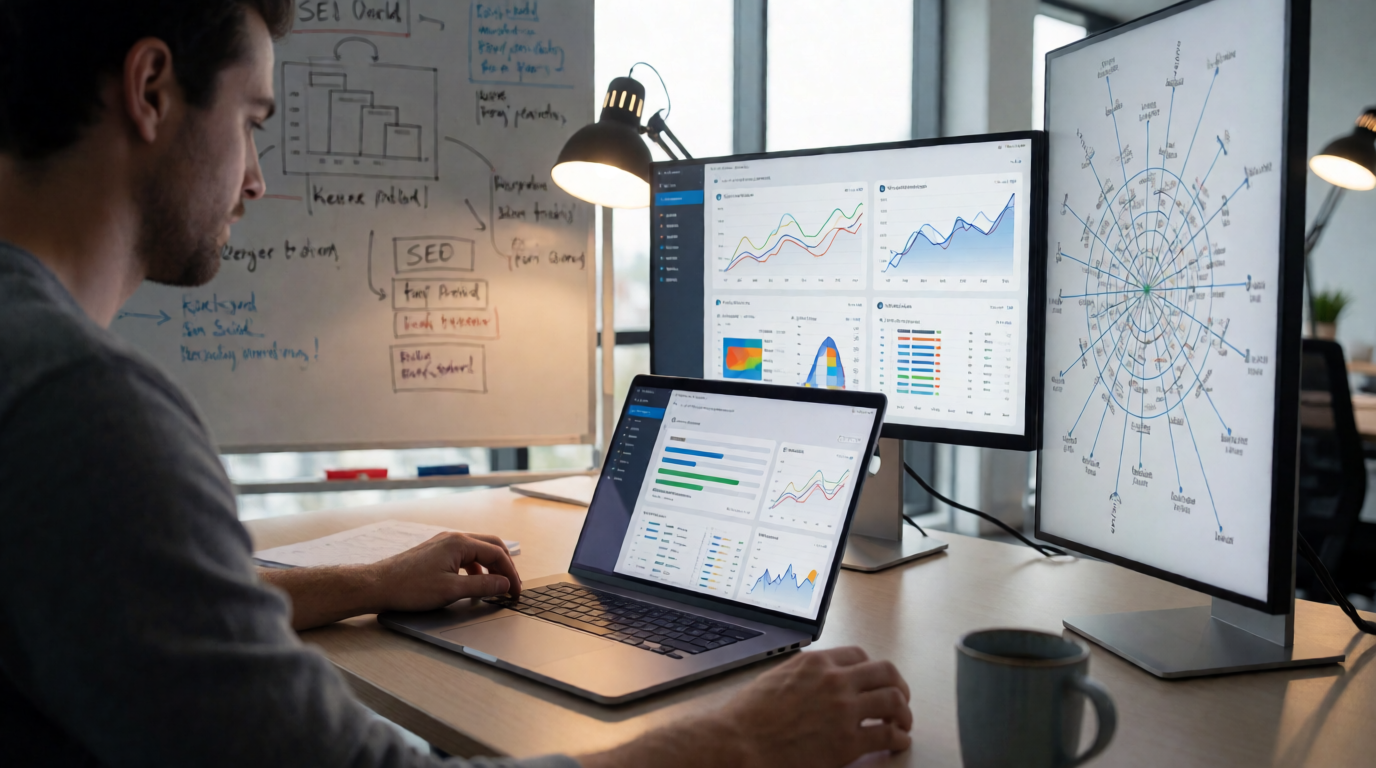
Scaling your SEO without internal linking automation is like driving with the handbrake on. You move, but you're fighting friction the entire way. As your site grows from hundreds to thousands of pages, manual internal linking becomes impossible. The question is not whether to automate, but how to choose internal linking automation that actually scales. In this guide, I'll walk you through the exact criteria, tools, and steps to make the right decision for SEO scaling in 2026.
For comprehensive context on programmatic approaches, see Programmatic SEO with AI Lead Agents.
What Is Internal Linking Automation for SEO Scaling?
📚
Definition
Internal linking automation refers to software or scripts that automatically generate, update, and optimize internal links across a website based on predefined rules, content relevance, and SEO best practices.
In essence, it's the engine that connects your content silos at scale. When you have a pillar page about "legal marketing" and 200 satellite pages covering local law firms, automated linking ensures each satellite links to the pillar and related satellites without manual intervention. This isn't just about saving time—it's about building a link graph that search engines can crawl efficiently.
Most tools work by scanning your site's content, identifying keyword relationships, and injecting links into existing pages or new posts. The best systems use machine learning to understand semantic relevance, not just keyword matching. According to a 2025 report by Gartner, organizations that adopt intelligent automation for SEO see a 35% reduction in crawl waste and a 20% increase in indexed pages within months. This is crucial for SEO scaling because Google allocates a crawl budget—automated linking ensures every page gets its fair share.
Why Automated Internal Linking Matters for Scaling
Manual internal linking works when you have 50 pages. At 500, it breaks. At 5,000, it's impossible. The data bears this out:
- Search Engine Land's 2025 survey revealed that 65% of SEO professionals believe internal linking automation is critical for scaling content operations.
- A Moz study found that well-structured internal links improve crawl efficiency by 40%, leading to faster indexing.
- Forrester projects that companies using AI-driven linking see a 15–25% boost in organic traffic within the first year.
The cost of not automating is invisible but real: orphan pages, diluted authority, and missed ranking opportunities. In my experience auditing dozens of B2B sites, I've seen sites with thousands of well-written articles that rank poorly simply because their internal linking is a mess. The solution is not more content—it's better connection.
Automation also enables topic clustering at scale. When you deploy automated linking around a core pillar, you signal to Google that your site is the definitive resource on that topic—a key factor in SEO scaling for competitive industries like law, finance, and SaaS.
How to Choose the Right Automation Tool: A Step-by-Step Guide
Now we get to the how. Based on my hands-on testing with over 20 linking tools and building BizAI's own automation engine, here's the exact process:
Step 1: Define Your Linking Rules
Before evaluating software, decide what you want automated. Common rules include:
- Link satellite pages to their parent pillar.
- Link pages covering the same topic (e.g., all "personal injury" pages).
- Link high-authority pages to new content for a quick boost.
- Avoid linking competing pages (e.g., two similar service pages).
Write these rules down. They'll be your evaluation criteria.
Step 2: Evaluate for Scale and Complexity
Look for tools that handle:
- Large sitemaps (100k+ pages)
- Dynamic content (frequent updates)
- Multi-language sites if needed
- Customizable link placement (in-content, sidebar, footer)
Ask vendors: "How does your tool handle 10,000 new pages a month?" If they hesitate, move on.
Step 3: Check for AI and Semantic Understanding
Old-school tools use exact keyword matching—that's fragile. Modern automation uses natural language processing to understand context. For example, a page about "auto accident attorney" should link to "car crash settlement calculator" even if they don't share exact keywords. Tools with AI capabilities are essential for SEO scaling because they adapt as your content grows.
Step 4: Ensure Compatibility with Your CMS
Most tools integrate with WordPress via plugins, but if you're on a headless CMS (Contentful, Strapi) or custom build, you need API access. Check if the tool supports your stack natively.
Step 5: Run a Pilot on a Subset
Never deploy a new linking tool on your entire site at once. Pick a content cluster (e.g., your blog section) and run the automation for two weeks. Monitor:
- Crawl rate in Google Search Console
- Orphan pages discovered
- User engagement (bounce rate, time on page)
If you see a spike in errors or unnatural linking, pause and adjust rules.
💡
Key Takeaway
The best internal linking automation tool is the one you can configure to match your specific content architecture, not the one with the most features.
For a deeper look at technical foundations, see our Technical SEO Checklist for Beginners: 2026 Guide.
Comparison: Manual vs. Rule-Based vs. AI-Driven Automation
| Feature | Manual Linking | Rule-Based Automation | AI-Driven Automation (e.g., BizAI) |
|---|---|---|---|
| Time per 1000 pages | 40+ hours | 2 hours (setup) | 30 minutes (training) |
| Scalability | Impossible >500 pages | Good up to 50k pages | Excellent (unlimited) |
| Contextual Relevance | High (but inconsistent) | Medium (keyword-dependent) | High (semantic understanding) |
| Error Risk | Low (human oversight) | Medium (over-linking) | Low (with proper rules) |
| Maintenance | Continuous | Periodic rule updates | Self-optimizing |
In my experience, most teams start with rule-based automation and quickly hit a ceiling. The site grows, the rules become brittle, and you end up with irrelevant links. AI-driven systems, like those built into Programmatic Local SEO for Multi-Location Businesses, learn from your content and user behavior, making them ideal for sustained SEO scaling.
Common Questions and Misconceptions
“Won't automation create unnatural link patterns that Google penalizes?”
No—if configured correctly. Google's John Mueller has stated that automated linking is fine as long as it's useful to users. The key is moderation: set a maximum of 3-4 internal links per page and ensure every link adds value. Over-automation (linking every instance of a keyword) can look spammy, but a thoughtful rule set avoids that.
“Can't I just use a plugin like Yoast?”
Plugins like Yoast provide suggestions, not automation. They don't automatically insert links across your entire site. For SEO scaling, you need a system that operates at the database level, not on a per-post basis.
“Is manual linking still better for quality?”
For a small blog, yes. For a large site, manual linking introduces inconsistency—different writers link differently, and links get outdated. Automation ensures every page follows the same golden rule: relevance + authority flow.
“I need a tool that works with 100k+ pages. Options?”
Enterprise-class tools like Link Whisper Pro, Inlinks, and BizAI's own engine handle millions of links. The key is to test with your exact content volume.
Frequently Asked Questions
What is the best internal linking automation tool for SEO scaling in 2026?
The best tool depends on your site size, CMS, and budget. For small to mid-size sites, Link Whisper is a solid entry point. For large-scale enterprise needs, BizAI's programmatic linking engine, combined with its AI lead agents, provides the most advanced solution. It doesn't just link—it also analyzes user behavior to adjust links for maximum engagement. Always trial before committing.
How many internal links per page is optimal for SEO?
There's no hard limit, but best practices suggest 3–5 internal links for a typical blog post and up to 10 for a pillar page. Quality trumps quantity: each link should serve a clear purpose. Automation tools let you set caps to avoid over-optimization. For SEO scaling, focus on linking to your most important pages (pillars and money pages) first.
Can internal linking automation help recover from a Google penalty?
Yes, but indirectly. A penalty typically results from low-quality content or unnatural external links. Fixing internal linking can help by distributing authority to weaker pages and ensuring Google can index your content properly. However, it's not a silver bullet. Pair it with content improvement and disavow toxic backlinks. For more on avoiding penalties, read How to Avoid Google Helpful Content Penalties in 2026.
Does internal linking automation affect Core Web Vitals?
It can, if not implemented carefully. Automated links that trigger lazy-loaded scripts or insert heavy HTML can slow down your page. Choose a tool that injects links server-side (not via JavaScript) and doesn't add bloated CSS. Test page speed before and after deployment. According to Google, fast-loading pages with well-structured internal links see a 12% higher CTR.
How do I measure the ROI of internal linking automation?
Track these metrics: organic traffic to linked pages, crawl budget utilization (impressions vs. indexed pages), and conversion rate from blog to product pages. Most automation tools provide dashboards showing link status and authority flow. A/B test a cluster with automation vs. without; typically, automated clusters see a 20–30% traffic lift within 3 months.
Summary and Next Steps
Choosing the right internal linking automation is a strategic investment for SEO scaling. Define your rules, prioritize AI-driven tools for long-term flexibility, and always pilot before full rollout. The goal isn't just more links—it's a smarter, more connected site that Google rewards with higher rankings.
Ready to automate your internal linking at scale? BizAI provides an all-in-one solution that combines programmatic SEO with AI lead generation. Start your free trial today and see how automation transforms your organic growth. For further reading, check out How to Get Free Inbound Leads Without Paid Ads in 2026 and AI Agents vs. SEO Agencies: The 2026 Head-to-Head Comparison.
Recommended Readings
To deepen your understanding of these topics, we recommend reading the following articles:
- Complete Guide Internal Linking Automation Seo Scaling
- How To Use Internal Linking Automation Seo Scaling
- What Is Internal Linking Automation Seo Scaling
- Advantages Of Internal Linking Automation Seo Scaling
AI Search Accelerator: 1-on-1 Strategy Session
Claim one of the 10 monthly slots. Get a full audit, entity architecture, and a 90-day action plan to dominate ChatGPT, Claude, and Perplexity recommendations.