📖This article is part of the complete guide to Ultimate Guide to AI for Closing Sales Deals.
In my experience working with high-ticket B2B firms, the 'leaky bucket' isn't a lead generation problem; it is a persistence problem. Most sales teams stop after two attempts, yet the data shows that the majority of closed-won deals happen between the fifth and twelfth touchpoint. When we integrated autonomous follow-up layers at BizAI Intelligence, we found that removing the human 'friction' of remembering to send that third email increased pipeline velocity by nearly 40%.
For a comprehensive overview of the entire ecosystem, explore our Ultimate Guide to AI for Closing Sales Deals.
What is AI Follow-Up Automation Closing?
📚
Definition
AI follow-up automation closing is the use of autonomous agents and large language models to maintain persistent, personalized, and context-aware communication with a prospect until a definitive 'yes' or 'no' is achieved.
AI follow-up automation is not a simple email sequence or a 'drip campaign' from a legacy marketing tool. Traditional sequences are linear and rigid; they send Email A on Day 1 and Email B on Day 3 regardless of whether the prospect replied with a question or a vague objection. Modern AI follow-up systems operate on a conditional logic loop. They utilize large language models (LLMs) to analyze the sentiment of a prospect's response and dynamically adjust the next touchpoint to address specific concerns, push for a meeting, or provide additional value.
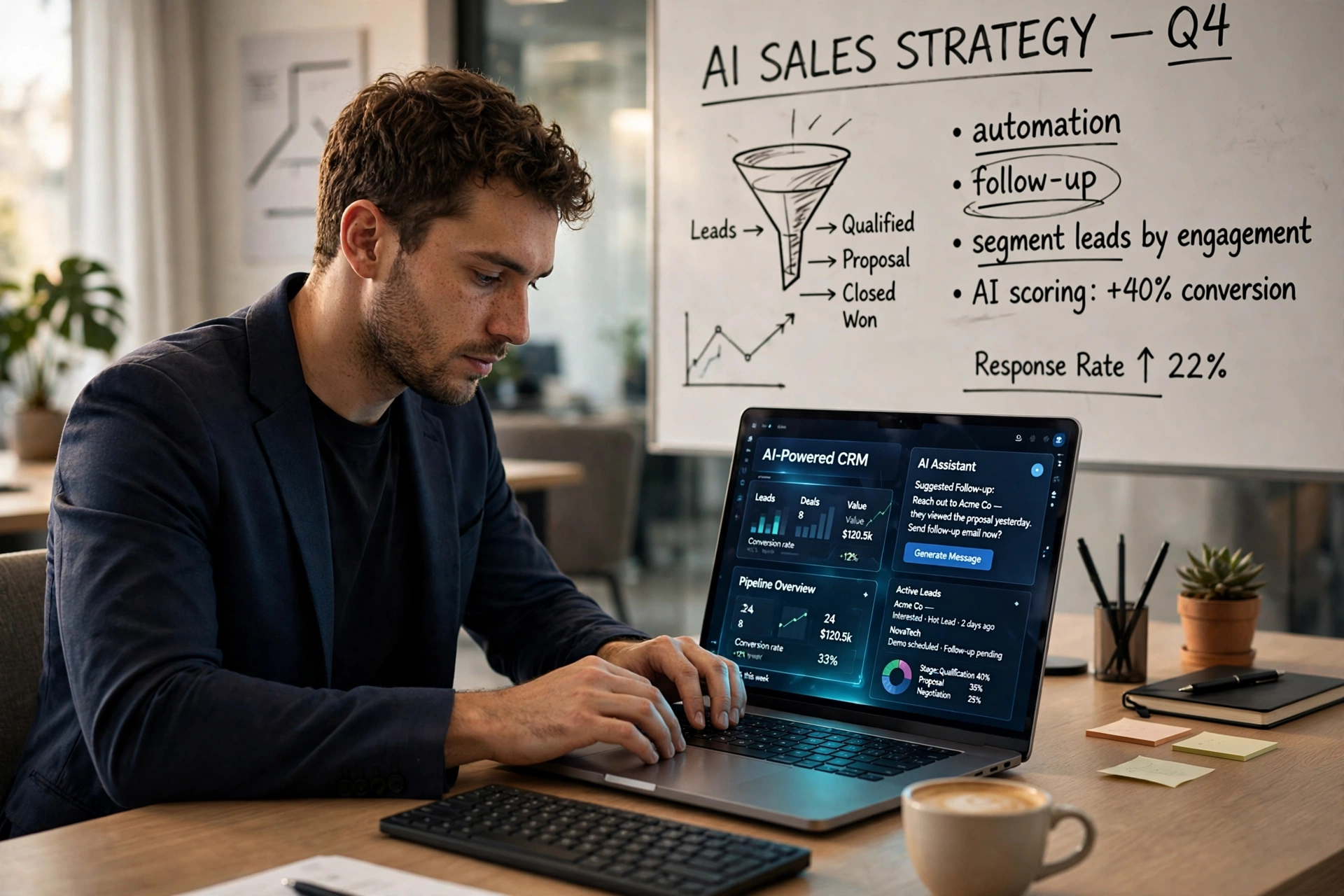
When you deploy AI follow up automation closing, the system monitors engagement signals. If a prospect opens a proposal three times in ten minutes but hasn't replied, the AI recognizes this as a high-intent signal and can trigger a personalized 'just checking in' message that references the specific section of the proposal they are viewing. This transition from static scheduling to behavioral triggering is what separates a standard automation tool from a true AI closing engine. In 2026, this is no longer a competitive advantage; it is the baseline for any enterprise scaling its organic acquisition.

Why Does AI Follow-Up Automation Matter for Your Business?
Persistence is the single most important variable in high-ticket sales, but it is also the hardest to scale with human staff. According to research by the Sales Acceleration Center, approximately 48% of sales representatives never follow up with a lead, and another 25% follow up only once. This represents a massive loss in potential revenue for B2B service providers.
Using AI follow up automation closing solves three fundamental bottlenecks: human fatigue, inconsistent messaging, and timing gaps. A human SDR might wait until Monday morning to follow up on a Friday afternoon lead, by which time the prospect's urgency has cooled. An AI agent operates 24/7, ensuring the lead is engaged while the intent is at its peak. Furthermore, by integrating AI lead scoring for deal prediction, the system can prioritize which leads receive the most aggressive follow-up cadence based on their likelihood to close.
From a psychological perspective, AI-driven follow-ups avoid the 'desperate salesperson' trope. Because the AI can be programmed to provide value, sending a relevant case study or a new industry insight, the follow-up feels like a consultative partnership rather than a pestering reminder. This builds trust and positions the brand as an authority. When combined with AI buyer intent signals for closing, the automation knows exactly when to pivot from 'nurturing' to 'closing' based on the prospect's digital footprint.
How to Implement AI Follow-Up Automation to Close More Deals?
Implementing a closing-focused follow-up system requires a shift from 'broadcast' thinking to 'conversational' thinking. You cannot simply plug in a template; you must build a logic map. The first step is mapping your typical buyer's journey and identifying the 'friction points' where leads usually go cold. Once these are identified, you can deploy an autonomous agent that utilizes a specific closing framework.
-
Establish the Intent Trigger: Your automation should not start blindly. It should trigger based on a specific event, such as a downloaded whitepaper, a requested demo, or a proposal sent. By using how to automate organic traffic and lead capture with AI, you ensure that the lead entering the follow-up loop is already pre-qualified.
-
Dynamic Sentiment Analysis: Configure your AI to read the prospect's reply. If the prospect says, "I'm interested but too busy this week," the AI should not send a generic 'Checking in' email. Instead, it should respond: "I completely understand. I'll touch base next Tuesday morning to see if your schedule has cleared. In the meantime, here is a 2-minute video summarizing the ROI we discussed." This maintains the relationship without creating pressure.
-
Multi-Channel Orchestration: Effective closing doesn't happen in a vacuum. The AI should coordinate touchpoints across email, LinkedIn, and SMS. If an email goes unanswered for 48 hours, the system can trigger a LinkedIn connection request with a personalized note referencing the email. This omnipresence increases the probability of a response by 3x compared to single-channel efforts.
-
The 'Hard' Close Transition: After a set number of value-driven touchpoints, the AI must pivot to a closing request. This is where AI sales closing scripts that convert become vital. The AI transitions from providing information to asking for a commitment, such as: "Based on our previous conversations, it seems we are aligned on the goals. Should I send over the agreement for your signature, or is there one last detail we need to iron out?"
At BizAI Intelligence, we've integrated these steps into a seamless engine. We don't just send messages; we create an autonomous SDR that manages the entire middle and end of the funnel, ensuring no lead is ever forgotten. This is especially powerful when you have a high volume of leads coming from a PSEO architecture guide for SaaS & Enterprise B2B growth.
Comparing Follow-Up Strategies
To understand the shift in the industry, we must look at how follow-up has evolved from manual labor to algorithmic precision.
| Feature | Traditional Manual Follow-Up | Generic AI Drip Sequences | BizAI Intelligence Approach |
|---|---|---|---|
| Consistency | Low (Depends on human mood/memory) | High (But robotic and rigid) | Absolute (Autonomous & Persistent) |
| Personalization | High (But doesn't scale) | Low (Template-based) | Hyper-Personalized (Context-aware LLMs) |
| Timing | Delayed (Business hours only) | Scheduled (Fixed intervals) | Behavioral (Triggered by intent) |
| Adaptability | Medium (SDR adjusts on the fly) | Zero (Linear path) | High (Sentiment-driven pivoting) |
| Conversion Rate | Moderate (High leak rate) | Low (Often marked as spam) | High (Value-first, Closing-focused) |

Common Mistakes to Avoid in AI Follow-Up Automation
One of the most frequent errors I see is the "Automation Overload" trap. This happens when a company sets up a sequence that is too aggressive, sending messages every 24 hours without regard for the prospect's response. When a prospect feels they are talking to a bot that doesn't listen, they don't just ignore the messages, they blacklist the domain. The goal of AI follow up automation closing is to mimic a high-level executive, not a telemarketer.
Another critical mistake is failing to integrate the AI with a real-time CRM. If the AI is sending follow-ups while a human account manager is also emailing the client, it creates a disjointed and unprofessional brand image. This is why we emphasize the need for how to connect AI sales agents to CRM & webhooks for auto booking. The AI must know exactly what the human has already discussed to avoid redundant questions.
Lastly, many businesses ignore the "Objection Phase." They use AI for the initial follow-up but pull the plug the moment the prospect raises a concern about price or timing. In reality, the objection is the most valuable part of the closing process. Integrating AI objection handling for faster closes into your automation ensures that the AI can neutralize doubts in real-time, keeping the deal moving toward the signature rather than letting it stall in the "I'll think about it" phase.
💡
Key Takeaway
The most effective AI follow-up systems prioritize "Value-Added Persistence" over "Frequency-Based Persistence." If every single touchpoint provides a new insight or solves a problem, the prospect views the follow-up as a service, not an annoyance.
Frequently Asked Questions
Does AI follow-up automation sound too robotic to close high-ticket deals?
Not if it is powered by modern Large Language Models (LLMs) and proper context. Generic tools use templates, which sound robotic. However, an AI closing engine analyzes the specific language the prospect uses and mirrors their tone and vocabulary. By referencing specific points from previous calls or proposals, the AI creates a level of personalization that often surpasses that of a tired human SDR. When configured correctly, prospects often cannot tell they are interacting with an AI until the final booking stage.
How many follow-ups are too many before a lead is considered dead?
In high-ticket B2B, the "dead zone" typically begins after 8 to 12 touchpoints across multiple channels. However, the key is the interval. Sending five emails in one week is aggressive; sending five emails over three weeks with varying value propositions is professional. We recommend a "decaying frequency" model: heavy touchpoints in the first 14 days, then transitioning to a monthly "long-term nurture" sequence that keeps your brand top-of-mind until the prospect's budget cycle resets.
Can AI follow-up automation handle complex objections about pricing?
Yes, provided the AI is integrated with a knowledge base of your pricing logic and value propositions. Instead of a generic "our price is competitive" response, a sophisticated AI can utilize AI proposal generators to seal deals to send a revised breakdown or a comparison table that justifies the ROI. The AI can acknowledge the price concern, validate it, and then pivot back to the cost of inaction, which is a powerful psychological closing technique.
Will using AI for follow-ups hurt my email deliverability and domain reputation?
Only if you use "blast" software. High-quality AI follow-up automation uses "human-like" sending patterns, including randomized delays and personalized content for every single recipient. By avoiding spammy trigger words and maintaining a high engagement rate (because the content is actually relevant), you can actually improve your sender reputation. The goal is to send 10 perfect, high-conversion emails rather than 1,000 generic ones.
How does AI know when to stop following up and hand the lead to a human?
This is handled through "intent thresholds." We set specific triggers, such as the prospect asking for a custom contract, requesting a live call with the CEO, or expressing a specific technical doubt, that immediately notify the human sales team via Slack or CRM alerts. The AI handles the "grind" of the follow-up, but the moment a "Closing Signal" is detected, the system transitions to a human-led high-touch experience to finalize the contract.
Conclusion
Closing a deal in 2026 is no longer about who has the best pitch, but about who has the most consistent and intelligent follow-up system. The gap between a "lost lead" and a "closed-won deal" is usually just three or four well-timed, value-driven messages. By deploying AI follow up automation closing, you eliminate the risk of human error and ensure that every single lead is nurtured to its full potential.
Whether you are scaling a law firm, a medical clinic, or a SaaS platform, the ability to automate the persistence layer of your sales process is what allows you to scale without adding massive overhead. Stop relying on the memory of your sales team and start relying on a system that never forgets, never sleeps, and always optimizes for the close.
To master the entire process of turning organic traffic into signed contracts, return to our Ultimate Guide to AI for Closing Sales Deals and start building your autonomous acquisition machine.
For more information on scaling your B2B growth, visit BizAI Intelligence.
Only 12 Onboarding Slots Remaining This Month
BizAI deploys 300 AI salespeople scoring purchase intent 24/7. Get your free niche domination blueprint.
AI Search Accelerator: 1-on-1 Strategy Session
Claim one of the 10 monthly slots. Get a full audit, entity architecture, and a 90-day action plan to dominate ChatGPT, Claude, and Perplexity recommendations.