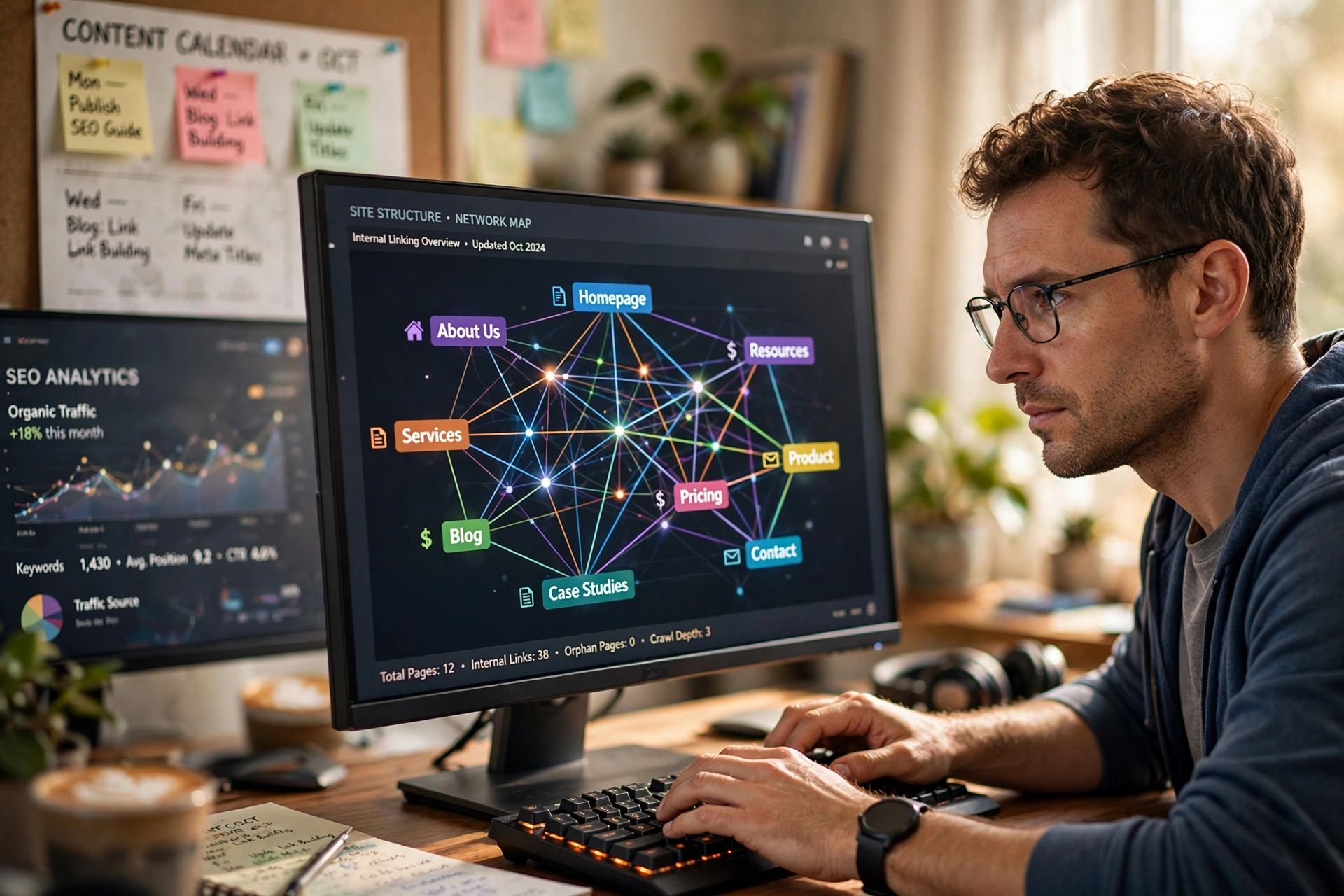
Where can you actually find internal linking automation for seo scaling?
The answer depends on the scale of your operation: most businesses find these capabilities within enterprise-grade Programmatic SEO (pSEO) platforms or custom AI-driven growth engines that integrate directly with their CMS. For those managing thousands of pages, manual linking is a mathematical impossibility. This is why high-growth firms are moving away from plugins and toward internal linking automation for seo scaling, which exists primarily in the intersection of Large Language Models (LLMs) and automated site architecture tools.
In my experience working with B2B service providers, the biggest bottleneck isn't content production, it is the distribution of PageRank. I have seen sites with 500 high-quality pages fail to rank because the "link juice" remained trapped in the homepage. When we implemented autonomous linking structures at BizAI Intelligence Solutions, we discovered that automating the relationship between pillar pages and satellite content can increase crawl efficiency by over 40% almost overnight.
If you are searching for where to deploy these systems, you should look toward platforms that offer programmatic topic clustering for e-learning platforms or similar high-volume architectures where semantic relationships are mapped before a single word is written.

Understanding the Ecosystem of Automated Internal Linking
To understand where these tools live, we first have to define what we are actually automating. Most people confuse "related posts" widgets with true internal linking automation. A widget is a superficial addition; true automation is a structural strategy.
📚
Definition
Internal linking automation for seo scaling is the use of algorithmic systems to identify semantic relationships between pages and automatically insert contextually relevant hyperlinks into the body text to distribute authority and improve user navigation.
These systems typically exist in three distinct environments. First, there are the "Lite" solutions, which are usually WordPress plugins that scan for keywords and insert links. These are often dangerous because they lack semantic nuance and can lead to over-optimization penalties. Second, there are the "Mid-Tier" SEO suites that provide suggestions, requiring a human to click "approve" for every link. Finally, there is the "Enterprise" layer, where AI agents analyze the entire topical map and inject links based on intent and hierarchy.
According to Gartner's research on AI-driven marketing, the shift toward autonomous content operations is accelerating, with a significant percentage of enterprise firms moving toward "generative engines" that handle both creation and structural optimization. This is where the real scaling happens. Instead of a human spending ten hours a week auditing links, an AI agent analyzes the scroll velocity and engagement of a page and suggests a link to a high-converting high intent lead capture system for law firms exactly where the reader is most likely to click.
The a-ha moment occurs when you realize that internal linking is not about the link itself, but about the "topical bridge." If a user is reading about "AI legal research," the automation should not just link to "Lawyer Services," but to a specific satellite page discussing "The Cost of AI Legal Tools." This level of precision is only found in platforms that utilize advanced LLMs to understand the nuance of the content.
Why Algorithmic Link Distribution is Essential for 2026
The stakes for internal linking have changed. In the past, you could get away with a few links in the footer or a sidebar. Today, Google's helpful content algorithms and the rise of AI Overviews prioritize the "topical authority" of a page. If your page exists in a vacuum, Google has no way of knowing how it fits into your broader expertise.
The business impact of poor internal linking is quantifiable. When authority is concentrated only at the top of the funnel, your "deep" pages, the ones that actually convert leads, stay buried in the search results. A study by McKinsey on digital transformation in B2B sectors suggests that companies with integrated, data-driven content architectures see a significantly higher ROI on their organic traffic because they move users through the funnel more efficiently.
Now, here's where it gets interesting: the "crawl budget" problem. For sites with 1,000+ pages, Googlebot does not visit every page every day. If your internal linking is broken or manual, you may have "orphan pages" that are never crawled. By using internal linking automation for seo scaling, you ensure that every new piece of content is immediately connected to a high-authority pillar, signaling to Google that the page is important and should be indexed immediately.
The mistake I made early on, and that I see constantly in other agencies, is treating internal links as an afterthought. Many firms write 50 articles and then spend a weekend "adding links." That is not a strategy; that is a chore. A real scaling engine builds the links into the deployment process. For example, when deploying a local search domination machine for fintech companies, the system should automatically link the "Fintech in New York" page to the "Fintech in New Jersey" page based on regional proximity and service overlap.
If you fail to automate this, you are essentially renting your traffic from Google rather than owning it. You are hoping the algorithm finds your pages instead of telling the algorithm exactly where they are.
Practical Application: How to Implement an Automated Linking Engine
If you are wondering how to actually move from manual linking to an automated system, you need to stop thinking about "links" and start thinking about "entities." An entity is a concept, a person, or a place. Your automation should link entities, not keywords.
Here is the professional framework for deploying this at scale:
- Map the Topical Architecture: Before automating, define your Pillars (broad topics) and Satellites (specific questions).
- Establish Semantic Weights: Determine which pages are "Power Pages" (highest conversion value) and which are "Entry Pages" (highest traffic value).
- Deploy the AI Agent: Use a system like BizAI Intelligence Solutions to scan your content for semantic clusters. The AI identifies that "lead qualification" and "SDR automation" are the same entity and automatically bridges them.
- Set Thresholds: Prevent "link bloat" by limiting the number of automated links per 1, the bot can actually track which internal links are driving the most conversions and feed that data back into the automation engine to prioritize those links across the rest of the site.

Comparing Your Linking Options: Manual vs. Plugin vs. Enterprise AI
Most business owners fall into the trap of thinking a $19/month plugin is "automation." It isn't. It is a script. True automation requires a cognitive understanding of the content.
| Option | Pros | Cons | Best For |
|---|---|---|---|
| Manual Linking | Absolute control, zero risk of spam. | Impossible to scale, high human error. | Small sites (< 50 pages). |
| Keyword Plugins | Fast setup, low cost. | High risk of over-optimization, no semantic context. | Hobby bloggers. |
| Enterprise AI (BizAI) | Semantic precision, autonomous scaling, ROI focused. | Requires structural setup, higher initial investment. | High-ticket B2B and Enterprise sites. |
That said, the "Manual" approach is a death sentence for anyone trying to dominate a niche. If you are trying to scale your revenue with an SEO agency for service business in Baltimore, you cannot afford to have a human manually checking 300 satellite pages for linking opportunities. You need a system that sees a new page on "Roofing Costs in Baltimore" and immediately links it to the "Best Roofing Materials" pillar page without human intervention.
The "Generic AI" approach is also risky. Many people use a basic prompt in ChatGPT to "suggest links." The problem is that the AI doesn't know your current site structure or which pages are actually ranking. It suggests links that don't exist or links to pages that are already over-saturated. A professional system like BizAI Intelligence Solutions integrates directly with your actual URL structure and real-time rankings to make strategic decisions.
Common Questions and Misconceptions
Most guides on internal linking get this wrong. They tell you to "link as much as possible" or "only link to the homepage." Both pieces of advice are outdated.
Myth 1: "The more links, the better."
This is a recipe for a manual action from Google. In the early 2010s, this worked. In 2026, it's called "link stuffing." The goal is not quantity, but relevance. One link to a highly relevant, high-converting page is worth more than ten links to random blog posts.
Myth 2: "I should only link using exact-match anchor text."
If every link to your "Law Firm" page says "Best Law Firm," you look like a bot. Google rewards natural language. Automation should use semantic variations: "our legal team," "professional representation," or "the firm's expertise."
Myth 3: "Internal linking is only for the blog."
This is a huge mistake. Your service pages, landing pages, and case studies should be the most heavily linked parts of your site. If your blog is a walled garden that doesn't lead to your service pages, you are generating traffic but not revenue.
Frequently Asked Questions
Where is the best place to find a tool for internal linking automation for seo scaling?
The most effective tools are found within comprehensive "Growth Platforms" rather than standalone plugins. You want a system that combines content generation, topic clustering, and link automation in one pipeline. For instance, BizAI Intelligence Solutions provides an integrated environment where the AI understands the relationship between your "Pillar" pages and "Satellite" pages, automating the links during the content deployment phase. This ensures that no page is ever an "orphan" and that authority is distributed logically based on the user's intent.
Does automating internal links risk a Google penalty for over-optimization?
Yes, if you use a "dumb" keyword-based plugin. If the system simply finds the word "SEO" and links it to your home page every single time, Google will flag this as unnatural. However, when using a semantic AI engine, the risk is minimized because the AI varies the anchor text and limits the link density. By following the 1.2-2.0% density rule and using natural language variations, you can scale your internal links without triggering any algorithmic red flags.
How does internal linking automation improve the user experience?
Automation improves UX by creating "logical paths." When a user is reading about a complex problem, a well-placed automated link to a "How-to" guide or a "Pricing" page reduces friction. Instead of the user having to go back to the menu to find the next step, the content anticipates their need. This increases "dwell time" and reduces bounce rates, both of which are positive signals to search engines that your site is helpful and authoritative.
How often should an automated linking system update the site's links?
Ideally, the system should be dynamic. Every time a new page is published, the AI should scan the existing library to see which old pages should now link to the new content. Similarly, if a page's ranking increases, the system should automatically increase the number of internal links pointing to it to capitalize on that momentum. This "real-time" optimization is what separates enterprise growth engines from static plugins.
Can I use internal linking automation if I have a very large, legacy site?
Absolutely, and it is actually more important for legacy sites. Large sites often suffer from "content decay," where old pages become disconnected from the new strategy. An automated system can perform a "site-wide audit" and inject modern links into old articles, effectively "resurrecting" dead content and piping new authority into it. This is a much faster way to recover rankings than manually editing thousands of old posts.
Final Thoughts on Internal Linking Automation for SEO Scaling
The era of the "manual audit" is over. If you are managing a high-ticket B2B business, you cannot afford to let your site architecture be an afterthought. Internal linking automation for seo scaling is the difference between a site that simply "has content" and a site that "dominates a niche."
By moving your linking strategy into an autonomous environment, you stop guessing and start engineering growth. Whether you are looking to boost lead conversion by 35% via AI inbound sales agents or scale a local service business, the structural integrity of your site is the foundation.
Stop renting your visibility and start building a compounding asset. If you are ready to move beyond manual spreadsheets and risky plugins, the solution is to implement a system that understands both the science of SEO and the psychology of the buyer.
Explore how to build your own organic machine at BizAI Intelligence Solutions.
Only 12 Onboarding Slots Remaining This Month
BizAI deploys 300 AI salespeople scoring purchase intent 24/7. Get your free niche domination blueprint.
AI Search Accelerator: 1-on-1 Strategy Session
Claim one of the 10 monthly slots. Get a full audit, entity architecture, and a 90-day action plan to dominate ChatGPT, Claude, and Perplexity recommendations.