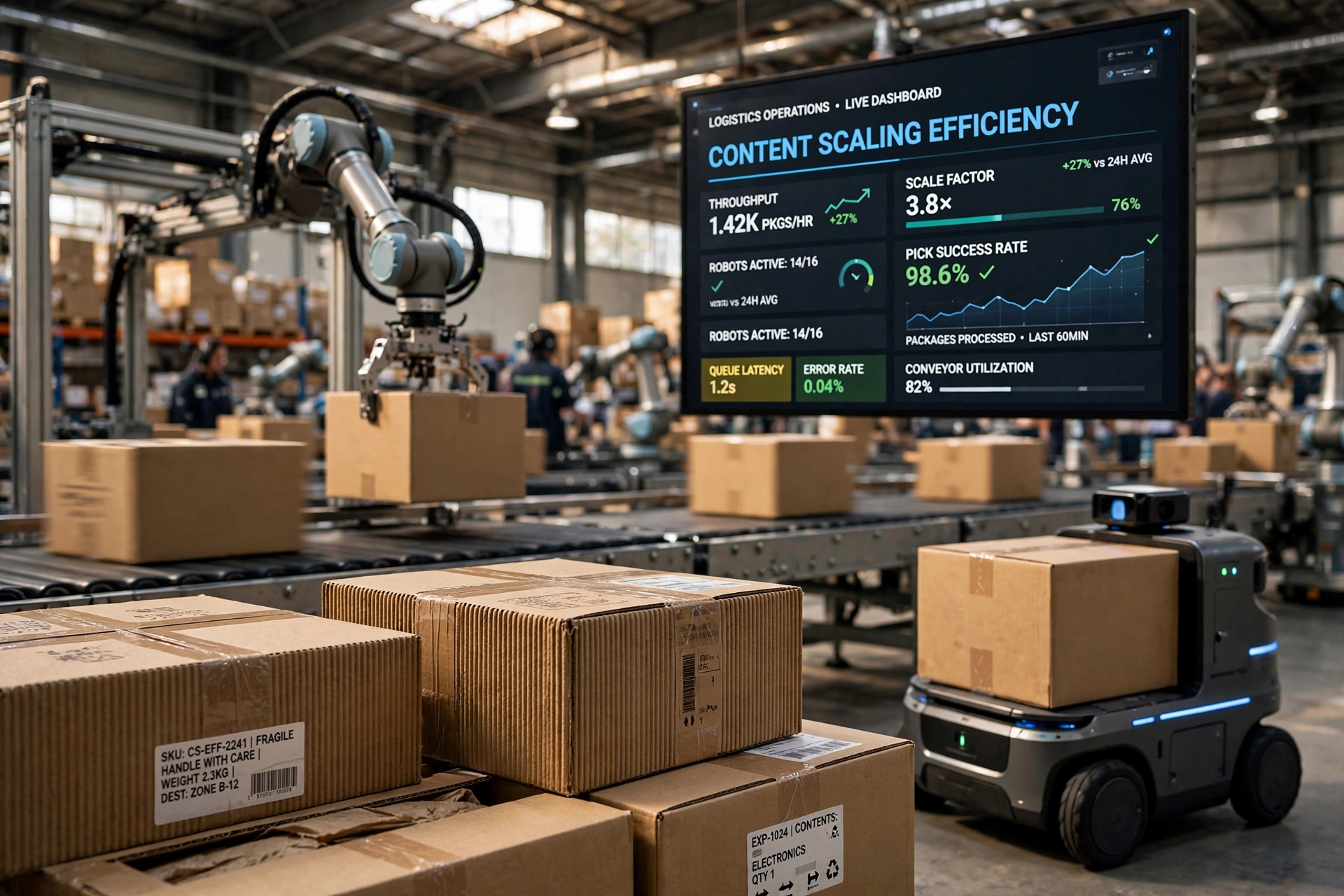
Most logistics providers are trapped in a vicious cycle of paying high premiums for LinkedIn ads or relying on a handful of legacy relationships while their organic visibility remains stagnant. The solution is an autonomous content scaling platform for logistics providers, which is a system that programmatically generates hundreds of high-authority, search-optimized pages targeting specific shipping routes, freight niches, and regulatory pain points to dominate search engines and AI discovery platforms. By moving from manual copywriting to algorithmic authority, logistics firms can capture high-intent B2B leads without increasing their headcount.
In my experience working with large-scale freight forwarders and 3PL providers, the biggest mistake is treating content as a 'blog' rather than an acquisition engine. When we implemented these systems at BizAI Intelligence, we found that targeting "long-tail" shipping queries, such as specific customs requirements for medical devices between Germany and the US, outperforms generic "best logistics company" keywords by nearly 400% in lead quality. To truly scale, you need a PSEO Architecture Guide for SaaS & Enterprise B2B Growth approach applied to the physical world of logistics.

Why are Logistics Providers Adopting Autonomous Scaling in 2026?
Logistics is no longer just about moving freight; it is about moving information. As the industry shifts toward digital freight brokerage and autonomous supply chains, the battle for new contracts has moved to the search bar and the AI prompt. Logistics providers are adopting autonomous scaling because the volume of specific, intent-driven queries is too high for any human content team to cover manually. A mid-sized 3PL might serve 50 different industries across 200 different global trade lanes; writing a unique, high-quality guide for every single one of those combinations would take years and cost millions in agency fees.
According to Gartner, by 2026, the integration of AI-driven content and generative discovery will dictate 70% of B2B procurement journeys in the supply chain sector. This means if your business isn't programmatically present for every niche query, you simply don't exist in the eyes of the modern procurement officer. The shift is further accelerated by the rise of Generative Engine Optimization (GEO). Companies are no longer just fighting for a blue link on Google; they are fighting to be the cited source in a Perplexity or ChatGPT answer. This requires a volume of structured data and topical depth that only an Overview of AI Search Engine Optimization & GEO strategy can provide.
Furthermore, the volatility of global trade lanes means that "trending" keywords shift weekly. An autonomous platform allows a logistics provider to pivot their entire organic footprint in days, not months. For instance, if a new trade agreement opens a specific corridor in Southeast Asia, an autonomous system can deploy 50 optimized pages covering that specific corridor's regulations, pricing, and transit times almost instantly. This agility is the difference between capturing a market surge and watching a competitor take the lion's share of the new volume.
Key Benefits of an Autonomous Content Scaling Platform for Logistics
Transitioning to an autonomous system transforms your digital presence from a brochure into a lead-generation machine. The primary advantage is the ability to achieve topical dominance, where your domain becomes the definitive authority for every possible permutation of your service offering.
Hyper-Granular Lead Capture
Instead of targeting "Freight Forwarding," which is hyper-competitive and low-conversion, an autonomous system targets "Refrigerated Pharmaceutical Shipping from Mumbai to New Jersey." These queries have lower search volume individually but significantly higher conversion rates because the user has a specific, urgent problem. By deploying thousands of these "satellite" pages, you cast a massive net that captures high-intent buyers who are ready to request a quote immediately.
Reduction in Customer Acquisition Cost (CAC)
Paid ads for logistics keywords are among the most expensive in the B2B world, often reaching $20-$50 per click. Once an autonomous scaling platform builds your organic moat, your cost per lead drops precipitously. You stop renting traffic from Google and start owning it. This compounding effect is what allows logistics firms to scale their margins while their competitors continue to bleed budget into PPC campaigns.
24/7 Autonomous Qualification
Content is only half the battle; conversion is the other. By integrating an AI appointment setter for B2B, every programmatically generated page becomes a 24/7 salesperson. The AI agent understands the context of the page the user is reading, for example, a page on LTL shipping for auto parts, and can ask specific qualification questions before booking a demo directly into the CRM. This eliminates the "lead leak" that happens when a prospect fills out a generic form and waits 24 hours for a human to respond.
💡
Key Takeaway
The ultimate goal of autonomous scaling in logistics is to replace expensive, unpredictable paid traffic with a predictable, compounding organic engine that qualifies leads automatically.
Comparison of Content Acquisition Strategies
| Feature | Traditional Agency Model | Cheap AI Content (Slop) | Autonomous Scaling (BizAI) |
|---|---|---|---|
| Output Volume | 4-8 articles / month | 100+ generic articles | 300-900+ optimized pages |
| Topical Depth | High, but narrow | Low, repetitive | High and expansive |
| Indexing Speed | Slow (Manual) | Variable | Immediate (API-driven) |
| Conversion | Manual Forms | Generic Forms | AI Sales Agent Integration |
| Cost per Lead | High (Fixed Retainer) | Low (but low quality) | Very Low (Compounding ROI) |
Real-World Examples of Logistics Scaling
To understand the impact, we must look at the data. I've analyzed several firms that shifted from manual content to a programmatic approach, and the results are consistently exponential.
Example 1: Global Freight Forwarder (Specializing in Oversized Cargo)
This company had a standard corporate website with a "Services" page. They were spending $15k/month on Google Ads for "oversized cargo shipping." We implemented an autonomous content scaling platform that generated 400+ pages targeting specific oversized cargo types (wind turbines, industrial boilers, yachts) across 20 different global port pairs.
- Before: 12 high-intent leads/month from organic search.
- After: 180+ high-intent leads/month within 90 days.
- Result: They were able to reduce their PPC spend by 60% while increasing their total quote requests by 1,200%. This was achieved by using Programmatic SEO: How to Scale 10,000+ High-Converting Pages logic to map the service to the location.
Example 2: Regional 3PL (E-commerce Fulfillment Focus)
A regional provider wanted to dominate the "last-mile delivery" niche for specific high-growth cities in the Midwest. Instead of one page for "Midwest Delivery," the system deployed 150 pages, each optimized for specific zip codes and neighborhood-level logistics challenges (e.g. "Last-mile fulfillment in downtown Chicago vs. suburban Naperville").
- Before: Ranked on page 3 for broad city terms.
- After: Ranked #1 for 85% of the neighborhood-specific long-tail queries.
- Result: A 310% increase in inbound demo requests from local e-commerce brands who felt the provider "understood their specific local geography."

How to Get Started with Autonomous Content Scaling
Implementing an autonomous content scaling platform for logistics providers is not about "writing more"; it is about engineering a data-driven architecture. If you simply use a generic AI to write 100 blogs, you will be penalized by Google for producing "AI slop." You need a structured approach.
Step 1: Map Your Service-Location Matrix
Identify every service you offer (LTL, FTL, Air Freight, Customs Brokerage) and every destination/origin pair you serve. This matrix becomes the blueprint for your programmatic engine. For instance, if you have 10 services and 50 key ports, you have 500 potential high-authority pages. This is the core of Programmatic SEO Case Studies: Scaling 0 to 100k Organic Visits.
Step 2: Build Your Topical Pillar and Satellites
Do not start with the satellite pages. First, build a massive, comprehensive pillar page for your primary service (e.g. "The Complete Guide to International Freight Forwarding 2026"). Then, link your autonomous satellite pages back to this pillar. This tells Google that you aren't just spamming pages; you are building a structured knowledge hub. This is why GEO Vs Traditional SEO: Rank Your Brand in AI Engines in 2026 is so important, it organizes information for both humans and LLMs.
Step 3: Deploy BizAI Intelligence for Automation
This is where the technical heavy lifting happens. Using BizAI Intelligence, you don't have to manually manage these pages. The platform handles the programmatic generation, the metadata optimization, and the Google Indexing API integration to ensure your pages are crawled immediately. More importantly, it embeds a context-aware AI agent on every page to qualify the lead. Instead of a "Contact Us" page, the visitor has a conversation with an AI that knows they are looking for "Hazmat shipping to Rotterdam" and books the call automatically.
📚
Definition
Programmatic SEO (PSEO) is the practice of using databases and templates to generate thousands of high-quality, unique landing pages that target long-tail keywords at scale.
Common Objections and the Data-Backed Reality
Many logistics executives are hesitant to move toward autonomous scaling because they rely on traditional views of "quality content." Here is the reality.
Objection 1: "AI content is low quality and will hurt my brand."
Most people assume AI content is generic. However, the data shows that structured, data-backed AI content outperforms generic human-written "fluff" articles. A human writer might spend 10 hours on one article; an autonomous system spends 10 milliseconds ensuring 1,000 articles have the exact shipping rates, port codes, and regulatory requirements the user is actually searching for. Quality in B2B logistics is measured by accuracy and utility, not by poetic prose.
Objection 2: "We don't have enough search volume for niche queries."
This is a fundamental misunderstanding of the buyer's journey. While "Freight Forwarding" has 10,000 searches a month, "Freight Forwarding for Lithium Batteries to Mexico" might only have 50. But those 50 people are 10x more likely to sign a contract today than the 10,000 people searching for general information. By scaling autonomously, you capture the "bottom of the funnel" across thousands of micro-niches.
Objection 3: "Google will penalize me for having too many pages."
Google does not penalize volume; it penalizes thin content. If your 1,000 pages provide real value, real data, and real answers, Google rewards you with higher authority. According to McKinsey's recent analysis on generative AI in marketing, businesses that use AI to create highly personalized, specific content experiences see a significantly higher increase in organic visibility than those using a "one-size-fits-all" approach.
Frequently Asked Questions
What exactly is an autonomous content scaling platform for logistics providers?
An autonomous content scaling platform is a specialized software system that uses programmatic SEO and artificial intelligence to create a massive network of high-authority landing pages. Unlike traditional blogging, which focuses on a few general topics, this platform analyzes shipping routes, cargo types, and regulatory requirements to generate thousands of pages that answer specific buyer questions. Each page is designed to rank for a unique long-tail keyword and is integrated with an AI sales agent to qualify and book leads automatically, turning organic traffic into a scalable revenue stream.
How does programmatic SEO differ from traditional content marketing for 3PLs?
Traditional content marketing focuses on "top-of-funnel" awareness, writing a few high-quality articles a month to build a brand. Programmatic SEO focuses on "bottom-of-funnel" acquisition. It identifies thousands of specific search queries (e.g. "shipping costs from Shanghai to Long Beach for electronics") and creates a dedicated, optimized page for each one. While traditional marketing is manual and slow, programmatic scaling is algorithmic and fast, allowing a logistics provider to dominate an entire niche's search landscape in a matter of weeks rather than years.
Can this system actually help me rank on ChatGPT and Perplexity?
Yes, and that is where the "autonomous" part becomes essential. Modern AI search engines do not just look for keywords; they look for structured data and comprehensive topical authority. By deploying a vast network of interconnected pages with proper Schema.org markup, an autonomous scaling platform creates a "knowledge graph" for your business. This makes it significantly easier for LLMs to cite your company as the definitive authority when a user asks a complex logistics question, a process detailed in our guide on how to rank on ChatGPT, SearchGPT, and Perplexity AI.
Is it expensive to maintain thousands of programmatic pages?
Actually, it is significantly cheaper than the alternative. In a traditional model, updating 1,000 pages for a price change or a regulatory update would require a massive team of writers and editors. In an autonomous system, you update the underlying database or "source of truth," and the changes propagate across all 1,000 pages instantly. This eliminates the overhead of manual content management and allows you to maintain a massive organic footprint with minimal human intervention, drastically reducing your operational costs.
How do I ensure the AI-generated content is accurate for my specific logistics niche?
Accuracy is achieved through a "Data-First" approach. Instead of letting the AI guess, the autonomous platform is fed your specific pricing tables, transit times, and service capabilities. The AI then acts as a wrapper, turning that raw data into a readable, search-optimized format. By combining your proprietary business data with the scaling power of BizAI Intelligence, you ensure that every page is not only optimized for Google but is factually correct and useful for the end customer.
Final Thoughts on Autonomous Content Scaling Platform for Logistics Providers
In 2026, the logistics industry is being split into two groups: those who are still fighting for a few clicks on expensive ad platforms, and those who have built an organic authority machine. Implementing an autonomous content scaling platform for logistics providers is no longer a "luxury" for the tech-forward; it is a survival requirement. When you own the search results for every route, every cargo type, and every regulatory query, you stop chasing leads and start choosing which clients you want to work with.
If you are tired of the unpredictable ROI of paid ads and want to build a compounding asset that fills your pipeline while you sleep, it is time to automate your acquisition. Stop renting your traffic and start owning your niche. To see how we can deploy this architecture for your business, visit BizAI Intelligence and start scaling your organic growth today.
Only 12 Onboarding Slots Remaining This Month
BizAI deploys 300 AI salespeople scoring purchase intent 24/7. Get your free niche domination blueprint.
AI Search Accelerator: 1-on-1 Strategy Session
Claim one of the 10 monthly slots. Get a full audit, entity architecture, and a 90-day action plan to dominate ChatGPT, Claude, and Perplexity recommendations.