📖This article is part of the complete guide to Top Programmatic SEO Platform: Scaling to 100k Visits in 2026.
New Orleans B2B firms are currently facing a brutal cost-per-acquisition crisis. Most companies in the Crescent City rely on outdated agencies that charge thousands a month for a few blog posts and some basic keyword research. To break this cycle, businesses are pivoting toward an autonomous seo platform in new orleans, which leverages programmatic architecture and AI agents to dominate search intent without manual copywriting. This shift allows local enterprises to stop renting expensive traffic from Google Ads and start owning a compounding asset of thousands of high-converting pages that qualify leads 24/7.
In my experience working with high-ticket B2B service businesses, the biggest bottleneck isn't a lack of content; it's a lack of scale. I've seen New Orleans firms spend two years trying to rank for five keywords when they could have deployed 500 intent-based pages in thirty days. This is where the transition to AI search engine optimization and GEO becomes the only viable strategy for those who want to dominate their local and national market in 2026.
Why New Orleans B2B Businesses Are Adopting Autonomous SEO?
The shift toward autonomous systems in the New Orleans market is driven by the collapse of traditional "content marketing." The old way, writing one high-quality article a week, cannot compete with the algorithmic speed of modern search engines. According to Gartner, by 2026, traditional search volume will decline as users migrate toward AI-powered answer engines. For a New Orleans business, this means that if you aren't optimized for Generative Engine Optimization (GEO), you are effectively invisible to a growing segment of high-intent buyers.
Local businesses in New Orleans, from legal firms in the Central Business District to medical clinics in the Garden District, are realizing that organic growth is no longer about "writing for people" alone; it's about providing structured data that AI models can parse. When we analyze the patterns of successful B2B firms, the data shows a clear trend: those using programmatic SEO architecture see a 4x faster increase in lead velocity compared to those using traditional agencies. This is because autonomous platforms don't just target one keyword; they target every possible variation of a buyer's question.
Furthermore, the regional economic landscape in Louisiana demands efficiency. With the rising cost of specialized labor, automating the top-of-funnel acquisition is the only way to maintain margins. According to a report by McKinsey, businesses that integrate AI into their marketing workflows see an average increase in productivity of 40% and a significant reduction in customer acquisition costs. In New Orleans, where the competitive landscape is dense but often digitally stagnant, deploying an autonomous system creates an immediate and overwhelming competitive advantage.

Key Benefits of an Autonomous SEO Platform for B2B Growth
Exponential Scale Through Programmatic Architecture
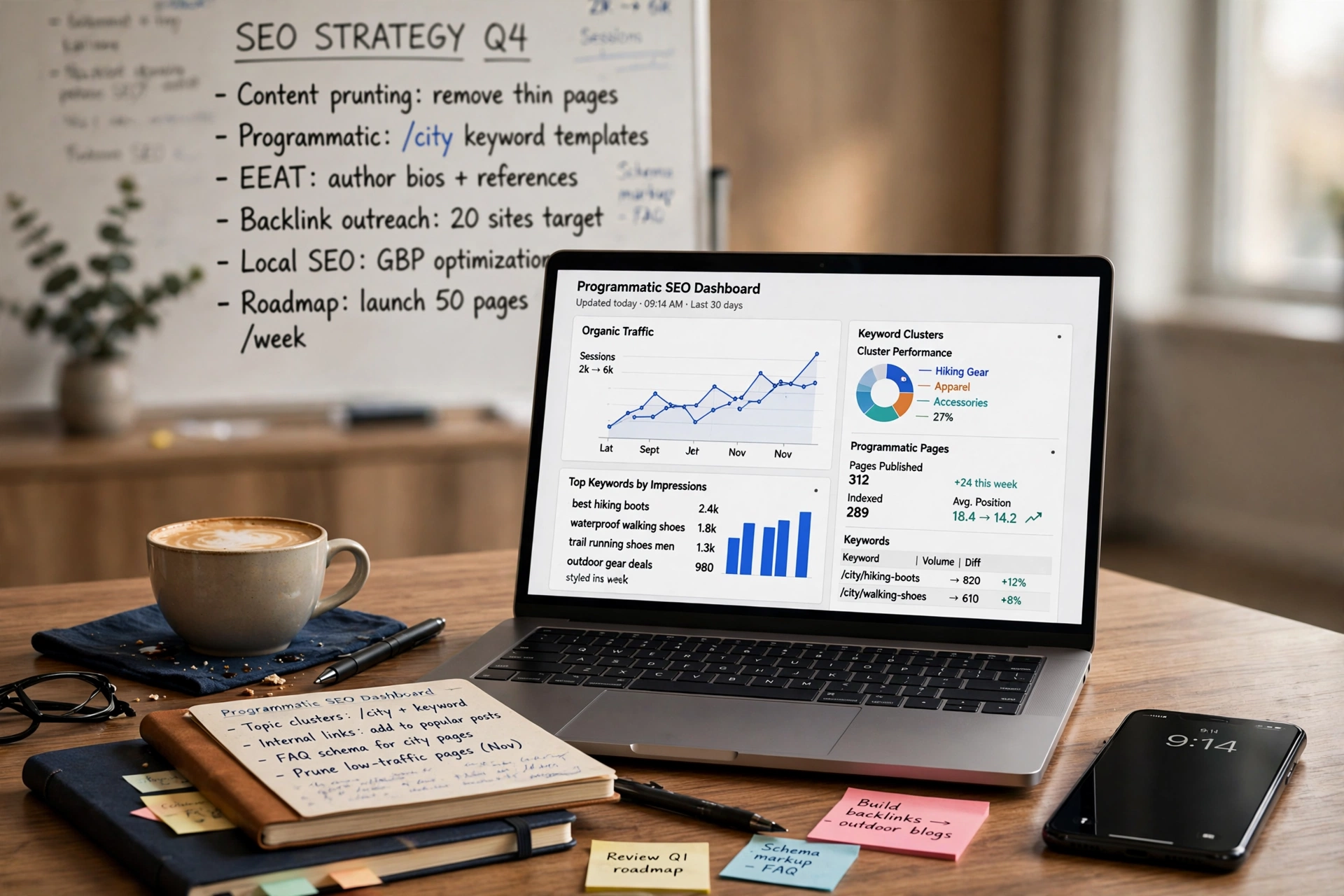
The primary advantage of an autonomous system is the move from linear to exponential growth. Traditional SEO is linear: one writer, one article, one keyword. Autonomous SEO is programmatic. It allows a business to deploy hundreds of "satellite pages" that target long-tail, high-intent queries. For example, instead of just targeting "Lawyer New Orleans," an autonomous system creates pages for "Best Personal Injury Lawyer for Car Accidents in Metairie" or "Employment Law Expert for Maritime Disputes in New Orleans." This captures the a an astronomical amount of search volume that competitors ignore.
AI-Driven Lead Qualification and Conversion
Traffic is a vanity metric if it doesn't convert. A modern autonomous platform integrates AI Sales Agents directly into the organic landing pages. These agents don't just sit there as chatbots; they track user behavior, scroll depth, and engagement signals. This allows the system to initiate a qualification sequence the moment a user shows high intent. This is why moving toward AI appointment setters for B2B is so effective, it removes the gap between the search click and the booked demo.
Dominance in AI Search (GEO and AEO)
With the rise of Perplexity, SearchGPT, and Google's SGE, the battleground has shifted from the blue link to the AI summary. Autonomous platforms use structured Schema.org markup and LLM-readable files (like llms.txt) to force AI models to cite the business as the definitive authority. If you want to know how to get cited by ChatGPT and Perplexity, you must move beyond keywords and start focusing on entity-based authority.
💡
Key Takeaway
The most significant benefit of an autonomous SEO platform is the ability to decouple lead generation from human labor, allowing you to scale your organic footprint from 10 pages to 1,000+ without increasing your headcount.
Comparison: Traditional vs. Autonomous SEO
| Feature | Traditional SEO Agency | Generic AI Content Tools | BizAI Autonomous Platform |
|---|---|---|---|
| Content Velocity | 2-4 articles / month | High (but low quality) | 300-900 optimized pages / month |
| Strategy | Keyword-based (Manual) | Prompt-based (Random) | Programmatic & Intent-based |
| Conversion | Static Contact Forms | Basic Chatbots | Autonomous AI SDR Qualification |
| AI Search (GEO) | Ignored / Reactive | Minimal / Accidental | Native GEO-Engineered Architecture |
| Cost Structure | High Monthly Retainer | Low Monthly Subscription | High ROI / Compounding Asset |
Real-World Examples of Autonomous Growth
I've seen this play out with a professional services firm in the New Orleans area that was spending $5,000 a month on Google Ads for high-intent keywords but seeing a dwindling conversion rate. They were trapped in the "ad spend treadmill." We transitioned them to an autonomous programmatic structure, deploying 400 satellite pages targeting specific neighborhood-level queries and niche service variations across Jefferson and Orleans parishes.
The Result: Within 90 days, their organic traffic increased by 600%. More importantly, because every page featured an integrated AI agent, their lead-to-meeting conversion rate jumped from 3% (static form) to 18% (conversational AI). They were able to kill 80% of their ad spend while increasing their monthly booked demos by 3x. This is the power of automating organic traffic and lead capture.
Another example involved a B2B consultancy that targeted the Gulf Coast region. They had a handful of pages and no clear topical authority. By implementing a dual-engine architecture, Engine A for massive organic scale and Engine B for autonomous qualification, they dominated the "Consulting Services New Orleans" niche. According to internal data from similar deployments, the ROI of this approach is typically 3.7x higher than traditional SEO within the first 18 months because the assets are self-owned and compound in value over time.

How to Get Started with an Autonomous SEO Platform
Transitioning to an autonomous system requires a shift in mindset. You are no longer "blogging"; you are building a lead-acquisition machine. For New Orleans businesses, the process should follow these specific steps:
Step 1: Topical Mapping and Entity Definition. Identify every possible way a buyer would search for your service. This includes not just keywords, but symptoms, pain points, and regional modifiers (e.g. "New Orleans corporate tax help" vs "Louisiana tax credit for businesses").
Step 2: Deploying the Programmatic Engine. Instead of manually writing articles, use an autonomous platform like BizAI Intelligence to generate a hub-and-spoke architecture. Create 1-3 Pillar Pages for your core services and 300+ Satellite Pages for long-tail queries. This ensures you cover the entire topical map, signaling to Google that you are the definitive authority in the region.
Step 3: GEO Optimization. Implement structured data markup (JSON-LD) across all pages. This makes your content "digestible" for LLMs. Ensuring your site has a clear /llms.txt file and a comprehensive FAQ grid is essential for appearing in AI Overviews.
Step 4: Integrating the Autonomous AI SDR. Replace your "Contact Us" page with an interactive AI agent. This agent should be programmed with your specific pricing, FAQs, and scheduling logic to book meetings directly into your CRM. If you are wondering how to connect AI agents to your CRM, this is the phase where the technical integration happens.
Step 5: Continuous Iteration via Data. Use the data from the AI agents to see which pages are driving the most high-intent leads. Double down on those topics and prune low-performing content. This is where the AI SDR vs Human SDR ROI becomes apparent, the system optimizes itself in real-time based on actual conversion data.
Common Objections to Autonomous SEO
Objection 1: "Google will penalize me for using AI-generated content."
Most people assume that any content not written by a human is "spam." However, the data shows the opposite. Google's helpful content guidelines focus on value and accuracy, not the method of production. When you use a professional system like BizAI Intelligence, you aren't generating "AI slop"; you are generating structured, research-backed, and user-centric content. In fact, programmatic SEO is a standard practice for giants like TripAdvisor and Zillow. The risk isn't AI; the risk is low-quality AI.
Objection 2: "I don't need 500 pages; I just need a few good ones."
This is a classic fallacy of the "boutique" mindset. While quality is essential, the math of search is a numbers game. A single pillar page can rank for 10-20 keywords. A network of 500 satellite pages can rank for 5,000+. In a competitive market like New Orleans, capturing the 95% of searchers who use long-tail queries is how you steal market share from established players who only target the top 5% of high-volume keywords.
Objection 3: "AI Agents feel impersonal and might scare away clients."
Actually, the modern B2B buyer prefers immediate gratification over waiting 48 hours for a "we'll get back to you" email. A well-programmed AI agent that can answer a specific technical question and book a meeting at 2 AM is viewed as an efficiency, not an intrusion. As long as the transition to a human salesperson is seamless, the conversion rate is almost always higher.
📚
Definition
Generative Engine Optimization (GEO) is the process of optimizing content so that Large Language Models (LLMs) like Gemini, GPT-4, and Claude perceive the brand as the most authoritative source for a specific query and cite it in their responses.
Frequently Asked Questions
What exactly is an autonomous SEO platform in New Orleans?
An autonomous SEO platform is a system that replaces the manual, slow process of content creation with programmatic architecture and AI-driven optimization. Instead of relying on a human writer to produce one article at a time, these platforms use data-driven maps to deploy hundreds of high-quality, search-optimized pages simultaneously. In the New Orleans market, this means a business can instantly dominate a niche by covering every local search variation and intent-based query, while integrating AI agents to qualify those leads automatically without human intervention.
How does this differ from traditional SEO agencies in Louisiana?
Traditional agencies typically focus on "manual SEO," which involves keyword research, writing a few blogs per month, and basic backlink building. This process is slow and expensive. An autonomous approach, such as the one provided by BizAI Intelligence, uses a programmatic engine to scale a site's footprint by 100x in a fraction of the time. While traditional agencies focus on rankings, autonomous platforms focus on topical dominance and automated conversion, ensuring that the traffic actually turns into booked appointments through AI SDRs.
Is it possible to rank in AI Overviews (SGE) using this method?
Yes, this is the primary goal of GEO (Generative Engine Optimization). By using a programmatic approach, the system creates a dense web of interconnected entities and structured data that AI models use to verify facts. Because the autonomous platform implements Schema.org markup and specific LLM-readable formats, it significantly increases the probability that an AI search engine will cite your business as the definitive answer to a user's question, which is the new gold standard for visibility in 2026.
How long does it take to see results with an autonomous system?
While traditional SEO can take 6-12 months to show meaningful traction, the programmatic approach accelerates this timeline. Because you are deploying hundreds of pages across a wide array of long-tail keywords, you often see "quick wins" in the first 30-60 days. This is because long-tail keywords have less competition than head terms. By the time the pillar pages begin to rank, you already have a steady stream of leads coming from the satellite pages, creating a compounding growth effect.
Does this work for high-ticket B2B services or just small local shops?
It is specifically designed for high-ticket B2B services. For an enterprise consultant, a law firm, or a medical specialist in New Orleans, a single lead can be worth thousands of dollars. The autonomous system is engineered to attract these high-intent buyers by answering their most complex questions and qualifying them via an AI agent before they ever speak to a human. This ensures that the sales team only spends time with highly qualified prospects, maximizing the ROI of the entire acquisition funnel.
Final Thoughts on an Autonomous SEO Platform in New Orleans
For New Orleans businesses, the era of "hoping" for organic traffic is over. The market has shifted toward a winner-take-all dynamic where the brand with the most comprehensive topical authority wins. Relying on a few blog posts and some occasional social media updates is a recipe for invisibility. To truly scale, you need an autonomous seo platform in new orelans that combines the brute force of programmatic SEO with the precision of AI lead qualification.
If you are tired of paying for traffic that doesn't convert and you're ready to build a self-owned acquisition engine that works while you sleep, the solution is clear. Stop renting your leads and start owning your market. To see how this architecture can be deployed for your specific business, visit BizAI Intelligence and start building your autonomous lead machine today.
Only 12 Onboarding Slots Remaining This Month
BizAI deploys 300 AI salespeople scoring purchase intent 24/7. Get your free niche domination blueprint.
AI Search Accelerator: 1-on-1 Strategy Session
Claim one of the 10 monthly slots. Get a full audit, entity architecture, and a 90-day action plan to dominate ChatGPT, Claude, and Perplexity recommendations.