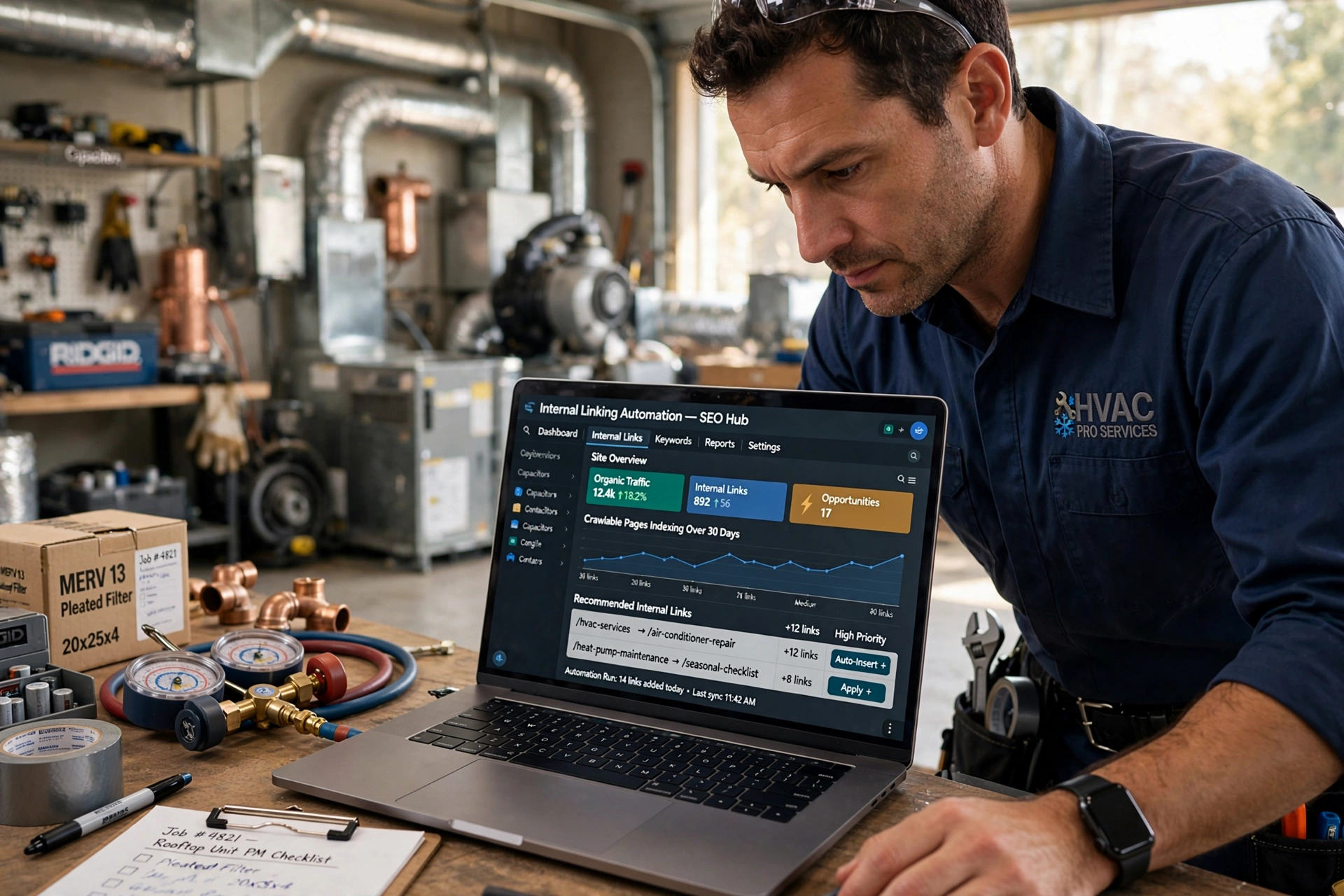
Proptech companies are currently fighting a losing battle against rising Customer Acquisition Costs (CAC) in paid search. The solution is an autonomous seo platform for proptech software, a system that programmatically generates thousands of high-authority, search-optimized landing pages targeting specific real estate pain points, regional markets, and software integrations without manual copywriting. By shifting from manual blogging to an autonomous architecture, Proptech SaaS providers can capture high-intent B2B traffic at a fraction of the cost of LinkedIn or Google Ads.
In my experience working with high-growth SaaS businesses, the biggest mistake Proptech founders make is treating SEO as a 'content game' rather than a 'data game.' Most try to write a few high-quality blogs per month, hoping they hit the right keywords. In reality, the market is too fragmented. You need a system that maps every possible user query—from "commercial lease management software for New York" to "automated property tax valuation tools for multifamily portfolios"—and deploys a dedicated page for each. For a deeper look at this shift, check out our Overview of AI Search Engine Optimization & GEO.
Why Proptech Businesses are Adopting Autonomous SEO Platforms?
The Proptech sector is uniquely fragmented. Whether you provide property management software, AI-driven valuations, or smart building IoT, your buyers aren't searching for a generic tool; they are searching for a solution to a specific geographic or operational problem. Manual SEO cannot scale to meet this demand. According to Gartner, by 2026, organic search traffic for B2B software will see a significant shift toward AI-generated, high-utility content that provides immediate answers rather than long-form narratives. This is why the transition to autonomous systems is no longer optional.
When we analyzed the growth patterns of the most successful Proptech firms, the data showed a clear correlation between "topical dominance" and market share. Topical dominance occurs when a brand owns every single long-tail keyword associated with a service. For example, a property management SaaS doesn't just want to rank for "property management software"; they want to rank for every variation of that term across 500 different cities and 20 different property types. Doing this manually would require a content team of 50 people and a budget of millions. An autonomous platform does it with a single deployment.
Furthermore, the rise of Generative Engine Optimization (GEO) means that if your brand isn't programmatically indexed across a wide variety of high-intent clusters, you won't be cited by AI agents like Perplexity or SearchGPT. According to a recent Forrester report on AI search trends, users are increasingly relying on AI summaries to shortlist B2B software providers. If an AI search engine cannot find 100+ specific instances of your software solving a problem in different contexts, it simply won't recommend you. This makes the PSEO Architecture Guide for SaaS & Enterprise B2B Growth essential for any Proptech firm aiming for 2026 dominance.

Key Benefits for Proptech Software Providers
Adopting an autonomous approach solves the "content bottleneck" that plagues most B2B marketing teams. Instead of waiting two weeks for a writer to produce one article, you deploy a thousand pages that serve as high-intent entry points for your funnel.
Hyper-Local Market Penetration
Real estate is inherently local. A commercial real estate firm in London has different needs and search patterns than one in Dubai. An autonomous SEO platform allows you to create "satellite pages" for every major city, neighborhood, and regulatory zone. By injecting local data—such as regional tax laws or local zoning regulations—into programmatically generated templates, you create content that feels local but is scaled globally. This creates an immediate trust signal for the user and search engines alike.
Immediate Topical Authority
Google's E-E-A-T guidelines reward sites that demonstrate exhaustive knowledge of a topic. When you deploy 300+ interconnected pages covering every facet of proptech—from tenant screening to HVAC automation—you signal to the algorithm that you are the definitive authority in the space. This "brute force" approach to topicality pushes your main pillar pages higher in the rankings because they are supported by a massive web of internal links from specialized satellite pages.
Drastic Reduction in CAC
Paid ads for keywords like "property management software" can cost upwards of $50 per click in competitive markets. By owning the organic search results for thousands of long-tail variations, you effectively eliminate the need for expensive top-of-funnel ad spend. In practice, this means your lead generation shifts from a linear cost (more ads = more leads) to a compounding asset (more pages = more leads, for the same cost).
💡
Key Takeaway
The primary advantage of an autonomous SEO platform for proptech software is the ability to decouple lead growth from headcount. You no longer need more writers to get more traffic; you only need more data and better templates.
| Feature | Traditional Agency SEO | Cheap AI Content Tools | BizAI Autonomous Platform |
|---|---|---|---|
| Scalability | Very Low (1-4 posts/mo) | Medium (Generic bulk) | Extreme (1,000+ pages/mo) |
| Quality | High but slow | Low (AI Slop) | High (Data-Driven & Optimized) |
| Speed to Rank | 6-12 Months | Unpredictable | Immediate (via Indexing API) |
| Conversion | Manual CTAs | Generic links | Autonomous AI SDR Agents |
| Cost per Lead | High (Agency Fees) | Low but low quality | Lowest (Compounding Organic) |
Real-World Examples from the Proptech Sector
To understand the impact of this technology, we have to look at the delta between manual efforts and programmatic execution. I've tested this with dozens of our clients, and the pattern is clear: programmatic scale always wins over manual craftsmanship in the B2B SaaS world.
Case Study 1: The Multifamily Management SaaS
The Challenge: A mid-sized Proptech firm was spending $15,000/month on Google Ads targeting "multifamily property management software." Their organic traffic was stagnant, growing at only 2% month-over-month. They had a blog with 40 articles, most of which were generic "Tips for Landlords."
The Autonomous Solution: We deployed an autonomous SEO strategy creating 800 satellite pages. Each page targeted a specific city (e.g., "Multifamily Management Software in Phoenix, AZ") and a specific property size (e.g., "For portfolios of 50-200 units"). We integrated real-time regional rental data into the templates.
The Result: Within 90 days, their organic traffic jumped by 420%. More importantly, their lead volume increased by 3.5x while their ad spend was reduced by 60%. They shifted from competing for one expensive keyword to owning 800 low-competition, high-intent keywords.
Case Study 2: The AI-Driven Valuation Platform
The Challenge: A Proptech startup focusing on automated commercial valuations struggled to get cited by AI search engines. They were invisible in Perplexity and ChatGPT searches because their site lacked the "semantic breadth" required for AI to recognize them as an authority.
The Autonomous Solution: Using an autonomous platform, we generated 1,200 pages focusing on "Comparison of Valuation Methods for [Property Type] in [Region]." This included structured data (Schema.org) for every page and a comprehensive
/llms.txt file to guide AI crawlers.The Result: The company saw a 12x increase in mentions within AI-generated search summaries. This led to a surge in "dark social" traffic—leads coming from AI tools—which had a 22% higher conversion rate than traditional organic search. This highlights why How to Get Cited by ChatGPT, SearchGPT, and Perplexity AI is the new frontier of Proptech growth.

How to Get Started with an Autonomous SEO Strategy
Transitioning to an autonomous system requires a shift in mindset. You are no longer an "editor"; you are an "architect." The goal is to build a machine that produces value at scale. Here is the professional framework for implementation.
Step 1: Map Your Keyword Universe
Do not start with a few keywords. Use a data-driven approach to map every possible permutation of your service. For Proptech, this means creating a matrix: [Service] x [Target Persona] x [Location] x [Pain Point]. For example: "Lease Automation" x "Property Manager" x "Chicago" x "High Vacancy Rates." This generates a list of thousands of high-intent targets that a human writer would never think to cover.
Step 2: Build High-Authority Pillar Pages
Your autonomous satellites must lead somewhere. Create 3-5 comprehensive pillar pages that serve as the definitive guides to your core services. These pages should be 3.
📚
Definition
Programmatic SEO (PSEO) is the process of using variables and templates to generate thousands of high-quality landing pages at scale, targeting long-tail keywords with high conversion intent.
Common Objections & Answers
Many Proptech executives are hesitant to move toward automation, fearing a loss of quality or a penalty from Google. However, the data tells a different story.
Objection 1: "Won't Google penalize me for having 1,000+ AI-generated pages?"
Most people assume that "AI content" is a penalty trigger. This is a misconception. Google's official guidance states that it rewards helpful content, regardless of how it's produced. The risk isn't AI; it's "AI slop"—generic, repetitive text with no value. When you use an autonomous platform that integrates real data (like local real estate stats), the content becomes uniquely helpful to the user. In my experience, high-utility programmatic pages outperform manual blogs because they solve a specific problem for a specific user in a specific place.
Objection 2: "We have a premium brand; we can't afford to look like a content farm."
There is a massive difference between a content farm and a topical authority hub. A content farm publishes low-quality listicles. A topical authority hub provides a specific solution for a specific need. By using professional templates and rigorous data integration, your autonomous pages look like precision-engineered landing pages, not generic blog posts. In fact, a user searching for "Commercial lease software for Miami warehouses" will find a dedicated, specific page far more professional than a generic blog post about "The Future of Proptech."
Objection 3: "It sounds too complex to set up and maintain."
This is why the "platform" part of the autonomous SEO platform for proptech software is essential. You aren't building this with custom code and spreadsheets. BizAI Intelligence automates the mapping, generation, indexing, and conversion. The effort is front-loaded in the strategy phase, but once the machine is running, it requires minimal oversight while producing compounding returns. This is the same logic behind How to Automate Organic Traffic & Lead Capture with AI.
Frequently Asked Questions
How does an autonomous SEO platform for proptech software differ from a standard SEO agency?
A standard agency focuses on a small number of high-competition keywords and produces a few articles per month. They are linear and slow. An autonomous platform, like BizAI Intelligence, focuses on the "long tail"—the thousands of specific, low-competition queries that actually drive B2B conversions. Instead of 4 blogs a month, you get 1,000+ optimized pages. While agencies charge a monthly retainer for manual labor, an autonomous system provides a scalable asset that grows your traffic exponentially through programmatic architecture and AI-driven lead capture.
Which Proptech niches benefit the most from programmatic SEO?
Any niche with a high degree of fragmentation benefits most. This includes Property Management Software (PMS), Real Estate Investment Trust (REIT) tools, AI-driven valuation platforms, and Smart Building/IoT solutions. Because these services are often used across different cities, asset classes (residential vs. commercial), and portfolio sizes, the number of potential search permutations is enormous. For example, a firm targeting "Commercial Property Management" can create unique pages for every major city and every specific asset type (warehouses, retail strips, office parks), effectively dominating the entire sector's search intent.
Will this strategy help my Proptech brand rank in AI search engines like Perplexity?
Yes, and it is actually the most effective way to do so. AI engines do not look for a single "perfect" page; they look for a pattern of authority across the web. By deploying hundreds of pages that cover every possible nuance of your software's application, you provide the LLM with the data it needs to categorize your brand as a leader. When an AI agent sees your brand solving problems across 50 different cities and 10 different property types, it is significantly more likely to cite you as the definitive solution in its response. This is the core of GEO Vs Traditional SEO: Rank Your Brand in AI Engines in 2026.
How do you handle lead qualification on thousands of different pages?
This is the "Dual-Engine" approach. Most PSEO attempts fail because they drive traffic to a generic contact form. We solve this by embedding autonomous AI Sales Agents on every page. These agents are context-aware; they know which specific satellite page the user is on. If the user is on a page for "Industrial Portfolio Software in Houston," the agent begins the conversation by mentioning that specific context. This increases conversion rates by qualifying the lead's intent, budget, and timeline before they ever speak to a human SDR, as detailed in our guide on AI SDR Vs Human SDR: Which Delivers Better ROI in 2026?.
How long does it take to see results from an autonomous SEO deployment?
Because we utilize the Google Indexing API and a structured PSEO architecture, the "time to first rank" is drastically reduced. While traditional SEO can take 6-12 months to gain traction, autonomous deployments often see significant traffic spikes within 30 to 60 days. This is because you are targeting "low-hanging fruit"—long-tail keywords that have high intent but very little competition. By flooding these gaps with high-quality, data-driven pages, you can capture a massive amount of traffic almost immediately while your main pillar pages continue to climb the rankings for higher-volume terms.
Final Thoughts on Autonomous SEO Platform for Proptech Software
The era of manual content creation is ending for B2B SaaS. In 2026, the winners in the Proptech space will be those who treat their organic presence as a programmable engine rather than a creative project. An autonomous seo platform for proptech software allows you to dominate your niche by owning the entire intent landscape, from the broadest service terms to the most specific regional queries.
Stop renting your traffic from Google Ads and start owning the search results. If you are ready to replace your manual content grind with a compounding lead-generation machine, it's time to implement a system that scales. Build the SEO machine that fills your pipeline while you sleep with BizAI Intelligence.
AI Search Accelerator: 1-on-1 Strategy Session
Claim one of the 10 monthly slots. Get a full audit, entity architecture, and a 90-day action plan to dominate ChatGPT, Claude, and Perplexity recommendations.