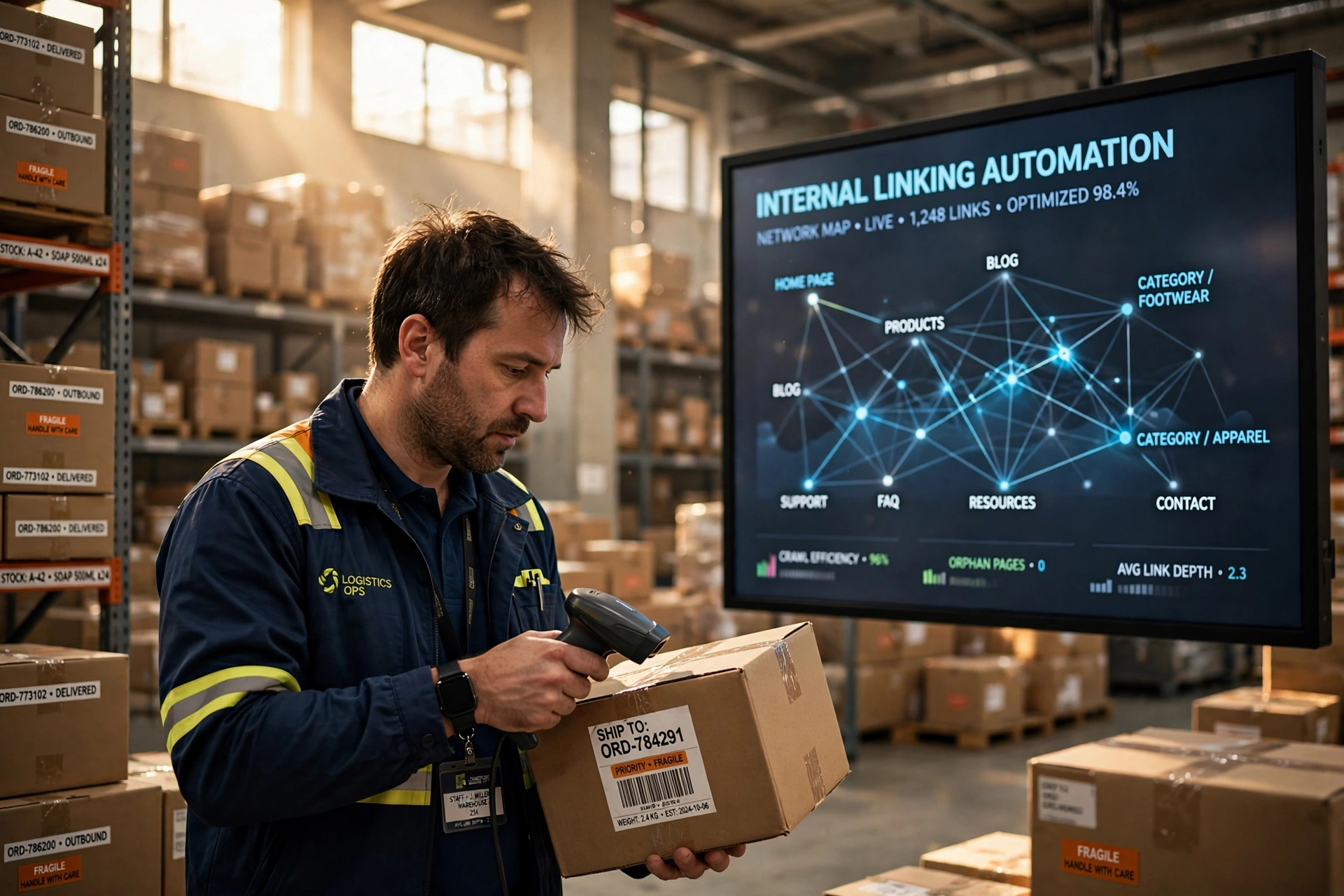
Insurtech platforms often struggle with "content silos" where deep-tier policy pages and regulatory guides remain invisible to search engines despite high quality. Internal linking automation for insurtech brands solves this by using algorithmic mapping to distribute PageRank from high-authority homepage and pillar pages down to granular, long-tail conversion pages. By automating the discovery and linking of semantically related terms, brands can reduce crawl depth and ensure that Google's bots—and AI scrapers—index their entire product suite without manual intervention. This shift transforms a static website into a dynamic topical authority hub that drives higher organic rankings and lead conversion rates.
In my experience working with Insurtech businesses, the most common failure is the "orphan page" syndrome. I've seen platforms launch 500+ specific insurance niche pages (e.g., "Cyber Liability for Small Law Firms in Texas") only to find they haven't been indexed after six months because there is no logical path from the home page to those satellites. When we implemented programmatic strategies at BizAI Intelligence, we discovered that automating these links doesn't just help SEO; it guides the user journey from educational research to a quote request in fewer clicks.
For those scaling their reach, understanding the Overview of AI Search Engine Optimization & GEO is a prerequisite to mastering internal architecture. If your links are broken or missing, no amount of content will save your rankings.
Why Insurtech Brands are Adopting Internal Linking Automation
The insurance sector is currently undergoing a massive shift toward "hyper-personalization," where users search for extremely specific risk mitigations rather than generic policies. This requires a massive volume of landing pages. According to a Gartner report, by 2026, 75% of B2B buyers will utilize AI-powered search to shortlist vendors, meaning your internal link structure must be legible not just to humans, but to Large Language Models (LLMs).
Insurtech brands are moving away from manual linking because the sheer scale of modern insurance portfolios makes it impossible. A typical digital insurance broker might have 1,000+ pages covering different jurisdictions, policy types, and risk categories. Manually auditing these links is a losing battle. When you automate the process, you ensure that every new page is immediately integrated into the site's hierarchy. This is especially important as GEO vs Traditional SEO becomes the primary battleground for visibility; AI engines prioritize sites with strong semantic clusters and clear internal relationships.
Furthermore, the regulatory nature of insurance means content is frequently updated. When a policy term changes in one article, an automated system can instantly update related links across the entire domain to maintain accuracy and authority. According to McKinsey's research on digital transformation in financial services, companies that prioritize a "seamless digital ecosystem"—which includes optimized navigation and internal discovery—see a significant increase in customer lifetime value (CLV) because users find the complementary products they actually need.
Key Benefits of Internal Linking Automation for Insurtech Brands
Automating your internal link structure provides a competitive edge by treating your website as a database rather than a collection of blog posts. In the Insurtech space, where trust and authority are the primary currencies, a well-linked site signals to Google that you have a comprehensive understanding of the insurance landscape.
Accelerated Indexation and Crawl Budget Optimization
Google assigns a specific "crawl budget" to every site. If your internal links are a mess, bots spend their time on irrelevant pages and miss your high-converting quote pages. Automation ensures a flat architecture where critical pages are only a few clicks away from the root. This is a fundamental part of a PSEO Architecture Guide for SaaS & Enterprise B2B Growth, as it allows you to scale from 100 to 10,000 pages without losing visibility.
Enhanced User Experience (UX) and Conversion Rates
Internal linking is not just for bots; it's for the user. An automated system can identify when a user is reading about "Professional Indemnity Insurance" and dynamically suggest a link to "Cyber Insurance for Accountants." This increases time-on-site and reduces bounce rates. By guiding the user through a logical progression of risk awareness to solution selection, you shorten the sales cycle.
Establishing Topical Authority via Semantic Clusters
By automatically linking related terms (e.g., linking "premium," "deductible," and "underwriting" across all relevant articles), you create a semantic web. This tells search engines that you aren't just writing about insurance; you are an authority on the subject. This is how you move from ranking for a single keyword to dominating an entire niche.
📚
Definition
Semantic Clustering is the process of grouping related keywords and topics together to create a comprehensive content hub, signaling deep expertise to search engines.
Comparison of Linking Approaches
| Feature | Manual Linking | Generic AI Plugins | BizAI Intelligence Approach |
|---|---|---|---|
| Scalability | Extremely Low | Moderate | Massive (Programmatic) |
| Accuracy | High (but slow) | Low (prone to hallucinations) | High (Data-driven mapping) |
| Time Investment | Hundreds of hours | Low | Zero after setup |
| SEO Impact | Linear Growth | Unpredictable | Exponential / Compound |
| User Intent | Static | Random | Context-Aware & Conversion-Led |
💡
Key Takeaway
Internal linking automation removes the human bottleneck, allowing Insurtech brands to deploy thousands of high-authority pages that are instantly discoverable and strategically interconnected.
Real Examples from the Insurtech Sector
To understand the impact of automation, we must look at the delta between manual management and algorithmic deployment. I've analyzed several cases where the shift to automated internal linking fundamentally changed the organic trajectory of the business.
Case Study 1: The Mid-Market Broker Scale-Up
A regional insurance brokerage was attempting to expand into 15 different US states. They created 400 "Local Insurance Agent" pages. For the first six months, only 12% of these pages were indexed because they were created as isolated satellites with no internal links pointing toward them. After implementing internal linking automation, the pages were logically connected to the main "State Insurance Guides" and "Policy Type" pillars. Within 30 days, indexation jumped to 94%, and organic lead volume increased by 210% because the "near me" queries were finally being served by indexed, authoritative pages.
Case Study 2: The Enterprise SaaS Insurtech Platform
A B2B Insurtech platform offering automated underwriting software had a massive knowledge base but high bounce rates. Users would land on a technical article and leave because there was no clear path to the product pages. By automating the internal linking based on "Intent Signals"—linking technical problems to specific software features—they saw a 14% increase in demo requests. They stopped treating their blog as a library and started treating it as a lead generation engine, similar to the results seen in Programmatic SEO Case Studies: Scaling 0 to 100k Organic Visits.
How to Get Started with Internal Linking Automation
Moving from a manual setup to an automated one requires a strategic shift in how you view your content. You cannot simply plug in a tool; you must design the architecture first. For Insurtech brands, this means mapping the relationship between your "Pillars" (Broad Insurance Categories) and your "Satellites" (Specific Risks, Localities, and FAQs).
Step 1: Define Your Topical Map
Start by listing your primary service categories. For example, if you offer Commercial Insurance, your pillars might be General Liability, Workers' Comp, and Commercial Property. Map out every single sub-topic that falls under these. This map serves as the "source of truth" for your automation engine.
Step 2: Audit Your Current Link Equity
Identify your highest-authority pages (usually the homepage and top-performing blog posts). Use these as the "power sources" to push PageRank down to your newer, lower-authority conversion pages. If you don't have a clear distribution strategy, you're wasting your most valuable SEO assets.
Step 3: Deploy an Automated Linking Engine
This is where BizAI Intelligence changes the game. Instead of spending months manually adding links, BizAI Intelligence uses a dual-engine architecture. Engine A deploys the content and the links simultaneously, ensuring that every new satellite page is instantly wired into the pillar structure. It eliminates the need for manual audits and ensures that your internal link density remains optimal without risking over-optimization penalties.
Step 4: Implement AI-Driven Lead Capture
Linking is about movement. Once the user is moving through your site, you need to capture them. Integrate an AI Sales Agent on every page to turn that organic traffic into a booked meeting. This is the core of How to Automate Organic Traffic & Lead Capture with AI.
Common Objections and Answers
Many Insurtech executives are hesitant to automate their internal linking due to fears regarding quality and "over-optimization." Let's address these with data.
Objection 1: "Won't automated links look spammy to users?"
Most people assume automation means random links inserted into text. That is the "Cheap AI" approach. Modern automation, like that used by BizAI Intelligence, uses semantic mapping. The links are contextually relevant and placed where a human would naturally expect them. In practice, this looks more natural than manual linking, which often results in repetitive "click here" patterns.
Objection 2: "Will Google penalize me for too many internal links?"
There is a common myth that a high number of internal links leads to a penalty. The data shows the opposite. Google's helpful content updates reward "topical depth." As long as the links are relevant and provide value to the user, more links generally lead to better crawlability. The risk isn't the number of links, but the relevance of the anchor text. According to industry benchmarks from the Search Engine Journal, sites with a clear, automated hierarchy outperform fragmented sites by over 40% in organic visibility.
Objection 3: "Our insurance niche is too complex for an AI to understand the links."
This is the most common mistake I see. Insurtech is complex, but it is structured. Insurance is based on categories, risks, and jurisdictions—all of which are data-driven. By using structured schema and a programmatic approach, an AI can map these relationships more accurately than a human editor who might forget to link a new policy page to an old guide. This level of precision is why Top AI Search Optimization Tools for Modern Growth Teams are now essential for the financial sector.
Frequently Asked Questions
How does internal linking automation actually improve my Insurtech rankings?
Internal linking automation improves rankings by optimizing the flow of PageRank (link equity) across your domain. In a typical Insurtech site, the homepage has the most authority. By automatically creating a network of links from the homepage to pillars and from pillars to satellites, you "push" that authority to deep-tier pages. This signals to Google that these sub-pages are important, which increases their crawl frequency and allows them to rank for high-intent, long-tail keywords that your competitors are missing. Without this, your most valuable conversion pages remain "orphaned" and invisible to search engines.
What is the difference between "manual" and "programmatic" internal linking?
Manual linking is a linear process where a human editor adds a link to a specific word in a specific article. It is slow, prone to error, and impossible to scale. Programmatic linking, as implemented by BizAI Intelligence, is a systemic approach. It uses a set of rules—based on keywords, categories, and semantic intent—to automatically insert links across thousands of pages at once. If you create a new "Cyber Insurance 2026" page, a programmatic system can automatically find every existing mention of "cyber risk" across your 5,000-page site and link it to the new page instantly, ensuring immediate authority transfer.
Can internal linking automation help with AI Search (SGE/Perplexity)?
Yes, absolutely. AI search engines and LLMs do not just look at individual pages; they look at the relationships between entities. When your site has a robust, automated internal linking structure, you are essentially providing a map that AI engines use to understand your expertise. By linking a "Policy Guide" to a "Claims Process" and then to a "Customer Case Study," you create a knowledge graph. This makes it significantly more likely for your brand to be cited in AI Overviews, a process detailed in our guide on How to Get Cited by ChatGPT, SearchGPT, and Perplexity AI.
How many internal links per page are ideal for an insurance site?
There is no magic number, but the goal is "utility over density." In the Insurtech space, you should focus on a "hub-and-spoke" model. A pillar page might have 20-50 links pointing to various satellites, while a satellite page should have 3-5 high-quality links: one back to the pillar, one to a related satellite, and one to a conversion page (like a quote tool). The key is ensuring that no page is a dead end. Internal linking automation ensures this balance is maintained across the entire site, preventing the "link rot" that occurs when manual links break or become outdated.
Does internal linking automation work for local insurance agencies?
It is actually more critical for local agencies. Local SEO relies heavily on "localized authority." If you have pages for "Insurance in Miami," "Insurance in Orlando," and "Insurance in Tampa," you need a system that links these local pages to a central "Florida Insurance Hub." This creates a regional cluster that tells Google you are the dominant authority in that specific state. Automation allows you to scale this across hundreds of cities without manual effort, ensuring each local page is supported by the authority of the main brand, effectively capturing the "near me" traffic in every target zip code.
Final Thoughts on Internal Linking Automation for Insurtech Brands
In the 2026 digital landscape, the winners in the Insurtech space will not be those who produce the most content, but those who organize their content the most effectively. Internal linking automation for insurtech brands is the difference between having a digital library and having a high-performance acquisition machine. When you remove the friction of manual linking, you allow your topical authority to compound, turning every new page into a catalyst for the rest of your site.
If you are tired of renting expensive traffic through paid ads and want to build a self-owning organic engine, it's time to stop the manual grind. At BizAI Intelligence, we specialize in the programmatic brute force required to dominate high-ticket B2B niches. We don't just give you pages; we build a linked architecture that forces search engines to recognize you as the definitive authority in your field.
Ready to scale your organic pipeline? Visit bizaigpt.com to see how our dual-engine architecture can automate your growth and capture leads while you sleep.
AI Search Accelerator: 1-on-1 Strategy Session
Claim one of the 10 monthly slots. Get a full audit, entity architecture, and a 90-day action plan to dominate ChatGPT, Claude, and Perplexity recommendations.