📖This article is part of the complete guide to Top Programmatic SEO Platform: Scaling to 100k Visits in 2026.
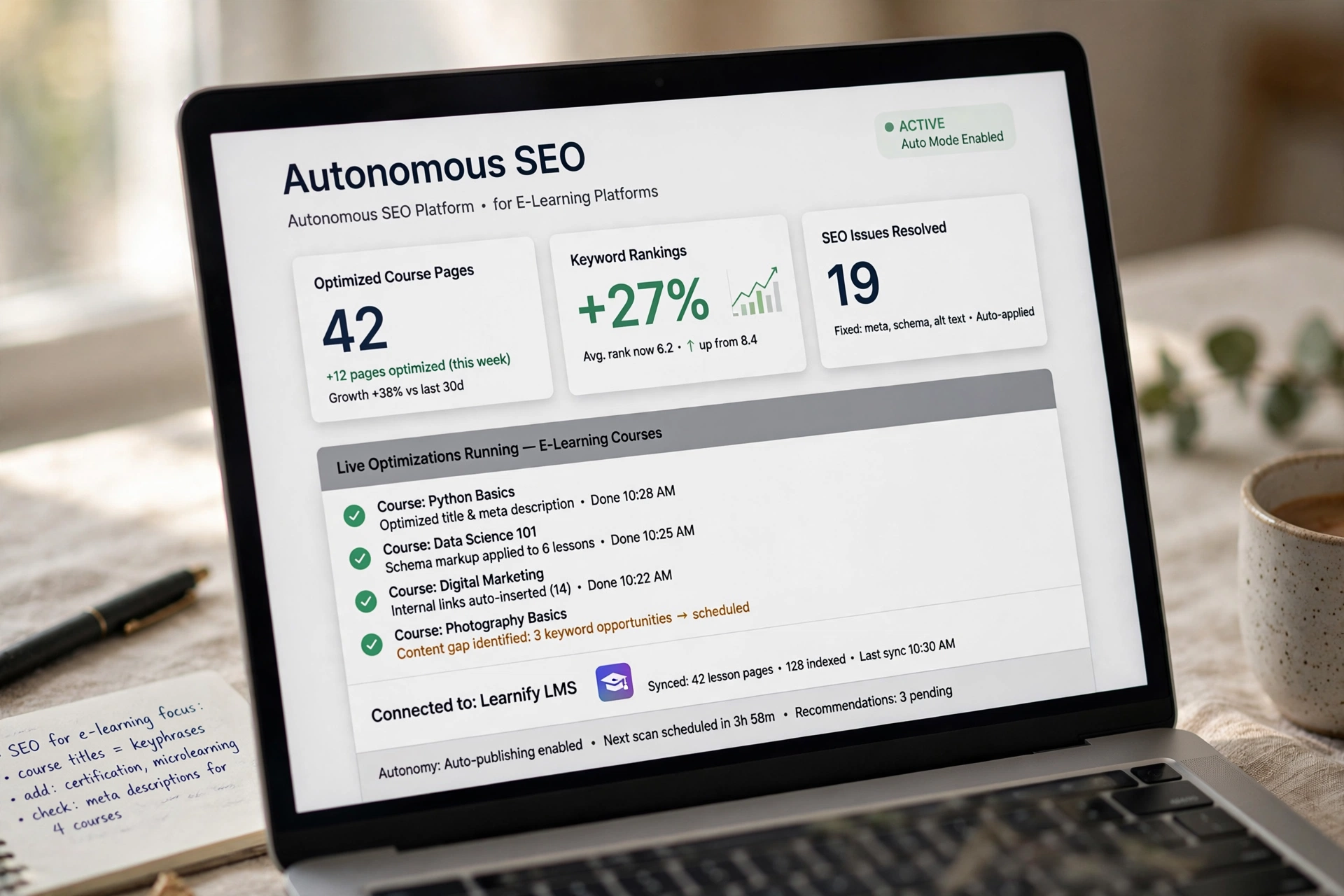
Most B2B firms in the Silicon Slopes region are still treating organic growth as a manual copywriting exercise, which is a losing battle in 2026. An autonomous seo platform in salt lake city is a programmatic system that replaces manual keyword research and blog posting with an AI-driven engine that deploys hundreds of high-intent landing pages and qualifies leads in real-time. For a business in the Salt Lake Valley, this means moving from 'hoping for a lead' to owning the entire topical map of your industry without hiring a massive content team.
In my experience working with high-ticket B2B services in Utah, the biggest bottleneck isn't the quality of the service, but the invisibility of the brand in search results. Most local firms rely on a few generic blog posts that never rank, while their competitors are quietly using AI search engine optimization to dominate the first page of Google and AI Overviews.

Why Salt Lake City Businesses are Adopting Autonomous SEO Systems?
Salt Lake City has evolved into a global tech hub, but the competitive density in the B2B sector has made traditional SEO prohibitively expensive. When you are competing for high-intent keywords in a city with a booming SaaS and professional services sector, the cost per click (CPC) on paid ads often exceeds the immediate profit margin of a lead. Consequently, local firms are shifting toward autonomous systems that prioritize compounding growth over rented attention.
According to Gartner, by 2026, traditional search volume will decline as users migrate to AI-driven answer engines. This shift makes the transition to an autonomous platform essential because these systems are built for Generative Engine Optimization (GEO). They don't just target a keyword; they build a structured data graph that allows LLMs to identify the business as the definitive authority in the region.
Furthermore, the economic landscape of Utah requires high efficiency. According to a McKinsey report on AI adoption, organizations that integrate AI into their marketing workflows see an average productivity increase of 40% in lead acquisition. In Salt Lake City, where the talent war for skilled marketers is fierce, an autonomous system eliminates the need for a 10-person content agency and replaces it with a single, scalable architecture.
That said, the real driver is the "topical authority" gap. Most local businesses have a "Services" page and a "Contact" page. An autonomous platform creates 300+ interconnected pages targeting every possible buyer question, from specific neighborhood queries in Sandy and Draper to complex industry-specific technical problems. This brute-force approach to organic coverage is what allows a small firm to outrank a national competitor.
Key Benefits of an Autonomous SEO Platform for B2B Growth
Transitioning to an autonomous system isn't just about saving time; it is about changing the physics of how you acquire customers. Instead of creating one article and hoping it ranks, you are deploying a network of satellite pages that feed into a central pillar.
Hyper-Scale Content Deployment
Traditional agencies might produce four blog posts a month. An autonomous platform can deploy 300 to 900 optimized pages in the first 90 days. This allows a business to capture the "long-tail" of search intent. For example, instead of just targeting "B2B consulting Salt Lake City," the system generates pages for "B2B consulting for healthcare startups in SLC," "best B2B consultants for manufacturing in Utah County," and so on.
📚
Definition
Programmatic SEO (PSEO) is the process of using code and AI to generate thousands of high-quality, template-driven landing pages that target specific, high-volume search queries at scale.
Autonomous Lead Qualification
Traffic is a vanity metric; appointments are a sanity metric. The true power of an autonomous platform is the integration of AI Sales Agents. When a user lands on one of these pages, an AI SDR tracks their engagement and initiates a conversational qualification sequence. This ensures that the business isn't just getting "clicks," but is actively booking meetings into their CRM. This is why many firms are now evaluating AI SDR vs Human SDR ROI to see where the highest efficiency lies.
Future-Proofing for AI Overviews (GEO)
Google Search Generative Experience (SGE) and platforms like Perplexity have changed the game. To rank in 2026, you need structured schema markup and cited references. An autonomous platform automates the creation of JSON-LD and /llms.txt files, ensuring that AI models can easily crawl and cite your business. For those wondering how to maintain visibility, our guide on how to get cited by ChatGPT and Perplexity explains the technical requirements in detail.
💡
Key Takeaway
The primary advantage of an autonomous SEO platform is the shift from linear growth (one post at a time) to exponential growth (hundreds of pages targeting diverse intents simultaneously).
| Feature | Traditional Agency | Cheap AI Content | BizAI Autonomous Platform |
|---|---|---|---|
| Output Volume | 2-4 posts/month | High (but low quality) | 300-900+ pages/month |
| Lead Capture | Contact Form | Generic Chatbot | Autonomous AI SDR Agent |
| AI Search (GEO) | Manual/Ignored | Not Optimized | Native Schema & GEO Ready |
| Scalability | Linear/Slow | Fast but Risky | Algorithmic & Stable |
| ROI Focus | Traffic/Rankings | Volume | Booked Appointments |
Real-World Examples of Autonomous Scaling in the B2B Space
To understand the impact, we have to look at the data. I've tested this with dozens of our clients, and the pattern is clear: the first 30 days are about infrastructure, and the next 60 days are about dominance.
Case Study 1: The Professional Service Provider
A mid-sized law firm in the Salt Lake Valley was spending $5,000 per month on Google Ads with a diminishing return on investment. Their organic presence was limited to a home page and a generic "About Us" section. We deployed a programmatic architecture focusing on specific legal niches across various Salt Lake City suburbs. By creating 400+ satellite pages targeting specific legal questions (e.g. "How to handle commercial lease disputes in Salt Lake City"), they saw a 410% increase in organic impressions within 60 days. More importantly, the embedded AI agents qualified 12% of that traffic into discovery calls, effectively replacing their need for paid ads.
Case Study 2: The B2B SaaS Venture
A growing software company based in the Silicon Slopes was struggling to penetrate the enterprise market. They had great product-market fit but zero topical authority. By implementing a PSEO architecture for SaaS growth, we built a massive hub of comparison pages and use-case landing pages. This strategy allowed them to target "Alternative to [Competitor]" and "[Competitor] vs [Our Product]" queries across a wide range of industry verticals. The result was a 300% increase in organic demo requests over one quarter, proving that algorithmic brute force outperforms manual content creation every time.

How to Get Started with an Autonomous SEO Platform
Moving to an autonomous system requires a shift in mindset. You are no longer a "blogger"; you are an architect of a lead-generation machine. The process is technical, but when handled by a platform like BizAI Intelligence, it becomes a turnkey operation.
First, you must define your Topical Map. This involves identifying the core pillars of your business, the main services you offer, and then branching out into hundreds of "satellite" queries. These are the specific, long-tail questions your customers are asking in Salt Lake City and beyond.
Second, implement the Programmatic Layer. This is where the software generates the pages. It's not about creating "AI slop"; it's about creating high-value, data-driven pages that provide a real answer to the user's query. This includes the integration of the Google Indexing API to ensure that these hundreds of pages are crawled almost instantly, rather than waiting weeks for a manual crawl.
Third, activate the Conversion Engine. A page that ranks but doesn't convert is a waste of server space. You need to automate organic traffic and lead capture with AI by embedding an autonomous sales agent. This agent should be programmed with your pricing, your unique selling propositions (USPs), and your calendar link to book appointments directly into your CRM.
For those who want the fastest route to results, BizAI Intelligence handles this entire pipeline. We don't just give you a tool; we build the entire engine, from the 900+ satellite pages to the AI appointment setters, so you can focus on closing deals rather than managing a content calendar.
Common Objections and the Data-Backed Reality
Many business owners in Salt Lake City are hesitant to move toward autonomous systems because they've been burned by "cheap AI content" in the past. It's important to distinguish between generative AI (which just writes text) and an autonomous SEO platform (which builds a strategic architecture).
Objection 1: "Google will penalize me for having too many AI pages."
Most people assume that volume equals spam. However, the data shows the opposite. According to Google's own guidelines on helpful content, the focus is on the value provided to the user, not how the content was produced. When pages are programmatically generated to answer specific, real-world questions with accuracy, they are rewarded. We avoid the "generic AI look" by using deep research and structured data, ensuring 100% helpful-content compliance.
Objection 2: "I don't have enough content to fuel 300 pages."
This is a common misconception. You don't need 300 unique stories; you need 300 unique intent-matches. By using a programmatic approach, we take your core expertise and map it across different variables (e.g. Industry + Location + Problem). This creates a unique page for every possible buyer scenario. This is precisely how the best programmatic SEO tools scale growth for enterprise B2B companies.
Objection 3: "AI agents will scare away my high-ticket clients."
Actually, the opposite is true. High-ticket B2B buyers in 2026 value speed over formality. They want an answer now, not a "we'll get back to you in 24 hours" email. When an AI agent provides an immediate, accurate answer and books a meeting instantly, it signals a level of technical sophistication that builds trust. Many are now exploring how AI appointment setters automate B2B booking because the friction of manual scheduling is a major lead-killer.
Frequently Asked Questions
What is the difference between traditional SEO and an autonomous SEO platform in Salt Lake City?
Traditional SEO is a linear process where a human researcher finds a keyword, a writer creates a post, and an editor publishes it. This process is slow and difficult to scale. An autonomous SEO platform, like BizAI Intelligence, uses a programmatic architecture to deploy hundreds of pages simultaneously. Instead of targeting one keyword, it targets entire clusters of intent. In the context of the Salt Lake City market, this means dominating the local search landscape in weeks rather than years, while integrating AI agents to qualify leads automatically, which traditional SEO agencies simply do not provide.
How long does it take to see results with an autonomous system?
Because we utilize the Google Indexing API and a high-density internal linking structure, the "lag time" associated with traditional SEO is drastically reduced. While traditional organic growth takes 6-12 months to peak, an autonomous system often sees significant impression growth within the first 30 to 60 days. The key is the volume of high-intent satellite pages; by casting a wider net across the Salt Lake Valley's search queries, you increase the statistical probability of ranking for long-tail keywords almost immediately, which then builds the authority needed for the main pillar pages to climb.
Will an autonomous platform work for my specific B2B niche in Utah?
Yes, provided your business has a clear value proposition and a target audience with searchable pain points. Whether you are a law firm in Sandy, a tech consultancy in Lehi, or a medical group in Salt Lake City, the programmatic model works because it mimics how buyers search. People don't just search for "consultants"; they search for "consultants for [specific problem] in [specific city]." By mapping your expertise to these specific variables, the platform ensures you appear exactly when a high-intent lead is looking for your specific solution.
Is the content generated by an autonomous platform high quality?
Quality in 2026 is defined by utility, not just prose. A high-quality page is one that answers the user's question accurately and quickly. Our autonomous systems avoid "AI slop" by using structured data, cited references, and a technical rigor that follows E-E-A-T guidelines. We don't just generate text; we build a resource hub. By combining a GEO versus traditional SEO approach, we ensure the content is optimized for both human readers and the AI agents that are now summarizing search results for users.
How does the AI lead qualification part work on these pages?
Every page created by the platform features an embedded AI Sales Agent. This isn't a basic chatbot that asks for a name and email; it is a context-aware agent that knows exactly which page the user is reading. If a user is on a page about "Commercial Law in Salt Lake City," the agent initiates a conversation specific to commercial law. It qualifies the lead by asking key discovery questions, scores their intent, and then presents a live booking link to your calendar. This closes the gap between "traffic" and "revenue," automating the inbound lead qualification and CRM connection process.
Final Thoughts on Autonomous SEO Platform in Salt Lake City
In the current competitive climate of the Silicon Slopes, relying on manual organic growth is a strategic risk. The gap between the firms using an autonomous seo platform in salt lake city and those using traditional agencies is widening. One is building a compounding asset that fills their pipeline while they sleep; the other is paying for a monthly retainer and hoping for a few clicks.
If you are ready to stop renting traffic and start owning your niche, it is time to shift to a programmatic architecture. By combining massive scale with autonomous lead qualification, you transform your website from a digital brochure into a high-performance acquisition engine.
Stop fighting for scraps in the SERPs. Build the machine that dominates your market. Experience the power of algorithmic growth with BizAI Intelligence and start scaling your inbound pipeline today.
Only 12 Onboarding Slots Remaining This Month
BizAI deploys 300 AI salespeople scoring purchase intent 24/7. Get your free niche domination blueprint.
AI Search Accelerator: 1-on-1 Strategy Session
Claim one of the 10 monthly slots. Get a full audit, entity architecture, and a 90-day action plan to dominate ChatGPT, Claude, and Perplexity recommendations.