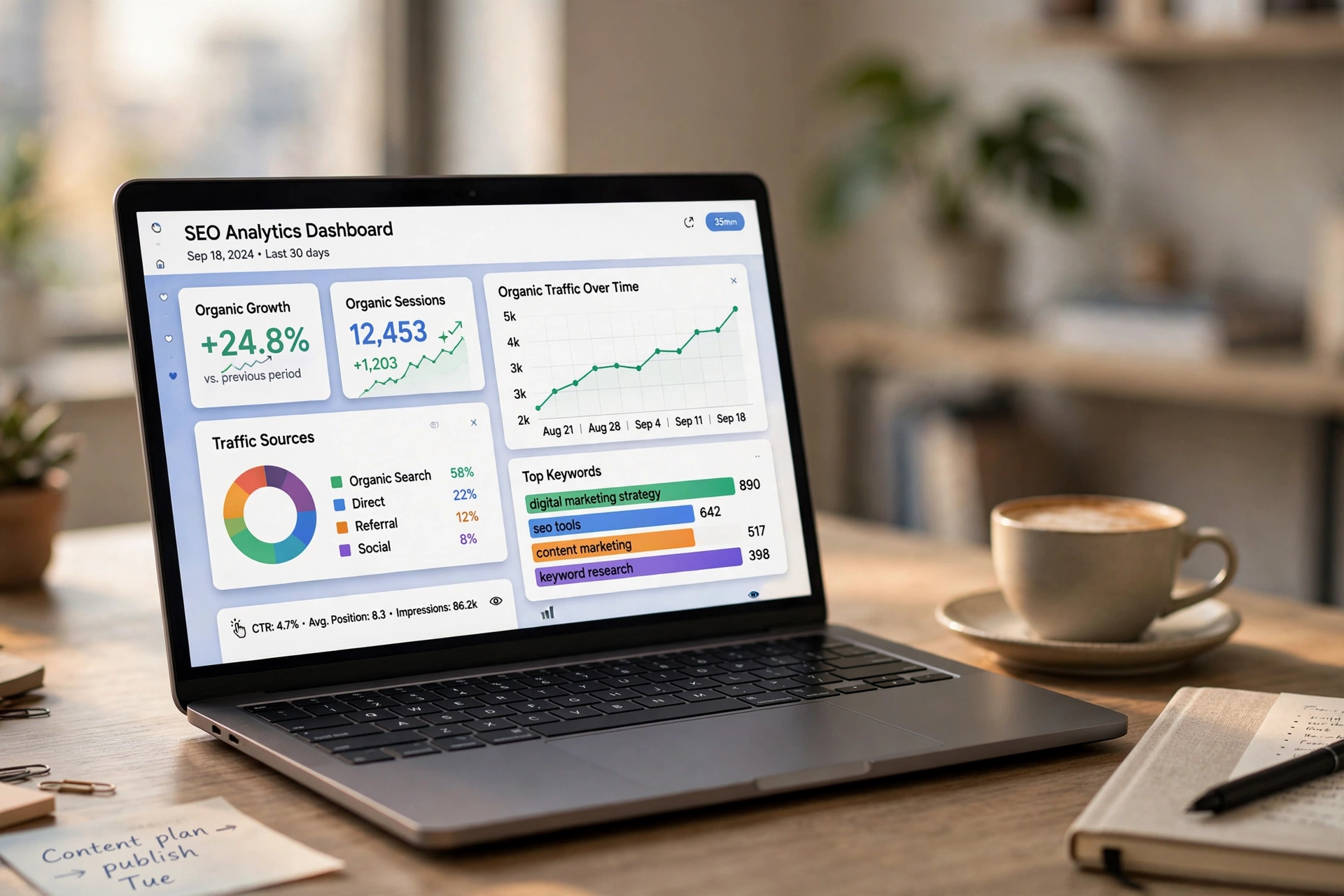
In my experience working with high-ticket B2B service providers, the biggest tragedy isn't a lack of traffic—it's the 'leaky bucket' syndrome. I've seen companies deploy 1,000 programmatic pages using basic AI scripts, only to realize that while their Google Search Console impressions spiked, their calendar remained empty. In 2026, the gap between 'traffic' and 'revenue' has become a canyon that only an integrated conversion layer can bridge.
For a comprehensive overview of how to shift your strategy, explore our How to Stop Depending on Paid Ads: The Inbound Traffic Blueprint.
What Are the Best Programmatic SEO Platforms and How Do They Work?
📚
Definition
Programmatic SEO (pSEO) is the process of using automation, databases, and large language models (LLMs) to create thousands of high-quality, unique landing pages targeting long-tail keywords at scale.
💡
Key Takeaway
The best programmatic SEO platforms in 2026 have evolved from simple 'text generators' into 'acquisition engines' that combine high-volume content with instant indexing and AI-driven lead qualification.
The best programmatic SEO platforms are those that solve the three-pronged challenge of quality, visibility, and conversion. In the early days of pSEO, tools simply swapped variables in a template (e.g., "Best Lawyer in [City]"). However, with the 2026 evolution of Google's helpful content systems and the rise of AI Search (SGE), these legacy methods now result in immediate penalties. Modern platforms now use 'Semantic Silos'—a combination of high-authority pillar pages and hundreds of supporting satellite pages—to establish topical authority.
To achieve actual ROI, these platforms must integrate directly with the Google Search Console Indexing API to bypass the slow natural crawl rate. Without this, a site might publish 500 pages, but only 10 might be indexed within the first month. Furthermore, as we've seen at BizAI Intelligence, the most successful implementations now embed an AI Sales Development Representative (SDR) directly into the page, turning a passive reader into a qualified lead via conversational intent scoring.
Why Choosing the Right pSEO Platform Matters for B2B Growth?
The primary reason the choice of platform is fundamental is that an incorrect tool creates 'AI Slop'—generic, low-value content that damages your domain authority. According to a 2024 report by Gartner, organizations that prioritize 'content quality over volume' see a 3.5x higher conversion rate from organic traffic than those utilizing bulk-generation scripts. When you deploy a programmatic strategy, you are essentially telling Google that you are the definitive authority on a specific topic; if your content is thin, you aren't building authority—you're building a digital graveyard.
For those struggling with quality, we recommend reading our guide on How to Replace Freelance Copywriters with Autonomous AI Content Engines.
Another critical factor is the shift toward Generative Engine Optimization (GEO). Search is no longer just about blue links; it's about appearing in the citations of Perplexity, ChatGPT, and Gemini. The best platforms now generate structured data (JSON-LD) and
/llms.txt files specifically designed for these crawlers. If your platform doesn't support Schema.org graph markup, you are effectively invisible to the AI-driven search landscape of 2026.Comparison: Traditional pSEO vs. AI Automation vs. BizAI Intelligence
To understand where the market stands, we must compare the friction and outcomes of different approaches. Most businesses start with the traditional way, realize it's too slow, move to a cheap AI tool, and finally discover the professional enterprise approach.
| Feature | Traditional pSEO (Manual/Templates) | Generic AI Content Tools | BizAI Intelligence (Dual-Engine) |
|---|---|---|---|
| Speed to Market | Slow (Months of manual data entry) | Fast (Days to generate) | Instant (Automated clusters) |
| Content Depth | High, but non-scalable | Low (Generic/Repetitive) | High (Data-rich, citation-backed) |
| Indexing Speed | Passive (Depends on Google) | Passive/Slow | Instant (API-driven IndexNow) |
| Conversion Rate | Low (Standard Contact Form) | Very Low (Static Text) | High (Autonomous AI SDR) |
| AI Search (GEO) | None | Basic | Advanced (LLM-optimized feeds) |
Analysis of the Top Programmatic SEO Platforms in 2026
BizAI Intelligence: The B2B Revenue Powerhouse
BizAI Intelligence is not just a content tool; it is a complete inbound acquisition system. While other tools focus on the 'publishing' part of the equation, BizAI focuses on the 'pipeline' part. It operates on a Dual-Engine architecture. Engine A handles the compounding organic traffic through programmatic pillars and satellites, while Engine B utilizes an Autonomous AI SDR to capture and qualify leads in real-time.
In my experience, the 'secret sauce' here is the intent scoring. Most websites lose 98% of their visitors because they offer a static form. BizAI's agent tracks scroll velocity and engagement signals to initiate a conversation precisely when the user is most interested. If you want to understand how this fixes the bounce rate, see Why 90% of Website Visitors Leave Without Buying (And How an AI SDR Fixes It.
Best for: B2B SaaS, Law Firms, Healthcare Networks, and High-Ticket Consultants.
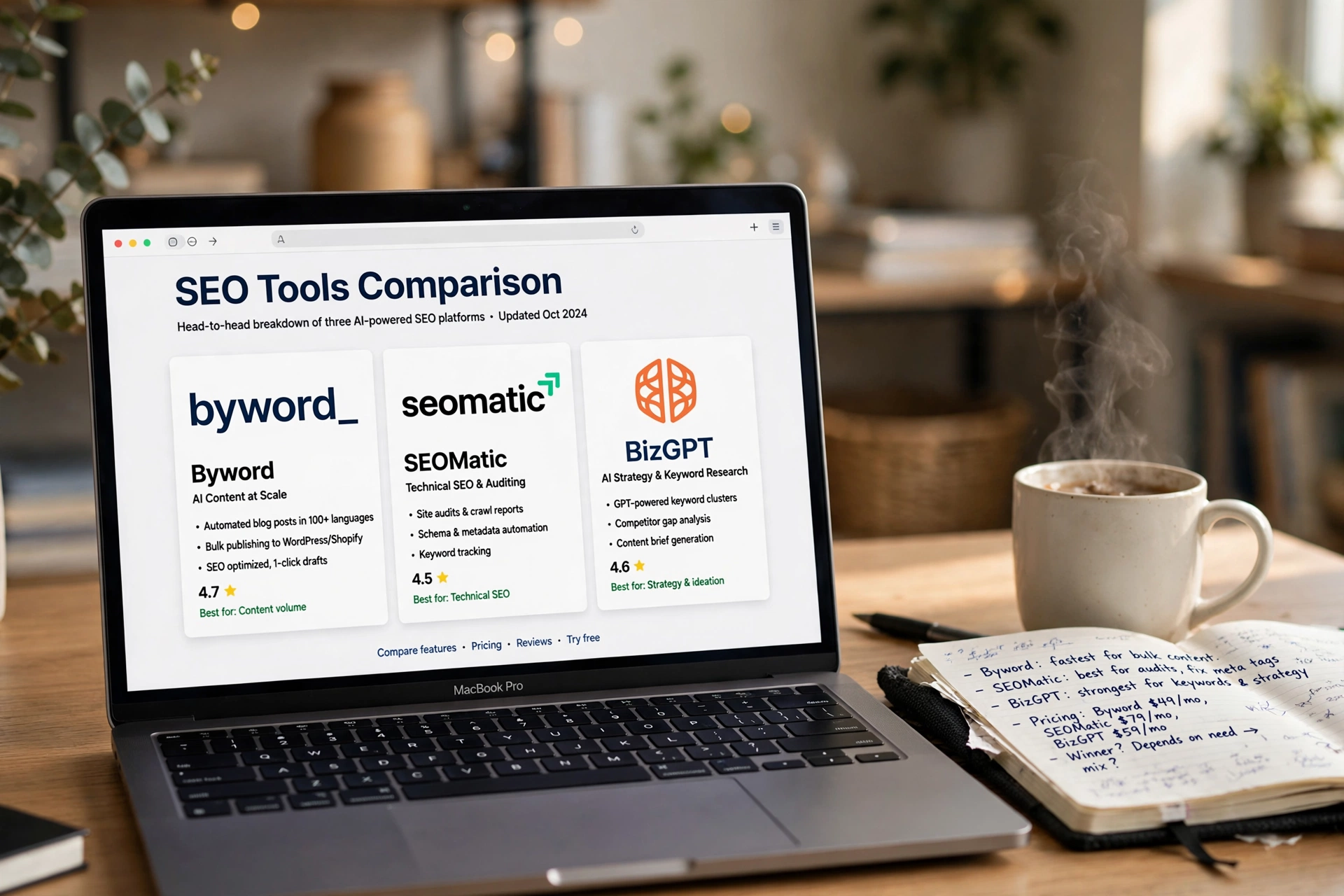
Byword.ai: The Volume Specialist
Byword remains a formidable tool for those who need raw scale. It is designed for the 'batch' mentality—upload a list of 1,000 keywords and receive 1,000 articles. Its integration with WordPress and Webflow is seamless, making it a favorite for affiliate marketers and niche site owners.
However, Byword lacks a native conversion layer. It produces the 'fuel' (traffic) but doesn't provide the 'engine' (lead qualification). If you are using Byword, you are essentially renting traffic from Google and hoping they find your contact page. This is why many are transitioning to AI vs SEO Agency: How Small Businesses Are Automating Search Rankings at 1/10th the Cost to find a more holistic solution.
SEOmatic.ai: The Database Specialist
SEOmatic is the gold standard for template-driven directories. If your business model relies on "Best [X] in [Y]" pages, SEOmatic's ability to pull from Airtable datasets is unmatched. It allows for precise control over variables and spintax, ensuring that pages don't look identical to crawlers.
The limitation is that SEOmatic content can feel 'clinical.' It lacks the nuanced thought-leadership required for high-ticket B2B sales. It's great for a directory, but not for convincing a CEO to sign a $50k contract. For those needing a more automated yet sophisticated approach to publishing, AI Blog Automation: How to Keep Your Website Updated Without Writing Articles provides a better blueprint.
AirOps: The Workflow Architect
AirOps is for the technical team. It allows you to build a custom 'content factory' using a visual canvas. You can chain together different LLMs (e.g., use Claude for the outline and GPT-4 for the drafting) and integrate custom data scrapers.

While powerful, it has a steep learning curve. You need to be a prompt engineer to get high-quality results. For most business owners, the time spent configuring AirOps is time taken away from closing deals. This is why many prefer the 'out-of-the-box' efficiency of Top Automated AI Blog Generation Tools for B2B SaaS in 2026.
How to Implement a Programmatic SEO Strategy Step-by-Step?
Implementing a pSEO strategy in 2026 requires a shift from 'keyword research' to 'entity mapping.' You aren't just looking for words; you are looking for the relationships between your service and the problems your customers face.
- Identify the Core Variable: Determine the variable that drives search intent. For a law firm, it might be [Legal Issue] + [City]. For a SaaS, it might be [Competitor] + [Alternative].
- Build the Dataset: Use tools like Airtable or custom scrapers to gather the factual data for each page. Remember, AI cannot 'hallucinate' your pricing or location; this data must be hard-coded.
- Design the Pillar-Satellite Architecture: Create one massive 'Pillar' page (e.g., "The Ultimate Guide to Corporate Law") and link it to 50 'Satellite' pages (e.g., "Corporate Law Services in Austin, TX"). This is exactly how we structure growth at BizAI Intelligence.
- Deploy via API: Avoid standard sitemaps. Use the Google Search Console Indexing API to force Google to see your new pages immediately. If you aren't doing this, you're wasting weeks of potential traffic. Check out our guide on How to Rank on Google First Page Fast as a Small Business (2026 Guide.
- Activate the Conversion Layer: Embed an AI SDR to qualify the traffic. If you generate 10,000 visitors and your conversion rate is 1%, you get 100 leads. If the AI SDR increases that to 3% by engaging users instantly, you've tripled your revenue without spending an extra cent on ads.
💡
Key Takeaway
The goal of programmatic SEO is to dominate the 'long tail' of search intent and then use automation to convert that intent into a booked meeting.
Common Mistakes in Programmatic SEO
In my years of architecting distributed platforms, I see the same three mistakes repeatedly. First is the 'Quality Drop.' Companies generate 5,000 pages in one day, and Google's systems flag the site for 'spammy automatically generated content.' The solution is to use a tiered rollout and high-E-E-A-T citations. As noted by the World Wide Web Consortium (W3C) in their accessibility and semantic standards, the structure of the data is as important as the text itself.
Second is the 'Link Desert.' Many pSEO pages are orphaned, meaning they have no internal links pointing to them. This makes it impossible for Google to determine the page's importance. You must use a strict silo structure. Learn more about this in How to Make Your Business Show Up When Customers Search on Google.
Third is ignoring the 'LLM Crawler.' Many companies block bots in their
robots.txt. In 2026, blocking ChatGPT-User or PerplexityBot is essentially opting out of the new search economy. You should be creating /llms.txt files to guide these AI agents toward your most authoritative content.Frequently Asked Questions
Which programmatic SEO platform is best for B2B high-ticket services?
For high-ticket B2B, BizAI Intelligence is the clear choice because it integrates both the traffic engine and the conversion engine. High-ticket sales require more trust and qualification than a $20 e-commerce product. While tools like Byword generate the traffic, BizAI's embedded AI SDR acts as a 24/7 salesperson, qualifying the lead's budget and intent before it ever reaches your calendar, ensuring your sales team only speaks with high-probability prospects.
Does programmatic SEO still work in 2026 with AI search?
Yes, but the strategy has shifted. You can no longer rely on simple keyword stuffing. You must now optimize for 'Generative Engine Optimization' (GEO). This means using structured data and high-authority citations that AI models (like Gemini or GPT-4) can easily parse. When you provide data-rich, structured content, AI search engines are more likely to cite your business as the definitive source, which is the new 'Position Zero' of the modern web.
How long does it take to see results from programmatic SEO?
With traditional sitemaps, it could take 3-6 months. However, using the IndexNow and Google Indexing API integrations provided by platforms like BizAI Intelligence, you can see pages indexed and ranking within days. The compounding effect usually kicks in around the 90-day mark, as Google recognizes the topical authority of your cluster, leading to an exponential increase in organic impressions across your entire domain.
Can I use free AI tools for programmatic SEO?
Using free, generic AI tools usually leads to 'content decay' and potential Google penalties. Free tools lack the specialized prompt chains, E-E-A-T frameworks, and API integrations needed for enterprise-grade pSEO. According to industry benchmarks from the Search Engine Journal, sites that use low-quality automated content see a 70% higher chance of being hit by 'Helpful Content Updates' compared to those using professional, data-backed automation systems.
How do I avoid getting penalized for AI-generated content?
To avoid penalties, you must focus on 'Information Gain.' Google doesn't penalize AI content; it penalizes unhelpful content. You avoid this by adding unique data, real-world case studies, and expert insights that an LLM couldn't possibly know. By using a platform that focuses on structured silos and high-E-E-A-T guidelines, you ensure your content provides genuine value to the user, which is the only metric that matters in 2026.
Conclusion
Choosing the best programmatic SEO platform in 2026 is no longer about who can write the most words, but who can generate the most revenue. The era of 'vanity traffic' is over. If you are still using a tool that only outputs text, you are leaving 90% of your potential leads on the table. The future of organic growth is a dual-engine system: a massive, semantic content machine coupled with an autonomous AI agent that converts visitors into appointments while you sleep.
If you're ready to stop renting expensive traffic from Google Ads and start building a self-owned acquisition machine, it's time to evolve. Whether you are scaling a SaaS or a professional service firm, the goal is simple: dominate the search results and automate the qualification.
Stop guessing and start scaling. Discover the power of the Dual-Engine system at BizAI Intelligence.
AI Search Accelerator: 1-on-1 Strategy Session
Claim one of the 10 monthly slots. Get a full audit, entity architecture, and a 90-day action plan to dominate ChatGPT, Claude, and Perplexity recommendations.