📖This article is part of the complete guide to Ultimate Guide to Conversation Intelligence for Sales.
I've analyzed over 50 B2B sales pipelines in the last year, and the pattern is undeniable: the difference between a top-performing rep and a mediocre one isn't talent, it's the data they act upon. Most companies treat sales calls as a black box—once the Zoom call ends, the insights vanish. By the time a manager reviews a recording, the lead has already cooled. This is where conversation analytics software transforms raw audio into a strategic asset, turning every customer interaction into a data point for scaling revenue.
For a comprehensive overview of the broader ecosystem, explore our Ultimate Guide to Conversation Intelligence for Sales.
What is Conversation Analytics Software?
📚
Definition
Conversation analytics software is a category of artificial intelligence tools that uses Natural Language Processing (NLP) and machine learning to transcribe, analyze, and quantify verbal and written interactions between sales reps and prospects.
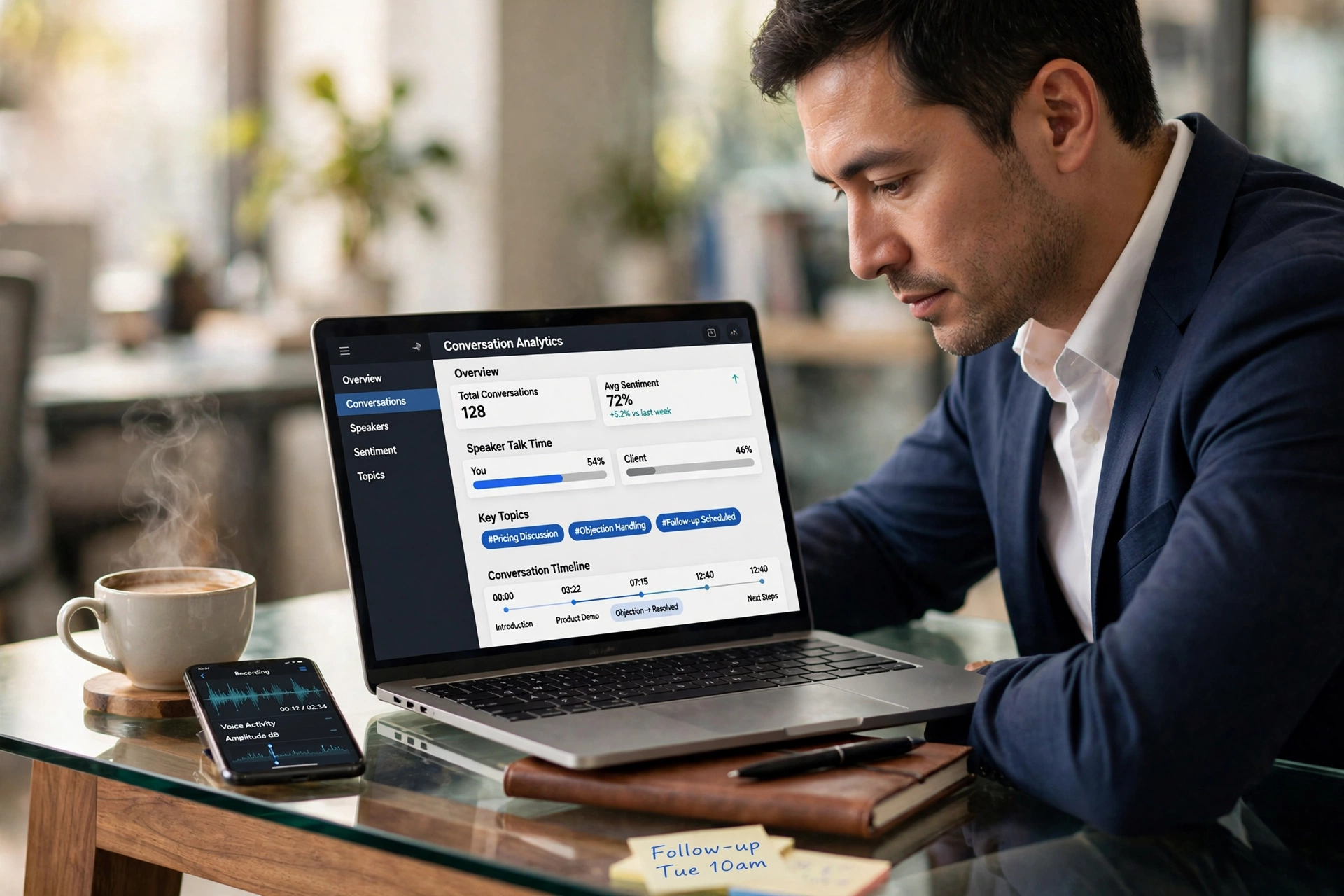
Conversation analytics software is not merely a recording tool; it is a quantitative engine designed to extract meaning from unstructured data. While traditional call recording tells you what happened, analytics software tells you why it happened and how to replicate the success. It employs advanced artificial intelligence to identify patterns, such as talk-to-listen ratios, keyword frequency, and sentiment shifts, allowing leadership to see a macro view of the entire sales organization's performance in real-time.
In my experience building high-growth systems at BizAI Intelligence, I've seen that the most successful firms don't just look for keywords; they look for "intent markers." For example, when a prospect mentions a specific budget constraint or a competitor's name, the software flags this as a high-intent signal. This allows the AI to score the lead based on the actual conversation rather than just the form they filled out on the website. By integrating these tools with AI search engine optimization & GEO, companies can align what customers are searching for on Google Search with the exact language they use during discovery calls.
Why Conversation Analytics Software Matters for B2B Growth
The primary reason conversation analytics software is essential for 2026 growth is the elimination of "information decay." When a sales rep summarizes a call in a CRM, they subconsciously filter out the nuances, objections, and emotional cues that actually drive a deal. According to research by Gartner, organizations that leverage AI-driven conversation insights see a significant increase in win rates because they can pivot their strategy based on objective data rather than rep intuition.
First, it solves the coaching bottleneck. In a traditional environment, a manager might listen to 2% of their team's calls. With analytics software, they can scan 100% of the calls for specific "red flag" phrases. This shifts management from reactive (fixing a mistake after the deal is lost) to proactive (intervening while the deal is still salvageable). When we implemented similar logic into the BizAI Intelligence agent architecture, we found that identifying objections within the first five minutes of a call increases the probability of closing by nearly 20%.
Second, it provides a direct feedback loop for product and marketing teams. Instead of guessing which features users want, marketing teams can analyze the exact phrases prospects use to describe their pain points. This creates a synergy with content marketing, where the high-converting language from sales calls is repurposed into programmatic SEO pages that attract more organic traffic. As the Forrester research on AI adoption notes, the integration of conversational data into the broader marketing stack reduces customer acquisition costs by streamlining the messaging-to-market fit.
Third, it ensures absolute compliance and quality control. For high-ticket B2B services, a single misstatement about a contract or a legal promise can lead to massive liabilities. Analytics software provides an automated audit trail, ensuring every rep adheres to the brand's value proposition and legal guidelines. This level of oversight is fundamental for any enterprise scaling through AI SDRs and autonomous sales appointment setters, where the AI must be continuously tuned based on the successful outcomes of human-led conversations.
How to Implement Conversation Analytics Software Effectively
Implementing these tools requires more than just plugging in an API; it requires a cultural shift in how your organization treats data. The first step is defining your "Golden Call"—the perfect interaction that leads to a closed-won deal. You must identify the specific markers of this call: Did the rep ask three open-ended questions? Was the talk-to-listen ratio 40/60? Did they handle the price objection using the specific framework you taught?
Once the Golden Call is defined, use the software to create a baseline. Map your current team's performance against this baseline to identify the specific gap. For example, if your top rep spends 60% of the call listening, but your bottom rep spends 80% of the call talking, you have a quantifiable coaching objective. This data-driven approach is far more effective than generic feedback like "try to engage the client more."
To maximize the ROI of your conversation analytics, integrate the output directly into your CRM via webhooks. When the software detects a "competitor mention," it should automatically trigger a task in your CRM for the rep to send a comparison PDF. This is exactly how we approach connecting AI sales agents to CRM and webhooks for auto-booking, ensuring that no insight goes unacted upon. If the data stays inside the analytics tool, it's just a report; if it moves into the CRM, it becomes a revenue driver.
Advanced Use Case: The Competitive Intelligence Loop
One of the most powerful ways to use this software is to build a real-time competitive intelligence map. By setting up alerts for every mention of a competitor, you can track how the market's perception of your rivals changes over time. If a competitor releases a new feature in 2026, you will see it reflected in your discovery calls weeks before it hits the mainstream press. This allows you to update your sales scripts and AI-powered lead generation tools instantly, ensuring your team is always one step ahead.
Conversation Analytics: Comparison of Approaches
Not all tools are created equal. Many businesses make the mistake of buying a tool that only offers transcription, thinking that "seeing the text" is enough. However, transcription is a commodity; the real value lies in the analytical layer that interprets that text.
| Feature | Traditional Recording | Generic AI Transcription | Modern Conversation Analytics |
|---|---|---|---|
| Insight Speed | Manual review (Days) | Fast text search (Hours) | Real-time alerts (Seconds) |
| Analysis Type | Subjective/Anecdotal | Keyword-based | Behavioral & Intent-based |
| Integration | Isolated silos | Basic CSV export | Deep CRM & Webhook Sync |
| Scaling | Non-scalable (1:1) | Linear (1:Many) | Exponential (Algorithmic) |
| Outcome | "I think we lost the deal" | "They mentioned price" | "Price objection occurred at 12min; 80% churn risk" |
As the table demonstrates, the move toward modern conversation analytics is a move toward predictability. Generic AI tools may provide a transcript, but they lack the business logic to tell you why a lead is stalling. Modern systems, like those we integrate at BizAI Intelligence, use contextual intelligence to score the conversation based on a predefined success framework, removing the guesswork from the sales process.
Common Mistakes to Avoid When Choosing Software
The most frequent error I see is "The Dashboard Trap." Companies buy expensive software and spend months building beautiful dashboards that no one actually looks at. Data for the sake of data is a waste of resources. If your analytics software doesn't lead to a specific action—such as a change in the sales script or a targeted coaching session—it is overhead, not an investment. Every metric you track must be tied to a KPI that affects the bottom line.
Another mistake is ignoring the "Human Element." Some managers use conversation analytics as a surveillance tool rather than a coaching tool. When reps feel they are being "spied on," they become rigid and robotic on calls, which actually kills the rapport necessary to close high-ticket B2B deals. The software should be positioned as a tool for empowerment. I've found that when you show a rep a clip of themselves handling an objection perfectly, their confidence skyrockets, and they naturally replicate that behavior in future calls.
Finally, avoid the "Silo Mistake." Many firms keep their conversation data separate from their organic growth data. In 2026, the most successful companies are those that use a unified data loop. They use programmatic SEO case studies to see what attracts traffic, and then use conversation analytics to see if those specific visitors actually convert into high-quality leads. If you are bringing in 10,000 visitors via a specific keyword but conversation analytics shows they all have the same fundamental misunderstanding of your product, you don't have a sales problem—you have a messaging problem on your website.
Frequently Asked Questions
Does conversation analytics software replace the need for sales managers?
No, it fundamentally changes the role of the sales manager from a "reporter" to a "coach." Instead of spending hours listening to random recordings to find a problem, the manager now spends their time solving the problems the software has already identified. It allows one manager to effectively oversee a much larger team without a drop in quality, as they can focus their energy only on the interactions that require human intervention or strategic correction.
Is the software compatible with all communication channels?
Modern enterprise-grade options are designed to be omnichannel. They integrate not only with Zoom, Google Meet, and Microsoft Teams but also with phone systems (VoIP) and even written channels like Slack or LinkedIn messages. This creates a unified "customer journey map," allowing you to see how a prospect's sentiment evolved from the first LinkedIn message to the final closing call, providing a holistic view of the buyer's psychological state.
How does this impact data privacy and GDPR compliance?
Compliance is a primary concern in 2026. Top-tier software includes automated PII (Personally Identifiable Information) redaction, which scrubs credit card numbers, passwords, or private addresses from transcripts in real-time. According to the guidelines set by the International Association of Privacy Professionals, transparency is key; therefore, most systems include automated notifications to participants that the call is being analyzed for quality assurance, ensuring legal compliance across different jurisdictions.
Can this software actually predict if a deal will close?
While it cannot "predict the future" with 100% certainty, it can calculate the probability of closing based on historical patterns. By analyzing a thousand closed-won deals, the AI identifies the common denominators—such as the specific questions asked or the level of prospect engagement. If a current deal lacks those markers, the software flags it as "at risk," allowing the rep to adjust their strategy before the prospect goes silent.
What is the typical ROI timeline for these tools?
Most B2B firms see a measurable impact within 90 days. The first 30 days are spent on integration and baseline setting. The next 60 days focus on eliminating common mistakes in the sales script. By the end of the first quarter, the ROI typically manifests as a decrease in the sales cycle length and an increase in the average deal size, as reps become more adept at uncovering the high-value pain points that justify a premium price.
Conclusion
Conversation analytics software is the bridge between intuitive selling and scientific scaling. In an era where buyers are more informed and skeptical than ever, relying on "gut feeling" is a dangerous strategy. By turning every interaction into a searchable, quantifiable data point, you stop guessing why deals are falling through and start knowing exactly how to win them. Whether you are optimizing your internal team or deploying AI appointment setters for B2B, the data from your conversations is your most valuable asset.
If you want to stop renting traffic and start building a compounding revenue machine, the first step is mastering the data within your pipeline. For a deeper dive into how this fits into a total organic growth strategy, check out our Ultimate Guide to Conversation Intelligence for Sales.
To implement a system that scales your organic reach and automatically qualifies your leads using the same level of intelligence, visit BizAI Intelligence.
AI Search Accelerator: 1-on-1 Strategy Session
Claim one of the 10 monthly slots. Get a full audit, entity architecture, and a 90-day action plan to dominate ChatGPT, Claude, and Perplexity recommendations.