📖This article is part of the complete guide to Ultimate Guide to Conversation Intelligence for Sales.
I have spent the last decade building scalable distributed platforms, and if there is one thing I have learned, it is that most B2B companies buy software based on a polished demo rather than a technical architecture that can actually scale. When it comes to choosing conversation intelligence software, the gap between a 'nice-to-have' recording tool and a revenue-driving engine is massive. In my experience working with high-ticket B2B firms, the mistake I see most often is treating this software as a digital filing cabinet for calls instead of a real-time data source for market intelligence.
For a comprehensive overview of the landscape, explore our Ultimate Guide to Conversation Intelligence for Sales.
What Exactly Should You Look for When Choosing Conversation Intelligence Software?
📚
Definition
Choosing conversation intelligence software is the process of selecting an AI-driven platform that records, transcribes, and analyzes verbal interactions between sales reps and prospects to extract behavioral patterns and buyer intent.
When you are choosing conversation intelligence software, you are not just buying a transcription service; you are investing in a Large Language Model (LLM) layer that sits on top of your sales process. The goal is to move from subjective anecdotal evidence ("I think the client liked the price") to objective data ("The client mentioned pricing 4 times and paused for 3 seconds after the quote"). To do this effectively, you need a system that integrates deeply with your existing tech stack, specifically your CRM, to ensure that the insights gathered from a call automatically update a lead's score or trigger a follow-up action.
In the current 2026 market, the baseline for these tools has shifted. It is no longer enough to have a search bar that finds keywords. You need software that understands sentiment, detects objections in real-time, and can summarize a 45-minute discovery call into three actionable bullet points. If the software requires your managers to manually listen to hours of tape to find the "golden nuggets," it isn't conversation intelligence; it is just a cloud recorder. Effective selection requires evaluating the software's ability to handle programmatic data extraction, allowing you to see trends across 1,000 calls as easily as you see them in one.

Why Choosing the Right Software Is Fundamental for B2B Growth
Selecting the wrong tool doesn't just result in a lost subscription fee; it creates a massive data debt. When you choose a tool with poor transcription accuracy or weak AI analysis, your sales managers spend more time correcting the AI's mistakes than they do coaching their reps. According to research from Gartner, organizations that implement AI-driven sales enablement tools see a significant increase in win rates because they can identify the exact "moment of truth" in a sales cycle where a deal is won or lost. By choosing the right software, you turn every single sales call into a training module for the rest of your team.
Furthermore, the ability to analyze buyer intent at scale is a competitive advantage. When you can identify that 70% of your lost deals in Q1 mentioned a specific competitor's new feature, you can pivot your product roadmap in real-time. This is where the intersection of AI conversation intelligence and strategic growth happens. Without the right tool, this insight is buried in the heads of your sales reps, who are often too busy to document every nuance of a failed call. A robust system extracts this data automatically, providing a direct line of sight from the customer's mouth to the executive's dashboard.
Consider the impact on onboarding. In my experience, the time it takes for a new sales rep to become fully productive is cut by nearly 30% when they have access to a library of "winning calls." Instead of guessing how to handle a complex objection, they can search for the exact moment a top performer handled that same objection. This transforms your sales organization from a collection of individual "stars" into a systematic, repeatable machine. If the software you choose doesn't make this discovery process frictionless, it is failing its primary purpose.
A Practical Framework for Choosing Conversation Intelligence Software
To avoid the demo-trap, you must implement a rigorous evaluation framework. Start by defining your primary objective: Is this for rep coaching, product feedback, or automated lead qualification? Once the goal is set, move through these technical requirements.
1. Integration Depth and CRM Synchronization
Your software must do more than "plug into" your CRM. It should bidirectionally sync. If the AI detects a "Budget Objection," that data point should automatically update a field in HubSpot or Salesforce. I've tested dozens of these integrations, and the ones that simply send a link to a recording are useless. You want a tool that pushes structured data, metadata about the call, into your CRM. This allows you to run reports on how often specific objections occur across your entire pipeline. For those looking to automate this further, understanding how to connect AI sales agents to CRM is the next logical step in scaling your acquisition.
2. Transcription Accuracy and LLM Sophistication
Not all transcriptions are equal. In a B2B environment, technical jargon, industry acronyms, and diverse accents can break a low-tier AI. You need to test the software with your actual call recordings. Check for "hallucinations" in the summaries. If the AI summarizes a client's concern as a compliment, your data is corrupted. Look for platforms that allow you to upload a custom dictionary of industry terms to improve accuracy. The sophistication of the underlying Large Language Model determines whether you get a generic summary or a strategic analysis of the buyer's psychological state.
3. Analytical Capabilities and Trend Tracking
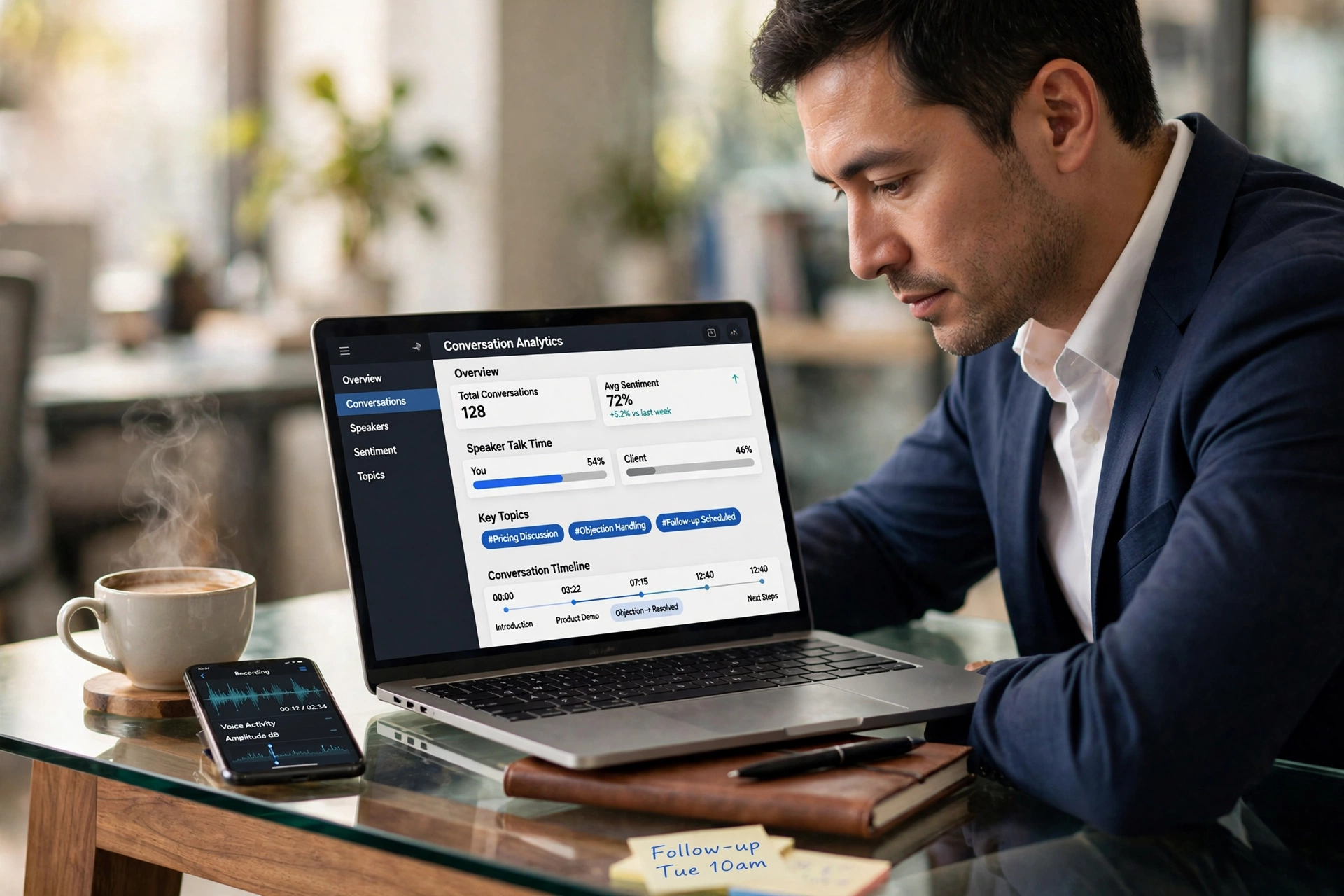
Can the software tell you the "talk-to-listen ratio" across your entire team? If your top performers listen 70% of the time while your struggling reps talk 70% of the time, you have a coaching goldmine. You should be looking for "Keyword Spotting" combined with "Sentiment Analysis." For example, spotting the word "pricing" is basic; spotting "pricing" coupled with a negative sentiment and a long silence is intelligence. This level of granularity is what separates the best conversation intelligence software for 2026 from the legacy tools.
4. User Experience and Adoption Friction
If the software is hard to use, your reps will find ways to avoid using it. The recording process must be invisible. It should automatically join Zoom, Teams, or Google Meet without requiring manual intervention. The interface for reviewing calls should be intuitive, allowing managers to jump to specific timestamps based on AI markers. If a manager has to spend ten minutes navigating the UI to find a three-minute clip, the tool will be abandoned within three months.
| Feature | Traditional Recording | Generic AI Tool | Modern Intelligence Engine |
|---|---|---|---|
| Data Extraction | Manual listening | Basic keyword search | Automated intent & sentiment analysis |
| CRM Workflow | Manual notes/links | One-way sync (links) | Bidirectional structured data sync |
| Coaching | Occasional ride-alongs | Random call reviews | Data-driven coaching based on patterns |
| Scaling | Linear (More reps = more time) | Moderate (Searchable) | Exponential (Pattern recognition at scale) |

Common Mistakes to Avoid When Selecting Your Tool
One of the most frequent errors I see is choosing a tool based on a "feature checklist" rather than a workflow analysis. Companies often check off "AI Summaries" and "CRM Integration" and assume they are set. However, if the AI summaries are too vague to be useful, the feature is a vanity metric. You must insist on a Proof of Concept (POC) using your own historical data. Upload ten of your hardest calls and see if the software identifies the same pain points that your best human manager found.
Another critical mistake is ignoring the security and compliance aspect. In 2026, with tightening global data privacy laws, how the software handles PII (Personally Identifiable Information) is non-negotiable. Does it have automatic redaction for credit card numbers or passwords mentioned on a call? Is the data encrypted at rest and in transit? If you are in a regulated industry like healthcare or finance, a tool that lacks enterprise-grade security is a liability, not an asset. This is why understanding the difference between GEO and traditional SEO is similar to software selection; you must look at the underlying architecture, not just the surface result.
Finally, avoid the "all-in-one" trap. Some platforms claim to do lead generation, CRM, and conversation intelligence in one. Usually, this means they are mediocre at all three. It is better to have a "best-of-breed" stack where your conversation intelligence tool excels at analysis and integrates seamlessly via API with your other systems. When you focus on a specialized tool, you get a higher level of technical rigor and faster updates to the AI models. For those optimizing their inbound flow, exploring AI SDR vs Human SDR ROI will show you why specialization in the AI layer is currently winning.
Frequently Asked Questions
How do I measure the ROI of conversation intelligence software?
ROI is measured by the increase in win rates and the reduction in ramp-up time for new hires. Specifically, look at the "conversion rate from discovery to demo." If the software helps you identify why deals are stalling at the discovery stage, and you fix that through coaching, the lift in conversion is your direct ROI. Additionally, calculate the hours saved by managers who no longer have to manually listen to calls to provide feedback. Most companies see a 15-20% increase in rep productivity within the first six months of a proper implementation.
Does conversation intelligence replace the need for sales managers?
Absolutely not. Instead, it evolves the role of the manager from a "monitor" to a "coach." Instead of spending their day listening to random calls to see what happened, managers spend their day analyzing patterns. They move from asking "What happened on this call?" to "Why is the team struggling with this specific objection across all calls this week?" It provides the evidence needed for high-impact coaching, making the manager's time significantly more valuable and their feedback far more objective.
How does this software handle different languages and accents?
Modern platforms use advanced neural networks and LLMs that are trained on global datasets. The best tools offer "Language Detection" and "Custom Lexicons." This allows the software to recognize industry-specific terminology that might sound like something else to a generic AI. When choosing, ensure the provider supports the specific dialects and languages your customers use, and test the transcription accuracy with a sample from your most diverse market to ensure there is no significant drop in quality.
Is it ethical to record every sales call?
Ethics and legality are two different things, but both are vital. Legally, you must comply with one-party or all-party consent laws depending on the jurisdiction. Ethically, transparency is the best policy. Informing the prospect that the call is being recorded for quality and training purposes is standard practice in 2026. Most buyers actually appreciate it because it ensures the rep is paying attention and that the notes from the call are accurate, preventing the "I already told you this" frustration in subsequent meetings.
Which is better: a standalone tool or a CRM-native feature?
Standalone tools almost always win on depth of analysis. CRM-native features are great for basic recording, but they rarely have the sophisticated LLM layers required for deep sentiment analysis or cross-call trend tracking. If you are a small business with very few calls, a native feature might suffice. However, if you are scaling a B2B organization, a dedicated tool allows you to implement sales conversation intelligence strategies that a basic CRM plugin simply cannot support.
Conclusion
Choosing conversation intelligence software is not a procurement task; it is a strategic decision about how your company will capture and utilize its most valuable data: the voice of the customer. By focusing on integration depth, LLM sophistication, and a rigorous POC, you can avoid the common pitfalls of vanity features and data silos. Remember that the goal is to create a feedback loop where every call improves the next one, effectively turning your sales team into a compounding intelligence engine.
If you are ready to stop guessing why your deals are stalling and start using data to drive your revenue, it is time to move beyond basic recording. For a deep dive into the frameworks and technologies driving this shift, revisit our Ultimate Guide to Conversation Intelligence for Sales.
To take your organic growth and lead capture to the next level, explore how BizAI Intelligence can help you build an autonomous inbound machine that qualifies leads while you sleep.
Only 12 Onboarding Slots Remaining This Month
BizAI deploys 300 AI salespeople scoring purchase intent 24/7. Get your free niche domination blueprint.
AI Search Accelerator: 1-on-1 Strategy Session
Claim one of the 10 monthly slots. Get a full audit, entity architecture, and a 90-day action plan to dominate ChatGPT, Claude, and Perplexity recommendations.