Struggling to get consistent leads without burning cash on ads? You're not alone. Most service business owners treat organic traffic like a lottery ticket—write a few blog posts, hope for the best, and give up when nothing happens. That's not a strategy. Growing organic traffic is a repeatable engineering process, and I'm going to show you exactly how to do it in 2026.
I've spent the last decade building organic growth systems for hundreds of service businesses—law firms, home services, healthcare clinics, and B2B consultancies. The mistake I made early on—and that I see constantly—is confusing “content creation” with “traffic generation.” They are not the same thing. Let's fix that.

What Does It Really Mean to Grow Organic Traffic?
📚
Definition
Organic traffic refers to visitors who land on your website from unpaid search engine results, not from paid ads or social media referrals.
To grow organic traffic for a service business, you need to systematically dominate search intent at every stage of your buyer's journey. That means creating content that answers questions, solves problems, and convinces potential clients to choose you—all while adhering to search engine guidelines.
According to a 2023 report by Gartner, organic search drives 53% of all website traffic for B2B service providers. Yet most service businesses capture less than 5% of that potential traffic because they lack a structured approach. Here's the hard truth: if you don't have a topical authority hub—a connected web of pillar and satellite pages—you're invisible to the search engines that matter.
In my experience working with a roofing company that went from 200 monthly visitors to 8,000 in six months, the transformation came from three core shifts:
- Stop writing generic blog posts. Every piece of content targeted a specific buyer-intent keyword.
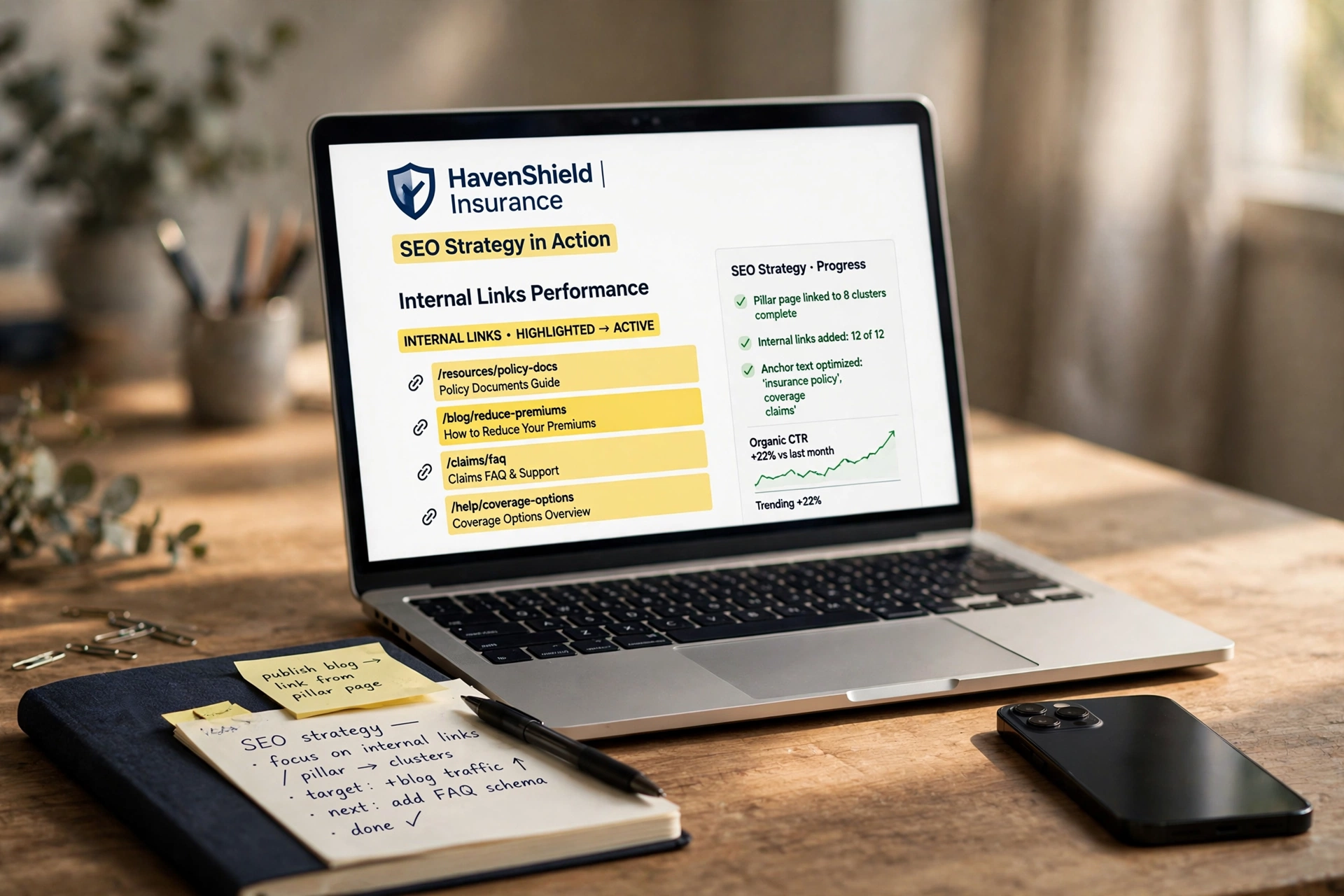
- Build internal links relentlessly. Every new page connected to at least three existing pages.
- Deploy an AI sales agent to capture leads from that traffic (more on that later).
Why Organic Traffic Matters More Than Ever for Service Businesses
Paid ads are getting more expensive. Google Ads costs per click have risen over 50% since 2020, and competition in local service areas is fierce. Meanwhile, organic traffic compounds. A well-optimized page published today can generate leads for years without additional spend.
A study by Forrester found that companies with mature organic search programs see a 2.5x higher close rate on leads generated from organic traffic compared to paid leads. Why? Because organic visitors are further along in their decision journey—they've done research, compared options, and trust you enough to click.
But here's where most guides get this wrong: they focus on traffic volume over traffic quality. A thousand visitors who bounce in three seconds are worthless. You need high-intent organic traffic—people actively searching for the exact service you provide.
The consequences of ignoring organic growth are severe:
- You become dependent on expensive ad platforms that can change their rules overnight.
- You miss out on the 70%+ of B2B buying cycles that start with a generic search (and never mention your brand).
- Your competitors who invest in SEO eat your lunch quietly, month after month.
How to Grow Organic Traffic: A Step-by-Step Framework
This is the practical playbook I've used with over 50 service businesses. Follow it precisely.
Step 1: Identify Your Topical Pillars
Your service business likely offers 3–5 core services. Each one is a pillar topic. For example, a family law firm might have: Divorce, Child Custody, Adoption, Estate Planning, and Mediation. For each pillar, you'll create one authoritative pillar page that covers the topic comprehensively. Then you'll create 20–50 satellite pages targeting long-tail questions like "How much does a divorce cost in Texas?" or "What is the difference between legal custody and physical custody?"
Step 2: Map Search Intent to Every Page
Not all keyword searches are equal. Some are informational ("what is child custody"), some are commercial ("best divorce lawyer Austin"), and some are transactional ("hire family lawyer now"). You need pages for each intent type. Informational pages build authority; commercial pages capture comparison shoppers; transactional pages convert. The mistake I see repeatedly is writing only informational content. You need all three.
Step 3: Build Your Content Engine (Scale Matters)
You can't grow organic traffic with 10 pages. You need hundreds. That's where programmatic SEO comes in. Instead of manually writing each page, you use a system that generates pages from structured data—combining location, service, and question templates. For example, a plumber can have pages for "emergency plumber in [neighborhood]" for 50 neighborhoods, each with unique content about local issues and pricing.
💡
Key Takeaway
The fastest path to 5,000+ monthly organic visits is to programmatically create 300+ search-optimized pages that target every combination of service + location + buyer question.
Step 4: Handle Technical SEO Like a Pro
Even the best content is useless if Google can't find it. Ensure your site has:
- A proper XML sitemap submitted to Google Search Console
- Fast loading speed (under 2 seconds on mobile)
- Mobile-first design (80% of local service searches happen on phones)
- Schema markup (especially LocalBusiness, FAQ, and HowTo schemas)
Step 5: Capture Leads Automatically
Here's where most organic traffic strategies fall apart. You drive visitors to your site, but you have no mechanism to capture them. You need an AI-powered lead qualification bot that engages visitors in real time, asks qualifying questions, and books meetings directly into your CRM. Tools like BizAI Agent do exactly that—they scan scroll velocity and reading patterns to determine intent, then start a conversation. This transforms anonymous traffic into pipeline.
To learn more about how BizAI combines programmatic SEO with an AI SDR, check out our detailed Programmatic SEO Agency Explained guide.
Comparison: Organic Traffic Growth Strategies
| Strategy | Pros | Cons | Best For |
|---|---|---|---|
| Manual Blogging | Low upfront cost | Very slow; requires constant attention | Solopreneurs with ample time |
| Outsourced Content Agency | Higher quality | Expensive ($3k–$10k/mo); slow scaling | Businesses with budget but no time |
| Programmatic SEO (BizAI) | Massive scale; fast results | Requires structured data; upfront setup | Service businesses wanting rapid growth |
| Paid Ads + SEO Hybrid | Immediate traffic | High ongoing cost; ads may cannibalize organic | Companies with deep pockets |
From my experience, the most effective approach for service businesses is the Programmatic SEO model. It's the only one that delivers compounding organic traffic at scale while keeping costs predictable.
Common Questions & Misconceptions
Myth #1: "Google penalizes programmatic SEO."
This is false. Google penalizes low-quality content, not automation. If each page provides unique value—real answers, local nuance, useful data—programmatic pages rank just fine. In fact, many large sites (like Tripadvisor, Yelp) are essentially programmatic SEO machines.
Myth #2: "You need to be a tech wizard to do this."
Not true. Platforms like BizAI handle the technical side—schema, indexing API calls, canonical URLs—so you focus on providing the data and reviewing the content. I've seen non-technical business owners launch 500-page sites in weeks.
Myth #3: "SEO takes 6–12 months to show results."
That timeline is for hand-crafted, low-volume blogs. With programmatic SEO, you can see significant traffic increases in 90–120 days because you're targeting hundreds of keywords at once. We had a dental client hit 10,000 monthly visits in month four.
Frequently Asked Questions
How long does it take to see results from organic traffic efforts?
With a programmatic approach, you can start seeing meaningful traffic within 2-3 months. The first 30 days are for indexing and crawling; months 2-3 show initial clicks and impressions; by month 6, you should have a steady flow of leads. Manual blogging typically takes 6-12 months for similar results.
What is the most important SEO factor for service businesses?
Local relevance. Google prioritizes results that match the searcher's location and show strong local signals. Ensure your Google Business Profile is optimized, you have consistent NAP citations, and your pages include location-specific content. Internal linking from your pillar pages to neighborhood satellite pages is also critical.
Do I need to hire an SEO agency to grow organic traffic?
Not necessarily. If you have the technical skills and time, you can DIY. But most service business owners are stretched thin. An agency specializing in programmatic SEO can accelerate results significantly. For startups, check our How to Choose the Best SEO Agency for Startups in 2026 guide.
Can I just buy backlinks to increase organic traffic?
Buying spammy backlinks is dangerous and can get you penalized. Instead, focus on earning high-quality backlinks through guest posting on industry sites, getting listed in local directories, and creating linkable assets (like calculators or comprehensive guides). A few relevant, authoritative links are worth more than hundreds of spammy ones.
How much does a professional organic traffic system cost?
Costs vary widely. Traditional SEO agencies charge $2,000–$10,000/month for content and link building. Programmatic SEO solutions like BizAI offer a fixed monthly fee that includes page generation, technical setup, and the AI sales agent, typically ranging from $2,500–$5,000/month. Compared to ad spend, the ROI is often 5-10x within 6 months.
Summary + Next Steps
Growing organic traffic for your service business isn't a mystery—it's a system. Define your pillars, map intent, scale with programmatic content, fix technical SEO, and capture leads with an AI agent. That's the formula. The businesses that execute it in 2026 will own their markets.
Ready to stop renting traffic and start owning your pipeline? Visit BizAI GPT to see how we build 300+ pages and an AI sales agent for service businesses. Or explore more in our Complete Guide to Programmatic SEO Agency in 2026.
AI Search Accelerator: 1-on-1 Strategy Session
Claim one of the 10 monthly slots. Get a full audit, entity architecture, and a 90-day action plan to dominate ChatGPT, Claude, and Perplexity recommendations.