📖This article is part of the complete guide to Ultimate Guide to Conversation Intelligence for Sales.
In my experience working with high-ticket B2B sales teams, the difference between a top-performing rep and a struggling one isn't usually talent, it's the lack of measurable data from their actual conversations. Most managers rely on anecdotal evidence from a few call recordings, but the real growth happens when you transition to hard conversation intelligence benchmarks. When we integrated these metrics at BizAI Intelligence, we found that shifting the talk-to-listen ratio by just 10% in favor of the customer led to a measurable spike in appointment setting success.
For a comprehensive overview, explore our Ultimate Guide to Conversation Intelligence for Sales.
What are Conversation Intelligence Benchmarks?
📚
Definition
Conversation Intelligence Benchmarks are standardized quantitative metrics derived from the analysis of sales interactions via AI, used to measure the effectiveness of a sales team against industry averages or internal historical performance.
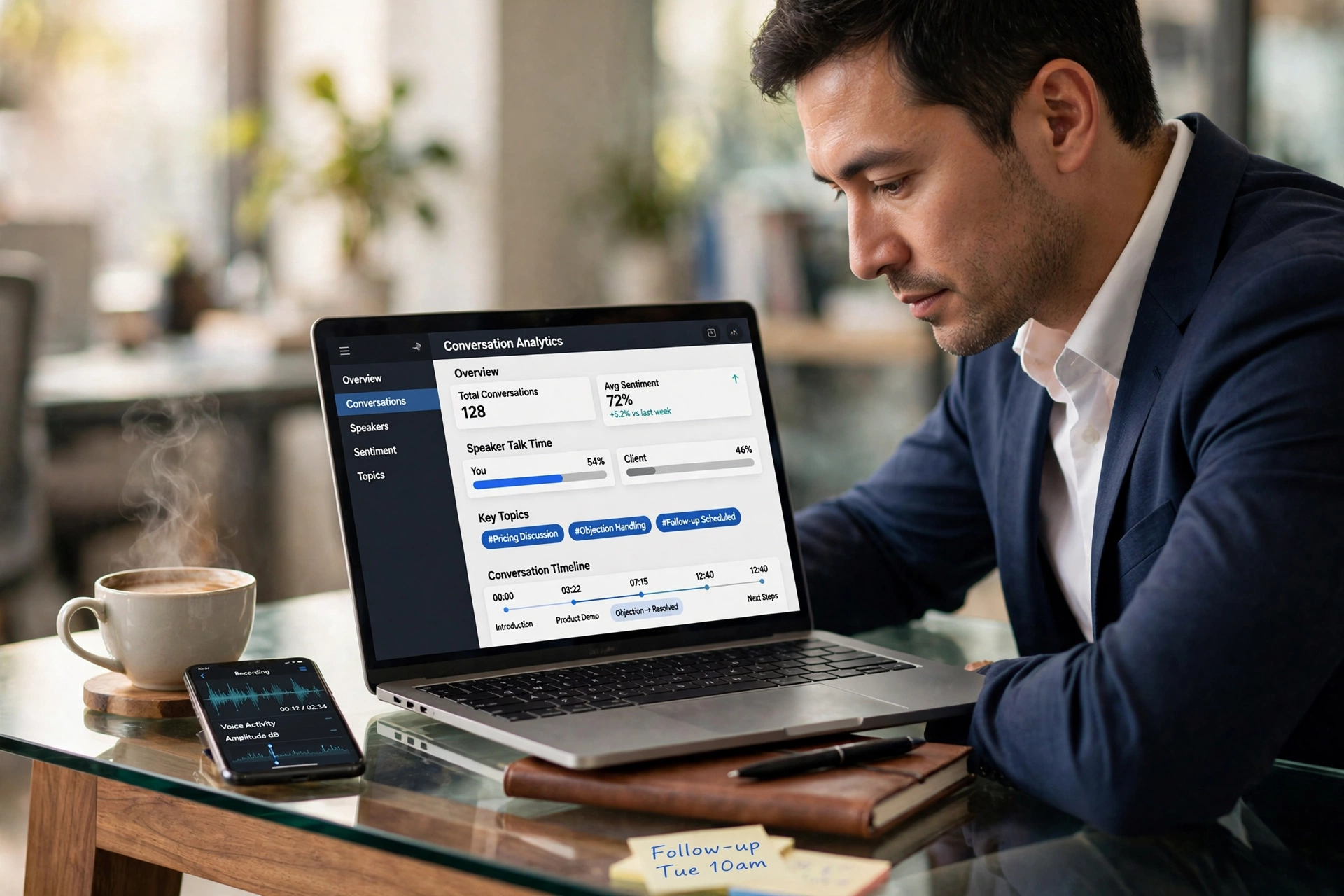
Conversation intelligence benchmarks represent the transition from qualitative "gut feeling" management to quantitative revenue operations. Instead of wondering if a salesperson is "building rapport," AI analyzes thousands of hours of audio to identify the specific linguistic patterns that correlate with closed-won deals. These benchmarks typically track variables such as talk-to-listen ratios, keyword frequency, sentiment analysis, and question-to-statement ratios.
When you apply these benchmarks, you are essentially creating a blueprint of your "Perfect Call." By analyzing the commonalities among your top 5% of closers, you can establish a baseline for what a successful interaction looks like in 2026. For instance, if your top performers consistently ask 8-12 discovery questions before presenting a price, that becomes your benchmark. Any rep asking only 2 questions is immediately flagged for coaching.
This data-driven approach allows companies to move beyond the generic training of the past. Rather than telling a rep to "listen more," a manager can provide a specific metric: "Your talk ratio is 75%, but our benchmark for winning deals is 45%. You are talking 30% too much during the discovery phase."

Why Do These Benchmarks Matter for Your Business Growth?
Establishing conversation intelligence benchmarks is essential because it eliminates the "black box" of the sales process. In a traditional environment, a manager only knows a deal was lost after the rep reports it. With AI-powered benchmarks, the manager knows the deal was likely lost the moment the rep failed to mention a key value proposition or let the customer dominate the conversation with 90% of the talk time.
According to research by the Sales Enablement Collective, organizations that implement data-driven coaching based on conversation benchmarks see an average increase in quota attainment of 15% to 20%. This happens because coaching becomes surgical. You are no longer guessing where the leak is in your pipeline; you are seeing the exact moment the lead lost interest based on sentiment shifts detected by the AI.
Furthermore, these benchmarks are the foundation for scaling a B2B organization. When you hire ten new reps, you cannot wait six months to see if they "get it." By comparing their early calls against your established benchmarks, you can identify performance gaps in week one. If the new hire is failing to use the benchmarked "objection handling" keywords, you can correct the behavior immediately.
In the context of modern acquisition, these insights feed directly into your overall strategy. For example, if your benchmarks show that leads coming from specific organic channels have a higher sentiment score during the first call, you can double down on those channels. This synergy is why many firms are now integrating AI lead generation tools to ensure the top-of-funnel quality matches the benchmarked expectations of the sales team.
How to Implement Conversation Intelligence KPIs Step-by-Step
Implementing a benchmark system requires a move from observation to orchestration. You cannot simply turn on a tool and expect the data to tell you how to run your business; you must define the targets first.
Step 1: Define Your "Golden Profile"
Start by isolating your top three performers. Analyze their last 50 closed-won calls. Look for the common denominators. Do they spend more time on the problem or the solution? How many times do they mention the competitor? This becomes your initial benchmark. If the top 3% of your team uses a specific framework (like SPIN or MEDDIC), use the AI to track the occurrence of those specific markers.
Step 2: Establish the Talk-to-Listen Ratio
One of the most critical benchmarks in B2B sales is the talk-to-listen ratio. In a high-converting discovery call, the rep should ideally occupy 30-45% of the airtime. If a rep is talking 70% of the time, they are pitching, not selling. Use your software to set a hard benchmark for this ratio. If a call exceeds 60% rep talk-time, it should be flagged as a "pitch-heavy" call for review.
Step 3: Track Question Volume and Type
High-performing sales cycles are driven by curiosity. Establish a benchmark for the number of open-ended questions asked per call. According to the Gong.io data archives, a high correlation exists between the number of discovery questions asked and the probability of a deal moving to the proposal stage. Set a target, for example, a minimum of 7 qualifying questions per first call.
Step 4: Monitor Sentiment Shift
Sentiment analysis allows you to track the emotional trajectory of a call. A winning call usually starts with neutral or slightly negative sentiment (the customer's pain) and ends with positive sentiment (the solution). If a call ends on a neutral or negative note, it fails the sentiment benchmark, regardless of whether the rep hit their talking points. This is where AI-powered conversation intelligence becomes a superpower, as it can detect subtle tonal shifts that a human manager would miss.
Step 5: Iterate and Update Quarterly
Benchmarks are not static. As your product evolves or the market shifts in 2026, the "perfect call" will change. Review your benchmarks every 90 days. If you find that your closing rate is dropping despite reps hitting the old benchmarks, it means the market's needs have shifted, and you need to redefine what a successful conversation looks like.
💡
Key Takeaway
The goal of benchmarking is not to turn sales reps into robots, but to provide a scientific baseline that proves what actually works, allowing the rep to apply their own personality over a proven structure.
Comparing Approaches to Sales Performance Tracking
To understand the value of conversation intelligence, we must compare it to the legacy methods most companies still use. The gap in efficiency is staggering.
| Metric | Traditional Management | Generic AI Transcription | BizAI Intelligence Approach |
|---|---|---|---|
| Feedback Loop | Weekly 1-on-1s based on memory | Raw text transcripts | Real-time KPI alerts & benchmarks |
| Accuracy | Subjective and biased | High accuracy, low insight | Insight-driven behavioral mapping |
| Scalability | Limited by manager's time | Fast, but requires manual review | Automated at scale across 1000s of calls |
| Outcome | Inconsistent rep performance | Information overload | Predictable revenue growth |
As shown in the table, the generic approach gives you the "what" (the transcript), but the modern approach gives you the "why" (the benchmark deviation). When you use a system like Best B2B Sales Automation Software for Inbound Leads in 2026, you aren't just recording calls; you are optimizing the very DNA of your sales process.

Common Mistakes When Setting Benchmarks
One of the most frequent errors I see is the "Averaging Trap." Many managers take the average of all reps, including the bottom performers, and set that as the benchmark. This is a recipe for mediocrity. If you average a top performer and a failing rep, you get a benchmark that is "fine" but doesn't actually drive growth. Always benchmark against your top 10% of performers.
Another critical mistake is over-indexing on quantity over quality. Some managers set a benchmark for the number of times a specific product feature is mentioned. This leads to reps "keyword stuffing" their conversations just to hit the metric, which feels unnatural and often alienates the buyer. The benchmark should be the presence of the value proposition, not the frequency of the word.
Lastly, avoid the "Punishment Loop." If conversation benchmarks are used solely as a disciplinary tool, reps will find ways to game the system. They might steer the conversation in unnatural ways just to hit the talk-to-listen ratio. Benchmarks must be framed as a coaching tool for professional development. The focus should be on "How can we get your metrics to match the top performers?" rather than "Why are your metrics low?"
For those looking to scale this level of precision across thousands of pages and leads, understanding the PSEO Architecture Guide for SaaS & Enterprise B2B Growth is a great way to ensure the leads entering the funnel are already primed for the benchmarked conversations you've designed.
Deep Dive: The Correlation Between Sentiment and ROI
To truly master conversation intelligence, one must understand the nuance of sentiment analysis. Sentiment is not just "happy" or "sad"; it is the measure of intent and friction. In the B2B space, a high level of "positive' sentiment too early in a call can actually be a red flag. It often indicates a "polite no", where the customer is being agreeable but isn't actually committed to the solution.
In my experience, the most successful benchmarks track the transition of sentiment. The "Aha! Moment" in a sales call is marked by a shift from negative sentiment (complaining about a current problem) to a state of active curiosity (asking how the product works). If a call stays purely positive from start to finish, it usually lacks the tension required to drive a high-ticket purchase.
According to the Gartner Sales Research framework, the most effective sales conversations involve a period of "constructive tension," where the rep challenges the customer's current worldview. Benchmarking this tension, the moment the customer realizes their current process is costing them money, is the most accurate predictor of a closed-won deal in 2026.
This level of analysis is why integrating How to Automate Organic Traffic & Lead Capture with AI is so powerful. When your inbound traffic is generated by high-intent, programmatic content, the initial sentiment is already skewed toward "solution-seeking," making it much easier for your reps to hit their benchmarks and close deals faster.
Frequently Asked Questions
What is a good talk-to-listen ratio for B2B sales?
For most high-ticket B2B sales, the ideal talk-to-listen ratio is between 35% and 45% for the sales representative. When a rep exceeds 60%, they are typically pitching rather than diagnosing. The goal is to let the prospect provide the bulk of the information, which allows the rep to tailor their solution specifically to the pain points mentioned. High-performing reps use the remaining 55-65% of the time to ask powerful, open-ended questions that guide the prospect toward a realization of the product's value.
How do I set benchmarks for a new sales team?
If you don't have historical top performers, start by using industry standards for the first 30 days. Focus on basic hygiene metrics: talk-to-listen ratio, number of discovery questions, and the presence of a clear next-step agreement. After 30 days, identify the rep with the highest conversion rate and use their specific call patterns to create your first internal benchmark. This "internal gold standard" is far more effective than any generic industry average because it reflects your specific product and customer avatar.
Can AI benchmarks actually predict revenue?
Yes, when combined with pipeline data. By tagging calls that resulted in a "closed-won' deal and analyzing the benchmarks of those calls, you can create a "Probability Score" for every current deal in your pipeline. If a deal in your CRM has a rep talk-ratio of 80% and zero mentions of the customer's primary pain point, the AI can predict a high probability of loss, regardless of what the rep tells the manager. This allows leadership to intervene and coach the rep before the deal is officially lost.
What are the most important keywords to track in conversation intelligence?
While specific keywords vary by niche, you should always benchmark three categories: Pain-Point Keywords (e.g. "too expensive," "slow," "manual"), Value-Proposition Keywords (e.g. "automation," "ROI," "scalability"), and Commitment Keywords (e.g. "next steps," "pricing," "implementation"). The benchmark is not just the mention of the word, but the context. For example, a benchmark for a winning call should include the customer repeating your value-proposition keywords back to you, indicating they have internalized the benefit.
How often should conversation benchmarks be updated?
Benchmarks should be reviewed and updated quarterly. The B2B landscape in 2026 is volatile, and customer objections evolve quickly. A benchmark that worked in Q1 might be obsolete by Q3 if a new competitor enters the market or a new regulation changes how your customers operate. A quarterly "Benchmark Audit" allows you to analyze the most recent winning deals and adjust your talk-to-listen ratios or keyword requirements to stay aligned with current buyer psychology.
Conclusion
Moving from a subjective management style to one based on conversation intelligence benchmarks is the only way to build a predictable, scalable sales machine in 2026. When you stop guessing and start measuring the talk-to-listen ratio, sentiment shifts, and question volumes, you turn your sales process into a science. The data doesn't lie: the reps who listen more and ask better questions win more often. By implementing these KPIs, you can reduce ramp-up time for new hires and increase the overall closing rate of your entire organization.
If you want to dive deeper into the technology and strategies that make this possible, read our Ultimate Guide to Conversation Intelligence for Sales. Start turning your sales conversations into a measurable asset today.
For those looking to automate the entire inbound journey, from the first search to the final booked meeting, visit BizAI Intelligence.
Only 12 Onboarding Slots Remaining This Month
BizAI deploys 300 AI salespeople scoring purchase intent 24/7. Get your free niche domination blueprint.
AI Search Accelerator: 1-on-1 Strategy Session
Claim one of the 10 monthly slots. Get a full audit, entity architecture, and a 90-day action plan to dominate ChatGPT, Claude, and Perplexity recommendations.