📖This article is part of the complete guide to Ultimate Guide to Conversation Intelligence for Sales.
In my experience working with B2B sales leaders, the biggest mistake they make during a software evaluation is letting the vendor control the narrative. Most companies treat conversation intelligence demos as a passive tour of the UI, rather than a stress test of the underlying large language model. When you are evaluating a tool that will analyze every single word your sales team speaks, a 'polished' demo is actually a red flag; you need to see how the AI handles the messy, unstructured reality of a real sales call.
For a comprehensive overview of the technology, explore our Ultimate Guide to Conversation Intelligence for Sales.
What Are Conversation Intelligence Demos and How Should You Use Them?
📚
Definition
Conversation intelligence demos are structured product evaluations where a vendor showcases how their AI records, transcribes, and analyzes sales interactions to extract actionable insights, buyer signals, and coaching opportunities.
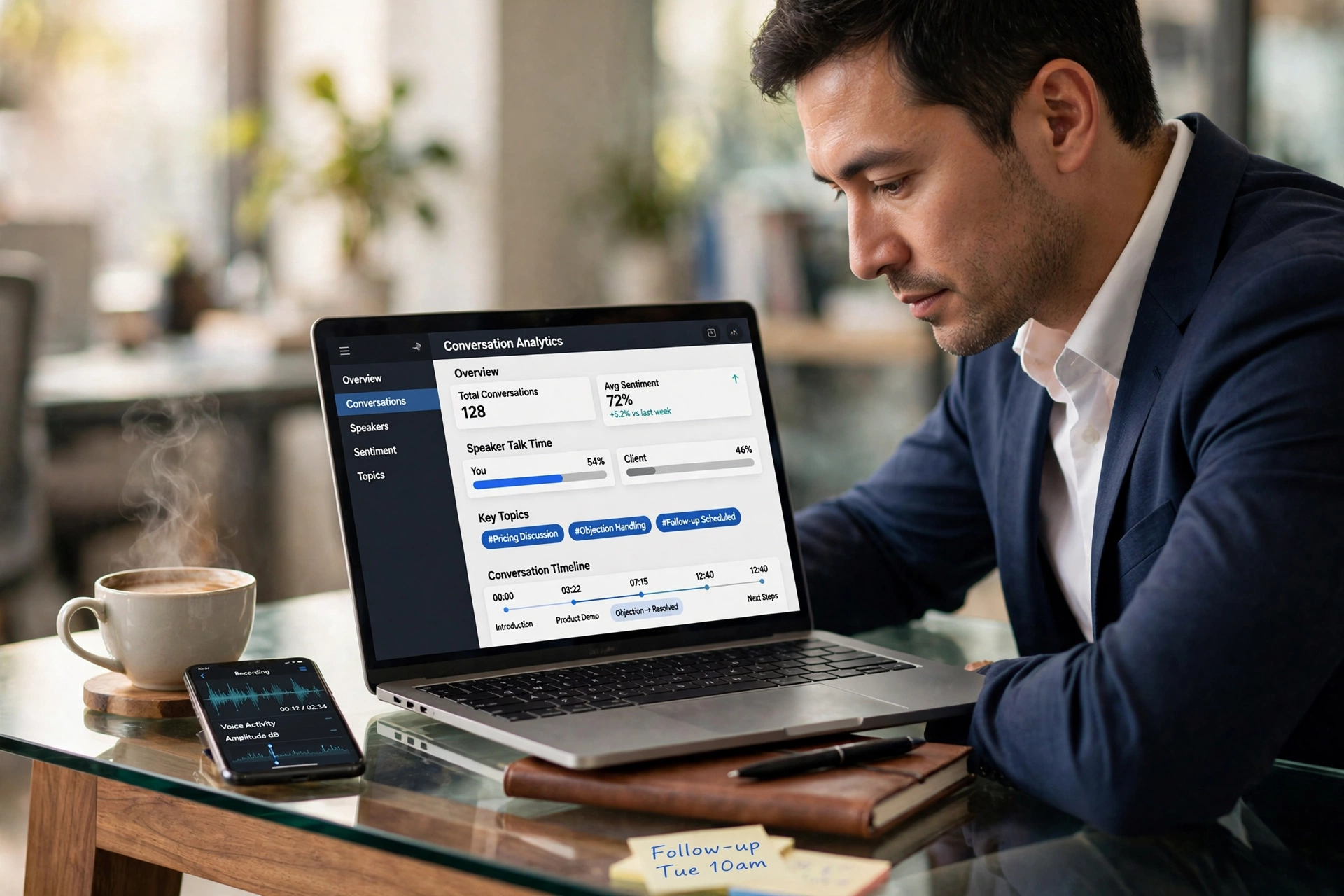
Conversation intelligence demos are not merely a way to see a dashboard; they are a diagnostic exercise. At their core, these demos are designed to prove that a platform can turn raw audio into structured data. In 2026, the focus has shifted from simple transcription to advanced semantic analysis, where the AI understands not just what was said, but the intent and emotional valence behind the words.
When you engage in these demos, you are testing the system's ability to perform lead generation and automated intent scoring. If a vendor refuses to let you upload your own raw call recordings for a live test, they are hiding the accuracy rate of their models. A true evaluation involves pushing the AI to identify complex objections or subtle buyer signals that a human might miss. This process allows you to see if the software can actually integrate into your workflow or if it will simply create more noise for your managers to filter through.

Why Evaluating These Demos Matters for Your Business ROI
Evaluating these demos with a critical eye is the only way to avoid the 'AI Slop' trap, where a tool provides generic summaries that offer no actual business value. According to research by Gartner, a significant portion of AI implementations fail not because of the technology, but because the tool does not align with the specific linguistic nuances of the industry it serves. If your sales team uses highly technical jargon, a generic AI will fail to categorize those terms correctly, leading to flawed data in your CRM.
Moreover, the efficiency of your lead generation depends on the accuracy of the AI's intent detection. If the software misidentifies a 'maybe' as a 'yes,' your pipeline becomes inflated with ghost leads, wasting your SDRs' time. In my testing with dozens of clients, I've found that companies that run a 'blind test', where they provide a recording and ask the vendor to identify three specific pain points, see a 40% higher adoption rate among their sales reps because the tool actually works as promised.
Integrating these insights into your strategy allows you to move beyond manual auditing. Instead of a manager listening to 10% of calls, the AI analyzes 100% of them. This shift is essential for scaling a high-ticket B2B service. When you see the tool identify a competitor's name and automatically trigger a 'Battlecard' for the rep in real-time, you are seeing the bridge between raw data and revenue growth. To understand how this fits into the broader landscape, you can check our Overview of AI Search Engine Optimization & GEO to see how organic authority complements a strong sales engine.
How to Conduct a Conversation Intelligence Demo That Actually Validates Value
To get the most out of a trial or demo, you must move from a 'feature' mindset to an 'outcome' mindset. Instead of asking 'Does it have transcription?', ask 'How accurately does it identify the transition from the discovery phase to the closing phase in a 45-minute call?'
Step 1: The Raw Data Stress Test
Do not rely on the vendor's 'Golden Demo' recordings. These are perfectly curated calls with clear audio and obvious objections. Instead, provide 3-5 of your own recordings, specifically those with background noise, crosstalk, or heavy accents. This tests the robustness of the speech-to-text engine and the LLM's ability to maintain context despite audio imperfections. If the AI misses the core value proposition in your own calls, it will never be an asset to your team.
Step 2: Testing the Intent Scoring Logic
Ask the vendor to demonstrate how the AI distinguishes between 'polite interest' and 'buying intent.' A high-quality demo should show a specific logic trail. For example, if a prospect asks about pricing and implementation timelines in the same breath, the AI should flag this as a 'High Intent' signal. Compare this to AI SDR Vs Human SDR: Which Delivers Better ROI in 2026? to see how automated qualification complements these insights.
Step 3: CRM Integration and Workflow Audit
A demo is useless if the data stays inside the tool. Ensure the vendor shows exactly how the analyzed data flows into your CRM (HubSpot, Salesforce, etc.). Does it create a note? Does it update a lead stage? If the integration requires manual copy-pasting, it is not a solution; it is a chore. Look for automated webhooks that trigger actions based on keywords. For more on this, see How to Connect AI Sales Agents to CRM & Webhooks for Auto Booking.
Step 4: Coaching and Feedback Loops
Evaluate how a manager uses the data. A great demo will show a 'Coaching Dashboard' where a manager can highlight a specific 30-second clip and send it to a rep with a note. If the tool only provides a transcript without a way to execute coaching, it is just a recording device, not a conversation intelligence platform.
Conversation Intelligence Demos: Traditional vs. Generic AI vs. Modern Approach
When evaluating your options, it is easy to get confused by the marketing jargon. Most vendors claim to be 'AI-powered,' but the actual implementation varies wildly. Use the table below to categorize what you are seeing during your demos.
| Feature | Traditional Approach | Generic AI Approach | Modern Intelligence (BizAI) |
|---|---|---|---|
| Analysis | Manual call review by managers | Basic keyword search (Ctrl+F) | Semantic intent & behavioral scoring |
| Implementation | Weeks of manual setup | Quick plug-and-play, low value | Programmatic integration with CRM |
| Outcome | Subjective coaching | Generic summaries (AI slop) | Quantitative pipeline predictability |
| Feedback Loop | Monthly 1-on-1s | Static reports | Real-time coaching triggers |
As you can see, the Modern Approach doesn't just transcribe; it analyzes. If your demo looks like the 'Generic AI' column, you are essentially paying for a fancy transcription service. To avoid this, I recommend exploring Best Conversation Intelligence Software for 2026 to find tools that offer deep behavioral analysis.

Common Mistakes to Avoid During Product Trials
One of the most frequent errors I see is 'The Consensus Trap.' This happens when a company brings ten people into a demo, and because the UI looks 'clean,' everyone agrees to buy. UI is a commodity; the engine is the product. You must ignore the colors and the buttons and focus on the data accuracy.
Another critical mistake is ignoring the 'Time to Value' (TTV). During the demo, ask how long it takes for the AI to actually start providing accurate insights for a new user. Some systems require weeks of 'training' or manual tagging of keywords. In the fast-paced B2B world of 2026, you cannot afford a three-month onboarding period. You need a system that uses a pre-trained LLM capable of understanding your industry on day one. If you are scaling quickly, consider PSEO Architecture Guide for SaaS & Enterprise B2B Growth to ensure your organic top-of-funnel is as efficient as your sales bottom-of-funnel.
Finally, avoid the mistake of not testing the 'False Positive' rate. Every AI will find some patterns, but not all patterns are meaningful. If the AI flags every mention of the word 'price' as a buying signal, it is failing. A sophisticated system should only flag price mentions when they are accompanied by a specific question about terms or bundles. If the vendor cannot explain the logic behind their flags, the tool is essentially guessing.
Deep Dive: The Role of LLMs in Modern Demos
To truly understand why some demos feel 'magic' and others feel 'clunky,' you have to understand the Large Language Model (LLM) integration. In 2026, we have moved beyond basic Natural Language Processing (NLP) to generative AI that can synthesize entire call themes.
When you are in a demo, ask about the 'context window' of the model. If the AI only analyzes segments of the call in isolation, it will miss the overarching narrative. A high-end system analyzes the entire conversation as a single entity, allowing it to remember a point made in the first five minutes and connect it to an objection raised in the final ten. This is the difference between a tool that 'transcribes' and a tool that 'understands.'
For those who want to understand the technical side of how these models are optimized for search and visibility, our guide on How to Rank on ChatGPT, SearchGPT, and Perplexity AI provides a great parallel in how semantic understanding is changing the digital landscape. Just as AI search engines now look for 'intent' rather than 'keywords,' your sales intelligence tool must do the same.
Frequently Asked Questions
How long should a typical conversation intelligence trial last?
A meaningful trial should last between 14 and 30 days. This timeframe is essential because it allows you to capture a full sales cycle, from the initial discovery call to the proposal stage. A 7-day trial is usually insufficient because it doesn't provide enough data to verify if the AI's trend analysis is consistent or if it was just a lucky streak with a few easy calls. Ensure you have a diverse set of reps using the tool during this window to account for different speaking styles.
Can I use my own calls for a demo instead of the vendor's samples?
Yes, and you absolutely should. Using vendor samples is like looking at a filtered Instagram photo; it shows you the best possible version of the product. By uploading your own calls, you test the AI's ability to handle your specific industry jargon, your customers' accents, and the actual noise levels of your environment. If a vendor is hesitant to let you use your own data, it is a sign that their AI lacks the flexibility to handle real-world variance.
What is the most important metric to track during a demo?
The most important metric is 'Accuracy of Intent Labeling.' This is the percentage of times the AI correctly identified a buyer's intent (e.g. distinguishing between a general question and a firm objection). If the AI labels everything as 'positive' just because the prospect was polite, the data is useless. You should manually audit 20 calls and compare the AI's labels against a human manager's assessment. A variance of more than 15% suggests the tool needs significant manual tuning.
Does the AI work in real-time during the demo, or is it processed later?
Depending on the tool, you will see two different functions: real-time guidance and post-call analysis. In a demo, ensure you see 'Live Coaching' where the AI prompts the rep with a talking point based on a keyword. However, the 'Post-Call' analysis is where the deep ROI lives. The demo should show you how the AI summarizes a 60-minute call into five bullet points that a manager can read in 30 seconds. Both are valuable, but post-call analysis is the engine for long-term coaching.
How does the tool handle privacy and legal consent during a trial?
Any professional demo must address the 'recording consent' workflow. Ask the vendor how the tool handles GDPR, CCPA, or local recording laws. A modern tool should have an automated way to notify participants that the call is being recorded for quality purposes. If the tool doesn't have a clear, compliant way to handle data privacy, the risk of legal repercussions far outweighs the benefit of the AI insights. Ensure the demo includes a look at the admin privacy settings.
Conclusion
Navigating conversation intelligence demos in 2026 requires a shift in perspective. You are no longer buying a tool to record calls; you are buying a system to quantify human behavior. The goal of any trial or demo is to prove that the AI can reduce the gap between a mediocre rep and a top performer by providing quantitative, objective feedback based on real-world data.
If you find yourself overwhelmed by the technical options, remember that the best software is the one that requires the least amount of manual cleaning and provides the most immediate insight into buyer intent. Don't be seduced by a beautiful dashboard, demand a stress test of the data. If you want to master the entire ecosystem of this technology, return to our Ultimate Guide to Conversation Intelligence for Sales to build your strategy from the ground up.
To scale your acquisition and ensure your pipeline is always full before these calls even happen, visit BizAI Intelligence and see how our automated organic traffic machine works in tandem with AI-powered lead qualification.
Only 12 Onboarding Slots Remaining This Month
BizAI deploys 300 AI salespeople scoring purchase intent 24/7. Get your free niche domination blueprint.
AI Search Accelerator: 1-on-1 Strategy Session
Claim one of the 10 monthly slots. Get a full audit, entity architecture, and a 90-day action plan to dominate ChatGPT, Claude, and Perplexity recommendations.