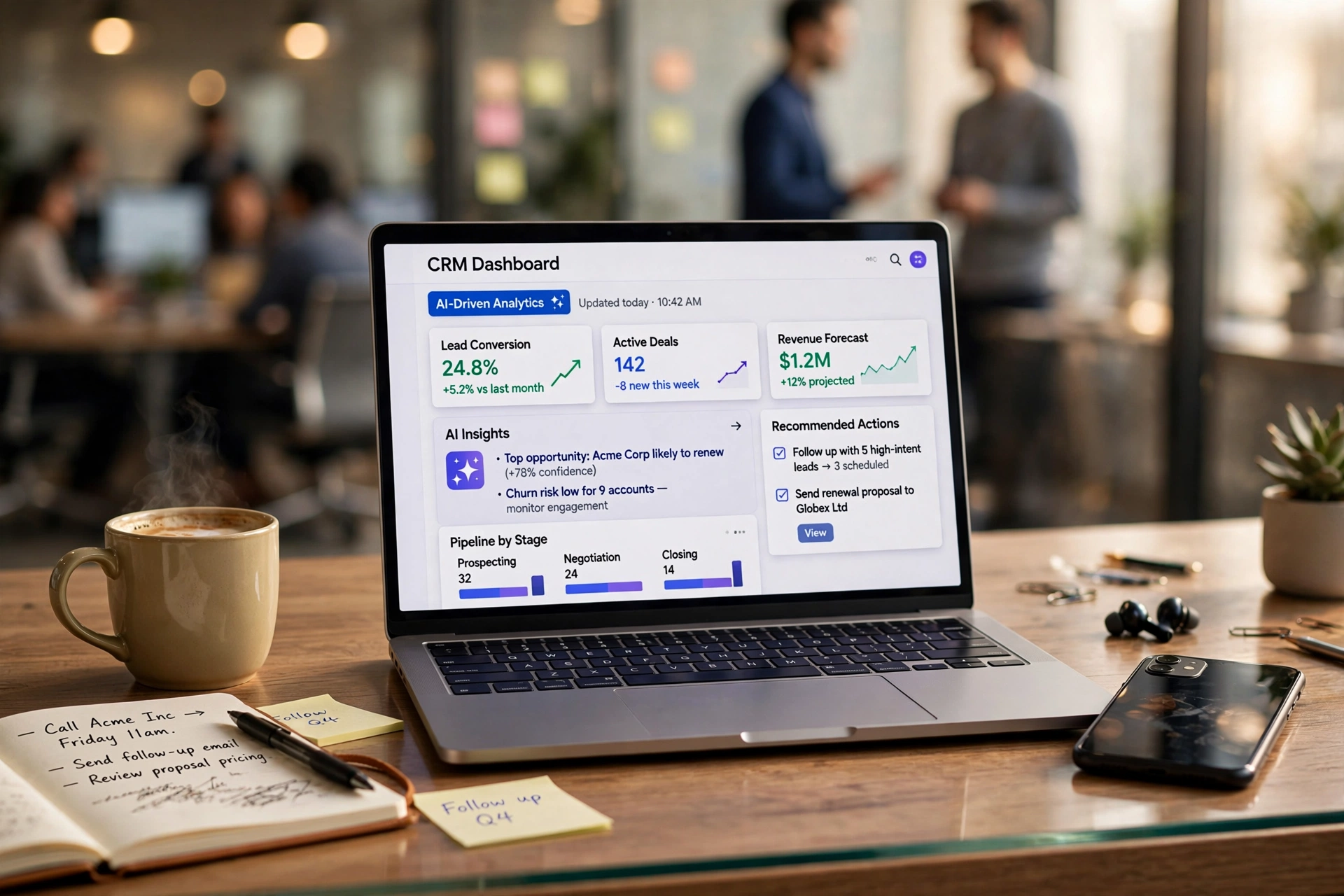
Most B2B sales teams are currently suffocating under a mountain of low-quality leads, spending 60% of their time on manual data entry rather than actual selling. In my experience working with high-ticket service providers, the bottleneck isn't a lack of leads; it's the inability to qualify them at scale without hiring an army of expensive SDRs. By 2026, the divide between market leaders and lagging companies will be defined by who has transitioned from a passive database to an active, intelligent acquisition engine.
For a comprehensive overview of how this technology transforms the entire sales cycle, explore our
guide on AI CRM.
📚Definition
CRM AI tools for lead generation are specialized software layers or native features within a Customer Relationship Management system that use artificial intelligence, machine learning, and natural language processing to identify, attract, and qualify potential buyers without manual intervention.
Unlike traditional CRMs, which act as digital filing cabinets for contact information, AI-driven tools transform the CRM into a proactive agent. They don't just store the lead; they predict the lead's likelihood to close based on historical patterns, intent data, and behavioral signals. When we implemented these systems at BizAI Intelligence, we found that the primary value isn't in the storage of data, but in the automation of the "first touch" and the "qualification screen."
These tools typically operate by analyzing massive datasets, including web browsing behavior, social signals, and email interactions, to score leads in real-time. This means a salesperson is notified only when a lead has reached a specific "intent threshold," effectively eliminating the guesswork associated with cold outreach. This shift is fundamentally powered by Large Language Models (LLMs) that can now handle complex, nuance-heavy conversations, making the transition from a simple chatbot to a sophisticated AI SDR possible.
The primary reason CRM AI tools are essential in 2026 is the collapse of the traditional linear sales funnel. Buyers now complete nearly 80% of their research before ever speaking to a sales representative. If your lead generation process relies on a human manually reviewing a form submission, you are losing the window of highest intent.
According to research from Gartner, organizations that integrate AI into their sales processes see a significant increase in lead conversion rates because they can respond to buyer signals in milliseconds rather than hours. In a high-ticket B2B environment, speed-to-lead is the most critical metric; a lead contacted within five minutes is 21 times more likely to qualify than one contacted after 30 minutes.
Beyond speed, these tools solve the "data decay" problem. Traditional CRMs are plagued by outdated information. Modern CRM AI tools utilize continuous web scraping and data enrichment to ensure that your sales team is working with current titles, company sizes, and funding statuses. This allows for hyper-personalized outreach that feels human but is executed by a machine.
Furthermore, the use of
AI lead scoring in CRM allows businesses to allocate their most expensive human resources, their top closers, only to the highest-probability deals. This optimization of human capital directly impacts the bottom line by reducing the Customer Acquisition Cost (CAC) while increasing the Lifetime Value (LTV) of the clients acquired.
Implementing AI tools for lead generation requires a shift from "collecting leads" to "engineering conversion paths." The goal is to create a frictionless loop where the AI finds the lead, qualifies them, and books the meeting directly into the calendar.
Step 1: Deploying Intelligent Capture Layers
Instead of static forms, use AI-powered conversational agents on your landing pages. These agents don't just ask for an email; they engage in a qualifying dialogue. For example, if a visitor asks about pricing, the AI can ask, "To give you an accurate estimate, may I ask how many users your team currently has?" This captures critical data points that would typically require a discovery call.
Step 2: Automated Lead Scoring and Routing
Once the data is captured, the CRM AI tool should automatically score the lead based on predefined ideal customer profile (ICP) markers. High-intent leads are routed immediately to a senior account executive, while low-intent leads are placed into an automated nurture sequence. For those looking to scale this process, understanding
how to integrate AI into your existing CRM is the first technical hurdle to clear.
Step 3: AI-Driven Personalized Outreach
Use AI to generate personalized outreach sequences based on the specific pain points identified during the capture phase. If the AI agent noted the lead is struggling with "scaling organic traffic," the follow-up email should explicitly reference that pain point, linking to a relevant case study. This is where AI integration with Salesforce CRM becomes powerful, as it allows these personalized triggers to happen at a scale of thousands of leads per day.
Step 4: Autonomous Appointment Setting
The final step is removing the human from the booking process. AI SDRs can now handle the back-and-forth of scheduling, checking the salesperson's calendar in real-time and sending the invite. This eliminates the "scheduling lag" that often kills deals.
💡Key Takeaway
The most effective lead generation pipelines in 2026 are those that use AI to handle the entire "top-of-funnel" process, leaving humans to focus exclusively on closing and relationship management.
Traditional vs. AI-Driven Lead Generation
To understand the impact, we must compare the legacy approach with the modern AI-powered engine. The following table illustrates the shift in efficiency and output.
| Feature | Traditional CRM Approach | Cheap/Generic AI Tools | Modern AI CRM Engine (BizAI) |
|---|
| Lead Capture | Static Forms (High Friction) | Basic Chatbots (Scripted) | Conversational AI Agents (Intent-Aware) |
| Qualification | Manual SDR Review (Slow) | Keyword-based Scoring (Basic) | Behavioral & Predictive Scoring (Advanced) |
| Outreach | Generic Email Templates | AI-written Spam (Low Quality) | Hyper-Personalized, Data-Backed Sequences) |
| Booking | Manual Back-and-Forth | Link-based (Self-Serve) | Autonomous Appointment Setting |
| Data Quality | Manual Entry (Prone to Error) | Basic API Sync | Continuous Autonomous Enrichment |
One of the biggest mistakes I see businesses make is treating AI as a "plug-and-play" solution without defining their Ideal Customer Profile (ICP). AI is an amplifier; if you feed it a vague target audience, it will simply generate low-quality leads faster. You must provide the AI with strict parameters of what a "winning lead" looks like before activating automation.
Another frequent error is the "uncanny valley" of personalization. Some companies use AI to fake intimacy, claiming they "loved a specific post" the lead wrote when the AI actually just scraped a keyword. Buyers in 2026 are savvy; they can smell generic AI-generated flattery from a mile away. The key is to use AI for relevance, not just personalization. Relevance means solving a problem; personalization means mentioning a city or a job title.
Avoid the trap of "over-automation." While the goal is to reduce manual work, removing the human element entirely from the middle of the funnel can alienate high-ticket B2B buyers who require trust and authority. Use AI to open the door and qualify the lead, but ensure a human expert takes over the moment the lead enters the high-intent phase. If you are unsure which tools to prioritize, checking out the
best AI CRM software for sales teams can provide a benchmark for what current industry leaders are deploying.
Finally, many firms ignore the technical architecture of their data. They try to layer expensive AI tools on top of a messy, unorganized CRM database. This results in "hallucinations" where the AI provides incorrect information to leads because it's pulling from duplicate or outdated records. Clean your data before you automate it.
Frequently Asked Questions
No, they replace the administrative and repetitive tasks associated with the early stages of the sales cycle. AI handles the lead sourcing, initial qualification, and appointment setting, tasks that typically consume 60-70% of an SDR's day. This allows human representatives to spend their time on high-value activities like strategic negotiation, complex problem solving, and building deep client relationships, which AI cannot replicate.
How does AI lead scoring differ from traditional scoring?
Traditional scoring is typically based on static rules (e.g. +10 points if they download a whitepaper). AI scoring is predictive and dynamic. It analyzes thousands of variables, such as time spent on a pricing page, the velocity of their interactions, and external intent signals from other websites, to predict the probability of a close. It looks for patterns in successful past deals to identify similar behaviors in new leads.
Security depends on the provider, but enterprise-grade tools now use SOC2 compliance and encrypted data silos. The most advanced systems ensure that the AI learns from the patterns of the data without actually storing sensitive PII (Personally Identifiable Information) within the LLM's training set. Always ensure your provider uses private instances of LLMs rather than public models to prevent data leakage.
Yes, most modern AI lead generation tools are designed as "middleware" that connects via API to existing systems. Whether you use a custom database or a major platform, the AI layer can read and write data to your existing records. However, the efficiency of this integration depends on how well your current data is structured and whether your CRM has an open API architecture.
Most businesses see an immediate increase in "speed-to-lead" metrics within the first 30 days. However, the full ROI, measured in increased pipeline value and reduced CAC, typically manifests after 90 days. This is because the AI requires a short learning period to calibrate its scoring models based on your specific conversion data and the feedback from your sales team regarding lead quality.
Recommended Readings
To deepen your understanding of these topics, we recommend reading the following articles:
Conclusion
In the 2026 B2B landscape, the competition is no longer just about who has the best product, but who has the most efficient acquisition engine. Relying on manual lead generation is like trying to win a Formula 1 race on a bicycle; you simply cannot compete with the velocity of an AI-powered pipeline. By deploying the right CRM AI tools, you move from a reactive state of "hoping for leads" to a proactive state of "engineering growth."
At BizAI Intelligence, we specialize in helping high-ticket B2B firms transition away from expensive paid ads and manual SDR toil toward a compounding organic machine. Our approach combines programmatic SEO with autonomous AI sales agents to ensure your pipeline is filled while you sleep. To truly master this transition and build a scalable growth engine, dive into our
complete guide on AI CRM: Revolutionizing Customer Relationships with Intelligence.
Ready to stop renting traffic and start owning your market? Visit
bizaigpt.com to see how we can automate your inbound acquisition.
Only 12 Onboarding Slots Remaining This Month
BizAI deploys 300 AI salespeople scoring purchase intent 24/7. Get your free niche domination blueprint.
AI Search Accelerator: 1-on-1 Strategy Session
Claim one of the 10 monthly slots. Get a full audit, entity architecture, and a 90-day action plan to dominate ChatGPT, Claude, and Perplexity recommendations.