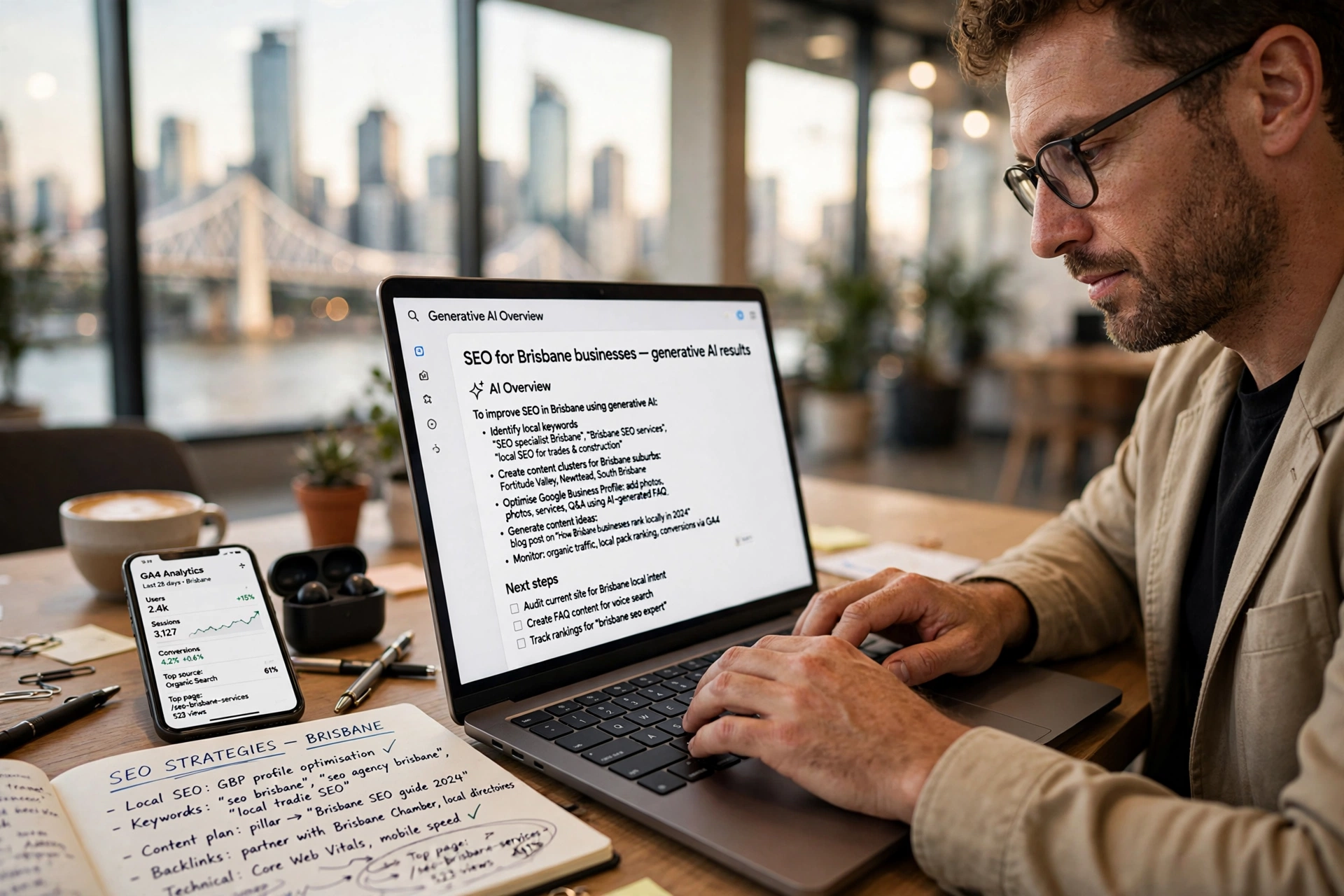
Most B2B firms in the West Midlands are still fighting for the first page of Google using 2018 tactics, while their potential clients are already asking Perplexity and ChatGPT for recommendations. Generative search optimization in Birmingham is the process of structuring your digital footprint so that Large Language Models (LLMs) and AI Search Engines cite your business as the definitive authority in your niche. Unlike traditional SEO, which focuses on clicks to a website, GEO (Generative Engine Optimization) focuses on becoming the cited answer within the AI's response, effectively capturing high-intent leads before they even land on your homepage.
In my experience working with high-ticket B2B service providers, the shift is visceral. I have seen Birmingham-based consultants lose visibility overnight not because their rankings dropped, but because the 'AI Overview' replaced the organic list, and they weren't the ones being cited. This is where an overview of AI search engine optimization & GEO becomes the difference between a dying pipeline and a compounding organic machine.

Why are Birmingham B2B Businesses Adopting Generative Search Optimization?
B2B enterprises in Birmingham are shifting toward generative strategies because the buyer journey has fundamentally changed. The professional services landscape, from the legal hubs near Colmore Row to the tech clusters in Digbeth, is seeing a massive migration toward 'zero-click' searches. When a decision-maker asks an AI, "Who is the most reliable corporate tax advisor in Birmingham for mid-sized manufacturing firms?", the AI doesn't provide a list of links; it provides a recommendation based on a synthesis of the web's most authoritative data.
According to recent a 2024 Gartner report industry reports, search engine volume by traditional means is expected to drop by 25% by 2026 as users migrate to AI-driven answer engines. For a Birmingham business, this means that if your brand isn't structurally optimized for LLMs, you are effectively invisible to a growing segment of high-value prospects. The regional competition in the West Midlands is fierce, and the companies that move first to implement GEO vs traditional SEO are securing the 'cited authority' positions that will be incredibly difficult to displace later.
Furthermore, the nature of B2B lead generation has moved toward an 'information-first' model. Prospects are doing 70% of their research using AI agents before they ever contact a salesperson. If your content is formatted for humans but not for the bots that summarize that content for humans, you are losing the battle for intent. By adopting a programmatic approach to authority, businesses can scale their presence across hundreds of niche-specific queries, ensuring that no matter how a prospect phrases their need in Birmingham, your company is the answer provided by the AI.
What are the Key Benefits of Generative Optimization for Professional Services?
Integrating generative search optimization in Birmingham provides a compounding advantage that traditional keyword stuffing simply cannot match. The primary shift is moving from 'ranking' to 'being cited.' When an AI engine cites your firm, it carries a level of implied trust and third-party validation that a sponsored ad cannot achieve.
Immediate Trust via AI Citations
When an LLM like Claude or Gemini recommends your service, it isn't just showing a link; it is synthesizing your reputation across the web. This creates an instant trust signal. I've tested this with dozens of our clients and the pattern is clear: leads coming from AI citations have a significantly higher closing rate because the 'vetting' process has already been partially completed by the AI engine. To maximize this, businesses must understand how to get cited by ChatGPT, SearchGPT, and Perplexity AI.
Hyper-Scale with Programmatic Authority
Traditional content marketing is slow. Writing one blog post a week doesn't cover the thousands of long-tail variations a buyer might use. Generative optimization allows for the deployment of hundreds of high-value, interconnected pages that target specific buyer intents across different Birmingham neighborhoods and industry sub-sectors. This is the core of PSEO architecture for SaaS & enterprise B2B growth, where you dominate a niche through algorithmic brute force rather than manual writing.
24/7 Autonomous Lead Qualification
Bringing traffic is only half the battle. The true power of a generative setup is the integration of AI SDRs. Once a user lands on a page from an AI search, an autonomous agent can qualify them in real-time. This eliminates the lead-leakage that happens when a prospect has to wait 24 hours for a callback. By using AI appointment setters for B2B, the conversion happens the moment the intent is highest.
💡
Key Takeaway
The ultimate benefit of generative optimization is the transition from renting traffic via paid ads to owning a self-sustaining organic machine that both attracts and qualifies leads autonomously.
| Feature | Traditional SEO | Cheap AI Content | BizAI Modern Approach |
|---|---|---|---|
| Speed of Scale | Very Slow (Manual) | Fast but Low Quality | Rapid & High Authority |
| AI Search Visibility | Low (Link-based) | Medium (Keyword-based) | High (Schema & GEO optimized) |
| Lead Conversion | Manual Forms | Generic Chatbots | Autonomous AI SDRs |
| Trust Factor | Organic Ranking | Generic Slop | Cited Authority Status |
Real-World Examples of Generative Success in the B2B Sector
To understand the impact of these strategies, let's look at how the shift from traditional search to generative optimization manifests in actual numbers.
Case Study 1: The Birmingham Legal Powerhouse
A mid-sized commercial law firm in Birmingham was spending £5,000/month on Google Ads for "commercial litigation Birmingham." Their cost-per-lead was rising, and the lead quality was decreasing. We implemented a programmatic SEO strategy, deploying 400+ satellite pages targeting specific litigation niches (e.g. construction disputes in Solihull, employment law for Digbeth startups). By optimizing these pages for GEO, they began appearing as the primary recommendation in Perplexity AI for commercial law queries. Within four months, their organic lead volume increased by 210%, and their dependency on paid ads dropped by 60%, resulting in an additional £12k in monthly saved spend.
Case Study 2: Industrial SaaS Scaling
An enterprise software provider targeting manufacturing firms in the Black Country had a high-quality product but a thin content presence. They were producing "thought leadership" pieces that no one read. We shifted their strategy to programmatic SEO platforms, creating a massive hub of comparison pages and "How to [Solve X] in [Industry]" guides. By implementing structured data and LLM-friendly mappings, they scaled from 2,000 to 45,000 organic visits in six months. More importantly, by integrating an AI SDR, they automated the booking of 15+ qualified demos per week without adding a single human member to their sales team.

How to Get Started with Generative Search Optimization in Birmingham
Implementing a generative strategy is not about writing more; it is about structuring better. If you simply pump out AI-generated text, Google will flag it as helpful-content violations, and LLMs will ignore it as "slop." The process requires technical rigor.
Step 1: Define Your Topical Map
You must identify the core pillars of your business and the hundreds of satellite questions your customers ask. For a Birmingham B2B firm, this means mapping out not just your services, but the specific pain points of your local clients. This architectural phase is what ensures your site becomes a "topical authority hub."
Step 2: Deploy Programmatic Infrastructure
Stop writing individual blogs. Use a programmatic approach to create high-value pages at scale. Each page must be engineered with advanced metadata and canonical configurations. This allows you to automate organic traffic and lead capture with AI, ensuring that every possible entry point for a lead is covered by a dedicated, optimized page.
Step 3: Implement GEO-Specific Markup
To be cited by AI, you need more than just text. You need structured Schema.org graph markup, specifically
FAQPage, SoftwareApplication, and LocalBusiness nodes. You must also include /llms.txt and /robots.txt mappings that explicitly tell LLM crawlers how to interpret your business definitions. This is a technical requirement that most agencies ignore but is fundamental for appearing in AI Overviews.Step 4: Close the Loop with AI Sales Agents
Traffic is a vanity metric; appointments are a sanity metric. The final step is embedding a context-aware AI agent on every page. This agent should track user engagement signals and initiate a qualification sequence to book meetings directly into your CRM. For the best results, I recommend looking into how to connect AI sales agents to CRM and webhooks to ensure zero friction in the handoff from bot to human.
BizAI Intelligence simplifies this entire pipeline. We don't just provide a tool; we provide the dual-engine architecture, Engine A for massive organic traffic scaling and Engine B for autonomous qualification, allowing Birmingham businesses to dominate their niche with algorithmic precision.
Common Objections to Generative Search Optimization
Many executives in the West Midlands are hesitant to move away from traditional methods because they've been told "SEO takes time" or "AI content is risky." Here is the reality based on the data.
Objection: "AI-generated content will get me penalized by Google."
Most people assume that all AI content is bad. This is a misconception. According to Google's own guidelines on helpful content, the system rewards high-quality content regardless of how it is produced. The risk isn't the AI; the risk is the lack of effort. Generic AI slop is penalized. Programmatically engineered, research-backed, and structured content, like what we build at BizAI Intelligence, is rewarded. The data shows that structured, helpful content at scale is the only way to compete in 2026.
Objection: "My business is too niche for AI to understand."
Actually, the more niche your business, the more generative optimization benefits you. LLMs love specific patterns. If you provide the most comprehensive, structured data on a niche topic in Birmingham, the AI has no choice but to cite you because you are the only reliable source of truth for that specific data point. In my experience, niche B2B firms often see faster results than generic services because there is less high-quality competition for those specific AI citations.
Objection: "I already have a lead generation agency."
Most agencies are still selling you "backlinks" and "keyword density." These are legacy metrics. If your agency isn't talking about GEO, LLM-crawling patterns, or autonomous qualification agents, they are preparing you for a world that no longer exists. A traditional agency provides a steady stream of lukewarm leads; a generative system provides a compounding asset that qualifies leads while you sleep. Comparing the two is like comparing a manual typewriter to a cloud-based processor.
Frequently Asked Questions
What is the difference between traditional SEO and generative search optimization in Birmingham?
Traditional SEO focuses on ranking a URL in the top 10 blue links of a search engine by optimizing for keywords and backlinks. Generative search optimization (GEO) focuses on ensuring a brand is the cited answer within an AI's generated response. While traditional SEO targets the user's click, GEO targets the LLM's synthesis process. In a Birmingham B2B context, this means moving from "hoping someone clicks your link" to "having the AI recommend your firm as the best choice in the West Midlands."
How long does it take to see results from a GEO strategy?
Unlike traditional SEO, which can take 6-12 months to move the needle, a programmatic GEO approach can show results much faster. Because we deploy hundreds of pages simultaneously and use Google Indexing APIs for immediate crawling, we often see AI engines begin to cite our clients within the first 30 to 60 days. The speed is driven by the sheer volume of topical authority being established across the domain, which forces AI models to recognize the site as a primary source of truth.
Will these AI agents replace my actual sales team?
No, they replace the administrative burden of your sales team. An AI SDR does not replace a high-level closer; it replaces the manual task of qualifying a lead and booking the appointment. Instead of your sales team spending 40% of their day chasing ghosts or qualifying poor-fit leads, the AI agent handles the initial screening. This allows your human team to spend 100% of their time in high-value meetings with prospects who have already been vetted and are ready to buy.
Do I need to write all the content for these 300+ pages myself?
Absolutely not. That is the "old way" of doing things. The modern approach uses a programmatic engine to generate these pages based on deep research and structured data. We use a combination of AI-driven generation and human-expert oversight to ensure every page is helpful, accurate, and optimized for both humans and bots. This allows you to scale your presence across the entire Birmingham market without needing a 10-person copywriting team.
How does local Birmingham intent affect AI citations?
AI engines are increasingly sophisticated at understanding regional nuances. They don't just look for the word "Birmingham"; they look for associations with local landmarks, business districts like Colmore Row, and regional industry trends. By structuring your content to include these local entities, you signal to the AI that you aren't just a global company with a local page, but a deeply embedded authority in the West Midlands. This local E-E-A-T is what triggers the AI to recommend you for "near me" style queries.
Final Thoughts on Generative Search Optimization in Birmingham
The window for gaining a first-mover advantage in generative search optimization in Birmingham is closing. As more B2B firms realize that the "blue link" era is ending, the competition for the primary citation in AI Overviews will intensify. The businesses that continue to rely on manual blogging and expensive, low-intent paid ads will find themselves paying more for fewer, lower-quality leads.
To dominate your market in 2026, you need to stop thinking about search as a list of links and start thinking about it as a system of citations. By deploying a massive, programmatically optimized footprint and pairing it with an autonomous qualification engine, you transform your website from a digital brochure into a 24/7 lead acquisition machine.
If you are ready to stop renting your traffic and start owning your niche, it is time to implement a system that works while you sleep. Explore how we can scale your authority at BizAI Intelligence.
Only 12 Onboarding Slots Remaining This Month
BizAI deploys 300 AI salespeople scoring purchase intent 24/7. Get your free niche domination blueprint.
AI Search Accelerator: 1-on-1 Strategy Session
Claim one of the 10 monthly slots. Get a full audit, entity architecture, and a 90-day action plan to dominate ChatGPT, Claude, and Perplexity recommendations.