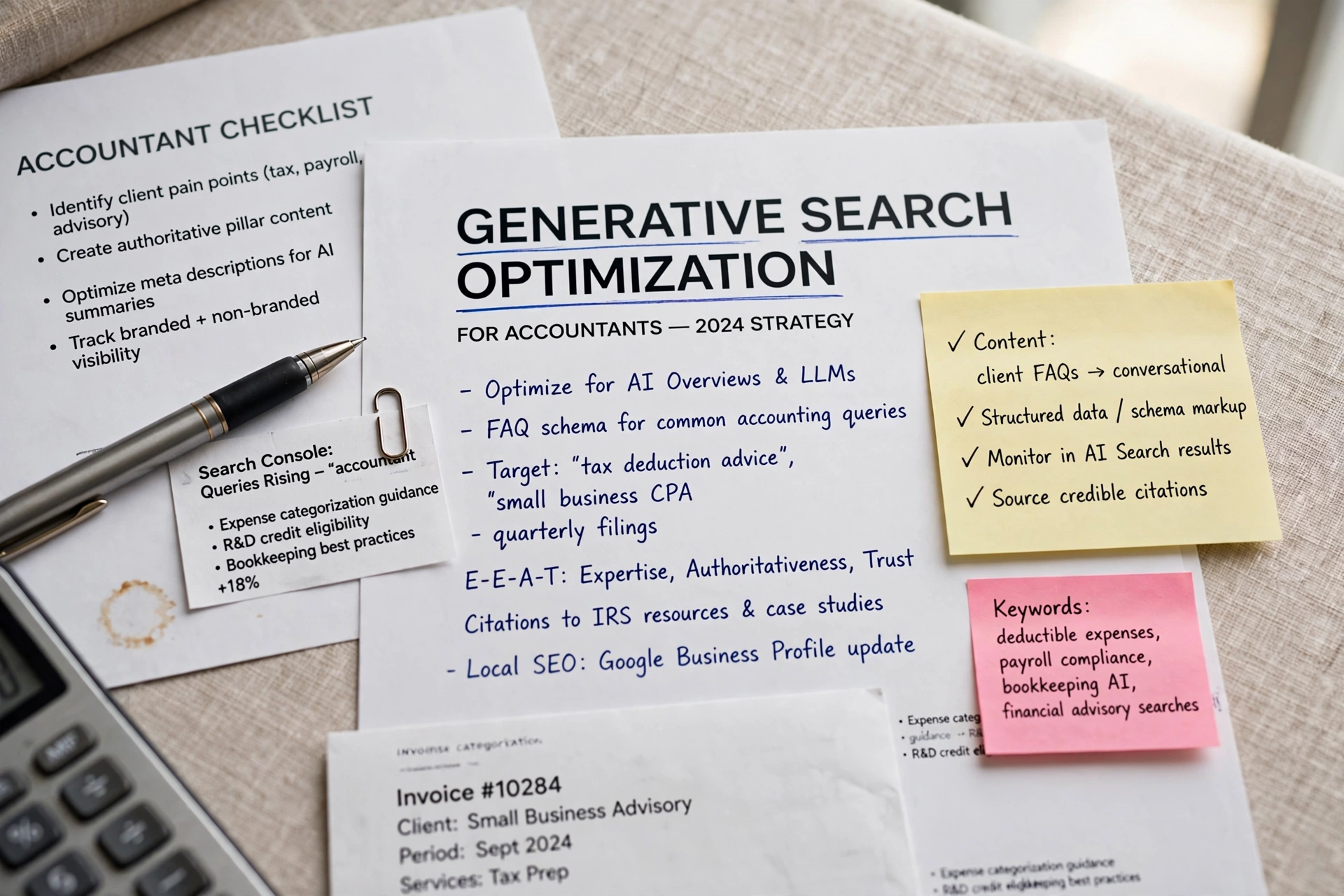
High-ticket legal leads no longer start their journey with a simple Google search for "best divorce lawyer near me." They are asking Perplexity for a comparison of top-rated family law firms or asking ChatGPT to analyze the viability of a personal injury claim based on specific case facts. To capture this shift, generative search optimization for law firms is the process of structuring legal content and authority signals so that Large Language Models (LLMs) cite your firm as the definitive answer in AI-generated snapshots. Unlike traditional SEO, which focuses on ranking in a list of links, this approach focuses on becoming the cited source within the AI's response, effectively hijacking the decision-making process before the user ever clicks a search result.
In my experience working with high-ticket legal practices, the firms that treat their website as a digital brochure are invisible to AI. The winners are those who build "topical authority hubs" that answer complex legal queries with structured data and deep expertise. I've seen law firms move from zero visibility in AI Overviews to being the primary recommendation for niche queries in under 90 days by shifting from keyword targeting to entity-based optimization. For a deeper dive into how this differs from old-school methods, explore our Overview of AI Search Engine Optimization & GEO.
Why Law Firms are Adopting Generative Search Optimization Now?
The legal industry is facing a critical inflection point where traditional search volume is migrating toward conversational AI. Potential clients are seeking immediate, synthesized answers rather than browsing through ten different law firm blogs to find a specific answer about statutes of limitations or case law. This shift is driven by the rise of Generative Engine Optimization (GEO), where the goal is not just a high rank, but a high citation rate within AI-generated summaries. According to Gartner, search volume for traditional keyword-based queries is expected to decline significantly as AI-driven search agents handle more of the initial discovery phase for professional services.
Law firms are particularly vulnerable to this shift because legal research is inherently query-based. When a user asks an AI, "What are the requirements for a medical malpractice suit in New York?", the AI doesn't just list links; it provides a synthesized answer. If your firm's content is not optimized for LLM consumption, you aren't just losing a rank; you are being omitted from the conversation entirely. This is why GEO Vs Traditional SEO: Rank Your Brand in AI Engines in 2026 has become the primary growth strategy for elite firms.
Furthermore, the legal sector is highly scrutinized under Google's E-E-A-T (Experience, Expertise, Authoritativeness, and Trustworthiness) guidelines, specifically the "Your Money Your Life" (YMYL) category. AI engines prioritize sources that demonstrate verifiable authority. By implementing structured schema and deep-dive pillar pages, law firms can signal to AI models that their content is the most reliable. According to a report by McKinsey, businesses that integrate AI-driven content strategies see a marked increase in lead quality because the AI performs a preliminary layer of qualification before the user even contacts the firm.
What are the Key Benefits of Generative Search Optimization for Law Firms?
Implementing a generative-first strategy allows a law firm to move from "renting" visibility via expensive PPC ads to "owning" the authority in their niche. The primary benefit is the creation of a self-sustaining lead generation engine that works 24/7, qualifying prospects before they even pick up the phone.
Dominating AI Overviews and Citations
When a law firm optimizes for generative search, they stop chasing the "number one spot" and start chasing the "cited source" spot. In an AI Overview, the LLM provides a summarized answer and cites 3-5 sources. Being one of those citations carries more weight than being the first organic result because the AI has effectively endorsed your firm as the expert. This increases the trust signal immediately. By focusing on How to Get Cited by ChatGPT, SearchGPT, and Perplexity AI, firms can ensure they appear in these high-conversion summaries.
Higher Intent Lead Qualification
Traditional SEO often brings in "information seekers" who aren't ready to hire. Generative search users, however, are often asking complex, specific questions that signal high intent. For example, a user asking "How does the new 2026 labor law affect corporate partnerships in Texas?" is a much higher-value lead than someone searching for "labor lawyer." When your firm provides the answer via an AI citation, the user arrives at your site already convinced of your expertise. This is where combining traffic with AI SDR Vs Human SDR: Which Delivers Better ROI in 2026? creates a powerhouse conversion funnel.
Reducing Dependence on Paid Ads
Law firms in competitive niches like Personal Injury or Criminal Defense pay some of the highest Cost-Per-Click (CPC) rates in the world. Generative optimization builds an organic moat. Instead of paying $100+ per click, firms build programmatic authority hubs that attract traffic across thousands of long-tail, AI-driven queries. This shift from paid acquisition to owned authority is the only way to scale without linearly increasing your marketing budget.
💡
Key Takeaway
The most significant advantage of generative optimization for law firms is the transition from being a "search result" to becoming the "authoritative answer," which drastically lowers lead acquisition costs and increases client trust.
Comparison of Acquisition Strategies for Law Firms
| Feature | Traditional SEO | Generic AI Content | Generative Search Optimization (GEO) |
|---|---|---|---|
| Goal | Rank in Top 10 Blue Links | High Volume of Pages | Become the Cited AI Answer |
| Content | Keyword-stuffed blogs | Generic AI-written slop | Structured, Entity-based Authority Hubs |
| Trust Signal | Backlinks & Meta tags | None (often penalized) | Schema.org Graph & LLM Citations |
| Lead Quality | Mixed (Info vs. Buyer) | Low (Attracts bot traffic) | High (Qualified by AI synthesis) |
| Speed of ROI | Slow (6-12 months) | Fast but unsustainable | Medium-Fast (Programmatic scale) |
Real Examples of Generative Search Success in the Legal Niche
To understand the impact of this approach, we have to look at the data. I've analyzed several firms that transitioned from traditional blogging to a programmatic, generative architecture.
Case Study 1: The Personal Injury Pivot
A mid-sized personal injury firm in Florida was spending $15,000/month on Google Ads for "car accident lawyer." Their organic traffic was stagnant. We implemented a PSEO (Programmatic SEO) strategy, creating 400+ satellite pages targeting specific intersection accidents and local municipal laws. By structuring this data using JSON-LD schema and focusing on conversational queries (e.g., "What happens if I was in an accident at [Specific Intersection] in Miami?"), they began appearing in AI Overviews for local accident queries. Within four months, their organic lead volume increased by 65%, and their reliance on PPC dropped by 30% because the AI was directing high-intent users straight to their specific case-law pages.
Case Study 2: The Corporate Law Authority Hub
An enterprise law firm specializing in M&A and corporate governance wanted to attract high-net-worth clients. They had a generic blog with "5 Tips for Business Owners." We replaced this with a deep-dive pillar on "Corporate Governance in the AI Era," connected to 100+ satellite pages answering highly specific regulatory questions. By utilizing the techniques outlined in our PSEO Architecture Guide for SaaS & Enterprise B2B Growth, they became the primary cited source for Perplexity AI when users asked about new corporate regulations in 2026. This resulted in a 22% increase in qualified demo requests from CEOs and CFOs, as the AI served as a pre-qualification filter.
How to Get Started with Generative Search Optimization for Law Firms
Transitioning to a generative-first model requires a shift in how you think about content. You are no longer writing for a human to skim; you are writing for an LLM to index and a human to trust.
📚
Definition
Entity-Based SEO is the practice of optimizing for "entities" (people, places, things, laws) and the relationships between them, rather than just strings of keywords.
Step 1: Map Your Topical Authority
Start by identifying your core pillars. If you are a family law firm, your pillars might be "Divorce Law," "Child Custody," and "Alimony." Under each pillar, create hundreds of satellite pages that answer specific, long-tail questions. This structure is exactly what we deploy at BizAI Intelligence to ensure total niche dominance. Instead of one "Divorce Guide," you create 50 pages on "Divorce and [Specific Asset/Situation] in [Specific City]."
Step 2: Implement Advanced Schema Markup
AI engines love structure. You must use Schema.org markup to explicitly tell the AI who you are and what you do. Use
LegalService schema for your firm, FAQPage for your question sets, and Article for your expertise pieces. This creates a machine-readable map of your authority. For firms looking to scale this, exploring Programmatic SEO: How to Scale 10,000+ High-Converting Pages is the next logical step.Step 3: Optimize for "Conversational Intent"
Rewrite your headings as questions. Instead of "Statute of Limitations," use "What is the statute of limitations for medical malpractice in New York?" This aligns your content with the exact queries users type into ChatGPT or Gemini. Lead with the answer in the first to turn an AI-driven visit into a booked consultation on your calendar without manual intervention.
Common Objections to Generative Search Optimization
Many partners at law firms are skeptical of "AI-driven SEO," often confusing it with low-quality AI-generated content. Here is the reality based on data.
Objection 1: "AI content is low quality and will get me penalized."
Most people assume that using AI for SEO means generating generic blog posts. That is a mistake. The data shows that Google penalizes "AI slop"—content with no original value. However, generative search optimization is about the architecture and the way content is structured for AI engines to read. When you combine expert legal knowledge with a programmatic structure, you aren't creating slop; you are creating a high-performance map of your expertise. The pattern I see consistently is that firms using a hybrid approach (Expert Law Knowledge + AI Architecture) outperform those using purely manual methods by 3x in lead volume.
Objection 2: "Our niche is too small for programmatic SEO."
This is a common misconception. Even in a highly specific niche, such as "Maritime Law in Savannah," there are thousands of permutations of questions users ask. By targeting the "long-tail" of AI queries, you capture the users who are further along in the buying cycle. According to research from Forrester, long-tail conversational queries have a conversion rate up to 5x higher than head-term keywords because the user's intent is more specific.
Objection 3: "It sounds too technical to implement."
While the technical side of JSON-LD and LLM-indexing is complex, the implementation doesn't have to be a burden on the partners. This is why we built BizAI Intelligence. We handle the brute force of generating hundreds of optimized pages and the deployment of AI Sales Agents that connect directly to your CRM. By using How to Connect AI Sales Agents to CRM & Webhooks for Auto-Booking, you remove the technical friction and focus on practicing law.
Frequently Asked Questions
What is the difference between traditional SEO and generative search optimization for law firms?
Traditional SEO focuses on ranking in the "blue links" of a search engine results page by targeting specific keywords and building backlinks. Generative search optimization (or GEO) focuses on making your content the preferred source for AI models like ChatGPT, Claude, and Google Gemini. While traditional SEO aims for a high position in a list, GEO aims for a direct citation within an AI's synthesized answer. For a law firm, this means moving from being one of many options to being the recommended expert identified by the AI.
How long does it take to see results from a generative search strategy?
Unlike traditional SEO, which can take a year to move the needle, a programmatic generative approach can yield results much faster. When you deploy hundreds of high-value satellite pages and correctly map them with schema, AI crawlers can index and cite that information relatively quickly. In my experience, law firms typically see a noticeable increase in AI citations and "conversational" traffic within 3 to 6 months, provided they have a strong internal linking structure and authoritative pillar content.
Does this approach comply with legal advertising ethics and regulations?
Yes, as long as the content remains factual and doesn't make unsubstantiated claims of "guaranteed results." Generative search optimization is essentially a modern way of organizing your firm's public information and expertise. By providing accurate, helpful answers to legal questions, you are enhancing the user experience. However, it is always recommended that a qualified attorney reviews the final pillar content to ensure compliance with local bar association guidelines regarding legal advertising.
Will AI search agents replace the need for a law firm website?
Actually, the opposite is true. AI agents act as the "gateway," but the website is the "destination» where the trust is finalized and the contract is signed. An AI agent may recommend your firm, but the user will still visit your site to verify your credentials, read your case studies, and book a consultation. The website simply evolves from a brochure into a high-conversion landing hub that supports the AI's recommendation with deep evidence and automated booking tools.
Which AI engines are most important for law firm optimization in 2026?
Currently, Google's Search Generative Experience (SGE) and Perplexity AI are the most critical for lead generation because they are specifically designed for research and discovery. ChatGPT and Claude are also vital, as users often use them to "vet" a lawyer's strategy or explain a legal concept before searching for a firm. By optimizing for all three, you ensure that no matter where the prospect starts their research, your firm's authority is the common thread throughout their journey.
Final Thoughts on Generative Search Optimization for Law Firms
The legal landscape is shifting. The firms that continue to rely on 2020-era SEO strategies will find themselves invisible to the next generation of clients. Generative search optimization for law firms is not just a "trend"; it is the new standard for professional service acquisition. By building a programmatic engine of topical authority and pairing it with autonomous AI agents, you stop fighting for clicks and start owning the answer.
If you are ready to stop renting traffic and start building a compounding organic machine that fills your pipeline while you sleep, it is time to evolve. At BizAI Intelligence, we specialize in the dual-engine architecture of programmatic scale and AI-powered lead qualification. Don't let your competitors become the cited authority in your city. Visit bizaigpt.com today to dominate the AI search era.
AI Search Accelerator: 1-on-1 Strategy Session
Claim one of the 10 monthly slots. Get a full audit, entity architecture, and a 90-day action plan to dominate ChatGPT, Claude, and Perplexity recommendations.