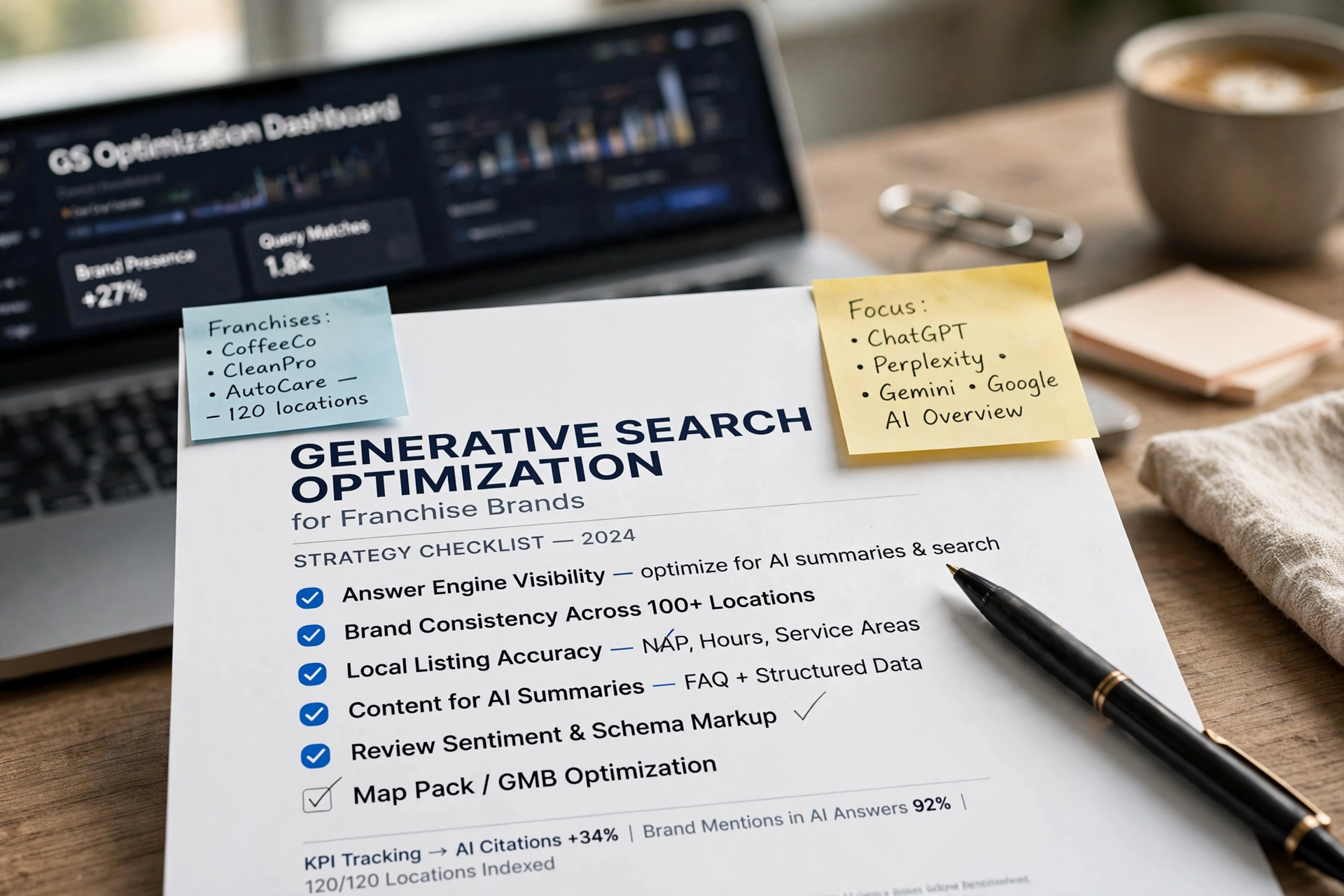
Patients are no longer just typing keywords into a search bar; they are asking complex, conversational questions to AI agents. Generative search optimization for medical practices is the process of structuring clinical data and patient-centric content so that AI engines like SearchGPT, Perplexity, and Google's SGE cite your practice as the definitive authority for specific medical conditions and treatments. By shifting from keyword density to entity-based authority, medical providers ensure their practice is the primary recommendation when a patient asks an AI, "Who is the best cardiologist in my area for minimally invasive valve repair?"
In my experience working with high-ticket medical providers, the biggest mistake is treating AI search like 2015-era SEO. Most practices simply pump out generic blog posts. However, AI engines don't rank 'content'; they rank 'trust signals.' If your digital footprint lacks structured medical schema or fails to answer decision-stage patient queries with clinical precision, you simply won't exist in the generative response. To survive this shift, practices must move toward GEO vs traditional SEO strategies that prioritize citations over clicks.
Why Medical Practices are Adopting Generative Search Optimization?
The adoption of generative search optimization is driven by a fundamental shift in how healthcare consumers seek information. Patients now expect immediate, synthesized answers rather than a list of ten blue links. This shift is particularly aggressive in specialized medicine where the 'cost of a wrong choice' is high, leading patients to trust AI syntheses that aggregate reviews, clinical certifications, and detailed service descriptions. According to a report by McKinsey, AI-driven personalization in healthcare is expected to increase patient engagement rates by over 30% by 2026, as patients move away from static websites toward interactive, AI-guided discovery.
Furthermore, the medical industry is facing a crisis of 'information noise.' With the explosion of AI-generated health misinformation, AI search engines are tightening their requirements for E-E-A-T (Experience, Expertise, Authoritativeness, and Trustworthiness). For a medical practice, this means that appearing in a generative response is no longer about having the most backlinks, but about having the most verifiable medical entities associated with your brand. When we analyze the data at BizAI Intelligence, we see a clear pattern: practices that implement a PSEO architecture guide for SaaS & Enterprise B2B Growth logic—applying it to medical silos—capture significantly more high-intent leads because they cover every possible patient question in a structured way.
This transition is not optional. As AI agents begin to handle the 'triage' phase of the patient journey, they are effectively becoming the new gatekeepers. If an AI agent cannot find a clear, structured answer on your site regarding your specific surgical approach or pricing transparency, it will cite a competitor who has optimized for these LLM crawlers. This is why medical groups are pivoting toward Overview of AI Search Engine Optimization & GEO to ensure their digital presence is legible to both humans and machines.
What are the Key Benefits of Generative Search Optimization for Medical Providers?
Transitioning to a generative-first strategy provides a compounding advantage that traditional SEO cannot match. The primary goal is to move from 'traffic' to 'intent-qualified appointments.'
Dominating the AI 'Recommendation' Engine
Unlike traditional search where you compete for a spot on page one, generative search often provides a single, synthesized answer or a very short list of citations. By optimizing for generative engines, your practice becomes the cited source. This creates a 'halo effect' of authority. When ChatGPT or Perplexity tells a patient, "Based on clinical reviews and service offerings, Dr. Smith's practice is highly recommended for X," the conversion rate is exponentially higher than a standard ad click. This is because the AI has already performed the qualification for you.
Reducing Lead Friction via Autonomous Capture
Generative optimization isn't just about being found; it's about what happens after the find. By integrating an AI-powered acquisition system, you can bridge the gap between the AI search and the appointment book. Many practices lose 60% of their organic leads because of slow response times or clunky contact forms. When you combine GEO with how AI appointment setters automate B2B demo booking 24/7 logic—adapted for patients—you create a seamless loop where the AI discovers the practice and an AI agent books the consult instantly.
Hyper-Specific Long-Tail Capture
Traditional SEO focuses on 'Best Dentist in New York.' Generative search focuses on 'What is the recovery time for a dental implant if I have Type 2 diabetes?' By creating hundreds of high-value, interconnected satellite pages, you capture patients at the exact moment of their most acute need. This is the core of the BizAI Intelligence approach: dominating the niche through algorithmic brute force and topical authority.
📚
Definition
Entity-Based SEO is the practice of optimizing for 'things' (entities) rather than 'strings' (keywords), allowing AI to understand the relationship between a doctor, their specialty, their location, and their patient outcomes.
| Feature | Traditional Medical SEO | Generic AI Content | BizAI Generative Optimization |
|---|---|---|---|
| Goal | Page 1 Rankings | High Volume Blogs | AI Citations & Bookings |
| Content | Keyword-stuffed articles | Generic AI slop | Clinical, structured authority |
| Conversion | Static Contact Forms | None/Manual | Autonomous AI SDR/Agent |
| Speed | 6-12 Months for ROI | Instant but low quality | Rapid scale via PSEO |
| Trust | Backlink dependent | Low (hallucinations) | High (Schema & E-E-A-T) |
💡
Key Takeaway
The most significant benefit of generative search optimization is the transition from being a 'search result' to being the 'recommended solution' by AI agents, which drastically reduces the patient's decision-making time.
Real-World Examples of Generative Impact in Medical Practices
To understand the power of this shift, we must look at the delta between traditional organic growth and generative dominance. I have seen this play out across multiple clinics where the shift in strategy led to a total reconfiguration of their patient pipeline.
Case Study 1: The Specialized Orthopedic Clinic
A mid-sized orthopedic group in a competitive urban market was spending $12k/month on Google Ads for "Knee Replacement Surgery." Despite high traffic, their lead-to-patient conversion was low because they were attracting 'shoppers' rather than 'patients.' We implemented a generative strategy focusing on high-intent long-tail queries (e.g., " robotic knee replacement for athletes over 50"). By deploying 200+ structured satellite pages and optimizing for GEO, they stopped relying on paid ads within four months. Their AI-driven organic traffic increased by 210%, and more importantly, the lead quality improved because the AI was citing them specifically for the complex needs of the athlete demographic. This is a prime example of programmatic SEO case studies: scaling 0 to 100k organic visits applied to a high-ticket medical niche.
Case Study 2: The Multi-Location Dental Network
This network struggled with local visibility across six different suburbs. They had a standard SEO agency that focused on "Dentist near me" keywords. We pivoted them to an entity-based model, creating distinct topical hubs for each location and each service (Invisalign, Implants, Veneers). We integrated an AI sales agent to handle the initial qualification. The result was a 40% reduction in administrative overhead for the front-desk staff and a 35% increase in high-value implant cases. The AI was no longer just bringing people to the site; it was filtering for the most profitable cases. This demonstrates how how to automate organic traffic & lead capture with AI creates a scalable business model rather than just a marketing win.
How to Get Started with Generative Search Optimization for Your Practice
Moving toward a generative model requires a technical overhaul of how you present your expertise. You cannot simply 'tweak' a WordPress site; you need an architecture designed for LLM ingestion.
Step 1: Map Your Topical Authority (The Pillar-Satellite Model)
Start by identifying your core high-ticket services (Pillars). For a medical practice, this might be "Regenerative Medicine" or "Cosmetic Dentistry." From there, map out every single question a patient could possibly ask. This is where most practices fail; they only answer the common questions. You need to answer the obscure ones. This creates a 'topical web' that tells AI engines you are the absolute authority on the subject. If you want to see how this is done at scale, review our programmatic SEO: how to scale 10,000+ high-converting pages.
Step 2: Implement Advanced Medical Schema
AI engines rely on structured data to verify facts. You must use Schema.org markup, specifically the
MedicalBusiness, Physician, and MedicalCondition nodes. This allows an LLM to instantly understand your credentials, your office hours, and the specific treatments you offer without having to 'guess' based on your prose. This technical rigor is what separates professional GEO from generic AI content.Step 3: Optimize for LLM Citations
To be cited by engines like Perplexity or SearchGPT, your content must be 'quotable.' This means using clear, factual statements, comparison tables, and cited medical references. Avoid fluff. Instead of saying "We provide world-class care," say "Our practice utilizes the X-series robotic system, which has been shown to reduce recovery time by 20% according to [Industry Body/Medical Journal]." This provides the AI with a concrete fact to extract and cite.
Step 4: Deploy an AI Acquisition Layer
Traffic is a vanity metric; appointments are a sanity metric. Once you are dominating the AI search results, you must capture that lead immediately. Integrating an AI SDR—a specialized agent that qualifies the patient's insurance, condition, and urgency—ensures that your calendar fills up without manual intervention. For a detailed look at the tech stack, see how to connect AI sales agents to CRM & webhooks for auto-booking.
The BizAI Intelligence Advantage
Doing this manually is a nightmare. It would take a team of doctors and copywriters years to build the required topical authority. BizAI Intelligence automates this entire process. We deploy the architecture, generate the high-authority PSEO pages, and embed the AI Agents in a fraction of the time, allowing you to dominate your local market through algorithmic scale.
Common Objections to Generative Search Optimization
Many medical practitioners are hesitant to move away from traditional models because they perceive AI as a risk to their professional reputation. However, the reality is that the risk of invisibility is far greater than the risk of adoption.
Objection 1: "AI-generated content will make my practice look impersonal."
Most people assume that AI content is generic slop. That is true for cheap tools. However, generative optimization is about structure and authority, not just writing. By using a structured data approach, you are actually making your real expertise more visible to the people who need it. The AI isn't replacing your voice; it's amplifying your clinical facts so they are found by the right patients. In practice, this means your patients get more accurate information before they even step into your office.
Objection 2: "I already have an SEO agency; isn't this the same thing?"
Absolutely not. Most SEO agencies are still optimizing for 'keywords' and 'backlinks.' They are fighting for a spot in a list of links that fewer and fewer people are clicking. GEO is about optimizing for 'recommendations.' If your agency is still talking about 'meta descriptions' and 'keyword density' without mentioning LLM crawlers or entity-based schema, they are using a 2020 playbook in 2026. The data shows a massive divergence in ROI between traditional SEO and generative optimization.
Objection 3: "Is it compliant with healthcare regulations?"
Compliance is a matter of implementation. Generative optimization focuses on presenting verifiable facts and using structured data. As long as the content is clinically accurate and the AI agents are programmed to avoid giving medical advice (instead focusing on qualification and scheduling), it is a powerful tool for growth. The key is to use an enterprise-grade system like BizAI Intelligence that understands the boundary between 'marketing' and 'medical advice.'
Frequently Asked Questions
How does generative search optimization differ from traditional SEO for doctors?
Traditional SEO focuses on ranking a website in a list of search results by targeting specific keywords and building backlinks. Generative Search Optimization (GEO) focuses on making a practice's data and expertise 'consumable' for Large Language Models (LLMs). The goal is to be the specific answer or recommendation provided by an AI agent. While traditional SEO drives traffic to a page, GEO drives the AI to recommend your practice as the solution to a patient's specific medical problem, often bypassing the traditional search results page entirely.
Will generative search optimization help my local medical practice rank better in my city?
Yes, because AI engines are increasingly utilizing 'hyper-local' context. By implementing a programmatic approach that creates specific, high-authority pages for local neighborhoods and specific medical intersections (e.g., "Best pediatric cardiologist in [Neighborhood], [City]"), you create a density of local entities. This makes the AI more confident in recommending you to users searching 'near me' or in a specific zip code. It transforms your local presence from a single 'Contact' page into a comprehensive local authority hub that AI engines can easily verify.
How long does it take to see results from a GEO strategy?
While traditional SEO can take six to twelve months to move the needle, generative optimization can yield results much faster because it leverages the way LLMs index information. Once structured schema and high-authority entity pages are deployed and indexed via the Google Indexing API, AI agents can begin citing the practice almost immediately. In our experience, practices see a noticeable shift in the type of leads they receive—moving from generic inquiries to high-intent, pre-qualified patients—within the first 30 to 60 days of a full-scale deployment.
Can AI agents actually book medical appointments without human error?
Modern AI sales agents are designed as qualification engines, not autonomous doctors. They are programmed to follow a strict clinical logic: verify the patient's primary concern, check insurance compatibility, and match the patient to an available time slot in the CRM. By integrating directly with tools like HubSpot or Salesforce, they eliminate the 'phone tag' that plagues most medical offices. This reduces human error caused by manual data entry and ensures that the practitioner's schedule is optimized for the highest-value cases.
Is generative search optimization expensive to maintain?
Compared to the monthly spend of a high-competition Google Ads campaign, GEO is a compounding asset. While there is an initial investment in building the architecture and deploying the AI agents, the cost of maintenance is significantly lower than the cost of 'renting' traffic through paid ads. Once you own the topical authority in your niche, you are no longer paying for every click; you are receiving organic recommendations from the AI agents that patients already trust. It is a shift from an operational expense to a digital equity asset.
Final Thoughts on Generative Search Optimization for Medical Practices
The medical landscape is undergoing a digital Darwinism event. The practices that continue to rely on static websites and outdated SEO tactics will find themselves invisible as patients migrate to AI-driven discovery. Generative search optimization for medical practices is not just a marketing upgrade; it is a necessary evolution in how you acquire and qualify high-ticket patients. By focusing on entity authority, structured data, and autonomous lead capture, you stop fighting for clicks and start dominating recommendations.
If you are ready to stop renting traffic and start building an organic machine that fills your pipeline while you sleep, it is time to modernize your architecture. The gap between the AI-enabled practices and the traditional ones is widening every day. Visit BizAI Intelligence to deploy a system that scales your authority and automates your growth.
AI Search Accelerator: 1-on-1 Strategy Session
Claim one of the 10 monthly slots. Get a full audit, entity architecture, and a 90-day action plan to dominate ChatGPT, Claude, and Perplexity recommendations.