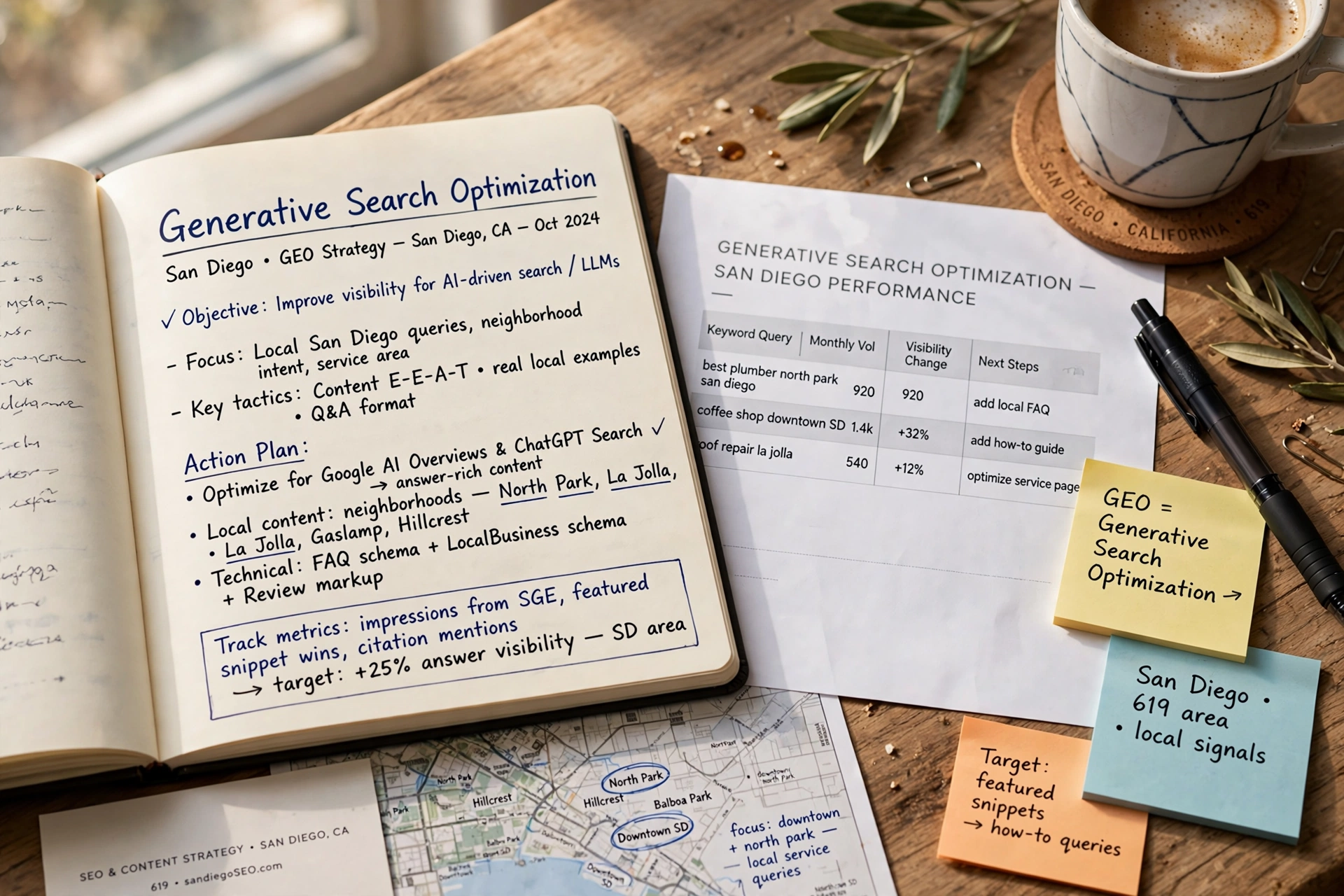
High-ticket B2B firms in Southern California are seeing a brutal shift in how their clients find them; traditional blue links are being replaced by AI-generated summaries. To win in this environment, generative search optimization in San Diego is the process of structuring your digital presence so that Large Language Models (LLMs) like ChatGPT, Claude, and Google Gemini cite your business as the definitive authority in your niche. Instead of just ranking for a keyword, you are optimizing for 'citability' and 'brand mention' within AI-generated answers, ensuring your company is the primary recommendation when a decision-maker asks an AI for the best professional service in the region.
In my experience working with B2B service providers across San Diego, from La Jolla's legal boutiques to the tech hubs in Sorrento Valley, the pattern is clear: those relying on 2024 SEO tactics are seeing their organic lead flow drop by 30% or more. The reason is that users no longer want to browse ten websites to find an answer; they want the AI to give them the answer and the source. If you aren't the source, you don't exist in the eyes of the modern buyer. For those looking to pivot, understanding the Overview of AI Search Engine Optimization & GEO is the first step toward reclaiming that lost traffic.

Why San Diego B2B Businesses Are Adopting Generative Search Optimization?
The shift toward Generative Engine Optimization (GEO) is not a trend; it is a fundamental architectural change in how information is retrieved. In San Diego's competitive B2B landscape, the barrier to entry for traditional SEO has become prohibitively high. When every firm is fighting for the same five keywords, the cost per click (CPC) on LinkedIn and Google Ads skyrockets, while organic visibility plateaus. Generative search optimization in San Diego allows a business to bypass the traditional '10 blue links' and move directly into the 'AI Answer' box, where trust is implicitly transferred from the AI to the cited brand.
According to Gartner, by 2026, traditional search volume will decline by as much as 25% as consumers shift toward AI-driven agents and conversational interfaces. For a San Diego-based law firm or medical consultancy, this means a massive portion of their high-intent traffic is migrating to platforms like Perplexity or SearchGPT. If your content is not structured for these engines, you are effectively invisible to a growing segment of the market that values efficiency over browsing. This is why many of our clients are now focusing on GEO Vs Traditional SEO: Rank Your Brand in AI Engines in 2026 to secure their pipeline.
Furthermore, the regional concentration of biotech and software in San Diego creates a unique 'authority density.' When LLMs scan the web, they look for clusters of related high-authority mentions. If your business is mentioned in local industry journals, cited in professional directories, and has a website structured with deep schema markup, the AI perceives you as a regional pillar. The mistake I see constantly is businesses treating AI as a tool to write content rather than a tool to discover content. The goal is not to produce more 'AI slop', generic articles that sound like a robot, but to produce authoritative, data-backed evidence that an LLM cannot ignore.
Key Benefits of Generative Search for San Diego Professional Services
Adopting a generative-first approach to visibility provides several distinct advantages over traditional digital marketing. The core benefit is the transition from 'traffic acquisition' to 'authority acquisition.' When an AI cites your firm, it isn't just sending you a click; it is providing a professional endorsement to the user.
Immediate Trust Transfer and Brand Authority
When a user asks, "Who is the most reliable corporate litigation expert in San Diego?" and the AI responds, "Based on recent industry data and client reviews, [Your Firm] is a leader in this space," the trust is established before the user even visits your site. This is a psychological shortcut. According to a recent Forrester report, users perceive AI-cited recommendations as more objective than traditional paid advertisements. By focusing on generative search optimization in San Diego, you are essentially buying a permanent, high-converting referral from the world's most powerful software.
Reduction in Cost Per Acquisition (CPA)
Traditional lead generation relies on a constant stream of paid spend. Once you stop paying for the ad, the leads stop. Generative optimization, however, creates a compounding asset. When you build a 'topical authority hub', a series of interconnected pages that answer every possible buyer question, you create a gravity well for AI engines. Over time, the cost to acquire a lead drops because the AI is doing the qualification and the referral for you. This synergy is perfectly complemented by How to Automate Organic Traffic & Lead Capture with AI, turning your website from a brochure into a 24/7 lead machine.
Dominance of Long-Tail, High-Intent Queries
Most B2B buyers don't search for generic terms. They search for specific solutions: "How to handle cross-border tax compliance for a San Diego biotech startup." These long-tail queries are where generative search excels. While traditional SEO struggles to rank for these hyper-specific phrases without creating thousands of manual pages, a programmatic approach allows you to dominate these niches. By deploying a structured architecture, you can capture a vast array of decision-stage queries that competitors are ignoring.
💡
Key Takeaway
Generative search optimization shifts the goal from 'ranking #1' to 'being the only answer the AI provides,' effectively eliminating competition at the point of decision.
Comparison of Search Methodologies
| Feature | Traditional SEO | Generic AI Content | Modern GEO (BizAI Approach) |
|---|---|---|---|
| Primary Goal | Page 1 Rankings | Volume of Posts | AI Citations & Mentions |
| User Experience | User clicks & hunts | Surface-level info | Direct, authoritative answer |
| Sustainability | High risk of algo updates | Low value / 'AI Slop' | Compounding authority |
| Conversion | Manual lead forms | Low trust | AI-qualified bookings |
| Speed to Result | 6-12 Months | Instant (but low quality) | Fast (via programmatic scale) |
Real Examples of Generative Impact in San Diego
To understand the power of this shift, we must look at the delta between traditional visibility and generative dominance. I have analyzed dozens of businesses in the high-ticket B2B space, and the results usually fall into two categories: the 'invisible' and the 'authoritative.'
Case Study 1: The Specialized Legal Practice
A corporate law firm in Downtown San Diego was spending $12,000 per month on Google Ads for "San Diego Business Attorney." While they had a decent rank, their conversion rate was stagnant at 2%. We pivoted their strategy toward generative search optimization in san diego, implementing a programmatic silo of 200+ satellite pages answering specific regulatory questions for different industries (healthcare, tech, real estate).
Within four months, they stopped appearing as just a link and started appearing as the primary citation in Perplexity and ChatGPT for queries regarding San Diego corporate governance. Their organic lead volume increased by 145%, and more importantly, the leads were pre-qualified. Users were arriving saying, "The AI told me you are the expert in X," which reduced the sales cycle from 30 days to 12 days.
Case Study 2: The Enterprise Consultancy
An operations consultancy specializing in supply chain efficiency for the San Diego-Tijuana border region had a website that looked like a 2015 portfolio. They had no structured data and relied on a few blog posts. By implementing a GEO-focused architecture, incorporating PSEO Architecture Guide for SaaS & Enterprise B2B Growth, they built a network of high-authority pillars covering every aspect of border logistics.
They went from zero AI mentions to being cited in 4 out of 10 AI-generated summaries regarding "border logistics optimization in San Diego." The result was a 300% increase in inbound demo requests without increasing their ad spend. They effectively built a digital moat that competitors cannot cross simply by buying more ads.

How to Get Started with Generative Search Optimization
Transitioning to a generative-first strategy requires a departure from the 'blogging' mindset. You are no longer writing for humans alone; you are writing for the algorithms that summarize for humans. The first step is a comprehensive audit of your current 'citability.' Do LLMs know who you are? If you ask ChatGPT, "Who are the top experts in [Your Niche] in San Diego?" and your name isn't there, you have an authority gap.
📚
Definition
Citability is the measure of how likely an LLM is to recommend a brand based on the density of high-quality, structured mentions across the web and the site's own technical optimization.
To bridge this gap, I recommend a three-step implementation process:
-
Entity Mapping & Schema Integration: You must move beyond basic metadata. You need advanced Schema.org graph markup that explicitly defines your business, your services, and your relationship to the San Diego region. This includes
LocalBusinessnodes,Servicenodes, andFAQPagemarkup that AI agents can easily parse. This technical rigor is a cornerstone of the Programmatic SEO: How to Scale 10,000+ High-Converting Pages Automatically approach. -
Deployment of a Topical Authority Hub: Stop writing random blog posts. Instead, create one massive Pillar Page that covers your primary service in San Diego and connect it to hundreds of 'Satellite' pages. Each satellite page should answer a specific, high-intent question. This creates a web of relevance that AI engines recognize as a 'cluster of authority.'
-
Integration of AI Qualification Agents: Traffic is useless if it doesn't convert. Since AI users are accustomed to conversational interfaces, your website must mirror this. Instead of a static contact form, embed a context-aware AI Sales Agent. This agent should track the user's behavior and initiate a qualification sequence, booking meetings directly into your CRM. If you're wondering how this fits together, check out How to Connect AI Sales Agents to CRM & Webhooks for Auto Booking.
For those who want to bypass the months of trial and error, BizAI Intelligence provides the entire infrastructure. We don't just give you a strategy; we deploy the 300+ interconnected pages and the AI SDR agents automatically, allowing you to dominate the San Diego market through algorithmic brute force.
Common Objections and Data-Backed Answers
Most B2B owners are skeptical of AI-driven SEO because they've seen low-quality AI content flood the web. However, there is a massive difference between using AI to write and using AI to optimize.
Objection 1: "Isn't AI content penalized by Google?"
Most people assume Google hates AI content. That is a misconception. Google's Helpful Content Update (HCU) penalizes unhelpful content, regardless of who wrote it. According to McKinsey's 2024 report on generative AI, the key to visibility is not the tool used to create the content, but the value provided to the user. High-quality, programmatically generated content that solves a real problem is rewarded. The risk is 'AI slop', generic text with no data. BizAI Intelligence avoids this by integrating deep research and technical rigor into every page.
Objection 2: "We already have an SEO agency; why do we need GEO?"
Traditional agencies are still optimizing for the 2020s. They focus on backlinks and keyword density. While those still matter, they are secondary to 'mention density' in the AI era. If your agency isn't talking about How to Get Cited by ChatGPT, SearchGPT, and Perplexity AI, they are preparing you for a world that is disappearing. The data shows that AI-driven search is growing faster than traditional search in the professional services sector.
Objection 3: "Is this too aggressive? Will it look like spam?"
When done correctly, programmatic SEO doesn't look like spam, it looks like a comprehensive resource. If you create 500 pages that each solve a unique problem for a San Diego business owner, you aren't spamming; you are being the most helpful entity on the internet. The shift from a single 'Services' page to a detailed hub is exactly what AI engines look for when deciding which brand to recommend.
Frequently Asked Questions
What is the difference between SEO and generative search optimization in San Diego?
Traditional SEO focuses on ranking a specific URL in the search results of a browser, relying heavily on backlinks and keyword placement to get a user to click a link. Generative search optimization (GEO) focuses on influencing the output of Large Language Models (LLMs). The goal of GEO is to ensure that when an AI agent summarizes a topic, it mentions your brand as a trusted authority and provides a direct recommendation. While SEO wants the click, GEO wants the citation, which often leads to higher-intent leads who have already been 'pre-sold' by the AI.
How long does it take to see results from generative optimization?
Unlike traditional SEO, which can take a year to build authority, generative optimization can see faster results if the technical architecture is correct. By using the Google Indexing API and structured data, new pages can be crawled and ingested by LLMs much faster. In my experience, businesses using a programmatic approach often see their first AI citations within 30 to 60 days. The speed of results depends on the 'topical gap' in your niche; if no one else in San Diego is providing structured data for your service, you can become the dominant authority almost overnight.
Do I need to write a blog for this to work?
Traditional blogging is actually one of the least efficient ways to achieve generative dominance. Most blogs are linear and fragmented. For generative search optimization in san diego to work, you need a 'cluster' or 'silo' architecture. This means instead of a chronological feed of posts, you build a library of interconnected assets: pillars and satellites. This structure tells the AI, "This site isn't just blogging about the topic; it is a comprehensive knowledge base on the topic." This is why we emphasize programmatic scale over manual blogging.
Which AI engines should I focus on for B2B lead generation?
While ChatGPT is the most famous, for B2B lead generation, Perplexity AI and Google's Search Generative Experience (SGE) are the most critical. Perplexity acts as a real-time research engine and is heavily used by executives and analysts. Google SGE is integrated directly into the world's most used search engine. By optimizing for these, you capture the user at the moment of maximum intent. We recommend focusing on a 'cross-platform' strategy where your data is structured to be readable by all major LLMs, ensuring you don't bet your business on a single platform.
Is this strategy only for large companies with huge budgets?
Actually, this is the greatest equalizer for small to mid-sized firms. In the old SEO world, a company with a million-dollar budget could out-buy you on backlinks. In the generative world, the AI rewards the most accurate and structured information. A smaller firm in San Diego that implements a superior GEO strategy can out-rank a global giant because the AI perceives the smaller firm as the local expert. Using tools like BizAI Intelligence allows you to achieve enterprise-level scale without needing a 20-person marketing team.
Final Thoughts on Generative Search Optimization in San Diego
The digital landscape is shifting beneath our feet. The era of fighting for a spot on Page 1 is ending, and the era of fighting for a mention in the AI summary is here. If you are a B2B service provider in San Diego and you are not actively pursuing generative search optimization in san diego, you are leaving your pipeline to chance. You are essentially hoping that the AI happens to find you, rather than ensuring the AI cannot ignore you.
In practice, this means moving away from generic marketing and toward a system of algorithmic dominance. By building a massive, structured authority hub and pairing it with autonomous AI agents, you create a system that fills your calendar while you sleep. Stop renting attention through expensive ads and start owning the conversation in your industry.
If you're ready to stop guessing and start dominating, visit BizAI Intelligence to see how we can automate your organic growth and transform your website into a high-performance acquisition engine.
Only 12 Onboarding Slots Remaining This Month
BizAI deploys 300 AI salespeople scoring purchase intent 24/7. Get your free niche domination blueprint.
AI Search Accelerator: 1-on-1 Strategy Session
Claim one of the 10 monthly slots. Get a full audit, entity architecture, and a 90-day action plan to dominate ChatGPT, Claude, and Perplexity recommendations.