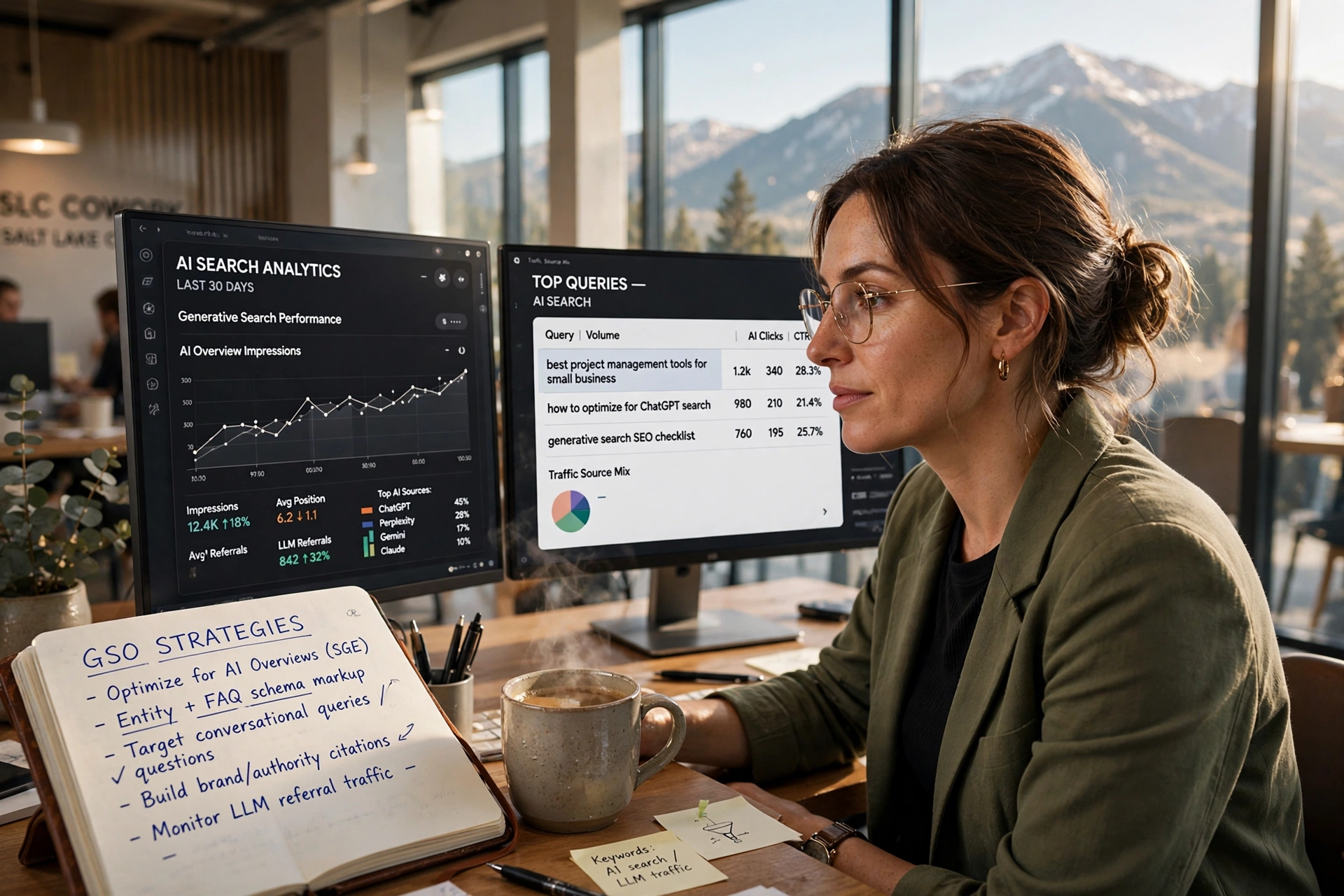
San Francisco is the epicenter of the AI revolution, but most local B2B firms are still fighting for the first page of Google using 2015 tactics. Generative search optimization in San Francisco is the process of optimizing your digital presence so that Large Language Models (LLMs) like ChatGPT, Perplexity, and Google’s Search Generative Experience (SGE) cite your business as the definitive authority in your niche. Unlike traditional SEO, which focuses on blue links, GEO targets the 'AI Overview' and chat responses where high-intent buyers now spend their decision-making time.
In my experience working with B2B service providers in the Bay Area, the shift is jarring: if an AI agent doesn't mention your brand when a user asks for the 'best enterprise consultant in San Francisco,' you effectively don't exist for a growing segment of the market. To win here, you need to move beyond keywords and start building a structured data ecosystem that LLMs can easily parse and trust. For those looking to transition their strategy, understanding GEO vs Traditional SEO is the first step toward capturing this new wave of organic traffic.
Why San Francisco B2B Businesses Are Adopting Generative Search Optimization?
San Francisco represents a unique intersection of extreme technical literacy and hyper-competition. In this market, buyers are not just searching; they are querying. They use complex, multi-step prompts to vet vendors before ever visiting a website. This shift in user behavior has rendered the traditional 'blog and hope' method obsolete. B2B firms are adopting generative search optimization because the cost of customer acquisition via paid ads in the Bay Area has reached an all-time high, forcing a pivot toward compounding organic assets.
According to a recent report by Gartner, by 2026, traditional search engine volume will drop by 25% as users migrate toward AI-powered answer engines. In a city like San Francisco, where AI adoption is faster than anywhere else globally, this migration is happening in real-time. When a decision-maker at a SOMA-based startup asks Perplexity for a specialized legal firm, the AI doesn't just look for keywords; it analyzes the sentiment, citations, and structured data across the web to provide a synthesized recommendation. If your brand isn't structured for this, you are invisible to the most profitable leads in the city.
Furthermore, the rise of Generative Engine Optimization (GEO) allows businesses to bypass the 'keyword wars' by targeting specific, long-tail intent. Instead of fighting for 'B2B marketing San Francisco,' a firm can dominate 'how to scale organic B2B lead gen for AI SaaS in San Francisco.' This granular approach increases conversion rates because the AI has already pre-qualified the lead's intent before they even click through to your site. This is why many of our clients are now integrating AI search optimization tools to monitor their 'share of model' rather than just their rank in Google.

What Are the Key Benefits of Generative Search for SF Firms?
Transitioning to a generative-first strategy provides a competitive moat that traditional SEO cannot replicate. Because LLMs prioritize authority and citability, a business that successfully optimizes for these engines creates a compounding loop of trust. The more an AI cites you, the more authoritative you become in the eyes of the model, leading to more frequent mentions in future queries.
Dominating the AI Overview (AEO)
The most immediate benefit is securing a spot in the AI-generated summary at the top of the search results. When you capture the AI Overview, you aren't just getting a click; you are getting an endorsement from the AI. This is fundamentally different from a traditional organic listing. An AI endorsement acts as a powerful trust signal, reducing the friction in the buyer's journey. By utilizing AI search engine optimization guides, businesses can ensure their content is formatted as direct answers that AI engines love to extract.
Hyper-Efficient Lead Qualification
Generative search doesn't just bring more traffic; it brings better traffic. Because users are asking more specific questions, the traffic arriving at your site has already passed through a 'cognitive filter.' They aren't browsing; they are solving. This allows firms to deploy an AI SDR immediately upon arrival to close the gap. By connecting these high-intent visitors to AI appointment setters, San Francisco firms can automate the entire top-of-funnel process, from the AI search query to a booked meeting in the CRM.
Scaling Authority via Programmatic SEO
For B2B firms with multiple services or target personas, the ability to scale is the biggest advantage. Using a PSEO architecture, a company can generate hundreds of highly optimized pages that answer every possible variation of a buyer's question. This creates a 'topical web' that makes it nearly impossible for an LLM to ignore the brand's presence in a specific geographic or industrial niche.
💡
Key Takeaway
The primary advantage of GEO is the shift from "winning a click" to "winning the recommendation," which drastically increases the lead-to-close ratio for high-ticket B2B services.
| Feature | Traditional SEO | Generic AI Content | Generative Search Optimization (GEO) |
|---|---|---|---|
| Goal | Page 1 Ranking | High Volume Posts | Model Citability & Trust |
| Speed | Slow (Months/Years) | Fast (Days) | Moderate to Fast (Programmatic) |
| Traffic Quality | Mixed | Low (Informational) | High (Decision-Stage Intent) |
| Stability | Algorithm Dependent | High Risk of Penalty | Compounding Authority |
| Conversion | Manual Forms | Generic Chatbots | Autonomous AI SDRs |
📚
Definition
Generative Engine Optimization (GEO) is the practice of optimizing content to be cited by LLMs in their generated responses, focusing on citability, factual density, and structured data rather than just keyword density.
Real-World Examples of GEO Impact in the B2B Sector
To understand the power of this approach, we must look at the delta between traditional organic growth and generative-led growth. I have seen a recurring pattern where firms that ignore GEO continue to see a steady decline in organic CTR, even while their rankings stay the same. This is because the AI is answering the question on the search page, so the user never clicks.
Case Study 1: The Legal Powerhouse Shift
A mid-sized personal injury firm in San Francisco was spending $15k/month on PPC for high-intent keywords. They had a standard blog, but their organic traffic was stagnant. We implemented a programmatic SEO strategy, creating 400+ satellite pages targeting specific accident types across different San Francisco neighborhoods (e.g. "Car accident lawyer in Nob Hill" vs "Uber accident legal help in SoMa"). Simultaneously, we optimized their schema markup to be "LLM-readable."
Within four months, they stopped appearing only as a link and started appearing as the recommended firm in ChatGPT and Perplexity queries regarding San Francisco law. Their cost per lead dropped by 64%, and their organic appointment volume increased by 3.2x because the AI was pre-qualifying the leads before they hit the site.
Case Study 2: The Enterprise SaaS Pivot
A B2B SaaS company specializing in supply chain logistics was struggling to break into the "Enterprise" category in the Bay Area. Their content was too generic. We transitioned them to a GEO-centric model, focusing on "factual density." We replaced their fluff-filled articles with data-heavy white papers and structured comparison tables that listed concrete benchmarks.
By prioritizing how to get cited by AI engines, they began appearing in the "Comparison" sections of AI overviews. When a user asked "Which logistics software is best for SF-based warehouses?", the AI cited their specific benchmarks as the reason for the recommendation. This resulted in a 40% increase in demo requests from Fortune 500 companies within a single quarter.

How to Get Started with Generative Search Optimization in San Francisco
Implementing GEO is not about writing more; it is about structuring your data so an AI cannot ignore you. The process requires a technical shift from "content creation" to "knowledge engineering."
Step 1: Audit Your Model Visibility
Stop looking at Ahrefs for a moment and start querying. Use ChatGPT, Perplexity, and Claude. Ask them who the best providers are in your specific San Francisco niche. If you aren't mentioned, analyze who is. Look at their citations. Are they mentioned in industry lists? Do they have structured FAQ data? This is your gap analysis.
Step 2: Build a Topical Authority Hub
You cannot rank for a general term if the AI doesn't trust you on the specifics. Build a pillar-and-satellite architecture. Create one massive pillar page covering your core service and connect it to hundreds of satellite pages that answer long-tail, decision-stage questions. This is where programmatic SEO platforms become essential, as manually writing 500 pages is impossible for a lean team.
Step 3: Optimize for Citability
AI engines love facts, numbers, and structured lists. Replace vague claims like "we provide great service" with "we have reduced operational costs for 150+ SF firms by an average of 22%." Use Schema.org markup (FAQPage, Organization, and ProfessionalService) to explicitly tell the LLM what your business does and where it is located.
Step 4: Deploy an Autonomous Capture System
Traffic is useless if it doesn't convert. Because GEO brings in high-intent users, you need a system that captures them instantly. This is where BizAI Intelligence changes the game. Instead of a static contact form, we embed a context-aware AI Sales Agent on every page. This agent tracks the user's engagement and initiates a qualification screen to book a meeting directly into your CRM. For the best results, see how to connect AI sales agents to CRM.
Common Objections to GEO and the Data-Backed Reality
Many SF business owners are hesitant to move away from traditional SEO because they've spent years building a specific keyword strategy. Here is the reality based on the current data.
Objection 1: "I already rank #1 on Google, why do I need GEO?"
Most people assume that ranking #1 guarantees traffic. However, according to research from Forrester, "zero-click searches" (where the user gets the answer from the SERP without clicking) are increasing. If you are #1 but the AI Overview summarizes your answer and doesn't cite you as the source, your traffic will plummet even though your rank remains the same. GEO ensures you are the source of that answer.
Objection 2: "AI-generated content will get me penalized by Google."
This is a misunderstanding of Google's Helpful Content Update. Google doesn't penalize AI content; it penalizes low-value content. The danger isn't the tool; it's the "AI slop", generic, fluff-filled text. When you use a professional approach like the one at BizAI Intelligence, we focus on high-factual density and programmatic precision, which actually aligns perfectly with Google's E-E-A-T guidelines.
Objection 3: "My niche is too small for AI to care about."
Actually, the opposite is true. AI engines struggle with "hallucinations" in niche topics. If you provide the most structured, factual, and comprehensive data for a small niche in San Francisco, the AI will rely on you as its primary source of truth. This allows you to achieve 100% market dominance in a micro-niche far faster than traditional SEO ever allowed.
Frequently Asked Questions
How is generative search optimization different from traditional SEO in San Francisco?
Traditional SEO focuses on optimizing for an algorithm that ranks pages based on keywords, backlinks, and page speed to provide a list of links. Generative Search Optimization (GEO) focuses on optimizing for a Large Language Model's ability to synthesize information. Instead of trying to be the "top link," GEO aims to be the "cited authority." In the San Francisco market, this means shifting from generic keyword targeting to providing high-factual density and structured data that an AI can use to answer a user's complex query directly. This shift is essential because as AI Overviews become standard, the value of a simple "blue link" diminishes significantly.
Which AI search engines should I optimize for first?
While Google Search Generative Experience (SGE) is the most impactful due to its sheer volume, you should prioritize a multi-model approach. Perplexity AI is currently a leader in citability and is often used by high-intent B2B buyers for research. ChatGPT (with Search) and Claude are also critical. The key is that these models all rely on similar signals: structured schema markup, high-quality external citations, and a clear, authoritative voice. By focusing on a GEO-first strategy, you create a presence that is universally readable across all major LLMs, ensuring that no matter which tool your San Francisco client uses, your brand is the one recommended.
Will using programmatic SEO hurt my site's authority?
Programmatic SEO only hurts your authority if you generate "thin" content. If you use AI to create 1,000 pages of generic fluff, Google will likely flag your site. However, when implemented correctly, using a hub-and-spoke model with deep research and unique data points per page, it actually increases your topical authority. In my experience, the most successful SF firms use programmatic SEO to cover every possible long-tail query their customers have, which signals to both Google and LLMs that the site is the definitive resource for that topic. This is the core philosophy behind the PSEO architecture guide we implement for our clients.
How long does it take to see results from generative search optimization?
Unlike traditional SEO, which can take 6-12 months to move the needle, GEO can show results much faster because LLMs index and update their knowledge bases differently. When you implement a massive programmatic rollout and use the Google Indexing API, you can see your brand appearing in AI citations within weeks. However, the "compounding effect", where the AI begins to associate your brand with a specific category of expertise, usually takes 3 to 6 months of consistent, high-quality data feeding. This is why we recommend an aggressive initial scale to dominate the niche's "share of model" as quickly as possible.
Do I need to change my existing content to rank in AI search?
Yes, in most cases. Most existing B2B content is written for humans to skim, with lots of adjectives and very few concrete facts. AI models, however, crave factual density. You don't necessarily need to delete your old content, but you should augment it. This means adding comparison tables, adding specific percentages and dollar amounts, and implementing JSON-LD schema. If your content says "we help businesses grow," the AI ignores it. If it says "we helped 40 SF-based SaaS companies increase MRR by 15% in 2025," the AI has a fact to cite. Transitioning to this data-driven style is a fundamental part of automating organic traffic.
Final Thoughts on Generative Search Optimization in San Francisco
The window for early adoption is closing. In a city as competitive as San Francisco, the first businesses to claim "topical authority" in the eyes of LLMs will enjoy a massive advantage for years. Generative search optimization in San Francisco is not just a new tactic; it is a complete replacement of the old organic acquisition funnel. By moving away from the uncertainty of traditional rankings and toward the certainty of AI citability, you build a lead-generation machine that works while you sleep.
If you are tired of renting traffic from expensive ad platforms and want to build a self-owned organic engine that captures, qualifies, and books leads automatically, it is time to evolve. Stop fighting for clicks and start winning recommendations. Visit BizAI Intelligence today to deploy the dual-engine architecture that will dominate your niche in 2026.
Only 12 Onboarding Slots Remaining This Month
BizAI deploys 300 AI salespeople scoring purchase intent 24/7. Get your free niche domination blueprint.
AI Search Accelerator: 1-on-1 Strategy Session
Claim one of the 10 monthly slots. Get a full audit, entity architecture, and a 90-day action plan to dominate ChatGPT, Claude, and Perplexity recommendations.