Where Do the Best B2B Organic Leads Actually Live in 2026?
Most B2B founders make the mistake of hunting for leads in the same "digital neighborhoods" as their competitors, leading to overpriced ad clicks and saturated LinkedIn inboxes. If you are wondering how to get b2b organic leads without spending your entire budget on Meta or Google Ads, you need to stop looking at "platforms" and start looking at "intent environments." High-intent B2B buyers aren't waiting for a sales pitch; they are actively searching for solutions in specialized hubs, long-tail search queries, and AI-driven discovery engines.
The "where" of organic lead generation has shifted from social media feeds to a distributed network of topical authority hubs. To win in 2026, your business must exist where the buyer's problem is most acute: specifically in deep-intent search results, niche industry directories, and AI-generated overviews. When you dominate these specific environments, you stop chasing leads and start attracting them. For those struggling to build this presence, learning how to make business show up on google search: 2026 growth strategy is the first step in transitioning from a hunter to a magnet.
The Ecosystem of Organic B2B Acquisition
To understand where organic leads come from, we must first define the architecture of a modern lead environment. Organic leads are not a monolith; they are a result of strategic placement across different "intent layers."
📚
Definition
Organic B2B Lead Generation is the process of attracting high-ticket business clients through non-paid channels by creating high-value assets that solve specific business problems, thereby triggering a voluntary inquiry from the prospect.
In my experience working with high-ticket service providers, the most common failure is the "Homepage Fallacy." This is the belief that a beautiful website is enough to generate leads. It isn't. Buyers do not land on homepages; they land on answers. The "where" is not your domain, it is the specific URL that answers a question like "How to reduce churn for a SaaS company using AI automation."
According to Gartner, nearly 80% of B2B buyers now prefer a digital-first experience, often completing a significant portion of their research before ever speaking to a sales representative. This means your leads are living in the "invisible funnel", the gap between their first search and their first contact. If you aren't present in the specific search environments where they are researching a problem, you effectively do not exist.

To capture these leads, you must deploy a "Satellite and Pillar" strategy. You build a massive central authority hub (the Pillar) and surround it with hundreds of specific, intent-driven pages (the Satellites). This allows you to occupy more "real estate" in the search environment. If a prospect searches for your service in a specific city or for a specific use case, you have a dedicated page waiting for them. This is the core of how to rank on google page 1 fast: 2026 small business growth guide, shifting the focus from general keywords to specific buyer intents.
Why Intent-Based Environments Matter More Than Traffic
Traffic is a vanity metric. A million views from people who aren't buyers is a liability, not an asset. The real business impact comes from "Intent Density", the ratio of qualified buyers to total visitors.
When you target the correct environment, the cost of acquisition (CAC) plummets because the lead has already "pre-sold" themselves through your content. According to a report from McKinsey, companies that prioritize high-intent organic content over broad-reach awareness campaigns see an average increase in lead-to-opportunity conversion rates of over 25%. This is because the prospect is moving from a state of "problem awareness" to "solution preference" before they even click your "Contact Us" button.
The danger of ignoring these environments is the "Ad Trap." Many businesses believe they can simply buy their way out of a lack of organic presence. However, as AI-driven search becomes the norm, the cost of paid keywords is skyrocketing while the trust in paid ads is eroding. B2B buyers in 2026 are biologically wired to trust organic recommendations and cited authority over a "Sponsored" tag.
If you continue to rely on paid traffic, you are essentially renting your growth. The moment you stop paying, the leads stop flowing. By building an organic machine, you are owning the asset. Field results across client projects confirm: those who transition to an inbound organic model typically see their lead quality increase while their monthly spend decreases. To break this cycle, you should look into how to stop depending on paid ads and build a compounding asset instead.
Practical Application: How to Deploy an Organic Lead Machine
Getting organic B2B leads requires a shift from "writing blogs" to "engineering intent assets." You don't need a content calendar; you need a topical map.
Step 1: Identify the "Buyer's Question" Map
Stop guessing what your customers want. Use tools to find the exact phrases they use when they are frustrated. Look for "How to," "Alternative to," and "Cost of" queries. These are the environments where the highest intent lives.
Step 2: Build the Topical Authority Hub
Create a comprehensive pillar page that covers your primary service from every possible angle. This page should be the "definitive guide" to your industry. However, the pillar alone is too broad to rank for most long-tail queries.
Step 3: Deploy Programmatic Satellites
This is where BizAI Intelligence changes the game. Instead of hiring a fleet of copywriters to write one article a week, you use programmatic SEO to deploy hundreds of "satellite" pages. These pages target specific niches, locations, or software integrations. For example, if you offer B2B consulting, you don't just write about "Consulting"; you create pages for "Consulting for HVAC Companies in Texas," "Consulting for SaaS Startups in New York," and so on.
💡
Key Takeaway
The goal is not to rank for one big keyword, but to dominate a thousand small ones that collectively drive a massive volume of high-intent leads.
Step 4: Solve the "Bounce" Problem with AI SDRs
Traffic is useless if it doesn't convert. Most B2B sites have a 90% bounce rate because the distance between "reading an article" and "booking a call" is too great. By embedding an AI Sales Agent, like the ones provided by BizAI Intelligence, you capture the lead the moment they show intent. The agent qualifies them in real-time and books the meeting directly into your CRM. Without this, you are just providing free education to your competitors' future clients. This is precisely why programmatic seo fails without embedded ai sdrs: 2026 revenue gap.

Comparing Lead Acquisition Environments
Not all organic channels are created equal. Depending on your ticket size and sales cycle, you should prioritize different environments.
| Environment | Lead Quality | Scaling Speed | Effort Level | Best For |
|---|---|---|---|---|
| Traditional Blogging | Medium | Slow | High | Thought Leadership |
| Social Media (LinkedIn/X) | Medium | Medium | High | Brand Awareness |
| Programmatic SEO (BizAI) | Very High | Very Fast | Low | Aggressive Pipeline Growth |
| Niche Directories | High | Slow | Medium | Local/Industry Trust |
The "Traditional Blogging" approach is what most people think of when they talk about organic leads. They write a "Top 10 Tips" post and hope for the best. This is a slow, manual process that depends on a writer's mood. In contrast, the modern programmatic approach treats content as an engineering problem. By automating the generation of high-value, optimized pages, you can occupy the entire search landscape in weeks rather than years.
If you are still using freelance writers to scale your B2B presence, you are fighting a war with sticks and stones. Learning how to replace freelance copywriters: 2026 ai content engine strategy allows you to scale your organic reach by 100x without increasing your headcount.
Common Questions and Misconceptions About Organic B2B Leads
There is a lot of outdated advice floating around the B2B world. Most guides get this wrong because they are still applying 2018 logic to a 2026 AI-driven search environment.
Myth 1: "You need a huge brand name to rank organically."
Wrong. Google and AI search engines (like Perplexity or Gemini) care about topical authority, not brand fame. If you provide the most comprehensive, data-backed answer to a specific problem, you will outrank a Fortune 500 company that only has a generic page on the topic.
Myth 2: "AI content is penalized by Google."
This is a massive misunderstanding. Google does not penalize AI content; it penalizes unhelpful content. If your AI-generated pages provide genuine value, specific data, and solve the user's problem, they will rank. The problem is "AI slop", generic, fluffy text. BizAI Intelligence avoids this by using deep research and technical rigor.
Myth 3: "Organic leads take too long to arrive."
While traditional SEO is slow, programmatic SEO is fast. When you deploy 300+ optimized pages using the Google Indexing API, you can start seeing traffic in days, not months. The "slow" reputation of SEO comes from people who only publish one blog post a month.
Myth 4: "You only need to focus on high-volume keywords."
Actually, the "gold mine" is in low-volume, high-intent keywords. A keyword with 50 searches a month that is "Cost of [Service] for [Specific Industry]" is worth 10,000 searches for a general term. The former is a buyer; the latter is a student or a curious browser.
Frequently Asked Questions
Where is the best place to find organic B2B leads in 2026?
The best place is within "Intent Hubs", specifically long-tail search queries on Google and AI-powered search engines. Instead of chasing leads on social media where they are in a "consumption" mindset, you target them in search environments where they are in a "problem-solving" mindset. By creating a vast network of programmatic satellite pages that answer every possible variation of a buyer's question, you position your business as the only logical solution. This is why the focus should be on topical dominance rather than individual viral hits.
How can I tell if my organic lead strategy is actually working?
Stop looking at your total traffic and start looking at your "Qualified Lead Velocity." This is the number of high-intent inquiries (people asking for pricing or a demo) divided by your total organic visits. If your traffic is growing but your meetings aren't, you have a "Conversion Gap." This is usually solved by implementing an AI SDR that captures leads instantly. For a detailed look at this, explore stop the 90% bounce: how ai sdrs recover lost b2b revenue in 2026.
Do I need a separate strategy for local B2B organic leads?
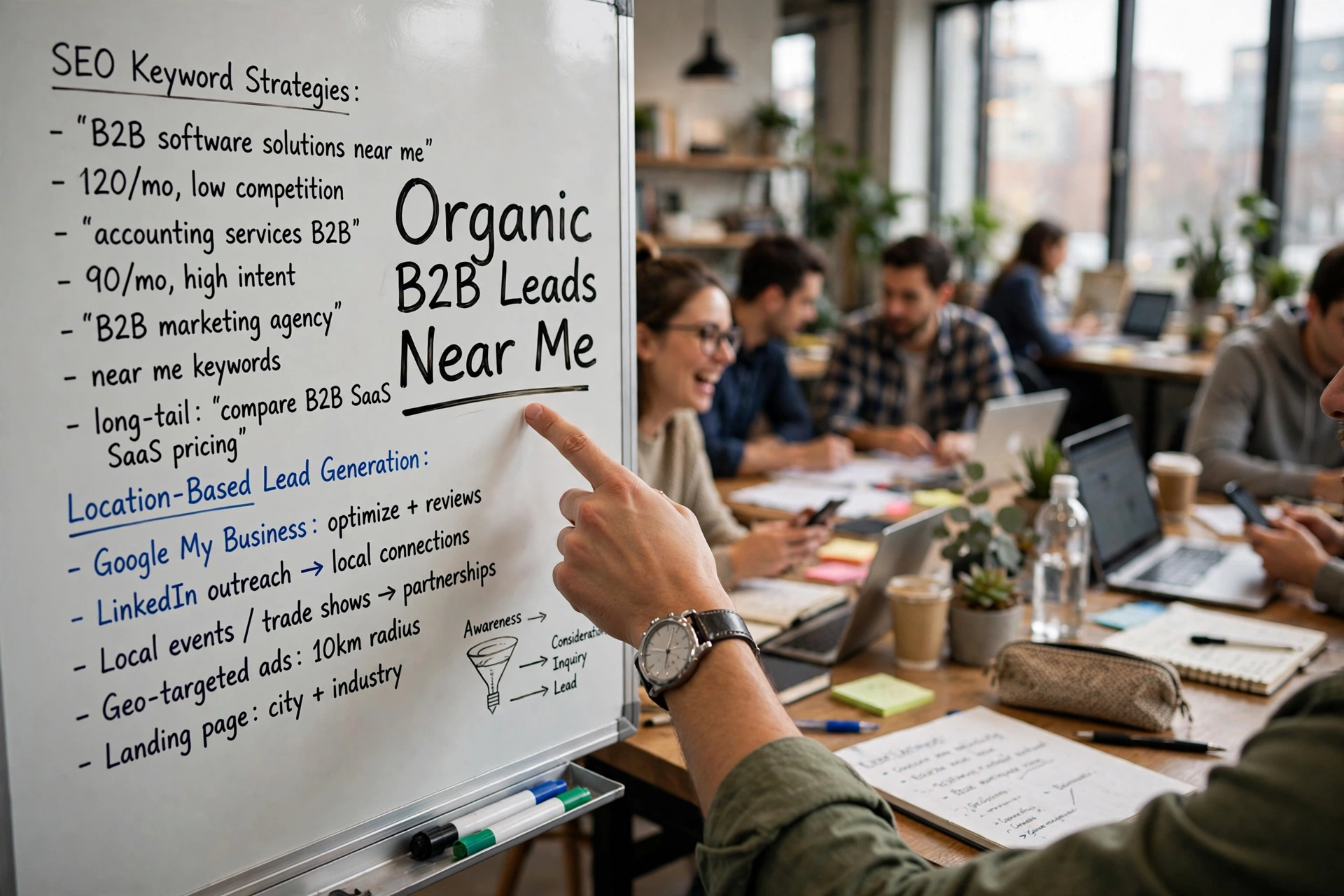
Yes. Local B2B leads are driven by "Proximity Intent." When a business owner searches for a service "near me," they are looking for reliability and accessibility. You must create dedicated local landing pages that mention specific cities, regional pain points, and local industry standards. Combining local SEO with a programmatic approach allows you to dominate an entire state or region quickly. Using the right tools can help you rank on google page 1 fast: 2026 small business growth guide.
Is LinkedIn still a viable place for organic B2B lead generation?
LinkedIn is excellent for "trust signals," but it is a poor environment for "discovery." People go to LinkedIn to network, not to solve an urgent business problem. The most effective strategy is to use Google to capture the intent and then use LinkedIn to validate your authority once the lead has already found you. If you rely solely on LinkedIn, you are limited by the algorithm's whim. An organic search engine strategy, however, creates a compounding asset that works while you sleep.
How does AI influence where B2B leads are found today?
AI has shifted the "where" from a list of blue links to a "single answer" experience (AEO - Answer Engine Optimization). Leads are now found in the citations of AI Overviews and Chatbots. To be the cited authority, your content must be structured with Schema.org markup and contain concrete data points. This is why generic content fails; AI engines prefer specific, structured data. If you want to automate this process, ai blog automation: keep your website updated without writing articles is the most efficient path.
Final Thoughts on How to Get B2B Organic Leads
Stop treating your organic growth as a side project and start treating it as an acquisition engine. The "where" of B2B lead generation is no longer a mystery, it is a map of buyer intent. If you are not occupying the specific, long-tail search environments where your clients are searching for answers, you are leaving your pipeline to chance.
The transition from "renting" leads via paid ads to "owning" them via organic authority is the only way to achieve sustainable, high-margin growth in 2026. By deploying a programmatic SEO strategy and pairing it with an autonomous AI SDR, you can transform your website from a digital brochure into a 24/7 sales machine.
If you are ready to stop the guesswork and start dominating your niche with algorithmic brute force, visit BizAI Intelligence. We help you build the SEO machine that fills your pipeline while you sleep.
Only 12 Onboarding Slots Remaining This Month
BizAI deploys 300 AI salespeople scoring purchase intent 24/7. Get your free niche domination blueprint.
AI Search Accelerator: 1-on-1 Strategy Session
Claim one of the 10 monthly slots. Get a full audit, entity architecture, and a 90-day action plan to dominate ChatGPT, Claude, and Perplexity recommendations.