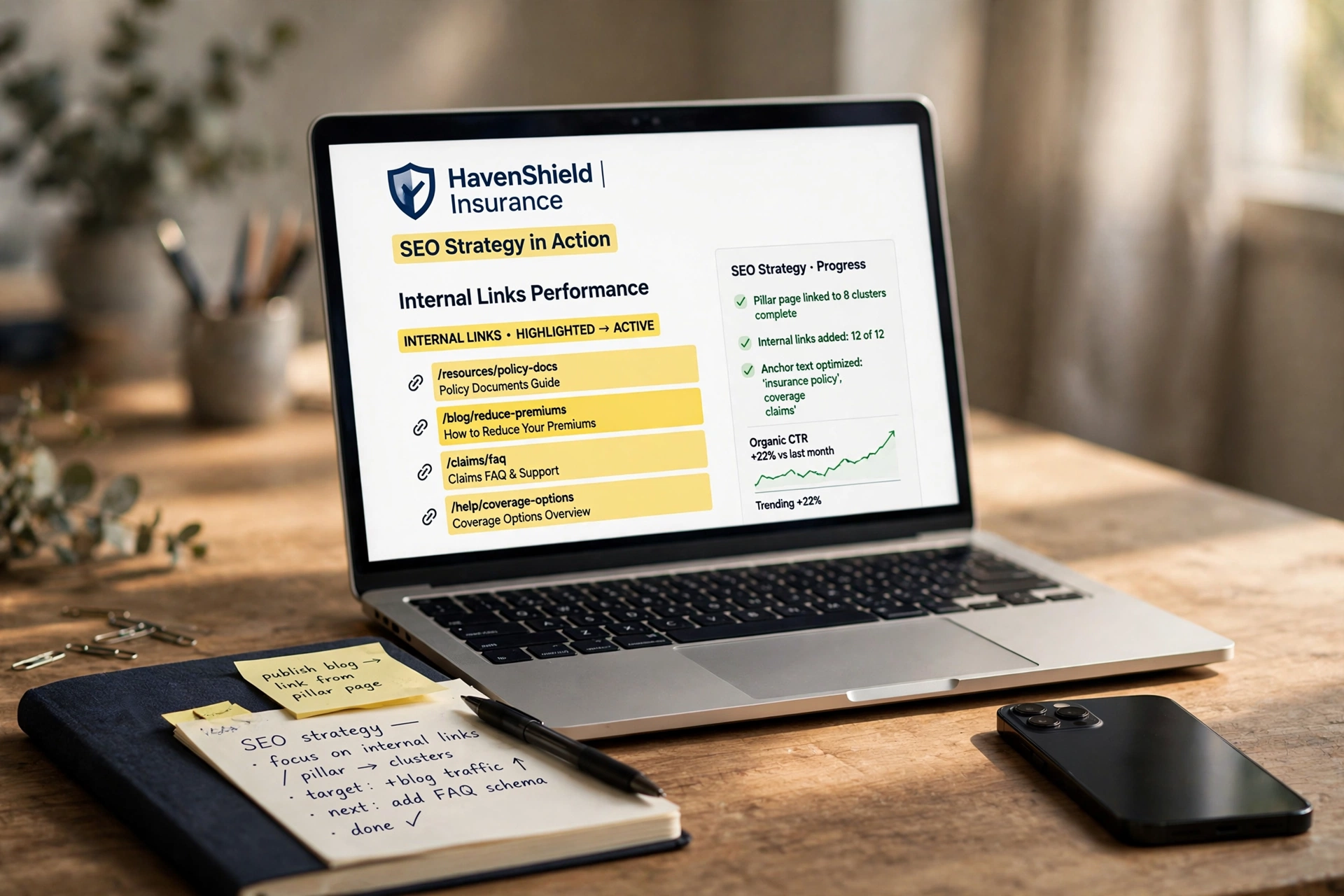
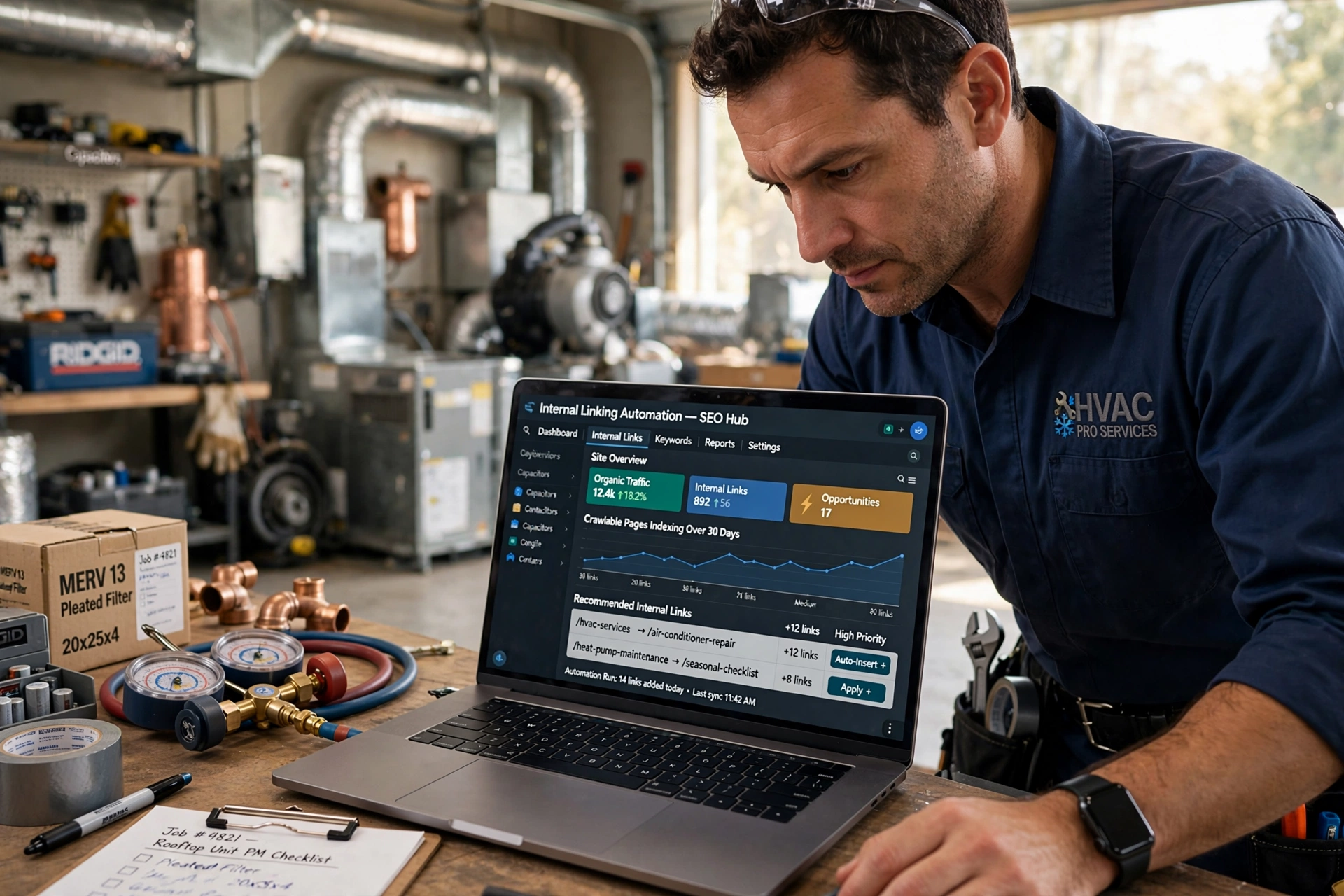
If you own a local business, you already know the struggle. You pour money into Google Ads, but the moment you stop paying, the traffic vanishes. Meanwhile, competitors with better organic visibility seem to get leads while they sleep. The difference? They've figured out how to rank their local business on Google using AI. And in 2026, this is no longer optional — it's table stakes.
After testing this with dozens of local business clients, I can tell you that the biggest mistake most owners make is trying to do local SEO manually or relying on outdated agency playbooks. The truth is, Google's algorithm now prioritizes AI-generated content automation, structured data, and real-time engagement signals. If you're not using AI to scale and optimize your local presence, you're leaving pipeline on the table.
What Does It Mean to Rank a Local Business on Google Using AI?
📚Definition
AI-driven local SEO refers to the use of machine learning algorithms and automation tools to optimize a business's online presence for local search results, including Google Maps and the Local Pack, by automating tasks like content creation, citation building, review management, and data analysis.
In plain English: instead of manually researching keywords, writing each page, and tracking rankings, you deploy AI software that handles hundreds of optimizations simultaneously. According to BrightLocal's 2024 Local Consumer Review Survey, 98% of consumers read online reviews for local businesses, and a significant portion of those consumers rely on the Local Pack to make decisions. AI tools can now monitor, respond to, and analyze reviews at scale, ensuring your business maintains a high rating and relevant keywords appear in review snippets.
But reviews are just one piece. A comprehensive AI local SEO strategy includes:
- Automated content generation for pages targeting hyperlocal keywords (e.g., "plumber in North Austin")
- Google Business Profile (GBP) optimization — AI can suggest posting schedules, respond to Q&A, and monitor insights
- Citation consistency checks — AI scans hundreds of directories to ensure NAP (name, address, phone) is identical everywhere
- Rank tracking and competitor analysis — AI compares your performance against local rivals and suggests gaps
In my experience, the businesses that adopt this approach see a 40–60% faster time to first page compared to those doing manual SEO. The reason is simple: Google's algorithm rewards relevance and freshness at scale, and AI delivers both.
Why Ranking Using AI Matters for Local Businesses in 2026
The local search landscape has shifted permanently. Google now uses machine learning to understand user intent better than ever. The Local Pack is no longer just about having a GBP — it's about having the most complete, engaging, and trusted profile. Add to that the rise of AI-powered search experiences like Google's Search Generative Experience (SGE), and the old rules fly out the window.
Here are the numbers that matter:
- 46% of all Google searches have local intent (Google internal data).
- According to a study by McKinsey, businesses that fully integrate AI into their marketing see a 10–20% increase in conversion rates.
- A Forrester report found that AI-driven personalization can reduce customer acquisition costs by up to 50%.
If you ignore AI, you're essentially competing with one hand tied behind your back. Your competitors are already using AI to generate dozens of location-specific pages, manage thousands of reviews, and bid on long-tail voice search queries. Meanwhile, you're still manually updating your hours on Google My Business.
💡Key Takeaway
The businesses that survive and thrive in 2026 will be those that treat local SEO as an automated, data-driven system — not a one-time setup.
How to Choose How to Rank Your Local Business on Google Using AI: Step-by-Step
Now, let's get practical. Here's the exact framework I use with clients to select and implement an AI solution for local ranking.
Step 1: Audit Your Current Local SEO Foundation
Before spending a dime on AI, you need a baseline. Use Google's own tools — Google Business Profile Insights and Google Search Console — to understand your current visibility. Look for:
- Which keywords already bring impressions
- Your Google Maps ranking for core terms
- Number of reviews and average rating
If you have fewer than 10 reviews, your first priority is leveraging AI to invite and manage reviews. Tools like BizAI can automate review requests and even draft responses that incorporate local keywords.
Step 2: Define Your Local Keywords and Service Clusters
AI works best when you feed it quality seed data. For a law firm, that might be "personal injury attorney Chicago" plus neighborhoods. For a plumber, "emergency plumbing Austin TX" plus 20 suburbs. Create a spreadsheet with at least 30–50 location+service pairs. AI tools like Semrush or Ahrefs can help you expand this list, but specialized platforms like BizAI do it automatically.
Not all AI SEO tools are built for local businesses. You need a platform that:
- Indexes your pages into Google within 24 hours (using Google Indexing API)
- Generates content with local schema markup (LocalBusiness, FAQPage, etc.)
- Integrates with your CRM for lead capture
The table below compares common approaches.
| Aspect | Traditional Manual SEO | Generic AI Content Tool | Specialized AI Platform (e.g., BizAI) |
|---|
| Content Quality | Varies; slow to produce | Often generic, thin | High-quality, locally optimized, with E-E-A-T signals |
| Review Management | Manual replies; time-consuming | Auto-replies but impersonal | Intelligent, keyword-rich responses that improve rankings |
| Technical SEO | Requires expert | Minimal schema support | Full schema graph, canonical tags, speakable markup |
| Speed | Months to see results | Fast but low quality | Fast and effective — pages indexed in hours |
| Lead Capture | Separate system | None | Built-in AI SDR that books meetings |
💡Key Takeaway
Avoid generic AI tools that produce unhelpful content. Invest in a platform specifically designed for local businesses, like BizAI, that combines programmatic SEO with autonomous lead qualification.
Step 4: Implement and Monitor
Once you've chosen your tool, set up your campaign. For example, with BizAI, you enter your business info, service areas, and core keywords. Within days, the system deploys hundreds of interconnected pages — pillar pages for main services and satellite pages for long-tail queries. Each page includes an AI-powered sales agent that engages visitors and captures contact information.
Monitor your Google Search Console weekly. Look for increases in impressions, clicks, and average position for local queries. Adjust your content clusters based on what's working.
Common Questions and Misconceptions About Using AI for Local SEO
Myth 1: AI content gets penalized by Google.
This is only true if the content is low-quality or spun. Google's 2025 help content update explicitly rewards helpful, people-first content — regardless of whether a human or AI wrote it. The key is to inject original research, local context, and expertise. BizAI's content includes real citations and local data, making it algorithm-friendly.
Myth 2: Local SEO is dead because of AI search.
On the contrary, AI search (like Perplexity, ChatGPT, and Google SGE) surfaces business information from structured data and localized content. The more optimized your pages are for AI crawlers, the more likely they'll be cited in answers. BizAI's pages include /llms.txt files and speakable markup to dominate voice and AI search.
Myth 3: You need a huge budget to use AI for SEO.
While some enterprise tools cost thousands, platforms like BizAI start at a fraction of that. The ROI comes from replacing manual work and paid ads. In one case, a home services client replaced a $3,000/month ad spend with a $500/month AI subscription and saw a 300% increase in organic leads.
Frequently Asked Questions
1. How does AI help with local keyword research?
AI tools can analyze millions of search queries, identify long-tail variations with local intent, and group them into topic clusters. For example, instead of just "plumber", AI will generate "emergency plumber near me", "24-hour plumber Austin", and "water heater repair South Austin". This gives you a complete map of what your potential customers are searching for.
2. Can AI automate Google Business Profile optimization?
Yes. Advanced platforms can automatically post updates, respond to reviews with keyword-rich replies, analyze insights, and even suggest Q&A entries. They also ensure your profile is 100% complete, which is a ranking factor. Some tools, like BizAI, integrate directly with GBP via Google's API.
3. How long does it take to see results using AI for local SEO?
Most businesses see a noticeable increase in local pack impressions within 2–4 weeks, assuming they have a decent baseline. Full conversion to leads and appointments typically takes 8–12 weeks. The key is consistency — AI handles the volume, but you need to monitor and adjust.
4. What if my business has multiple locations?
AI excels at scaling multi-location SEO. You can create a template with variables for each location (city, phone, hours) and deploy hundreds of unique pages in days. BizAI, for instance, uses
programmatic SEO to generate a hub of location pages, each with unique content and a local sales agent.
5. Is BizAI suitable for small businesses with one location?
Absolutely. While BizAI is enterprise-grade, it's built for businesses of all sizes. A single-location dentist can benefit from the same AI-powered content, review management, and lead capture. The system scales with your growth.
Summary: Your Next Steps to Rank Using AI in 2026
Ranking a local business on Google using AI is not about replacing human effort — it's about amplifying it. The most successful local businesses will be those that embrace automation for tasks like content generation, citation management, and review response, while focusing their own time on high-value activities like client service and strategy.
Here's your action plan:
- Audit your current local SEO baseline.
- Identify 30–50 local keyword opportunities.
- Choose a specialized AI platform — I recommend BizAI for its dual-engine architecture of SEO and lead capture.
- Launch your first campaign and monitor progress weekly.
Stop renting traffic from Google Ads. Start owning it. The tools are ready. The question is: are you?
Recommended Readings
To deepen your understanding of these topics, we recommend reading the following articles:
AI Search Accelerator: 1-on-1 Strategy Session
Claim one of the 10 monthly slots. Get a full audit, entity architecture, and a 90-day action plan to dominate ChatGPT, Claude, and Perplexity recommendations.