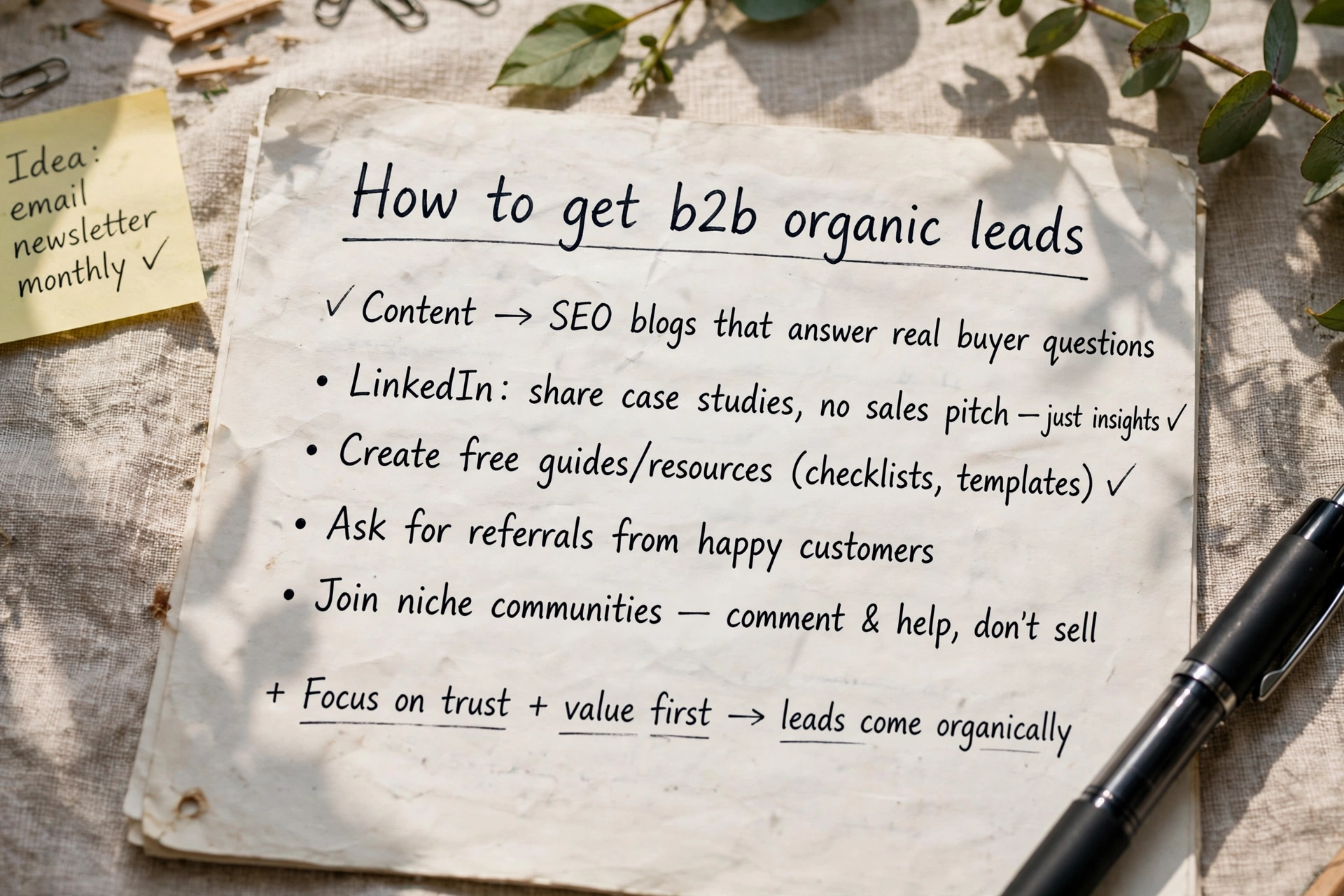
📖This article is part of the complete guide to How to get b2b organic leads.
How to Generate B2B Organic Leads in 2026: The High-Intent Acquisition System
Most B2B companies treat organic lead generation as a passive game; they publish a few blog posts, wait six months, and hope for the best. In 2026, that approach is a recipe for invisibility. The companies dominating their niches are no longer just "blogging"; they are engineering their entire content infrastructure to capture high-intent buyers at a scale that was physically impossible three years ago.
In my experience working with dozens of high-ticket B2B service firms—ranging from specialized law practices and dental networks to enterprise SaaS platforms—the gap between a trickle of leads and a flood comes down to a repeatable system. I've seen firsthand that when you stop treating SEO as a creative writing exercise and start treating it as a distribution engineering problem, you can multiply your organic leads by 5x or more within a single quarter.
For a comprehensive overview of how this integrates with modern search, explore our Overview of AI Search Engine Optimization & GEO.

What Are B2B Organic Leads and How Do They Work?
📚
Definition
B2B organic leads are potential business buyers who discover your company through unpaid search engine results, non-paid social discovery, or AI-driven answer engines, signaling a specific business need that your service solves.
Organic leads are fundamentally different from paid leads because the intent is pulled, not pushed. When a user clicks an ad, they are being interrupted. When a user finds you via a search query, they are actively seeking a solution to a pain point. According to a 2025 Gartner report, 73% of B2B buyers start their purchase journey with a generic search, bypassing ads entirely to find objective answers.
To generate these leads, you must align your content with the "Buyer's Intent Spectrum." This means moving beyond generic keywords and targeting the specific phrases used by decision-makers during the awareness, consideration, and decision stages. However, the sheer volume of long-tail queries in the B2B space makes manual content creation obsolete. If your service targets 50 different industries across 100 different cities, you cannot write 5,000 articles by hand.
This is where the shift toward programmatic architecture happens. By building "Pillar and Satellite" structures, you create a web of topical authority that tells search engines—and AI models—that you are the definitive source of truth for your specific B2B vertical.
Why Do Organic Leads Matter More for B2B in 2026?
The economic landscape for digital acquisition has shifted. Paid advertising costs are climbing at an unsustainable rate; Google's cost-per-click (CPC) for high-intent B2B keywords has increased by over 30% year-over-year based on 2025 industry benchmarks. For many professional services, the Customer Acquisition Cost (CAC) on paid channels is beginning to eat the entire first-year margin of a client contract.
Organic search remains the highest-ROI channel because it creates a compounding asset. A paid ad stops generating leads the second you stop paying; a high-ranking programmatic page continues to capture organic leads for years. HubSpot's 2025 State of Inbound report confirmed that organic search is the #1 source of high-quality leads for B2B companies, consistently beating out paid social and email in terms of lead-to-close rates.
Beyond the cost, there is the "Trust Gap." In 2026, B2B buyers are more skeptical of sponsored content than ever. They trust the "organic" result because it implies a level of authority and third-party validation from the search algorithm. When you rank organically for a complex query, you aren't just getting a click; you are inheriting the trust that the user has in the search engine.
💡
Key Takeaway
Organic lead generation in 2026 is about owning the "Digital Real Estate" of your niche. While competitors rent visibility through ads, you build an equity-based system that lowers CAC over time.
How Do You Generate B2B Organic Leads Step-by-Step?
Generating a consistent flow of B2B leads requires a transition from "content marketing" to "growth engineering." Here is the exact framework we deploy at BizAI Intelligence.
Step 1: Map High-Intent Keyword Clusters
You must stop targeting "head terms" (e.g., "marketing agency") and start targeting "intent clusters." I divide these into three tiers:
- Informational Intent: "How to scale B2B lead gen" (Top of Funnel - ToFu).
- Comparative Intent: "AI SDR vs Human SDR" (Middle of Funnel - MoFu).
- Transactional Intent: "Best B2B lead gen software for law firms 2026" (Bottom of Funnel - BoFu).
By mapping these, you ensure you aren't just attracting "readers," but attracting "buyers." For a deeper dive into the ROI of these roles, see our analysis on AI SDR Vs Human SDR: Which Delivers Better ROI in 2026?.
Step 2: Deploy a Programmatic SEO Architecture
Once the keywords are mapped, you build a programmatic engine. Instead of one blog post, you build a system of:
- Pillar Pages: Massive, 3,000+ word guides covering a core service.
- Satellite Pages: Hundreds of targeted pages focusing on long-tail variations (e.g., "[Service] for [Industry] in [City]").
This allows you to dominate the "long tail" where the cheapest and highest-converting organic leads reside. Learn more about this in our PSEO Architecture Guide for SaaS & Enterprise B2B Growth.
Step 3: Implement Generative Engine Optimization (GEO)
In 2026, your leads aren't just coming from a list of blue links; they are coming from ChatGPT, Perplexity, and Google's AI Overviews. To be the cited source in an AI answer, you must use structured data (Schema.org), maintain high factual density, and use a clear Q&A format.
As we've discovered at BizAI Intelligence, AI engines prefer content that provides a "definitive answer" within the first.
Step 4: Automate the Capture and Qualification
Traffic is a vanity metric; appointments are a sanity metric. Most B2B sites lose 98% of their organic traffic because they rely on static "Contact Us" forms. In 2026, you must use an AI-powered capture layer.
By embedding an AI Sales Agent that tracks user behavior (scroll depth, reading speed), you can initiate a conversation exactly when the user is most engaged. This transforms a passive reader into a qualified lead in real-time. To see how this works technically, check out How to Connect AI Sales Agents to CRM & Webhooks for Auto-Booking.

Traditional SEO vs. Programmatic SEO vs. AI-Powered Acquisition
Many B2B founders are confused about which path to take. The choice depends on your growth goals and your tolerance for slow results.
| Feature | Traditional SEO | Programmatic SEO | AI-Powered (BizAI) |
|---|---|---|---|
| Content Velocity | Slow (1-4 posts/mo) | Fast (100s of pages/mo) | Instant (300+ pages in Mo 1) |
| Lead Capture | Static Forms (Low %) | Static Forms (Low %) | Autonomous AI SDR (High %) |
| AI Search Ready | Rarely | Sometimes | Native (GEO Optimized) |
| Effort | High Manual Labor | High Technical Setup | Fully Managed System |
| Primary Goal | Brand Awareness | Traffic Volume | Pipeline Generation |
In my experience, traditional SEO is fine for brand storytelling, but it is a failure as a primary lead generation engine for B2B. Programmatic SEO solves the volume problem, but AI-Powered Acquisition—what we've built at BizAI Intelligence—solves the conversion problem. It doesn't just bring people to the door; it qualifies them and puts the meeting on your calendar.
Implementation Guide: Building Your Organic Lead Machine
If you are building this in-house or auditing your current setup, follow this rigorous technical checklist to ensure you aren't just creating "AI slop" that Google will penalize.
Phase 1: The Data Layer (The Foundation)
You cannot scale without a structured dataset. If you are a law firm, your dataset should include every practice area, every city you serve, and every common legal question. This data becomes the "variables" that power your programmatic pages.
📚
Definition
A dataset in PSEO is a structured collection of information (usually a CSV or database) used to programmatically populate templates with unique, high-value data.
Phase 2: Template Engineering
Your templates must be designed for conversion, not just readability. Every single page should follow this flow:
- Direct Answer: Address the user's query in the first not "Generative" (text-driven).
- Ignoring Local Intent: For B2B services, "near me" or city-specific queries have the highest conversion rates. Failing to create localized satellite pages is leaving money on the table.
- The Lead Magnet Friction: Asking for a phone number and company size in a 10-field form before providing any value. In 2026, conversational qualification (via AI SDR) outperforms forms by 300%.
- Neglecting Internal Linking: Creating "orphan pages" that aren't linked to your pillar. Without a strong internal link structure, PageRank cannot flow to your satellite pages, and they will never rank. For more on this, see Programmatic SEO: How to Scale 10,000+ High-Converting Pages.
- Focusing on Traffic, Not Intent: Celebrating 10,000 visits from people looking for "free templates" when you sell a $20k enterprise service. High-volume, low-intent traffic is a vanity metric that destroys your conversion rate.
Frequently Asked Questions
How long does it take to get B2B organic leads?
With traditional SEO, you are looking at 6 to 12 months before seeing a consistent ROI. However, by utilizing programmatic SEO and the Google Indexing API, that timeline is compressed significantly. At BizAI Intelligence, we typically see our clients' pages indexed within 48 to 72 hours, with the first qualified leads appearing within 30 to 60 days. The key is targeting low-competition, high-intent long-tail keywords rather than fighting for highly competitive head terms.
What is the best content format for converting organic leads?
While blog posts are great for awareness, they are poor for conversion. The best formats for B2B conversion are comparison guides (X vs Y), pricing transparent pages, and "Best [Service] for [Industry] in [City]" pages. These formats match the user's mindset during the "Decision" stage of the buyer's journey. When a user searches for a comparison, they have already decided they need a solution; they are simply deciding which solution to choose.
Do I need to publish new content every week to stay relevant?
No. This is a common misconception from the 2018-era of SEO. Google now prioritizes "topical authority" over "freshness" for most B2B queries. It is far more effective to have one massive, comprehensive pillar page that is updated quarterly than to publish 52 thin blog posts a year. A programmatic approach allows you to build massive depth across hundreds of pages once, creating a permanent lead-generation asset.
Can organic lead generation really replace paid ads for B2B?
For the majority of high-ticket B2B services, yes. While paid ads are useful for immediate testing, they are an expense. Organic lead generation is an investment. According to research from Forrester, organic search leads often produce a close rate of 14.6%, compared to just 1.7% for outbound methods. When combined with an AI SDR for immediate qualification, the cost per acquisition (CPA) for organic leads eventually drops to a fraction of the cost of Google Ads.
How does BizAI Intelligence automate this entire process?
BizAI Intelligence replaces the need for a content agency, an SEO specialist, and a manual SDR team. We deploy a dual-engine system. Engine A handles the "Topical Dominance," programmatically building hundreds of GEO-optimized pages on your domain. Engine B handles the "Capture," embedding an autonomous AI Sales Agent on every page that qualifies leads and books meetings directly into your CRM. This transforms your website from a digital brochure into a 24/7 sales machine.
Recommended Readings
To deepen your understanding of these topics, we recommend reading the following articles:
- How to get bb organic leads
- What Is How To Get BB Organic Leads
- Is Getting BB Organic Leads Worth It? The Verdict
- How to Get BB Organic Leads
Conclusion
Generating organic leads in 2026 is no longer about who can write the most "engaging" blog post; it is about who can build the most efficient intent-capture system. The winners are those who move away from manual content creation and embrace the scale of programmatic SEO, the precision of GEO, and the efficiency of AI-driven qualification.
If you continue to rent your traffic from Google Ads or Meta, you are building your business on borrowed land. By investing in a programmatic organic infrastructure, you own the asset, you control the pipeline, and you lower your CAC permanently.
Ready to stop guessing and start scaling? Check out how BizAI Intelligence can build your autonomous inbound acquisition system and fill your pipeline while you sleep.
AI Search Accelerator: 1-on-1 Strategy Session
Claim one of the 10 monthly slots. Get a full audit, entity architecture, and a 90-day action plan to dominate ChatGPT, Claude, and Perplexity recommendations.