📖This article is part of the complete guide to AI Customer Service: The Complete Guide to 24/7 Automated Support.
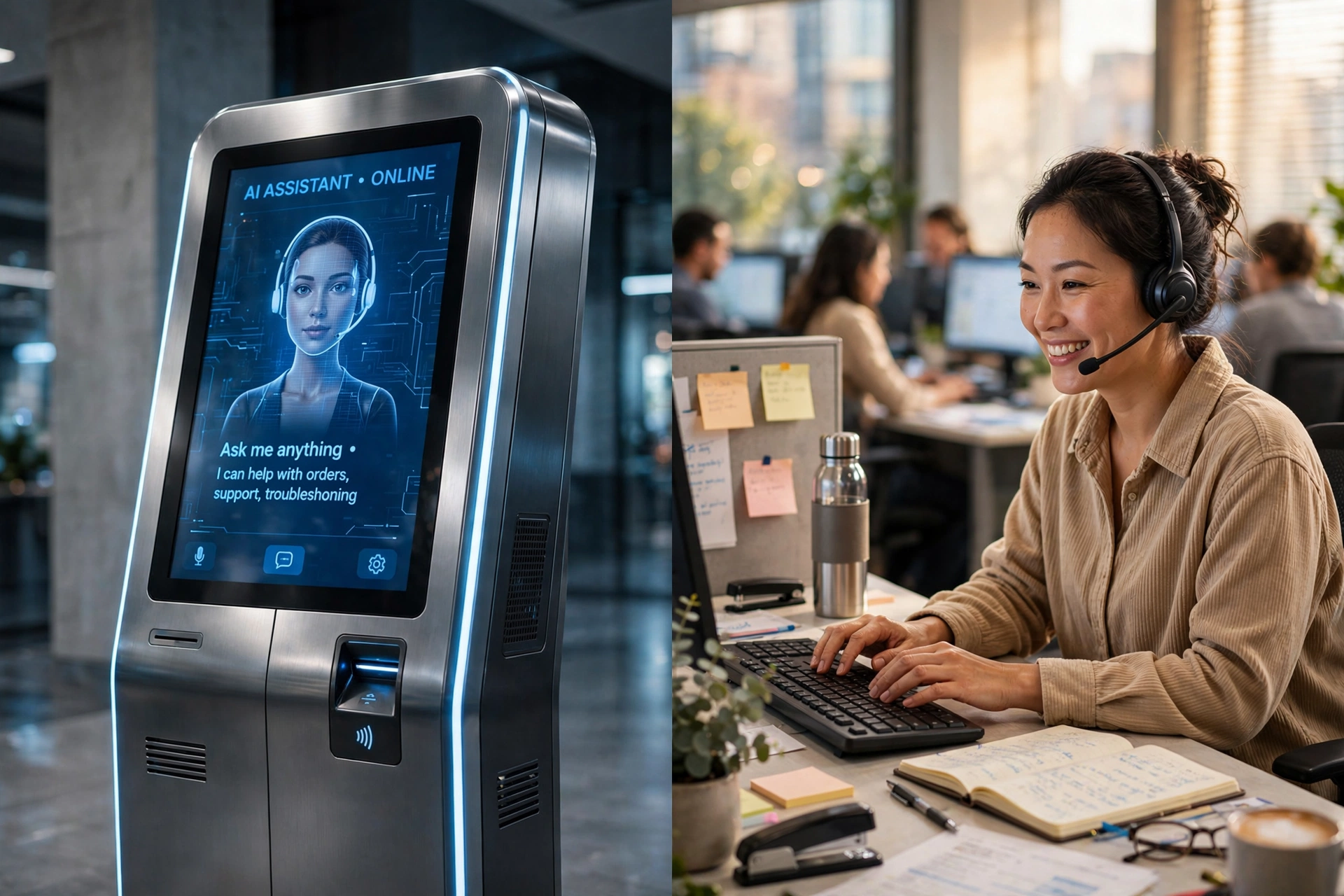
I recently analyzed a B2B portfolio where the company had pivoted entirely to a fully automated chatbot system. On paper, their resolution speed was breathtaking, but their churn rate had quietly climbed by 12% over six months. The clients didn't hate the AI; they hated the feeling of being trapped in a loop when their problem became complex. This is the classic 'automation trap.' The most successful enterprises in 2026 aren't replacing humans with AI; they are using a hybrid AI human customer service model to ensure that efficiency never comes at the cost of empathy.
For a comprehensive overview of how this fits into your broader strategy, explore our guide on AI customer service.
What is Hybrid AI Human Customer Service?
📚
Definition
Hybrid AI human customer service is a strategic operational model where artificial intelligence handles high-volume, repetitive queries and initial triage, while human agents are dynamically looped in for complex problem-solving, emotional escalation, and high-value account management.
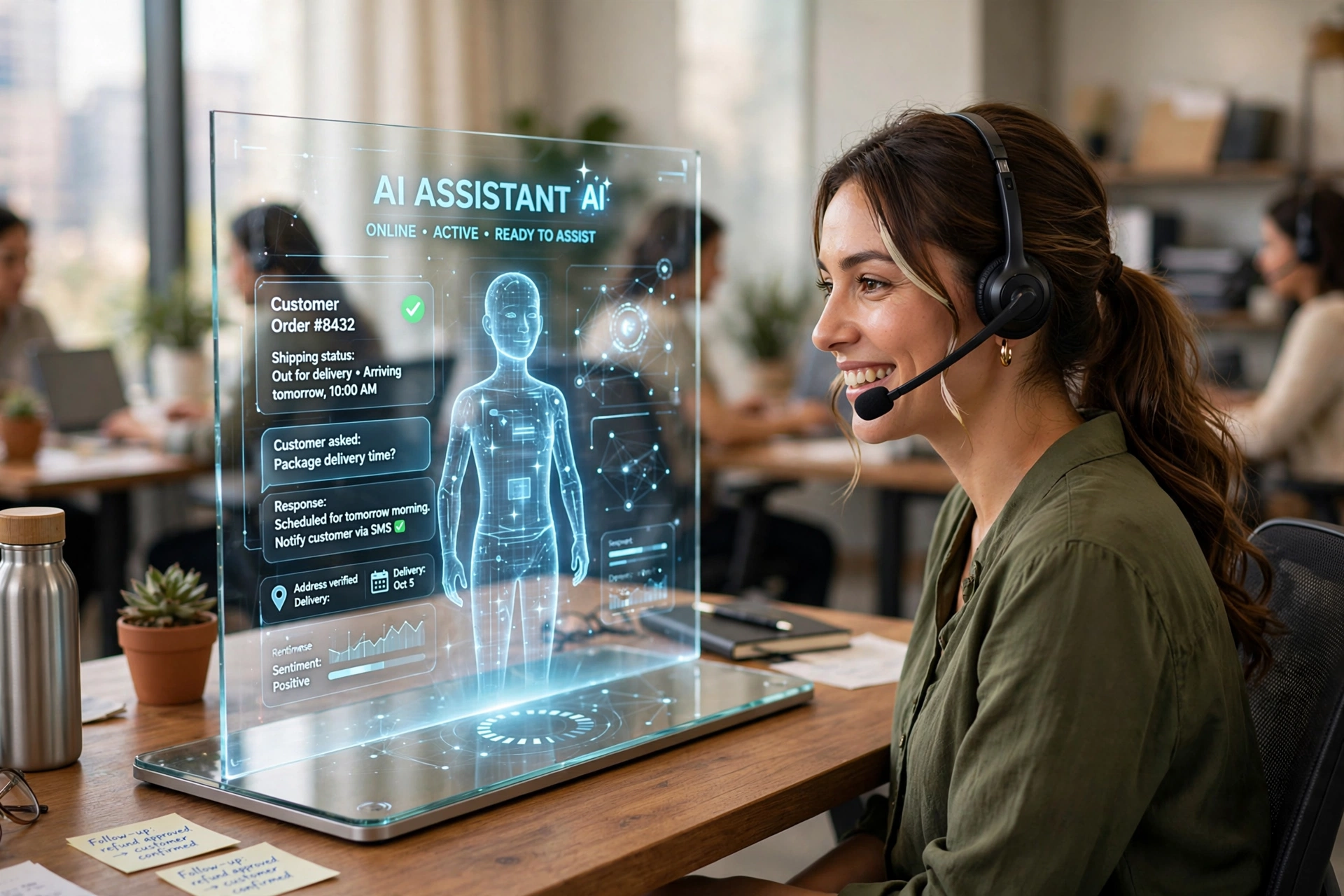
At its core, a hybrid model is not just about having a chatbot and a support team; it is about the seamless handover between the two. In a poorly implemented system, the transition is a jarring "Press 0 for an agent," which often results in the customer having to repeat their entire problem. In a true hybrid architecture, the AI acts as a sophisticated front-end layer—utilizing a Large Language Model (LLM) to analyze intent, sentiment, and urgency—and then passes a full transcript and summarized context to the human agent in real-time.
In my experience building growth engines at BizAI Intelligence, I've seen that the most effective hybrid systems use AI not just for the customer, but for the agent. This is often called "Agent Assist." While the customer sees a polished interface, the agent sees an AI-powered dashboard suggesting the best responses, pulling data from the CRM, and flagging potential churn signals before the human even speaks. This synergy allows a single agent to handle three times the volume of tickets without sacrificing the quality of the interaction.

This approach leverages the brute force of digital marketing and SEO to bring in leads, but keeps the human touch to close and retain them. When you combine the scale of programmatic SEO architecture for SaaS with a hybrid support model, you create a flywheel where organic acquisition meets high-retention service.
Why Does a Hybrid Model Matter for Your Business in 2026?
The primary reason hybrid AI human customer service is essential is that it solves the "Empathy Gap." While AI can solve a password reset in three seconds, it cannot navigate the nuance of a frustrated enterprise client who is losing thousands of dollars per hour due to a system outage. According to research from Gartner, companies that integrate AI into their customer service workflows see a significant increase in agent productivity and a decrease in turnover, as humans are freed from the soul-crushing boredom of answering the same five questions 400 times a day.
From a technical perspective, the hybrid model protects your brand from the "hallucination risk" inherent in LLMs. Even the most advanced AI can occasionally misinterpret a complex policy or invent a feature that doesn't exist. By having a human-in-the-loop (HITL) system, you create a safety net. The AI handles the 80% of simple queries, and the human provides the final verification for the 20% of high-stakes interactions.
Furthermore, the hybrid approach is a massive driver of Life Time Value (LTV). When a customer feels that a company is "AI-first" but "Human-centered," trust increases. This trust is what allows you to scale your inbound efforts. If you are using AI lead generation tools to fill your pipeline, the last thing you want is for those high-intent leads to hit a wall of generic AI responses that make them feel like a number.
Consider the operational impact on your bottom line. A fully human team is unscalable and expensive. A fully AI team is efficient but risky and often cold. The hybrid model optimizes the cost-per-ticket by routing low-value tasks to the AI and reserving expensive human hours for high-value tasks. This is precisely why many businesses are now shifting their focus toward AI SDR vs human SDR ROI calculations, as the same logic applies to sales: AI opens the door, humans close the deal.
How to Implement a Hybrid AI Human Customer Service Workflow
Implementing a hybrid system requires more than just buying a software license; it requires a redesign of your customer journey. The goal is to create a "frictionless escalation path." Here is the professional framework for deployment:
-
Intent Mapping and Triage: Start by analyzing your last 1,000 tickets. Categorize them by "complexity" and "emotional weight." Simple queries (billing dates, status updates, basic troubleshooting) are assigned to the AI. Complex queries (technical bugs, contract disputes, high-churn risk) are flagged for immediate human intervention.
-
The Contextual Handover: Ensure your AI tool integrates directly with your CRM. When a ticket is escalated, the human agent must receive a "Briefing Note" generated by the AI. This note should include: the customer's goal, the steps the AI already tried, and the detected sentiment (e.g., "Frustrated," "Confused," "Urgent").
-
Agent-Side AI Augmentation: Deploy AI as a co-pilot. Instead of the AI talking to the customer, the AI suggests three possible answers to the agent, who then selects, edits, and sends the best one. This maintains the human voice while gaining the speed of AI.
-
Feedback Loops for LLM Training: Every time a human agent corrects an AI's mistake during a handover, that correction should be fed back into the training set. This is how you reduce the need for human intervention over time.
For those looking to automate the front end of this process, understanding how to automate organic traffic and lead capture with AI is the first step in ensuring the right people enter your hybrid funnel in the first place.
💡
Key Takeaway
The success of a hybrid model is measured not by how many tickets the AI closes, but by how seamlessly the customer moves from AI to human without repeating themselves.
Comparing Service Models: Traditional vs. Generic AI vs. Hybrid
To understand the value proposition, we must look at the trade-offs between the three dominant strategies in the current market.
| Feature | Traditional Human Support | Generic AI Chatbots | Modern Hybrid Model |
|---|---|---|---|
| Response Time | Slow (Queue-based) | Instant | Instant $\rightarrow$ Fast |
| Scalability | Linear (Hire more people) | Infinite | Exponential |
| Empathy | High | Low/None | High (Targeted) |
| Accuracy | High (but inconsistent) | Variable (Hallucination risk) | Highest (AI Speed + Human Audit) |
| Cost per Ticket | Very High | Very Low | Optimized/Balanced |

As the table demonstrates, the Generic AI approach often fails because it sacrifices accuracy and empathy for cost. In contrast, the Hybrid model uses AI to eliminate the "wait time" while utilizing humans to eliminate the "error rate." This is the only sustainable path for B2B companies that rely on high-ticket contracts. If you are managing a complex product, you cannot afford the brand damage that comes from a hallucinating chatbot.
Common Mistakes to Avoid in Hybrid Implementations
In my years of consulting for enterprise growth, I have seen several recurring failures that turn a promising hybrid system into a customer service nightmare. Avoiding these is essential for maintaining a high CSAT.
Mistake 1: The "Hidden" Human.
Many companies try to hide the fact that they use AI, only offering a human agent after the customer has failed five times to get an answer. This creates a sense of betrayal. Be transparent. Tell the customer: "I'm your AI assistant; I can solve most things instantly, but I can bring in a specialist if we hit a wall." Transparency builds trust.
Mistake 2: Ignoring the Agent's Experience.
If you use AI to increase the volume of tickets an agent must handle without giving them better tools, you will burn out your best staff. AI should be used to remove the "grunt work," not to turn humans into faster processors of AI-filtered tickets. The goal is to allow agents to do the deep, creative problem-solving they were hired for.
Mistake 3: Poor Integration with CRM.
An AI that doesn't know the customer's history is just a fancy FAQ page. If the AI doesn't know that the customer has a Gold-tier subscription and had a major outage yesterday, it will treat them like a stranger. This is why we emphasize connecting AI sales agents to CRM and webhooks to ensure a unified data layer across the entire customer journey.
Mistake 4: Set-and-Forget Mentality.
LLMs evolve, and so does customer behavior. A hybrid system requires weekly auditing. You must review the "handover points" to see where the AI is failing. If 40% of users are asking for a human at the same point in a flow, your AI is failing that specific intent, and the prompt needs optimization.
Mistake 5: Over-automating the "High-Value" Moments.
There are moments in the customer lifecycle—like a contract renewal or a major complaint—where AI should be completely bypassed. Attempting to use AI for these "moment of truth" interactions is a recipe for churn. Ensure your system has a "VIP Route" that sends high-LTV customers directly to a human.
Frequently Asked Questions
How does a hybrid model improve CSAT scores?
A hybrid model improves Customer Satisfaction (CSAT) by removing the two biggest pain points in support: long wait times for simple questions and robotic, unhelpful answers for complex ones. By using AI to provide instant answers for routine queries, you eliminate the queue. Simultaneously, by routing complex issues to humans who have the full AI-generated context, you ensure the customer feels heard and understood. This balance of speed and empathy is the primary driver of high satisfaction ratings in 2026.
Can a hybrid AI system actually reduce operational costs?
Yes, significantly. While you still maintain a payroll for human agents, the "cost per resolution" drops because the AI handles the bulk of the volume. Instead of hiring ten new agents to handle a 20% increase in traffic, you can scale your AI capacity and keep your human team lean, focusing them only on high-impact tickets. This allows the business to grow revenue without a linear increase in support overhead, effectively decoupling growth from operational cost.
What is the ideal ratio of AI to human interactions?
There is no one-size-fits-all ratio, but for most B2B SaaS companies, the goal is an 80/20 split. AI should resolve 80% of the initial touchpoints (FAQs, status checks, basic navigation), while humans handle the 20% that require critical thinking or emotional intelligence. If your human ratio is too high, you aren't leveraging the efficiency of AI; if it's too low, your churn rate will likely increase due to a lack of human connection.
How do I handle the transition from AI to a human agent?
The transition must be "invisible" to the customer in terms of effort. The AI should say, "I'm bringing in our technical lead, Sarah, who can help with this specific bug. She has the history of our conversation and will be with you in a moment." The human agent should then open the conversation with a summary: "Hi, I see you're having trouble with the API integration on your Enterprise account; let's fix that." This proves the company is attentive and efficient.
Is a hybrid model suitable for small businesses?
Absolutely. In fact, it's often more essential for small businesses that cannot afford a 24/7 support team. A small business can use a sophisticated AI to maintain a professional, instant presence around the clock, while the founder or a single employee handles the critical escalations during business hours. This allows a small team to punch well above its weight class, providing enterprise-level responsiveness without the enterprise-level headcount.
Conclusion
In 2026, the debate is no longer about "AI vs. Human." The real winners are those who understand that AI provides the scale and humans provide the soul. By implementing a hybrid AI human customer service model, you protect your brand from the coldness of total automation and the inefficiency of total manual labor. You create a system where the AI handles the noise so the humans can handle the signal.
If you are ready to stop renting traffic and start building an autonomous acquisition and retention engine, it's time to look at the bigger picture. The hybrid model is just one piece of a larger strategy involving programmatic scale and AI-driven qualification. For the full blueprint on how to dominate your niche, return to our Complete Guide to AI Customer Service and start building your organic authority hub today.
For more information on scaling your business with these technologies, visit BizAI Intelligence.
AI Search Accelerator: 1-on-1 Strategy Session
Claim one of the 10 monthly slots. Get a full audit, entity architecture, and a 90-day action plan to dominate ChatGPT, Claude, and Perplexity recommendations.