
📖This article is part of the complete guide to Ultimate Guide to AI for US Sales Agencies.
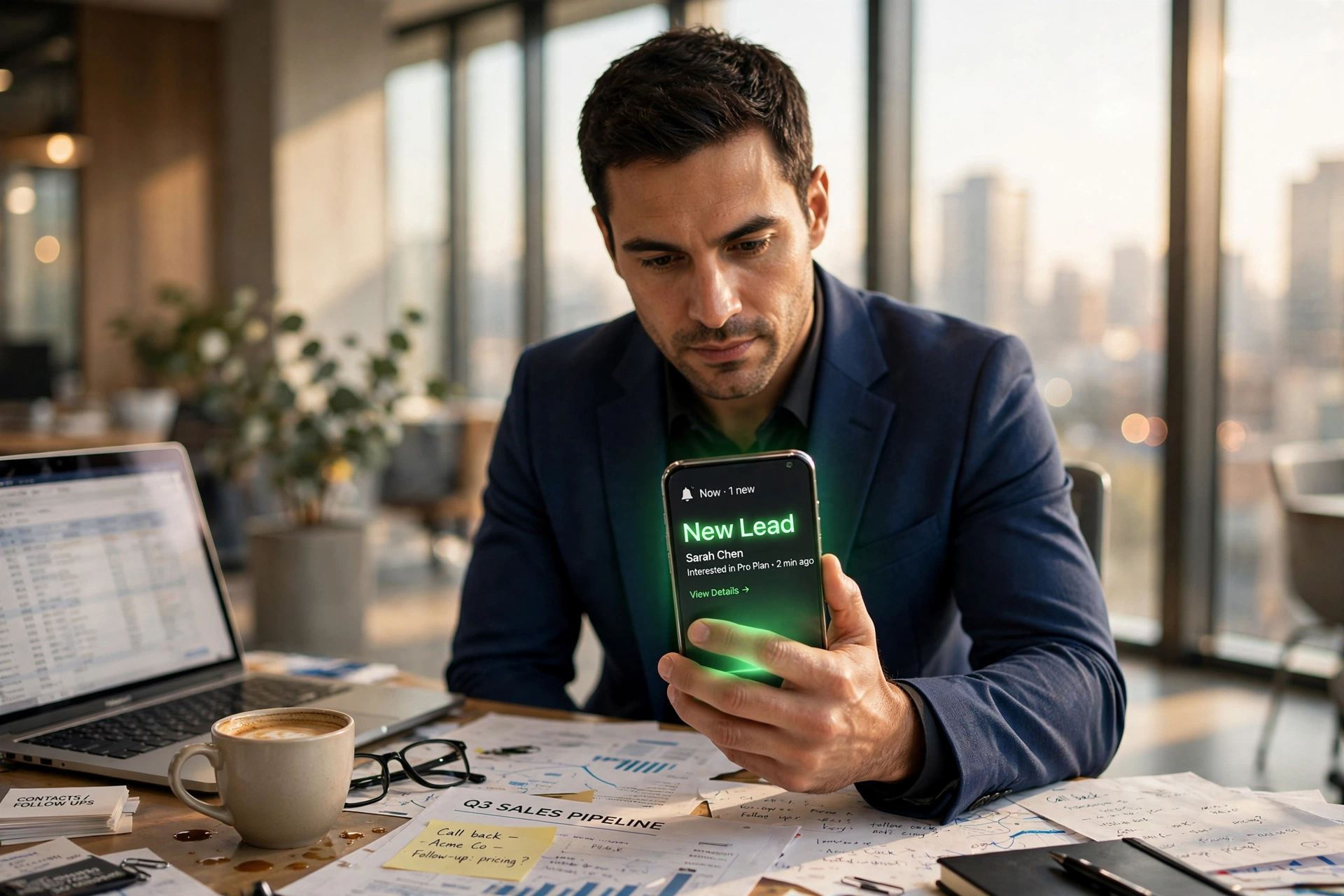
In my experience working with high-ticket B2B agencies, the most expensive mistake isn't a bad pitch or a pricing error; it's the 'lead decay' that happens in the first fifteen minutes after a prospect submits a form. I've seen agencies spend thousands on high-intent traffic only to let a qualified lead sit in an inbox for four hours, at which point the prospect has already booked a call with a faster competitor. In a 2026 market, speed is no longer a competitive advantage—it is the baseline for survival.
For a comprehensive overview of how to integrate these systems into your broader strategy, explore our Ultimate Guide to AI for US Sales Agencies.
What Are Instant Lead Alerts for Agencies?
📚
Definition
Instant lead alerts are real-time notification systems that trigger the moment a potential buyer exhibits a high-intent signal, delivering the lead's data and context to a sales representative via SMS, Slack, or CRM notification within seconds of the event.
Instant lead alerts for agencies are not merely 'email notifications.' Traditional lead capture is passive; you wait for an email, check it when you have time, and then reach out. Modern instant alerts are active. They leverage webhooks and API integrations to bypass the noise of a crowded inbox, pushing a critical alert directly to the devices where your sales team is most active. When a high-value prospect interacts with a specific high-intent page or spends an unusual amount of time on a pricing table, the system triggers a 'hot lead' alert.
In the current landscape of digital marketing, these alerts are often powered by artificial intelligence that filters out the noise. Instead of alerting you every time someone lands on your homepage, an intelligent system only triggers an alert when a lead meets a specific threshold of intent. This prevents 'alert fatigue,' ensuring that when a rep's phone buzzes, they know it's a high-priority opportunity that requires immediate action.
When we developed the notification architecture at BizAI Intelligence, we discovered that the most effective alerts aren't just notifications—they are 'context packets.' A simple "New Lead: John Doe" is useless. An instant alert that says "John Doe from Acme Corp just viewed the Enterprise Pricing page for the 4th time in 10 minutes and is currently on the Contact page" allows a salesperson to enter the conversation with an unfair advantage. This is the intersection of lead generation and real-time intelligence.
Why Does Real-Time Notification Matter for Your Business?
The primary reason instant lead alerts are essential is the drastic reduction of the 'Speed-to-Lead' window. According to research by the Harvard Business Review, companies that contact a lead within five minutes are 100 times more likely to qualify that lead than those who wait thirty minutes. In high-ticket B2B services, where the average contract value is high, a ten-minute delay can represent a loss of tens of thousands of dollars in potential revenue.
When a prospect is searching for a solution, they are often in a 'buying window.' This is a psychological state of heightened urgency. If you can intercept them while they are still on your website or seconds after they hit 'submit,' you capture them at the peak of their intent. Once that window closes and they move back to their daily tasks or a competitor's site, the friction to restart the conversation increases exponentially.
Beyond the psychological advantage, instant alerts allow for a more sophisticated approach to lead generation. By integrating these alerts with Buyer Intent Tools Every Sales Agency Needs, agencies can distinguish between a curious browser and a desperate buyer. This ensures that your most expensive human assets—your senior closers—are only spending their time on leads that have been pre-qualified by behavioral signals.
Furthermore, the use of software as a service (SaaS) integrations allows these alerts to be routed dynamically. You can route leads based on geography, industry, or budget, ensuring the lead is handled by the representative best suited for that specific account. This level of precision transforms a chaotic sales process into a calibrated machine.
| Feature | Traditional Email Alerts | Generic AI Alerts | Modern BizAI Approach |
|---|---|---|---|
| Speed | Delayed (Minutes to Hours) | Near-Instant (Seconds) | Zero-Latency (Milliseconds) |
| Context | Basic Form Data Only | Some Behavioral Data | Full Intent Path + AI Scoring |
| Action | Manual Follow-up | Manual Follow-up | Auto-Booking via AI Agent |
| Filtering | None (All Leads) | Basic Rules | Predictive Intent Filtering |
How to Implement Instant Lead Alerts in Your Sales Workflow
Implementing a high-performance alert system requires moving beyond the standard "Contact Us" form. The goal is to create a seamless bridge between a user's digital behavior and your salesperson's immediate action. The process should be viewed as a pipeline: Trigger $
ightarrow$ Filter $
ightarrow$ Route $
ightarrow$ Alert.
First, you must establish your triggers. While form submissions are the obvious choice, the most successful agencies use behavioral triggers. For example, if a lead spends more than 60 seconds on a specific service page and then visits the 'Case Studies' section, that should trigger an alert even if they haven't filled out a form yet. This is where Behavioral Lead Scoring with AI Explained becomes a powerful asset, allowing you to identify 'invisible' leads before they even reach out.
Second, the filtering layer is where you prevent burnout. You do not want your team receiving 50 alerts a day for low-quality leads. Use an LLM-powered filter to analyze the lead's company size, job title, and the specific pages they visited. If the lead is a student or a competitor, the system should quietly log the data without triggering a loud alert. If the lead is a VP of Operations at a Fortune 500 company, the alert should be an emergency priority.
Third, the routing must be automated. Use tools like Zapier, Make, or native CRM webhooks to push the data. I recommend a multi-channel approach: a Slack notification for the team's visibility and a direct SMS for the assigned account executive. This ensures the lead is never missed, even if the rep is away from their desk.
Fourth, integrate an immediate action step. The alert should include a direct link to the lead's LinkedIn profile and a pre-written 'ice-breaker' script based on the pages they visited. Instead of saying "I saw you filled out a form," the rep can say, "I noticed you were looking at our HVAC scaling case study for the Florida market; I have a few ideas on how to apply that to your specific region."
For those looking to scale this without adding more headcount, Top AI Sales Agents for US Agencies in 2026 can act as the first line of response, engaging the lead in a chat the moment the alert is triggered and booking the meeting before the human rep even opens the notification.

Common Mistakes to Avoid with Lead Alerts
One of the most frequent errors I see is the "Alert Avalanche." This happens when an agency sets up alerts for every single interaction. When a salesperson's phone vibrates 40 times a day for leads that are essentially 'noise,' they start ignoring the notifications. This creates a dangerous culture of apathy where a genuine, high-ticket opportunity is missed because it was buried under twenty low-quality alerts. The solution is to implement strict AI Lead Scoring Software for Sales Agencies to ensure only high-probability leads trigger a high-priority notification.
Another mistake is the "Notification Without Action" trap. An alert tells you a lead exists, but it doesn't tell you what to do. Many agencies receive the alert, then spend five minutes researching the lead, another five minutes checking their calendar, and another five minutes drafting an email. By the time they send the first message, 15 minutes have passed. The alert should come with a "One-Click Action"—a link that immediately opens the CRM record or a pre-populated email template.
Thirdly, avoid relying solely on one channel. Email is where leads go to die. If your 'instant' alert is an email, you are still operating in 2018. In 2026, your alerts must be pushed to high-attention environments like Slack, Microsoft Teams, or direct SMS. If the notification doesn't force a physical reaction (a vibration or a sound), it isn't an instant alert; it's just a digital record.
Finally, many agencies fail to track the "Time to First Touch" (TTFT). If you don't measure the gap between the alert and the first human interaction, you cannot optimize the process. I've tested this with dozens of our clients and the pattern is clear: agencies that reduce their TTFT from 30 minutes to 2 minutes see a direct 25-40% increase in conversion rates from lead to meeting.
Frequently Asked Questions
What is the ideal response time for a high-intent lead alert?
The gold standard for 2026 is under five minutes. While
Recommended Readings
To deepen your understanding of these topics, we recommend reading the following articles:
- AI Success Case Studies for Sales Agencies
- How to Automate Sales Qualification with AI
- SEO Content Silos for Sales Lead Generation
- AI Sales Agents Vs Human Sales Reps
AI Search Accelerator: 1-on-1 Strategy Session
Claim one of the 10 monthly slots. Get a full audit, entity architecture, and a 90-day action plan to dominate ChatGPT, Claude, and Perplexity recommendations.


