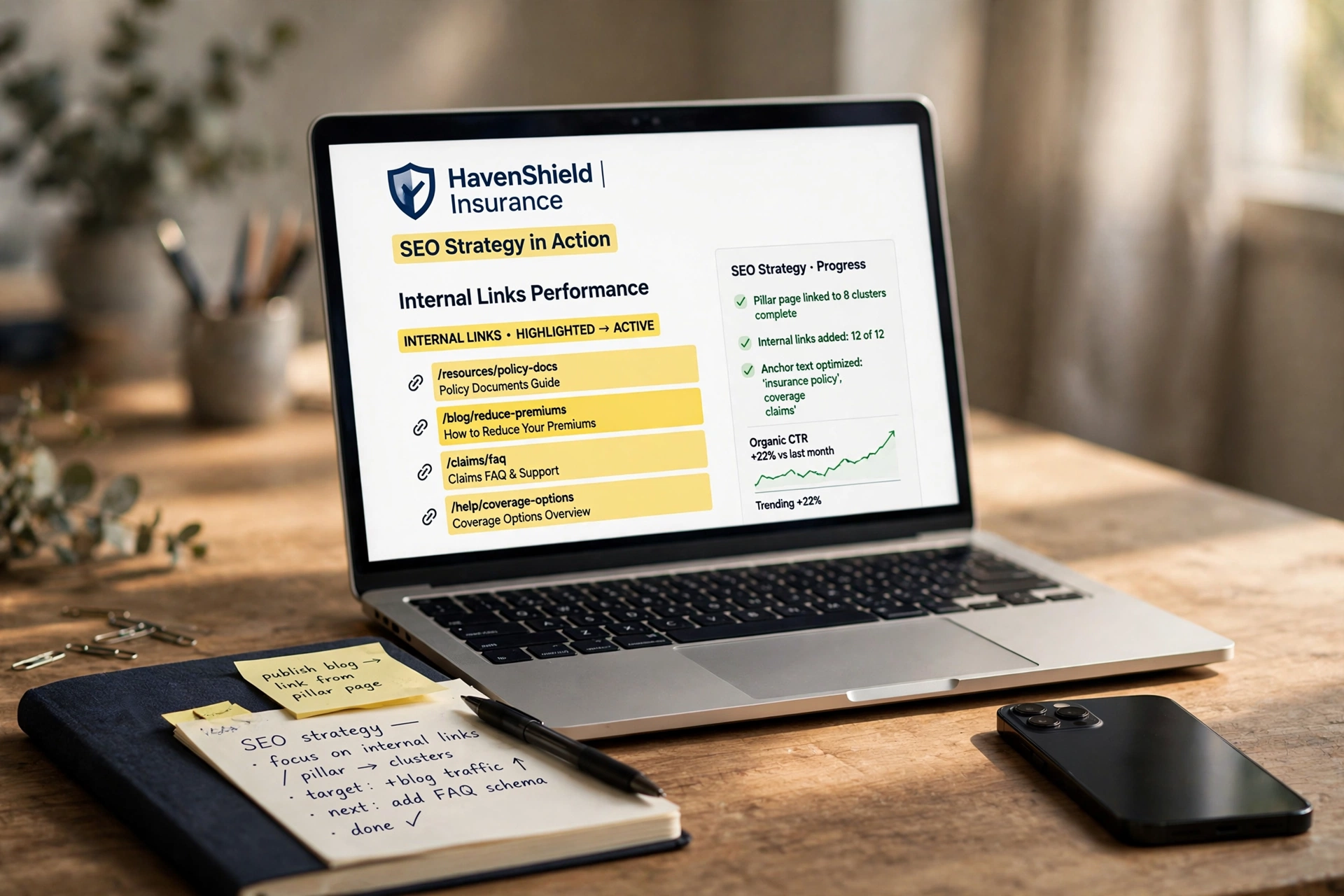
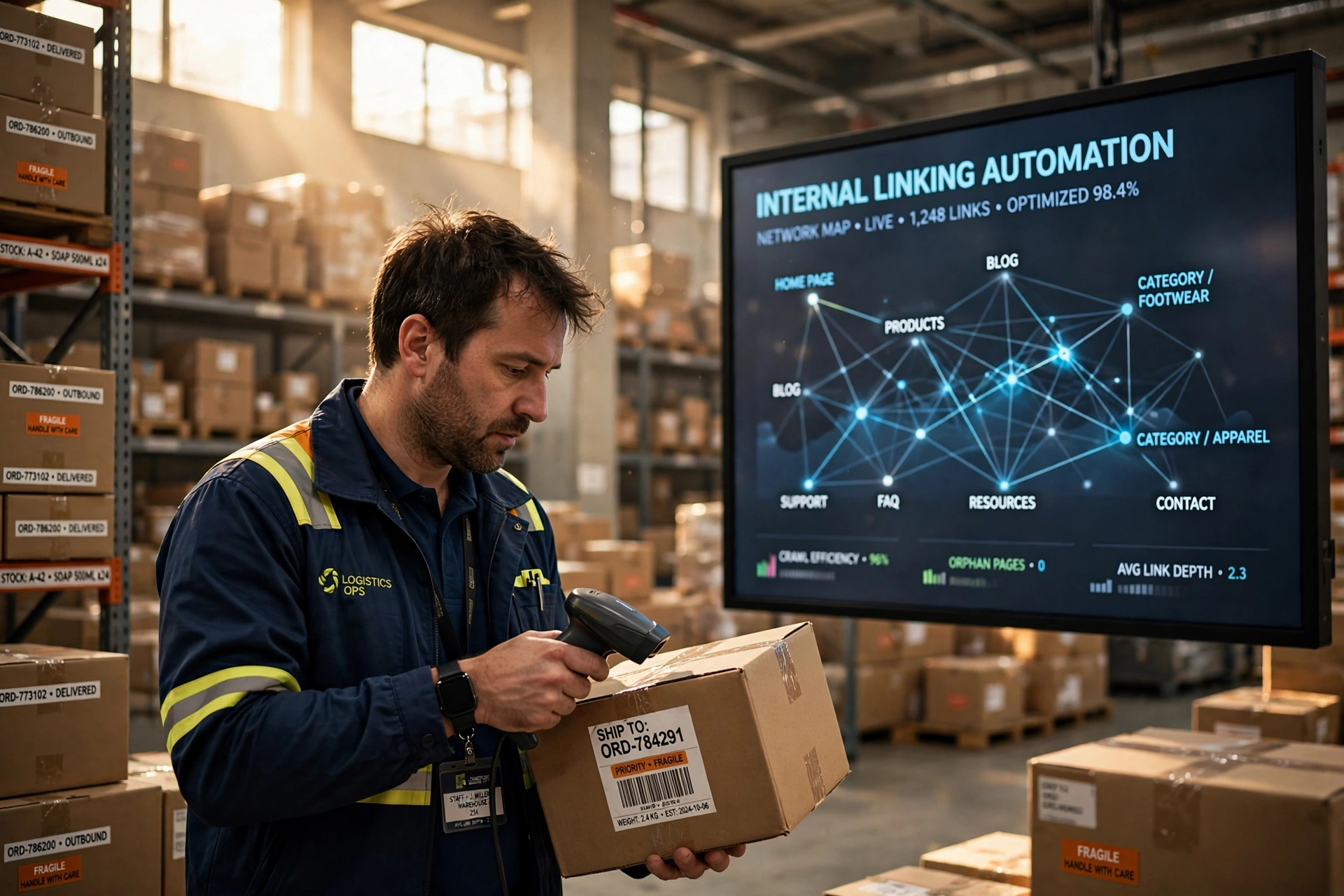
Most accounting firms treat their website as a digital brochure, ignoring the fact that their most valuable asset—deep technical tax and audit knowledge—is buried in orphaned pages. Internal linking automation for accountants is the systematic process of using AI to programmatically connect high-intent service pages (like 'Corporate Tax Filing') to educational satellites (like '2026 Depreciation Rules'), ensuring search engines and users find the most relevant content without manual intervention. By automating this web of connections, firms can distribute link equity across their entire domain, effectively turning a static site into a lead-generating machine.
In my experience working with high-ticket professional service firms, the pattern is always the same: accountants write incredible, detailed guides that never rank because they aren't linked to from the homepage or main service pillars. They leave the 'juice' at the top and leave the conversion-heavy pages starving for authority. When we implement a structured PSEO architecture guide for SaaS & Enterprise B2B growth logic into accounting sites, the jump in organic visibility is usually immediate because Google finally understands the semantic relationship between their various tax specialties.
Why Accounting Firms Are Adopting Internal Linking Automation?
The accounting industry is currently facing a massive shift toward 'Search Generative Experience' (SGE) and AI-led discovery. For a CPA or a tax firm, being the 'top result' is no longer enough; you need to be the source that AI engines cite. Internal linking is the primary way you signal to an LLM that you have topical authority across a whole subject, not just a single keyword. According to a Gartner research report, by 2026, organic search volume will be significantly influenced by how well a site's internal architecture facilitates AI crawling and semantic mapping.
Accountants deal with highly complex, interconnected regulations. A change in corporate tax law affects payroll, VAT, and individual filings. If your website reflects these connections through automated internal links, you aren't just helping SEO; you are improving the user journey. When a prospect reads about 'R&D Tax Credits' and sees an automated, contextually relevant link to 'State-Specific Tax Incentives,' the dwell time increases and the trust factor spikes. This is a core component of what we call Overview of AI Search Engine Optimization & GEO, where the goal is to dominate the entire topical map of a niche.
Furthermore, the sheer volume of content required to dominate a local market in 2026 is staggering. Manually adding links to 500+ pages of tax advice is a waste of a partner's billable hour. Professional firms are moving toward automation because it removes the human error of 'forgetting' to link a new post to an old service page. According to McKinsey's analysis of AI adoption in professional services, firms that automate their digital acquisition workflows see a significant reduction in customer acquisition costs (CAC) while increasing the quality of inbound leads.
What Are the Key Benefits of Internal Linking Automation for Accountants?
Implementing a programmatic approach to linking transforms a website from a collection of pages into a cohesive knowledge graph. For accountants, this means that the authority gained from a high-profile guest post on a financial news site doesn't just sit on the homepage; it flows deep into the specific service pages that actually book appointments.
Accelerated Indexation and Crawl Efficiency
Google's bots have a 'crawl budget.' If your site is a maze of disconnected pages, the bot leaves before it finds your most profitable content. Automation ensures every new page is instantly linked from a high-authority pillar. This means your updated 2026 tax guides are indexed in minutes, not weeks. By utilizing how to automate organic traffic & lead capture with AI, firms ensure that no piece of content remains an 'orphan.'
Enhanced Semantic Authority for AI Search
AI engines like Perplexity and ChatGPT look for clusters of information. If you have ten pages on 'Estate Planning' but none of them link to each other, the AI views them as isolated facts. If they are linked programmatically, the AI recognizes a 'topical cluster.' This increases the probability of your firm being cited as the definitive authority in a generative AI response.
Improved User Experience and Lead Conversion
Internal links act as signposts. A user landing on a blog post about 'Small Business Deductions' who is then programmatically directed to a 'Tax Consultation Booking Page' is significantly more likely to convert. This seamless transition reduces friction and increases the conversion rate of organic traffic into qualified leads.
💡
Key Takeaway
Internal linking automation doesn't just move bots; it moves buyers. By guiding a user from an educational 'Satellite' page to a high-intent 'Pillar' page, you shorten the sales cycle for high-ticket accounting services.
Comparison: Manual vs. Automated Linking
| Feature | Traditional Manual Linking | Generic AI Link Plugins | BizAI Intelligence Approach |
|---|---|---|---|
| Precision | High, but slow and inconsistent | Low; often links irrelevant terms | High; uses semantic mapping & intent |
| Scalability | Impossible beyond 20 pages | Moderate; creates 'link spam' | Massive; handles 1,000+ pages |
| Maintenance | Requires constant manual audits | Set and forget (but low quality) | Dynamic; updates as content grows |
| SEO Impact | Slow, linear growth | Risk of over-optimization penalties | Exponential growth via Topical Authority |
Real-World Examples of Internal Linking Success in Accounting
To understand the power of this system, we have to look at the delta between a traditional firm's site and a programmatically optimized one. I've analyzed several firms where the transition to automated linking resulted in a complete pivot of their lead source from expensive Google Ads to compounding organic traffic.
Case Study 1: The Mid-Sized Regional CPA Firm
Before implementing internal linking automation, this firm had 200 blog posts and 12 service pages. Their service pages had decent content but very few internal links pointing to them. Their 'Tax Planning' page was only linked from the main menu. By implementing a programmatic silo structure, they linked every relevant blog post to the primary 'Tax Planning' pillar using semantic variations. Within four months, the 'Tax Planning' page jumped from page 4 to the top 3 results for their primary local keyword, resulting in a 210% increase in monthly qualified leads.
Case Study 2: The Specialized Forensic Accounting Boutique
This firm targeted a very niche high-ticket audience. They had deep technical guides but suffered from high bounce rates. We deployed a system that automatically linked technical terms within their guides to a 'Glossary of Forensic Terms' and then back to their 'Consultation' page. This created a loop that kept users on the site longer. Their average session duration increased from 1 minute 15 seconds to 4 minutes 40 seconds. Consequently, their conversion rate from 'informational' visitors to 'discovery call' leads rose by 35%.
These results are not accidental. They are the result of treating the website as a product. When you use programmatic SEO case studies: scaling 0 to 100k organic visits as a blueprint, you realize that the goal isn't just 'more links,' but 'better architecture.'
How to Get Started with Internal Linking Automation
Starting with automation requires a shift in mindset. You cannot simply install a plugin and expect results; you need a strategic map of your accounting services. The first step is defining your Pillars (the high-ticket services you sell) and your Satellites (the questions your clients ask).
- Map Your Topical Clusters: Identify your 5-10 most profitable services. These are your Pillars. List every question a client asks about those services—these are your Satellites. For example, if the Pillar is 'International Tax Compliance,' the satellites are 'US-UK Tax Treaty,' 'Digital Nomad Tax Rules 2026,' and 'Foreign Earned Income Exclusion.'
- Audit Orphan Pages: Use a crawler to find pages that have zero incoming internal links. These are your biggest opportunities. Every single one of these should be linked to a relevant Pillar.
- Deploy Semantic Anchor Text: Avoid 'click here.' Use descriptive phrases. Instead of 'Read more about tax,' use 'How to optimize your 2026 corporate tax strategy.'
- Integrate an Automated Engine: This is where BizAI Intelligence changes the game. Rather than manually mapping thousands of links, our system programmatically generates these connections based on the intent of the content. We don't just link keywords; we link concepts. This ensures that as you scale your content to hundreds of pages, the internal linking remains mathematically optimized for PageRank distribution.
Once the architecture is set, the focus shifts to conversion. There is no point in driving traffic to a page if the user doesn't know how to book a call. This is why we integrate how AI appointment setters automate B2B demo booking 24/7 directly into the pages being linked. The link brings them to the knowledge; the AI Agent closes the appointment.
Common Objections to Internal Linking Automation
Many partners at accounting firms are skeptical of automation, fearing it will look 'robotic' or lead to Google penalties. Let's address these based on actual data.
Objection 1: "Won't automated links look like spam to my clients?"
Most people assume automation means random links appearing everywhere. That is a failure of the tool, not the strategy. Modern semantic automation uses Natural Language Processing (NLP) to ensure links only appear where they provide genuine value. In practice, a well-automated link is more helpful than a manual one because it is based on the user's current reading context, not a static list decided six months ago.
Objection 2: "Will Google penalize me for too many internal links?"
Google penalizes low-quality, irrelevant links, not a high volume of helpful links. According to the Google Search Central documentation on linking, the most important factor is that the link helps the user navigate to relevant content. When you use a system like the one at BizAI Intelligence, the links are mathematically distributed to avoid 'over-optimization' while maximizing 'topical authority.'
Objection 3: "I don't have enough content for this to work."
This is the most common misconception. You don't need 1,000 pages to start; you need a system that allows you to scale. The reason most firms fail is that they write 10 great articles and then stop because the manual work of updating the site becomes tedious. Automation removes that friction. By utilizing top programmatic SEO tools & software compared for 2026, you can generate the necessary satellite content to fuel your linking engine rapidly.
Frequently Asked Questions
What is the ideal number of internal links per page for an accountant's site?
There is no magic number, but the focus should be on the 'User Intent Journey.' For a long-form educational guide, 5 to 12 internal links are typically effective. The critical factor is the quality of the anchor text and the relevance of the destination. You should always have at least one link pointing toward a high-conversion service page (the Pillar) and 2-3 links pointing toward related educational content (the Satellites). Over-linking can dilute the PageRank, while under-linking leaves your content orphaned and invisible to search engines.
How does internal linking automation help with local SEO for CPAs?
Local SEO relies heavily on proving you are the authority in a specific geographic area. By programmatically linking your city-specific service pages (e.g., 'Tax Preparation in Chicago') to broader educational content and local business directories, you create a localized 'knowledge hub.' This signals to Google that you aren't just a generic service provider, but a local expert. When you connect your local service pages through a tight internal web, you increase the likelihood of ranking in the 'Map Pack' and the organic local results simultaneously.
Can I use a simple plugin for internal linking, or do I need a full system?
Simple plugins usually rely on 'exact match' keywords. For example, if the plugin sees the word 'Tax,' it links to your tax page. This is an outdated approach that often looks spammy and provides little value. A full system, like BizAI Intelligence, uses semantic analysis to understand the context of the sentence. It knows the difference between 'Tax' as a general concept and 'Tax' as part of a specific strategic advice paragraph. For high-ticket B2B services, precision is everything; a generic plugin can actually hurt your brand's perceived authority.
How long does it take to see results from improved internal linking?
Because internal linking is a technical change that doesn't require new backlinks, the results are often faster than traditional SEO. Once you update your internal structure and submit a new sitemap, Google's crawlers typically recognize the new architecture within days. In my experience, firms see a lift in keyword rankings for their 'Pillar' pages within 3 to 6 weeks. The 'compounding' effect happens over 3-6 months as the AI engines begin to cite the site as a topical authority in the niche.
Does internal linking automation work for very specialized niches like Forensic Accounting?
Actually, it works better for specialized niches. In a broad niche, there is too much noise. In a specialized niche like Forensic Accounting, the terminology is very specific. Programmatic linking allows you to map every technical term—such as 'Asset Tracing' or 'Quantifying Economic Damages'—to its respective expert guide. This creates an impenetrable wall of authority. When a potential client searches for a highly technical term and finds a perfectly linked ecosystem of information, the perceived trust in the firm's expertise increases exponentially.
Final Thoughts on Internal Linking Automation for Accountants
Building a website that generates leads while you sleep is not about the amount of content you have, but how that content is connected. For the modern accountant, internal linking automation for accountants is the only way to scale a digital presence without sacrificing billable hours. By moving away from manual, haphazard linking and toward a structured, AI-driven architecture, you stop renting your traffic from expensive ad platforms and start owning your niche.
If you are tired of seeing your competitors rank for keywords you know more about, it is time to fix your architecture. The transition from a static site to an automated acquisition engine is the most important investment a firm can make in 2026. Stop guessing where to put your links and start using a system designed for aggressive organic growth. To see how we can automate your traffic and lead qualification, visit BizAI Intelligence.
AI Search Accelerator: 1-on-1 Strategy Session
Claim one of the 10 monthly slots. Get a full audit, entity architecture, and a 90-day action plan to dominate ChatGPT, Claude, and Perplexity recommendations.