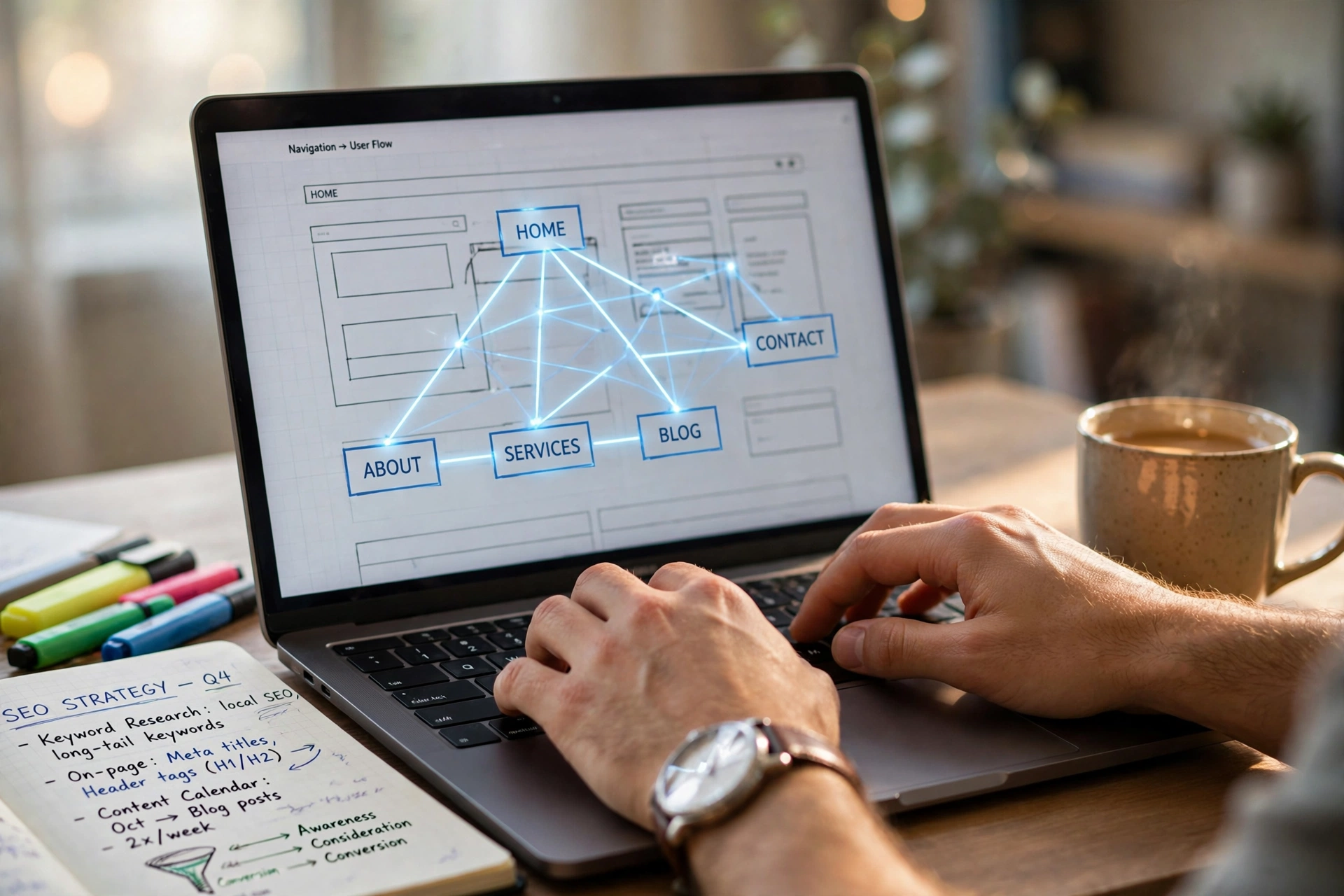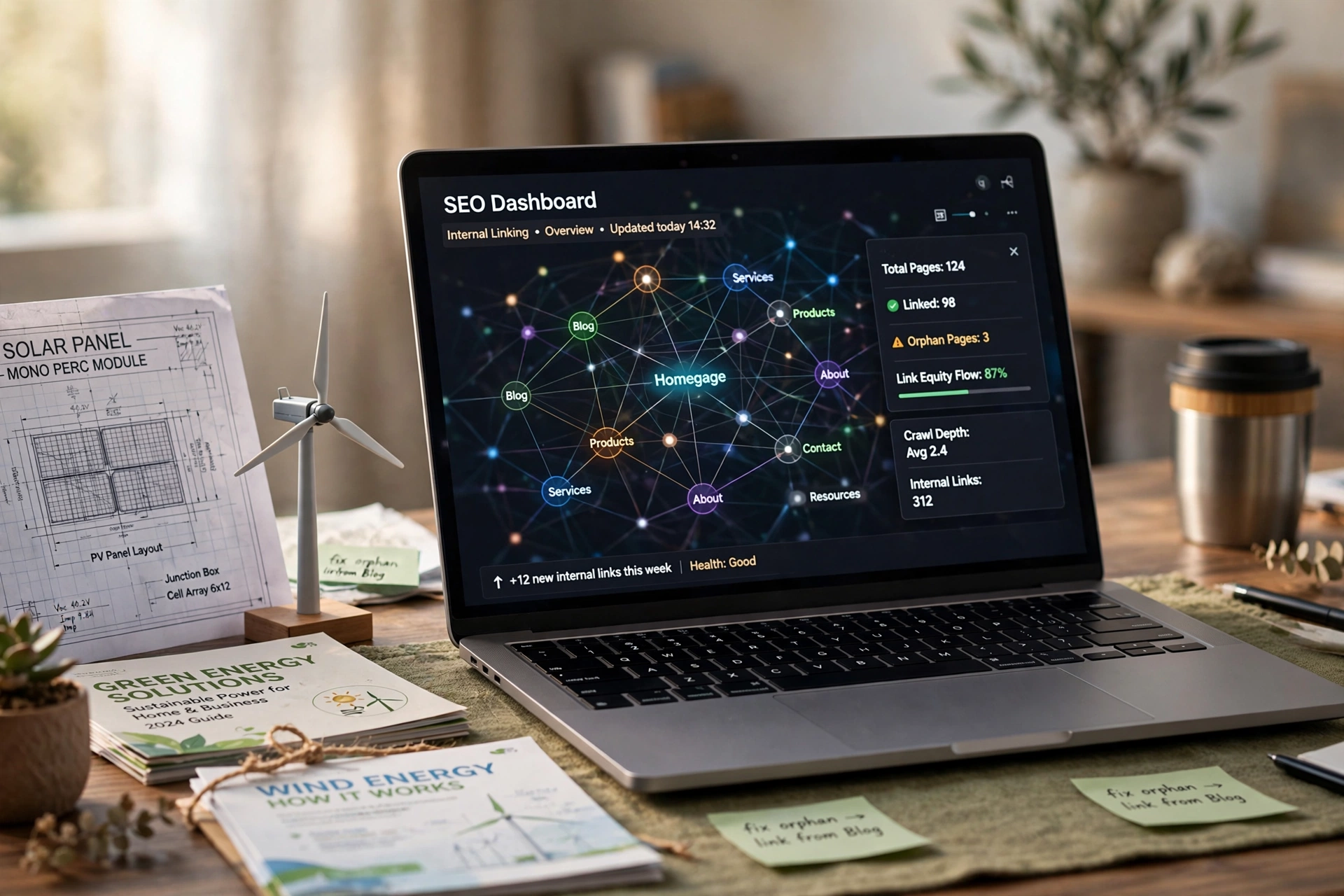
Solar installers and wind farm developers often possess thousands of pages of technical specifications and regional landing pages, yet most of that equity is trapped. Internal linking automation for clean energy providers is the systematic use of AI and programmatic logic to interconnect high-authority pillar pages with long-tail satellite content, ensuring that search engines and users can navigate the entire service ecosystem without friction. By automating the distribution of PageRank, providers can move from stagnant organic growth to a compounding traffic machine that qualifies leads 24/7.
In my experience working with clean energy businesses, the biggest bottleneck isn't a lack of content; it is a lack of connectivity. I've seen firms produce 500+ pages on 'commercial solar incentives in Texas' only to have those pages sit in isolation, never receiving the authority needed to rank on page one. When we implement a structured internal linking framework, we aren't just adding links; we are building a topical map that signals absolute authority to Google's algorithms.
To truly dominate the search landscape in 2026, providers must move beyond manual linking. This is why many are now integrating Overview of AI Search Engine Optimization & GEO to ensure their architectural links align with how generative AI models perceive topical clusters.
Why Clean Energy Providers Are Adopting Internal Linking Automation?
The clean energy sector is currently facing a massive surge in information density. As governments push for net-zero targets, the volume of regulatory data, rebate programs, and technical hardware specifications has exploded. For a B2B provider, this creates a 'content sprawl' problem where critical conversion pages are buried under layers of technical documentation. According to a recent Gartner report on digital transformation, companies that implement structured data and automated internal architectures see a 25% increase in user engagement and a significant reduction in bounce rates across complex service silos.
In the current market, the competition for 'commercial solar' or 'industrial wind energy' keywords is fierce. However, the real opportunity lies in long-tail, decision-stage queries. When a provider automates their internal links, they ensure that a user landing on a niche page about 'monocrystalline vs polycrystalline panels for warehouses' is immediately guided toward a high-converting consultation page. Without this automation, the user journey ends at the information stage, and the lead is lost.
Furthermore, the shift toward Generative Engine Optimization (GEO) has made internal connectivity a requirement rather than a luxury. LLMs and AI search engines do not just look at keywords; they look at the relationship between entities. If your page on 'Battery Storage' is not programmatically linked to your 'Grid Integration' and 'Tax Credit' pages, the AI perceives your brand as having fragmented knowledge. According to McKinsey's analysis of AI-driven growth, structured internal connectivity allows businesses to maintain a 'single source of truth' that AI agents can easily cite, directly impacting how brands appear in AI-generated summaries.

What Are the Key Benefits for Clean Energy Businesses?
Automation solves the scalability problem. Manually auditing 1,000 pages to ensure every 'solar rebate' mention links to the main rebate pillar is a waste of human capital. By using programmatic logic, clean energy providers can maintain a perfect link equity distribution across their entire domain regardless of how many new pages they publish.
Accelerated Crawl Budget Efficiency
Google's crawlers have a finite amount of time to spend on any given site. In the clean energy niche, where sites often include massive PDF catalogs and technical spec sheets, the crawl budget is often wasted on low-value pages. Internal linking automation ensures that the 'link juice' flows directly to the most important conversion pages. By creating a logical hierarchy of pillars and satellites, you essentially provide a map to the crawler, telling it exactly which pages are the most valuable.
Enhanced User Experience and Lead Journey
For a B2B buyer, the path from 'curiosity' to 'contract' involves significant research. A CFO looking at a solar investment isn't just looking for a price; they are looking for ROI data, case studies, and regulatory compliance. When internal linking is automated, the site dynamically suggests the next logical step in the buyer's journey. For example, a reader on a page about 'Net Metering' is automatically linked to a 'Cost-Benefit Calculator' and then to an 'Appointment Booking' page. This reduces friction and increases the conversion rate of organic traffic.
Dominating Long-Tail Keyword Clusters
Most clean energy providers target 5-10 main keywords. However, the highest-intent leads are often searching for very specific, long-tail phrases. By deploying a programmatic SEO strategy, providers can create hundreds of satellite pages targeting these specific queries. When these satellites are automatically linked back to the main pillar, they create a 'topical authority hub' that is nearly impossible for competitors to displace. This is the core logic behind a PSEO Architecture Guide for SaaS & Enterprise B2B Growth, which applies equally to high-ticket energy services.
💡
Key Takeaway
Internal linking automation transforms a flat website into a multidimensional authority hub, forcing search engines to recognize your brand as the definitive expert in the clean energy vertical.
Comparison of Linking Approaches
| Feature | Manual Linking | Generic AI Plug-ins | BizAI Intelligence Approach |
|---|---|---|---|
| Scalability | Low (Slow, error-prone) | Medium (Often creates irrelevant links) | High (Programmatic, intent-based) |
| Strategic Control | High (But tedious) | Low (Black box logic) | Absolute (Pillar-Satellite Architecture) |
| SEO Impact | Linear growth | Unpredictable/Risk of spam | Exponential (Compounding equity) |
| Maintenance | Constant manual audits | Occasional updates | Fully Automated/Self-healing |
Real Examples from the Clean Energy Sector
To understand the impact of this approach, we can look at the transition from fragmented content to automated architecture. I've analyzed several firms where the gap between 'traffic' and 'leads' was massive because the site lacked a cohesive linking strategy.
Case Study 1: Commercial Solar Installer (Midwest US)
This provider had 400 pages of localized content targeting different cities. However, these pages were 'islands', they didn't link back to the main commercial solar pillar or to each other. Their average time-on-site was 45 seconds. After implementing internal linking automation, every city page was programmatically linked to the 'Commercial Solar ROI' pillar and a related 'Local Incentive' page.
The Result: Organic traffic increased by 22%, but more importantly, the lead conversion rate jumped from 1.2% to 3.8% because users were finally being guided toward the booking agent. By integrating How to Automate Organic Traffic & Lead Capture with AI, they turned their static pages into an active sales funnel.
Case Study 2: Industrial Wind Energy Consultant
This firm struggled with 'keyword cannibalization,' where multiple pages were competing for the same term, confusing Google. We implemented a strict silo structure using internal linking automation. We designated one 'Master Pillar' for Wind Turbine Efficiency and linked all related technical guides, case studies, and blog posts back to that pillar using specific, intent-driven anchor text.
The Result: The Master Pillar moved from page 4 to the top 3 positions on Google Search within 60 days. The 'link equity' that was previously scattered across 20 mediocre pages was consolidated into one powerhouse page that now drives 80% of their high-ticket inbound inquiries.

How to Get Started with Internal Linking Automation
Implementing this is not about installing a random plugin; it is about designing a data-driven architecture. In practice, this means you stop thinking about 'pages' and start thinking about 'entities' and 'relationships.'
Step 1: Define Your Topical Pillars
Identify the 5-10 core services that drive your revenue. These are your Pillars. For a clean energy provider, these might be 'Commercial Solar Installation,' 'Energy Storage Systems,' and 'EV Fleet Infrastructure.' Every other piece of content on your site must exist to support one of these pillars.
Step 2: Map Your Satellite Content
Create a list of all long-tail queries related to your pillars. These are your Satellites. If 'Commercial Solar' is the pillar, a satellite would be 'Solar tax credits for manufacturing plants in 2026.'
Step 3: Establish Programmatic Linking Logic
This is where automation happens. Instead of manually adding links, you use a system that identifies keywords within your satellite content and automatically links them to the corresponding pillar. More importantly, the pillar should dynamically list the most relevant satellites. This creates a bidirectional flow of authority.
Step 4: Integrate AI Qualification
Linking is only half the battle. Once the user is guided to the pillar, you need to capture them. This is where BizAI Intelligence changes the game. We don't just automate the links; we embed context-aware AI Sales Agents on every page. As a user moves through your automated link structure, the AI tracks their intent and initiates a qualification screen to book a meeting directly into your CRM.
For those looking to scale this to thousands of pages, we recommend studying Programmatic SEO: How to Scale 10,000+ High-Converting Pages to understand how to generate the content that these links will support.
Common Objections and Answers
Many energy executives are hesitant to automate their SEO because they fear losing 'editorial control' or triggering Google penalties. However, the data suggests the opposite.
Objection 1: "Won't automated links look spammy to Google?"
Most people assume that automation means 'random links.' That is the old way. Modern internal linking automation is based on semantic relevance. We use LLMs to ensure the anchor text is natural and the link is contextually helpful. According to Google's own helpful content guidelines, links that genuinely help a user find related information are rewarded, not punished. The risk isn't automation; the risk is irrelevant automation.
Objection 2: "Our site is too small to need automation."
I often hear this from providers with only 50 pages. Here is the thing though: if you plan to grow, you are building technical debt every day you link manually. Once you hit 200 pages, the manual effort becomes unsustainable. Implementing a programmatic framework early allows you to scale from 50 to 5,000 pages without ever having to do a 'site-wide link audit' again.
Objection 3: "We already have a sitemap; isn't that enough?"
A sitemap is for crawlers; internal links are for users and algorithms. A sitemap tells Google a page exists, but an internal link tells Google that the page is important. A page with zero internal links is effectively invisible to the ranking algorithm, regardless of whether it's in the sitemap. This is why GEO Vs Traditional SEO: Rank Your Brand in AI Engines in 2026 emphasizes the need for structured, interconnected entity maps.
Frequently Asked Questions
How does internal linking automation improve B2B lead generation for energy firms?
Internal linking automation transforms a passive informational site into an active sales funnel. In the clean energy B2B sector, the sales cycle is long and involves high capital expenditure. By programmatically guiding a user from a technical blog post (top of funnel) to a case study (middle of funnel) and then to a booking page (bottom of funnel), you remove the friction that usually kills conversions. When combined with AI SDR Vs Human SDR: Which Delivers Better ROI in 2026?, this creates a system where the website does the heavy lifting of education and qualification before a human salesperson ever enters the conversation.
What is the difference between a 'Pillar' and a 'Satellite' page?
A Pillar page is a comprehensive resource that covers a broad topic in depth (e.g. "The Ultimate Guide to Commercial Solar Energy"). It is designed to rank for high-volume, competitive keywords. A Satellite page is a narrower, more specific piece of content (e.g. "How to Calculate Solar ROI for Warehouses in Ohio"). The satellite targets low-volume, high-intent keywords. The automation ensures that every satellite links back to the pillar, passing authority upward, while the pillar links to satellites, providing the user with deeper dives into specific sub-topics.
Can internal linking automation help with AI Search (SGE/Perplexity)?
Yes, it is actually fundamental. AI search engines use a process called Retrieval-Augmented Generation (RAG). They look for clusters of related information to verify the accuracy of a claim. If your site has a strong, automated internal linking structure, the AI can easily crawl the relationship between your different service offerings. This increases the likelihood that the AI will cite your brand as a 'definitive authority' rather than just a random source. For more on this, see our guide on How to Get Cited by ChatGPT, SearchGPT, and Perplexity AI.
How often should internal links be updated or audited?
With manual linking, you should audit every quarter. With automation, the system is self-healing. When you publish a new satellite page, the programmatic logic automatically identifies which pillars it should link to and updates the pillar's "Related Resources" section in real-time. This eliminates the need for the traditional, painful SEO audit and ensures that no "orphan pages" (pages with no inbound links) ever exist on your domain, which is a critical requirement for maintaining a healthy crawl budget.
Does this work for local energy providers or only enterprise firms?
It is actually more effective for local providers. Local SEO relies heavily on proving regional relevance. By automating links between your 'Main Office' page and your 'Service Area' pages (e.g. linking a 'Solar Installation in Dallas' page to a 'Solar Installation in Plano' page), you create a regional web of authority. This signals to Google that you are the dominant player in that specific geography. For those using advanced capture systems, we recommend learning How to Connect AI Sales Agents to CRM & Webhooks for Auto-Booking to ensure local leads are captured instantly.
Final Thoughts on Internal Linking Automation for Clean Energy Providers
Building a clean energy brand in 2026 requires more than just quality content; it requires a sophisticated architectural engine. Manual linking is a relic of the past that limits your growth and creates a fragile SEO foundation. Internal linking automation for clean energy providers allows you to scale your organic footprint with clinical precision, ensuring that every page you publish contributes to the authority of your entire brand.
If you are tired of renting expensive traffic from Google Ads and want to build a self-owning acquisition machine, the answer lies in the synergy between programmatic SEO and AI-powered qualification. Stop letting your high-value content sit in isolation. It is time to build a system that fills your pipeline while you sleep.
Ready to dominate your niche? Experience the power of the dual-engine architecture at BizAI Intelligence and start scaling your organic lead capture today.
Only 12 Onboarding Slots Remaining This Month
BizAI deploys 300 AI salespeople scoring purchase intent 24/7. Get your free niche domination blueprint.
AI Search Accelerator: 1-on-1 Strategy Session
Claim one of the 10 monthly slots. Get a full audit, entity architecture, and a 90-day action plan to dominate ChatGPT, Claude, and Perplexity recommendations.