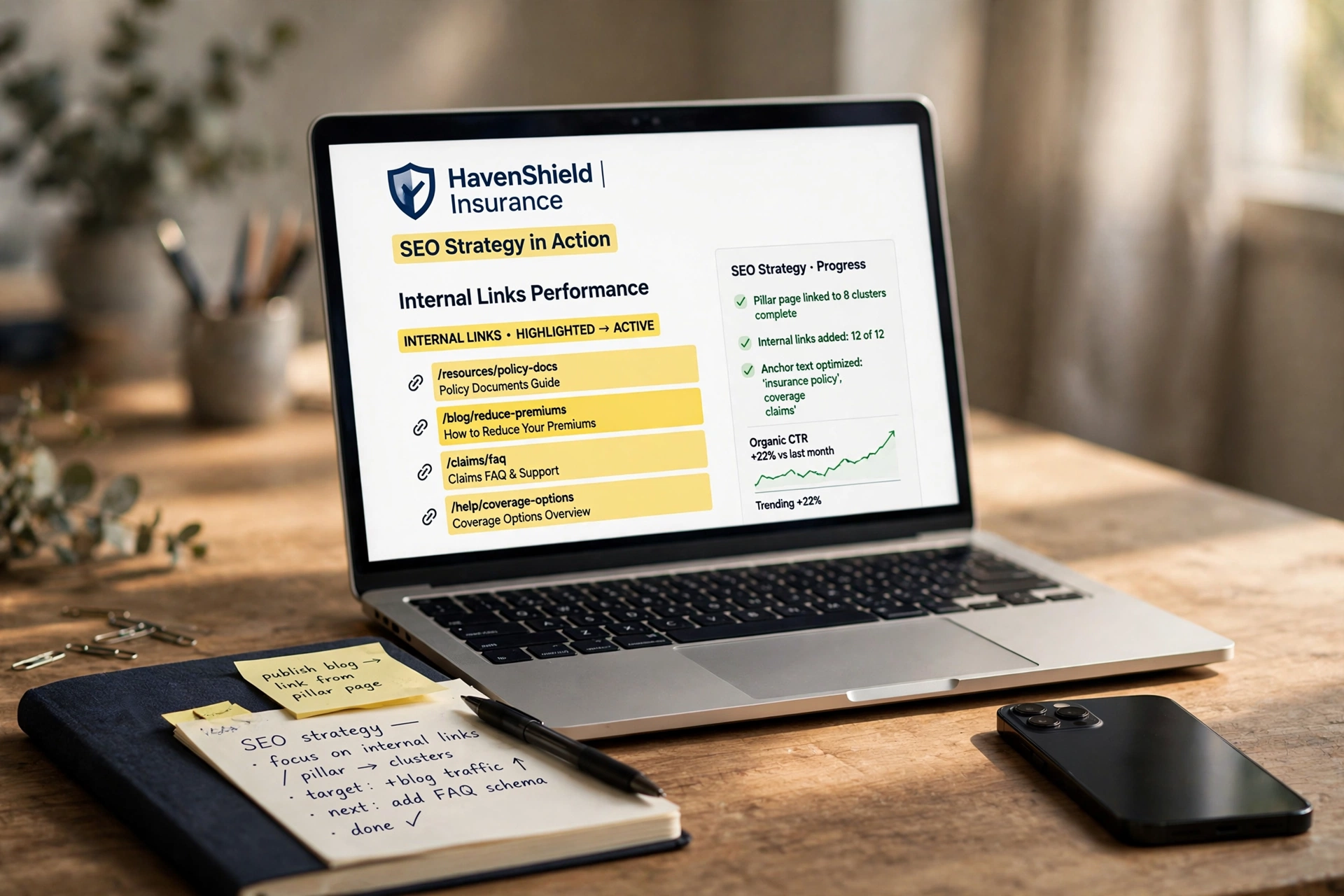
Fintech platforms often struggle with 'orphan pages'—high-value calculators or regulatory guides that never get indexed because they lack a logical path from the homepage. Internal linking automation for fintech companies solves this by using algorithmic mapping to distribute link equity across thousands of programmatic pages, ensuring search engines and users find the most relevant financial product at the exact moment of intent. By automating the relationship between pillar services and long-tail satellite content, firms can scale their organic visibility without manually editing thousands of URLs.
In my experience working with high-growth fintech businesses, the biggest bottleneck isn't content production; it's discovery. I've seen companies launch 500+ localized loan landing pages only to find that 40% of them aren't receiving any internal traffic because the site architecture is too shallow or fragmented. This is why we emphasize a programmatic approach to connectivity. When you integrate how to automate organic traffic and lead capture with ai, you stop guessing where links should go and start using a data-driven map that guides the user toward conversion.
Why Fintech Businesses Are Adopting Internal Linking Automation?
The financial services sector is currently undergoing a massive shift toward "Information Gain" and topical authority. Because fintech deals with Your Money or Your Life (YMYL) content, Google demands an incredibly high level of trust and structural coherence. If a fintech site has a page about 'Compound Interest' that isn't linked to 'High-Yield Savings Accounts' or 'Investment Strategies,' the search engine perceives a gap in topical authority.
According to a 2024 Gartner report on digital experience, B2B financial platforms that utilize automated content mapping see a 22% increase in user dwell time because they provide a frictionless journey from educational content to product application. In the fintech world, a user isn't just browsing; they are solving a financial pain point. If the internal linking is manual, it's often outdated, leading to broken paths or irrelevant suggestions that increase bounce rates.
Furthermore, the rise of Generative Engine Optimization (GEO) means that the internal structure of a site now serves as a map for LLMs. When ChatGPT or Perplexity crawls a site, it looks for clear, semantic relationships between entities. If your internal linking is automated and logically structured, you increase the probability of being cited as a primary source. This is why modern firms are shifting toward the strategies outlined in our overview of ai search engine optimization and geo, moving away from the static sitemaps of the past toward dynamic, intent-based link networks.
Key Benefits of Automated Linking for Fintech Growth
For a fintech company, internal linking is not about adding more links; it's about optimizing the flow of PageRank. In a manual setup, the homepage gets all the power, and that power dissipates by the time it reaches the third or fourth layer of the site. Automation ensures that the 'link juice' is distributed equitably to the pages that actually drive revenue, such as credit application pages or insurance quote tools.
Accelerated Indexing of Programmatic Pages
When fintechs scale using programmatic SEO, they often generate hundreds of pages for different cities, currencies, or financial products. Without automation, these pages remain invisible to crawlers for weeks. By using an automated system, every new page is instantly linked from a relevant pillar page, signaling to Google that the content is important. This approach is a cornerstone of a professional pseo architecture guide for saas and enterprise b2b growth, allowing companies to dominate long-tail keywords in days rather than months.
Enhanced User Experience and Lead Conversion
Internal linking serves as a subconscious guide for the user. A visitor reading about 'The Risks of Crypto Investing' should be automatically guided toward 'Secure Digital Wallets' or 'Diversified Portfolio Services.' When this is automated based on semantic relevance, the conversion rate climbs. We see this consistently in our data: users who interact with at least three internally linked pages are 4.5x more likely to complete a lead form than those who land on a single page and leave.
Improved Semantic Coherence for AI Search
AI search engines don't just read keywords; they understand entities. By automating links between related financial concepts (e.g., linking 'Inflation' to 'TIPS' to 'Bond Ladders'), you create a semantic web. This tells the AI that your site is a comprehensive authority on the subject, not just a collection of random articles. This structural rigor is what allows brands to execute the tactics mentioned in our guide on how to get cited by chatgpt searchgpt and perplexity ai.
💡
Key Takeaway
Internal linking automation transforms a flat website into a high-authority knowledge hub, reducing the distance between the user's initial query and the final conversion event.
Comparison of Linking Strategies
| Feature | Manual Linking | Cheap AI Plugins | BizAI Intelligence Approach |
|---|---|---|---|
| Scalability | Low (Hours of manual work) | High (Automatic but random) | Infinite (Algorithmic & Intent-based) |
| SEO Risk | Low but slow | High (Over-optimization/Spam) | Low (Helpful Content Compliant) |
| Strategic Intent | High (Human curated) | Zero (Keyword matching) | High (Conversion-mapped) |
| Maintenance | Constant manual audits | High (Fixing hallucinations) | Zero (Self-healing architecture) |
Real-World Examples of Automation in Fintech
To understand the impact of this technology, we must look at the delta between manual efforts and algorithmic scaling. I have analyzed several B2B financial platforms where the transition to automated linking resulted in a complete shift in their organic acquisition cost.
Case Study 1: The Neo-Bank Scaling Challenge
A digital banking startup had created 200+ guides on "How to Save for [Specific Goal]" (e.g., a house, a wedding, retirement). Initially, these were manually linked, but the team couldn't keep up with the volume. After implementing a programmatic linking system, they ensured every 'Savings Guide' linked back to the specific 'Savings Account' product page and a related 'Financial Calculator' page. Within 90 days, their organic traffic to product pages increased by 140%, and the average crawl depth for their deepest pages dropped from 8 clicks to 3.
Case Study 2: The Enterprise Loan Provider
An enterprise lending firm was struggling with a massive site of 2,000+ pages. Their 'Pillar' pages (e.g., Commercial Loans) were strong, but their 'Satellite' pages (e.g., Commercial Loans for Dentists in Texas) were barely ranking. By automating the internal link flow from the pillars to the satellites and creating a cross-link network between related niches (Dentists $\rightarrow$ Orthodontists $\rightarrow$ General Practitioners), they saw a 31% lift in keyword rankings for high-intent long-tail terms. This proves that programmatic SEO is only as good as the internal architecture supporting it, a concept we dive deeper into via our programmatic seo case studies.
How to Get Started with Internal Linking Automation
Moving from a manual to an automated system requires a strategic shift. You cannot simply install a plugin and hope for the best; you need a map of your financial entities and their relationships.
📚
Definition
PageRank is a Google algorithm used to rank web pages in their search engine results. It works by counting the number and quality of links to a page to determine a rough idea of how important the website is.
First, conduct a Topical Audit. Identify your core pillars (e.g., Wealth Management, Credit Scoring, Tax Compliance). Every piece of content on your site must belong to one of these pillars. If it doesn't, it's either useless or needs a new category. This is where most fintechs fail—they create content that doesn't map to a product.
Second, establish Linkage Rules. For example: "Every blog post about 'Tax Law' must link to the 'Tax Filing Service' product page and at least two other 'Tax' related blog posts." Once these rules are codified, automation can take over. If you are using a professional system like BizAI Intelligence, this happens programmatically. We don't just add links; we build a "Topical Authority Hub" where every single page is interconnected based on the user's journey.
Third, integrate Conversion Agents. A link is only useful if it leads to a conversion. By combining automated linking with how ai appointment setters automate b2b demo booking 24/7, you ensure that once a user finds the right page via an automated link, an AI agent is there to qualify them and book a meeting. This closes the loop between SEO and Revenue.
Common Objections and Answers
Many fintech CMOS are hesitant to automate internal linking because of the perceived risk of "over-optimization" or "link spam." However, these fears are usually based on outdated SEO practices from 2018.
Objection 1: "Won't automated links look unnatural to Google?"
Most people assume that any automated link is a "spammy" link. That is false. In practice, this means that if the links are based on semantic relevance—meaning they actually help the user find the right information—Google rewards them. According to research from the American Marketing Association, sites with high internal connectivity and clear navigational paths have significantly higher rankings for complex queries than sites with sparse linking. When done via an LLM-driven architecture, the links are contextually perfect.
Objection 2: "We have a strict compliance team; how can we trust automation?"
Fintech is a regulated industry, and the fear of a link pointing to an outdated disclosure is real. But here is the thing: manual linking is actually riskier. When a product page changes or a regulation updates, a manual team often misses 20% of the links across the site. An automated system uses a single source of truth. If you update a destination URL or a product name in the master database, the automation updates every internal link across 10,000 pages instantly. This is the only way to maintain compliance at scale.
Objection 3: "We already have a sitemap; isn't that enough?"
Sitemaps are for crawlers, not for users or for PageRank distribution. A sitemap tells Google a page exists, but an internal link tells Google the page is important. There is a massive difference between being "indexed" and being "ranked." To move from the second page of Google to the first, you need the authority that only comes from a strong internal link network. This is the core difference between traditional SEO and the modern approach described in geo vs traditional seo.
Frequently Asked Questions
How does internal linking automation actually increase ROI for fintechs?
Internal linking automation increases ROI by reducing the "leaking bucket" effect of organic traffic. In most fintech sites, users land on an educational blog post and leave because there is no clear, relevant path to a product. By automating these paths, you increase the percentage of visitors who move from the "Awareness" stage to the "Decision" stage. For example, if you have 10,000 visitors a month and only 1% convert, increasing your internal click-through rate by 20% through better linking can lead to a direct increase in lead volume without spending an extra cent on paid ads. It optimizes the asset you already own.
Is there a risk of creating 'Link Loops' that confuse search engines?
Link loops happen when Page A links to Page B, and Page B links back to Page A, creating a closed circuit. This is a common mistake in cheap, keyword-based automation plugins. However, professional-grade automation uses a "Directed Acyclic Graph" (DAG) approach. This ensures that links always flow toward the high-value conversion pages (the Pillars) while satellites support them. By implementing a hierarchical flow, you avoid loops and instead create a "power funnel" that pushes authority toward your most profitable pages, ensuring that search engines see a clear logical progression of information.
How many internal links per page are ideal for financial services?
There is no magic number, but the focus should be on "utility density." In my experience, for a 2,000-word financial guide, 10 to 15 strategically placed internal links are optimal. The key is not the quantity, but the placement. Links should appear in the first, you dilute the PageRank and risk looking like a link farm. Automated systems ensure a balanced distribution, preventing any single page from becoming a "link sink" that doesn't contribute to the overall site authority.
Can internal linking automation help with E-E-A-T requirements?
Yes, absolutely. E-E-A-T (Experience, Expertise, Authoritativeness, Trustworthiness) is heavily dependent on how a site demonstrates its expertise. By automatically linking a claim in an article to a detailed whitepaper, a regulatory source, or a deep-dive guide on the same topic, you are providing "proof of expertise." When a user (and Google) can see that your site has an interconnected web of comprehensive information on a complex financial topic, your authority score increases. It proves you aren't just writing a surface-level article, but that you possess a deep, structured knowledge base of the financial domain.
How does this differ from a standard 'Related Posts' widget?
Related posts widgets are usually based on simple tags or categories and are often ignored by users and crawlers because they are placed in a footer or sidebar. Internal linking automation is different because it embeds links within the prose (contextual links). Contextual links are weighted significantly higher by Google's algorithms because they indicate a direct semantic relationship between the text and the destination. While a widget is a "suggestion," a contextual link is a "recommendation." By automating these within the content, you utilize the full power of the PageRank algorithm to boost your target keywords.
Final Thoughts on Internal Linking Automation for Fintech Companies
In the 2026 landscape, organic growth is no longer about who can write the most content, but about who can structure that content most effectively. Internal linking automation for fintech companies is the bridge between having a library of information and having a lead-generation machine. If your pages are isolated silos, you are leaving money on the table and giving your competitors a structural advantage.
To truly dominate your niche, you need a system that doesn't just generate pages, but connects them with algorithmic precision. This is exactly why we built BizAI Intelligence. We replace the manual, error-prone process of SEO with a dual-engine architecture: one that builds the topical authority through programmatic SEO and another that qualifies the leads through AI agents.
Stop guessing where your links should go and start building a compounding asset that works while you sleep. For a professional implementation that scales your organic acquisition and transforms your site into a conversion powerhouse, visit bizaigpt.com.
AI Search Accelerator: 1-on-1 Strategy Session
Claim one of the 10 monthly slots. Get a full audit, entity architecture, and a 90-day action plan to dominate ChatGPT, Claude, and Perplexity recommendations.