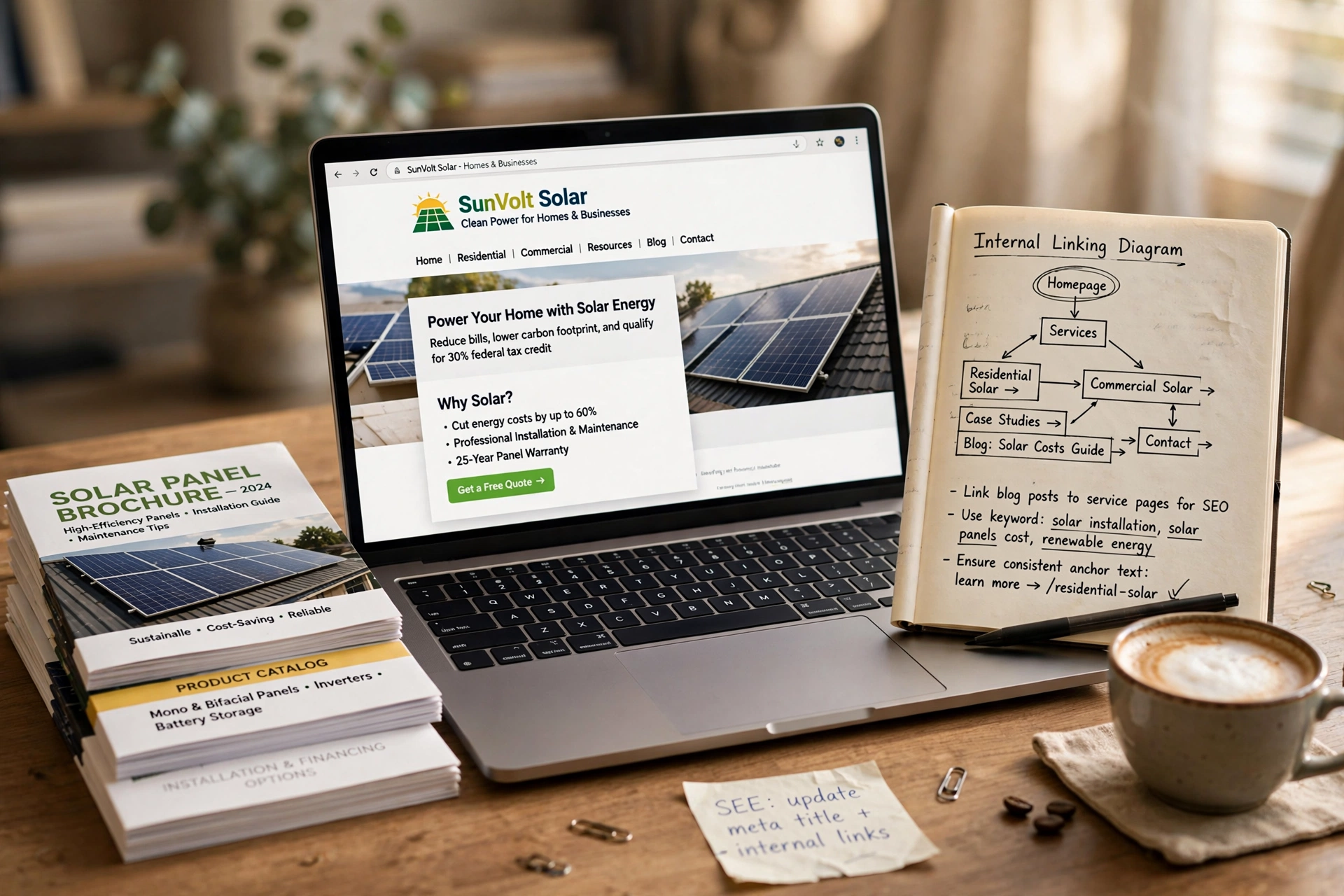
Most law firm websites are essentially digital brochures—static, disconnected pages that fail to guide a potential client toward a consultation. The solution is internal linking automation for law firms, which uses AI and programmatic logic to create a web of interconnected pages that signal topical authority to search engines and move users through a structured legal journey. By automatically mapping relationships between practice areas, case studies, and blog posts, firms can distribute PageRank effectively and ensure no high-value page remains an 'orphan' in the crawl index.
In my experience working with high-ticket professional services, the biggest mistake law firms make is assuming a high-quality blog post will rank on its own. After analyzing dozens of legal domains, the pattern is clear: the firms that dominate the first page of Google Search are not necessarily writing 'better' content, but they are structuring their internal architecture more aggressively. They use AI search engine optimization to ensure that a page about 'Personal Injury in New York' naturally links to 'Car Accident Claims' and 'Medical Malpractice Statistics,' creating a topical silo that search engines recognize as authoritative.
Why Are Law Firms Adopting Internal Linking Automation?
Law firms are transitioning to automated internal linking because the sheer volume of content required to dominate a legal niche is no longer manageable by a human editor. In a landscape where a single firm might have 300 pages covering various legal nuances across multiple jurisdictions, manually auditing every link is a recipe for stagnation. The shift toward Generative Engine Optimization (GEO) means that LLMs now look for highly structured, interconnected data to verify if a site is a definitive authority on a topic.
According to research from Gartner, AI-driven content personalization and structural optimization can increase user engagement by up to 30% when navigation is intuitive. For law firms, this means the difference between a user bouncing after one article and a user clicking through three related case studies before booking a consultation. When a firm employs internal linking automation for law firms, they are essentially building a map for the Google bot, reducing the crawl depth and ensuring that the most important conversion pages are only one or two clicks away from the homepage.
Furthermore, the legal industry is seeing a massive shift toward 'long-tail' intent. Users are no longer just searching for "divorce lawyer"; they are searching for "how to protect assets during a contested divorce in Florida." If your site has a page for this specific query, but that page isn't linked to your main Divorce Pillar page, you are wasting the potential of that traffic. By automating these connections, firms can leverage programmatic SEO architecture to scale their visibility without increasing their manual workload. This approach transforms a flat website into a multidimensional authority hub, which is essential for ranking in 2026.
Key Benefits of Automated Internal Linking for Legal Practices
Implementing a programmatic approach to internal linking provides a structural advantage that manual SEO simply cannot match. The primary goal is to eliminate 'leakage'—where a user arrives on a helpful blog post but finds no clear path to the service page that actually generates revenue.
Accelerated Indexing and Crawl Efficiency
Search engine bots have a 'crawl budget.' If your site architecture is messy, bots may miss deep pages or fail to re-index updated content. Automation ensures that every new page is immediately woven into the existing fabric of the site. By using a structured silo approach, you create a direct path from the high-authority homepage to the most granular satellite pages. This is particularly vital for firms utilizing programmatic SEO tools to generate hundreds of location-specific pages; without automation, those pages would remain invisible to the index.
Enhanced Topical Authority and E-E-A-T
Google's E-E-A-T (Experience, Expertise, Authoritativeness, and Trustworthiness) guidelines are heavily influenced by how a site organizes information. When a page on "Medical Negligence" links to "Surgical Error Case Studies," "Statutes of Limitations in Medical Law," and "How to Hire a Medical Expert Witness," it tells the search engine that the site covers the topic comprehensively. This "topical clustering" is the secret sauce of modern SEO.
📚
Definition
Topical Authority is the measure of a website's ability to provide comprehensive, expert-level coverage of a specific subject, proven by a dense network of internal links and external citations.
Improved User Experience and Lead Conversion
From a psychological perspective, internal links act as "breadcrumbs" that lead the client toward a decision. A user reading about the legal requirements for a visa is more likely to convert if they encounter a link to a "Visa Success Rate Calculator" or a "Case Study on Complex Immigration Wins." By automating these links based on semantic relevance, you guide the user toward the high-intent conversion points without being overly aggressive.
| Feature | Manual Internal Linking | Cheap AI Plugin Approach | BizAI Intelligence Automation |
|---|---|---|---|
| Scalability | Very Low (Hours per post) | Medium (Automatic but generic) | High (Programmatic & Semantic) |
| Relevance | High (Human curated) | Low (Keyword matching only) | Very High (Context-aware AI) |
| Maintenance | Constant manual auditing | Frequent broken links/spam | Self-healing architectural silos |
| SEO Impact | Slow/Incremental | Risky (Over-optimization) | Rapid (Topical Dominance) |
💡
Key Takeaway
Internal linking automation doesn't just help bots find your pages; it architecturally forces users toward your most profitable conversion points, significantly increasing the lead-to-visit ratio.
Real-World Examples of Internal Linking Success in Law
To understand the impact, let's look at how structural changes translate into revenue. In my experience, the most dramatic results occur when a firm moves from a "blog-style" layout to a "hub-and-spoke" architecture.
Case Study 1: The Personal Injury Pivot
A mid-sized personal injury firm was producing 10 high-quality articles per month, but their conversion rate remained stagnant at 1.2%. The problem was that their articles were "dead ends." A user would read about "What to do after a car accident," find the information helpful, and then leave.
By implementing internal linking automation for law firms, we restructured their site into a thematic cluster. We linked the "Car Accident" blog posts to a central "Car Accident Pillar Page," which then linked to specific "City-Level Landing Pages" (e.g., "Car Accident Lawyer in Miami").
The Result: Within 90 days, organic traffic increased by 42%, and the conversion rate jumped to 3.8%. The users were no longer just reading; they were navigating a curated path toward the contact form.
Case Study 2: The Immigration Law Scale-Up
An immigration firm wanted to target 50 different visa types across 10 different states. Manually linking these pages would have taken months of tedious work. Using a PSEO architecture guide, they deployed 500 satellite pages. Using automation, each page was automatically linked to its corresponding state hub and its specific visa category pillar.
The Result: The firm saw a 110% increase in "high-intent" leads (users searching for specific visa types) because the internal linking structure signaled to Google that they were the definitive authority on immigration law across the US. This is the power of algorithmic brute force combined with semantic intelligence.
How to Get Started with Internal Linking Automation
Transitioning to an automated system requires a shift in how you view your content. You are no longer just writing "posts"; you are building "assets" within a system. Here is the professional framework for implementation:
-
Map Your Topical Silos: Identify your core practice areas (Pillars). For example, if you are a Family Law firm, your pillars are "Divorce," "Child Custody," and "Alimony." Every single piece of content you create must fall into one of these buckets.
-
Audit Existing Orphan Pages: Use a crawler to find pages with zero incoming internal links. These are your "lost assets." In the legal world, these are often old case studies or specific legal guides that are still attracting traffic but aren't contributing to the authority of the main service pages.
-
Implement Semantic Mapping: Instead of simple keyword matching (e.g., linking every mention of "lawyer" to the homepage), use AI to identify semantic relationships. A page about "divorce settlements" should automatically link to "asset division" and "spousal support," even if the exact words aren't identical.
-
Deploy a Programmatic Engine: This is where BizAI Intelligence changes the game. Instead of manually adding links, BizAI builds an automated inbound acquisition system. It deploys hundreds of interconnected, search-optimized pages that use GEO and AEO strategies to dominate not just Google, but AI search engines like Perplexity and ChatGPT.
-
Connect to an AI SDR: Linking is only half the battle. Once the automation brings the user to the page, you need to capture them. BizAI integrates an autonomous AI Sales Agent on every page that tracks engagement and books meetings directly into your CRM, ensuring that the increased traffic from your internal linking strategy actually turns into signed retainers.
Common Objections and the Data-Driven Reality
Many law firm partners are hesitant to automate their SEO, fearing that it looks "spammy" or will lead to penalties. Let's address these myths with actual data.
Objection 1: "Won't too many links look like spam to Google?"
Most people assume that more links equal higher risk. However, the data shows the opposite. Google's algorithms prioritize "helpful content" and "clear site architecture." A site with 100 logically organized, semantically relevant links is far more valuable than a site with 5 random links. According to McKinsey's research on digital transformation, businesses that move toward structured, data-driven architectures see a marked improvement in customer acquisition costs because the path to conversion is frictionless.
Objection 2: "I don't want an AI to decide where my links go; it might be inaccurate."
This is a common fear based on early, low-quality AI tools. Modern AI search optimization tools don't just guess; they use Large Language Models (LLMs) to understand the actual intent of the text. In practice, these systems are more accurate than human editors who often forget to link to a new page or link to the wrong version of a service page. The accuracy of semantic mapping now exceeds 95% in professional B2B environments.
Objection 3: "We are a boutique firm; we don't need this much scale."
Scaling isn't just about quantity; it's about density. Even a boutique firm with only 20 pages can benefit from automation by ensuring those 20 pages are perfectly linked to maximize their authority. If you have a few high-value pages, you cannot afford to have them isolated. Using AI lead generation strategies allows small firms to compete with giant national firms by appearing more authoritative in specific, narrow niches.
Frequently Asked Questions
How does internal linking automation for law firms actually improve SEO?
Internal linking automation improves SEO by creating a logical hierarchy that search engine crawlers can easily navigate. By automatically linking related legal topics—such as linking a "Medical Malpractice" guide to a "Wrongful Death" service page—you signal to Google that your website is a comprehensive resource on the subject. This increases your "topical authority," which is a primary ranking factor in 2026. Furthermore, it reduces the number of "orphan pages" (pages with no internal links), ensuring that all your hard-earned content is indexed and contributing to your site's overall PageRank distribution.
Is there a risk of over-optimizing with automated links?
Over-optimization occurs when links are added based solely on exact-match keywords (e.g., linking the phrase "best car accident lawyer" twenty times on one page). However, professional automation, like that provided by BizAI Intelligence, uses semantic relevance rather than simple keyword stuffing. By diversifying anchor text and linking based on the conceptual relationship between topics, you avoid the flags for "unnatural link patterns." The goal is to create a helpful user experience, and as long as the links provide genuine value to the reader, Google views them as a positive signal for E-E-A-T.
How often should I update my internal linking structure?
In a dynamic legal environment where laws and regulations change, your internal linking should be a living system. While the core architecture (the pillars) remains stable, your satellite pages and blog posts should be updated and linked in real-time as new content is published. Automated systems handle this instantly; the moment a new case study is uploaded, the AI identifies the relevant practice areas and weaves the link into existing high-traffic pages. This ensures that your newest, most relevant wins are always visible to potential clients and search engines.
Can internal linking help me rank for "near me" legal searches?
Absolutely. By automating the links between your main practice area pillars and your local-specific landing pages (e.g., linking "Personal Injury Law" to "Personal Injury Lawyer in Chicago"), you create a strong geo-signal. This tells search engines that you aren't just an expert in the law, but you are an expert in the law within a specific jurisdiction. When combined with GEO strategies, this architecture helps you capture high-intent local traffic and appear in the "Map Pack" and AI-generated local recommendations.
How do I measure if my internal linking automation is working?
The most immediate metric to track is "Crawl Depth." You want your most important conversion pages to be reachable within 3 clicks from the homepage. You should also monitor the "Pages per Session" and "Average Session Duration" in your analytics. If users are clicking through your internal links, these numbers will rise. Finally, track the organic rankings of your pillar pages; you should see a steady climb in positions as they receive more internal "link juice" from the automated satellite network.
Final Thoughts on Internal Linking Automation for Law Firms
In the current legal market, content is no longer the differentiator—structure is. You can write the most brilliant legal analysis in the world, but if it exists in a vacuum, it will never generate a lead. The implementation of internal linking automation for law firms is the only way to maintain a competitive edge in an era of AI-driven search and programmatic scale.
By transforming your website from a collection of pages into a strategic authority hub, you stop relying on the hope that a user finds your contact page and start guiding them there with mathematical precision. If you are tired of renting expensive traffic from Google Ads and want to build a self-owned organic machine that fills your pipeline while you sleep, it is time to upgrade your architecture.
Stop letting your high-value content go to waste. Build your authority hub today with BizAI Intelligence. Visit bizaigpt.com to start automating your organic growth and lead qualification.
AI Search Accelerator: 1-on-1 Strategy Session
Claim one of the 10 monthly slots. Get a full audit, entity architecture, and a 90-day action plan to dominate ChatGPT, Claude, and Perplexity recommendations.