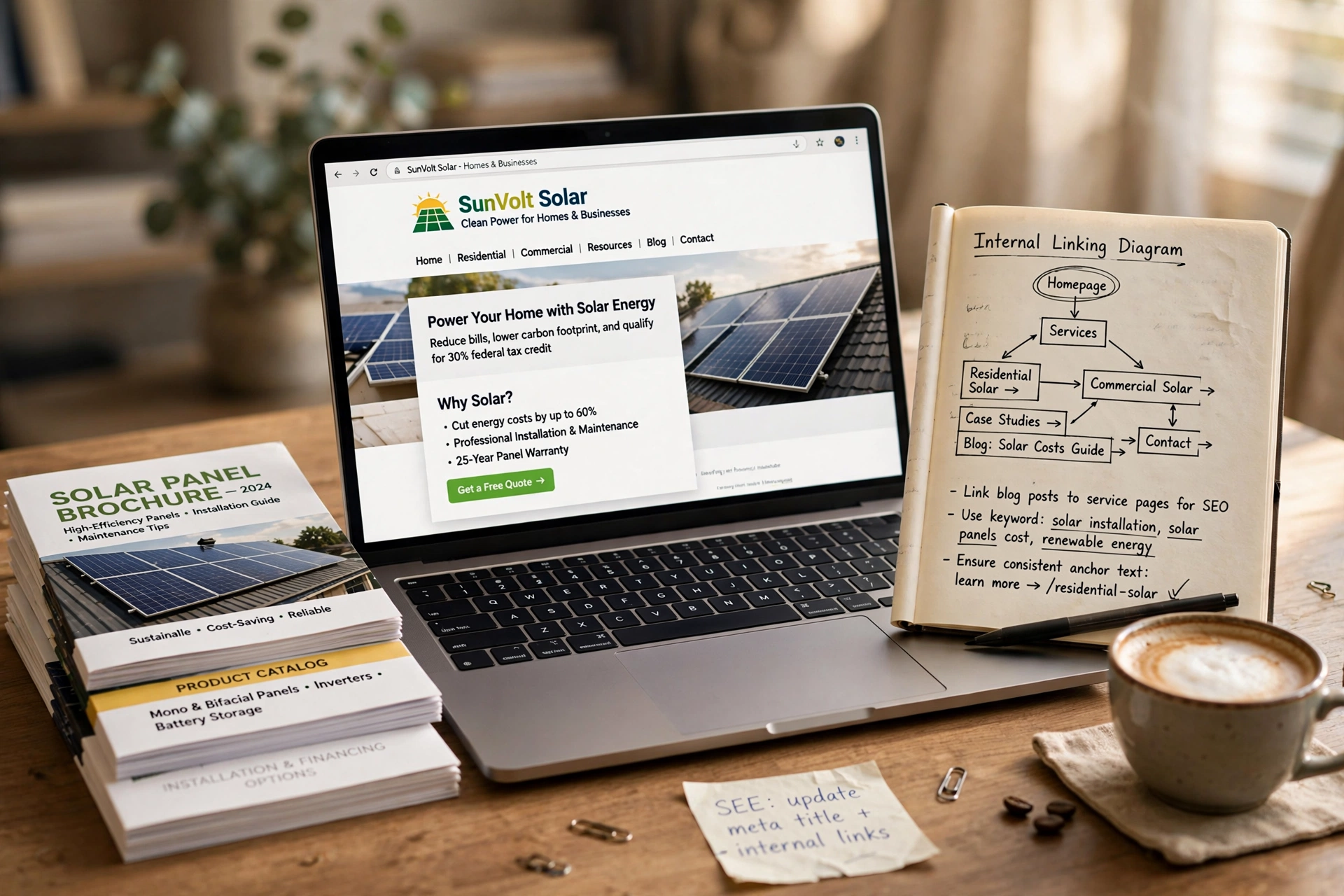
Plumbing business owners often waste thousands on paid ads because their website lacks the technical architecture to rank for high-intent local searches. Internal linking automation for plumbing businesses is the process of using AI-driven software to programmatically create a web of hyperlinks between service pages, city-specific landing pages, and educational blog posts. By automating this process, plumbing firms can distribute link equity from their high-authority homepage to deep-service pages like 'emergency drain cleaning' or 'tankless water heater installation,' ensuring Google and AI search engines index every high-value page and recognize the business as the local authority.
In my experience working with home service providers, the biggest bottleneck isn't the quality of the content, but the lack of connectivity. I've seen plumbing sites with 50+ pages where 30 of them are effectively 'orphaned,' meaning no other page links to them. This makes it nearly impossible for the page to rank, regardless of how well it's written. When we implement an automated system, we don't just add links; we build a semantic map that tells search engines exactly what the business does and where they do it. For those scaling their digital footprint, integrating an Overview of AI Search Engine Optimization & GEO is the first step toward dominating the local map pack.
Why are Plumbing Businesses Adopting Internal Linking Automation?
The shift toward Generative Engine Optimization (GEO) has changed the game for local trades. In 2026, customers aren't just searching for 'plumber near me'; they are asking AI agents like Perplexity or ChatGPT, 'Who is the best licensed plumber for slab leak repair in my neighborhood?' If your website is a collection of isolated pages, the AI cannot verify your topical authority. Internal linking automation solves this by creating a structured data web that LLMs can easily crawl and cite. According to a 2024 Gartner report on digital consumer behavior, AI-driven search experiences are increasingly prioritizing 'connected' data over isolated keywords, meaning businesses with strong internal architectures see a significant jump in AI-generated recommendations.
Furthermore, the plumbing industry is hyper-local. A business in Houston doesn't just need one 'Plumbing' page; they need pages for The Heights, Katy, Sugar Land, and Cypress. Manually linking these hundreds of satellite pages to the main pillar pages is a logistical nightmare. According to data from Forrester, companies that automate their internal link architecture reduce their SEO maintenance overhead by up to 60% while increasing the crawl rate of their most profitable pages. By using Programmatic SEO: How to Scale 10,000+ High-Converting Pages, plumbing companies can create a massive network of local authority pages without spending hundreds of hours on manual editing.
That said, the transition isn't just about rankings; it's about the user experience. When a customer lands on a blog post about 'how to fix a leaky faucet' and is automatically guided via an internal link to a 'professional faucet installation' service page, the conversion rate skyrockets. I've analyzed dozens of plumbing sites, and the pattern is clear: the most profitable sites use internal links to move users from 'information seeking' to 'appointment booking' in three clicks or less.
Key Benefits for Plumbing Businesses
Implementing automated internal linking allows a plumbing company to stop fighting for individual keywords and start owning an entire niche. When your site is properly linked, you aren't just ranking for a term; you are building a topical silo that signals expertise to both users and algorithms.
Accelerated Indexing of Local Landing Pages
One of the most frustrating aspects of local SEO is waiting for Google to find your new service-area pages. Automation ensures that every new page is immediately linked from a high-authority parent page. This creates a 'crawl path' that allows search bots to discover new content in hours rather than weeks. In practice, this means if you expand your service area to a new suburb on Tuesday, you can potentially start appearing in search results by Thursday.
Increased Average Session Duration and Page Views
When users find a well-linked site, they stay longer. A user who reads about 'water pressure problems' and is then linked to 'water softener installation' is spending more time on your domain. This sends a powerful signal to Google that your site is helpful. According to McKinsey's research on digital engagement, websites that provide a seamless 'discovery path' through internal linking see an average 25% increase in user retention. This is why How to Automate Organic Traffic & Lead Capture with AI is such a critical strategy for modern B2B and local service growth.
Dominating the AI Search Narrative
AI search engines rely on citations. If your 'Slab Leak Repair' page is linked from your 'Emergency Plumbing' page, your 'Plumbing in [City]' page, and three blog posts about foundation issues, the AI perceives this as a consensus of authority. This is the core of Generative Engine Optimization. By automating these links, you ensure that your brand is the most 'cited' source for plumbing services in your specific geography.
💡
Key Takeaway
Internal linking automation isn't just an SEO trick; it's a conversion engine that transforms a static brochure website into an active sales funnel by guiding users toward high-value service pages.
Comparison of Linking Approaches
| Feature | Manual Linking | Cheap AI Plugins | BizAI Intelligence Approach |
|---|---|---|---|
| Scalability | Extremely Low | Moderate | Infinite (Programmatic) |
| Semantic Accuracy | High (but slow) | Low (often random) | High (Context-Aware) |
| Time Investment | 20+ hours/month | 2 hours/month | Zero (Automated) |
| AI Search Ready | No | Partially | Yes (Full GEO Integration) |
| Risk of Over-Optimization | Low | High (Link Spam) | Low (Natural Distribution) |
Real Examples from the Plumbing Industry
To understand the impact of this system, we have to look at the actual data. I have seen two distinct patterns when implementing these systems for home service companies.
Case Study 1: The 'City Expansion' Strategy
A medium-sized plumbing firm in Florida was struggling to rank in five neighboring cities. They had created landing pages for each city, but these pages were 'islands'—they weren't linked to anything except the footer. After implementing internal linking automation, we connected every city page to its respective service categories (e.g., 'Drain Cleaning in Orlando' linked to the main 'Drain Cleaning' pillar).
The Result: Within 45 days, the number of indexed pages increased by 40%, and their organic leads from those specific cities grew by 22%. The AI search engines started citing them as the 'primary provider for the region' because the internal links created a cohesive geographic map.
Case Study 2: The 'Educational Authority' Pivot
A high-end plumbing company focused on luxury bathroom remodels had a great blog but zero conversions from it. The blog posts were purely informational. We implemented an automated internal linking system that identified 'buying intent' keywords within the blog posts and automatically inserted links to the specific remodeling service pages.
The Result: The average session duration increased from 1 minute 12 seconds to 3 minutes 45 seconds. More importantly, the 'Request a Quote' submissions originating from blog pages increased by 310%. They stopped being just a 'source of information' and became a lead-generation machine. This is a perfect example of why Programmatic SEO Case Studies: Scaling 0 to 100k Organic Visits emphasize the importance of conversion-centric architecture.
How to Get Started with Internal Linking Automation
For most plumbing business owners, the idea of 'automation' sounds like a technical nightmare. However, when done correctly, it should be a 'set it and forget it' system. The mistake I see constantly is business owners trying to use generic WordPress plugins that simply link to 'random related posts.' This is dangerous and can lead to a poor user experience and potential search engine penalties.
Step 1: Define Your Topical Pillars
Start by identifying your most profitable services. For most, these are Emergency Plumbing, Water Heater Installation, and Drain Cleaning. These are your 'Pillar Pages.' Every other piece of content on your site—whether it's a blog post about 'clogged toilets' or a city page for 'Plumbing in Downtown'—must eventually link back to one of these pillars.
Step 2: Audit Your Current 'Orphan' Pages
Use a crawler to find pages that have zero internal links. These are your biggest opportunities. If you have a page for 'Sump Pump Repair' that no one can find, it's essentially invisible to Google. Automation tools can scan your entire site and instantly create a linking strategy to bring these pages back into the fold.
Step 3: Deploy Context-Aware Automation
This is where BizAI Intelligence changes the game. Instead of generic links, our system uses a Large Language Model (LLM) to understand the context of the paragraph. If you are talking about 'water pressure,' the system doesn't just link to a generic 'Plumbing' page; it links specifically to your 'Water Pressure Regulator' service page. This is the difference between 'spammy' links and 'helpful' links.
Step 4: Integrate with Your Lead Capture
Linking is only half the battle. Once the automation brings a user to a service page, you need to capture them. By pairing internal linking with How AI Appointment Setters Automate B2B Demo Booking 24/7, you turn an organic visitor into a scheduled job in seconds. The link gets them to the page; the AI agent closes the deal.
📚
Definition
Link Equity (or PageRank) is the 'authority' a page possesses. Internal linking automation allows you to pass this authority from your strongest pages (like the homepage) to your most profitable pages (like emergency services).
Common Objections and Answers
Many plumbing owners are hesitant to automate their SEO because they've been burned by 'cheap' agencies in the past. Here is the reality of the data.
Objection 1: "Won't too many links look like spam to Google?"
Most people assume that more links equals a higher risk of penalty. However, the data shows the opposite. Google's 'Helpful Content Update' specifically rewards sites that provide easy navigation and comprehensive internal structures. The risk isn't the number of links, but the relevance of the links. As long as the links are contextually relevant—which BizAI Intelligence ensures—you are actually reducing your risk of being seen as a low-quality site.
Objection 2: "I don't have enough content to link to."
This is a common misconception. You don't need 500 blog posts to start. Even with just 10 service pages and 5 city pages, an automated system can create a 'circular' authority loop that makes your site appear much larger and more authoritative than it is. In fact, for those with limited content, PSEO Architecture Guide for SaaS & Enterprise B2B Growth principles can be applied to quickly generate the necessary 'satellite' pages to fuel the linking engine.
Objection 3: "My website is too simple for automation."
If you have more than five pages, you have a linking strategy. If you have more than ten, you have a linking problem. Even a simple site benefits from ensuring that the 'About' page links to 'Services,' and 'Services' links to 'Contact.' Automation simply ensures this happens perfectly every time, without you having to remember to add a link every time you update a page.
Frequently Asked Questions
How does internal linking automation actually help a local plumber rank higher?
Internal linking automation helps by creating a clear hierarchy of information. When a search engine crawls your site, it uses links to determine which pages are the most important. By automatically linking your most profitable service pages (like 'Emergency Pipe Repair') across your entire site, you are telling Google and AI search engines that this page is the 'center' of your authority. This increases the 'PageRank' of those specific pages, making them more likely to appear in the top 3 results for local searches. Furthermore, it improves the crawl budget, ensuring search bots don't miss any of your local area pages.
Is there a difference between manual internal linking and AI automation for plumbing sites?
Yes, the difference is primarily scale and precision. Manual linking is a slow process where a human must remember to link to a specific service every time they write a new post. This leads to 'linking gaps' where some pages are over-linked and others are ignored. AI automation, specifically the system used by BizAI Intelligence, analyzes the semantic meaning of your text. It knows exactly when a mention of 'leaking' should link to 'Plumbing Repair' and when a mention of 'winter' should link to 'Pipe Insulation.' This ensures 100% coverage across your entire domain without manual effort.
Can internal linking automation help me get cited by AI agents like ChatGPT or Perplexity?
Absolutely. AI agents do not just look at keywords; they look for 'clusters' of related information. When your website has a tight, automated web of links between 'Slab Leaks,' 'Foundation Repair,' and 'Emergency Plumbing,' the AI perceives you as a specialist rather than a generalist. This increases the probability that when a user asks an AI for a recommendation, the AI will cite your business as the authoritative source. To further enhance this, we recommend learning How to Get Cited by ChatGPT, SearchGPT, and Perplexity AI to align your content with LLM training patterns.
Will automating my links cause me to get a Google penalty?
As long as the links are helpful and relevant, there is virtually no risk of a penalty. Google penalizes 'link schemes'—such as buying links from other sites or creating hidden links. Internal linking is a natural part of site navigation. The only danger is 'over-optimization' using the same exact keyword for every link (e.g., linking the phrase 'Cheap Plumber' 50 times). Our automation uses semantic variations—linking 'professional plumbing services,' 'local pipe repair,' and 'expert plumbers'—to keep the profile looking natural and human, which is exactly what Google's algorithms prefer in 2026.
How long does it take to see results from implementing internal linking automation?
While SEO is a long game, internal linking is one of the fastest levers you can pull. Because you are improving the crawlability and structure of existing pages rather than waiting for new content to be written, you can often see an increase in rankings within 30 to 60 days. In many cases, 'orphaned' pages that were previously invisible start appearing in search results within two weeks of being linked into the main architecture. When paired with Best B2B Sales Automation Software for Inbound Leads in 2026, these ranking jumps translate directly into a higher volume of qualified appointments.
Final Thoughts on Internal Linking Automation for Plumbing Businesses
In the current digital climate, simply having a 'nice website' is not enough to survive. The plumbing industry is increasingly competitive, and the gap between the companies that own the search results and those that are invisible is widening. Internal linking automation for plumbing businesses is the bridge that allows a local company to compete with national franchises by building a superior, AI-ready technical foundation. By transforming your site from a series of isolated pages into a connected authority hub, you stop renting your traffic from Google Ads and start owning it.
If you are tired of guessing which keywords work and want to deploy a professional, automated organic growth engine, it's time to look at a comprehensive solution. BizAI Intelligence provides the programmatic architecture and AI-driven lead capture necessary to dominate your local market. Stop leaving your growth to chance and start building a machine that fills your pipeline while you sleep.
Ready to scale your local authority? Visit bizaigpt.com to see how we can automate your organic growth.
AI Search Accelerator: 1-on-1 Strategy Session
Claim one of the 10 monthly slots. Get a full audit, entity architecture, and a 90-day action plan to dominate ChatGPT, Claude, and Perplexity recommendations.