Which Internal Linking Strategy Should You Choose for Scaling?
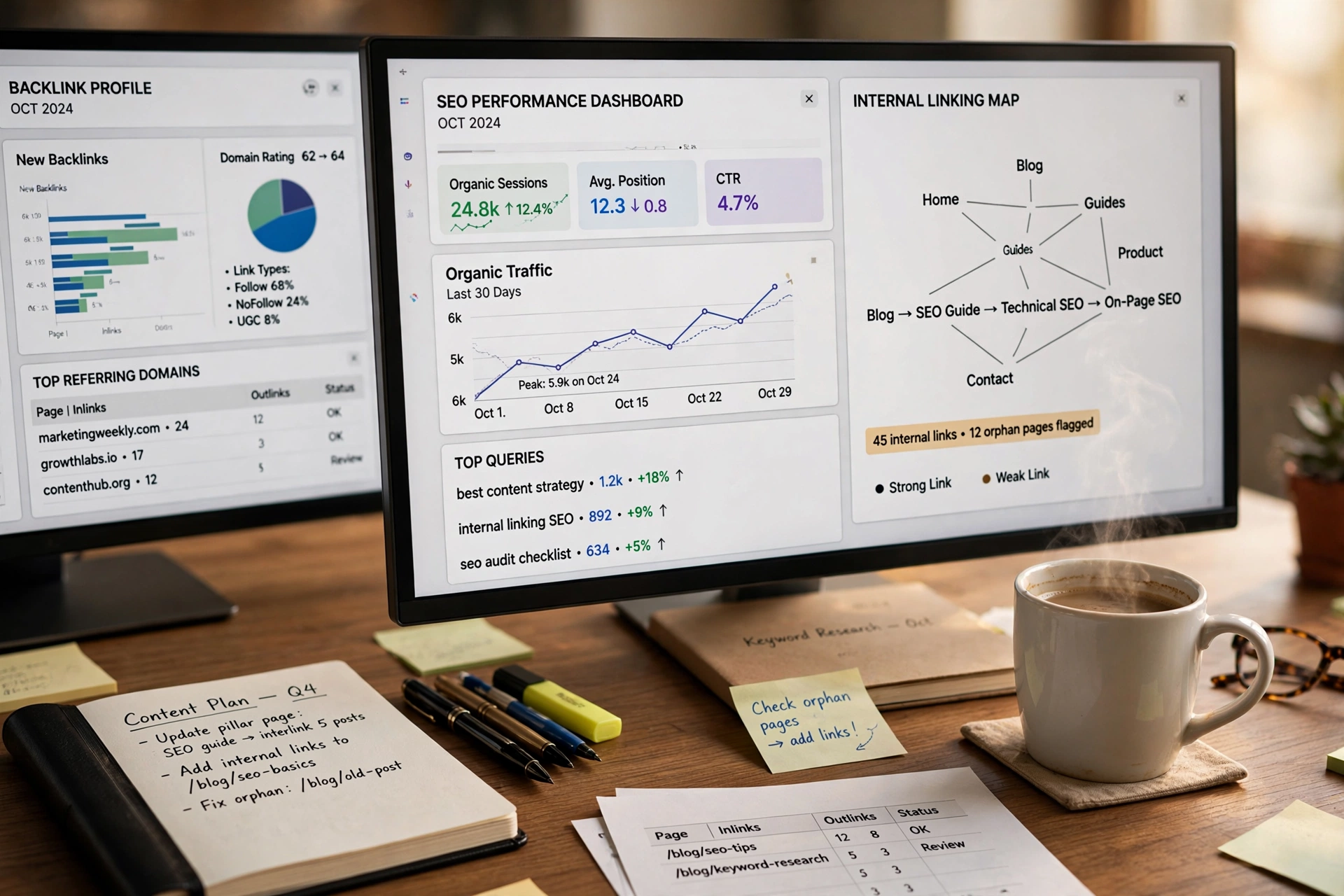
Most B2B companies treat internal linking as an afterthought, manually adding a few links to new posts and hoping for the best. When you scale to 1,000+ pages, this manual approach collapses, leading to "orphan pages" and wasted PageRank. For high-growth enterprises, the choice comes down to three paths: manual curation, plugin-based automation, or programmatic internal linking automation for seo scaling. The latter is the only viable option for those deploying massive topical hubs, as it uses algorithmic logic to distribute authority based on semantic relevance rather than basic keyword matching.
In my experience working with enterprise SaaS platforms, the biggest mistake I see is the "link blast" approach—using plugins that simply link to the most recent posts. This doesn't just fail to help SEO; it confuses Google's crawlers by creating irrelevant associations. To actually scale, you need a system that understands the hierarchy of your content silos, ensuring that satellite pages feed authority back into pillar pages while guiding the user toward a conversion event. If you are managing a high-volume site, you should prioritize a programmatic approach that integrates with your content architecture.
How Does Internal Linking Automation Work at Scale?
To understand how to automate this process, we first have to define the technical mechanism. Internal linking automation isn't about a "magic button"; it is about creating a programmatic rule set that dictates how Page A connects to Page B based on shared intent and topical clusters.
📚
Definition
Internal linking automation is the use of software or programmatic scripts to identify, insert, and manage hyperlinks between pages on the same domain, removing the need for manual editor intervention.
When we talk about scaling, we are usually referring to Programmatic SEO (PSEO). In a PSEO environment, you might have 500 pages targeting "Lawyers in [City]." Manually linking these is impossible. Instead, the system uses a "Silo Architecture." The automation engine identifies the "Pillar" (the main service page) and ensures every "Satellite" (the city-specific page) links back to it. Simultaneously, it identifies related satellites (e.g., "Lawyers in Miami" linking to "Lawyers in Fort Lauderdale") to keep the user in the loop.
According to research by Gartner, high-performing digital experiences are increasingly reliant on "semantic connectivity," where the relationship between pages mimics the user's mental model of the topic. This means automation must move beyond exact-match keywords. Modern systems use embeddings—mathematical representations of meaning—to determine if two pages are actually related. If you are building a massive site, you should look into PSEO Architecture Guide for SaaS & Enterprise B2B Growth to see how these silos are constructed from the ground up.
Now, here is where it gets interesting: the most effective automation doesn't just place links; it manages "link equity." If one page has 1,000 backlinks from external sites, it is a powerhouse of authority. Automation allows you to "flow" that power to underperforming pages that have high conversion potential but low visibility.
Why Does Automation Matter for Organic Growth in 2026?
The stakes for internal linking have shifted. With the rise of AI-driven search, Google is no longer just looking for keywords; it is looking for "topical authority." If your site has 1,000 pages but no cohesive internal structure, Google views those pages as isolated fragments rather than a comprehensive resource.
A report from Forrester indicates that sites with a structured, interconnected internal architecture see significantly faster indexing times for new content. This is because the Googlebot discovers new URLs through links. If a new page is "orphaned" (has no internal links pointing to it), it may take weeks to be indexed, or it may never be crawled at all. In a competitive B2B landscape, that delay is a direct loss in revenue.
The business impact is measurable. When we implement how to automate organic traffic & lead capture with ai for our clients, we often see a "lift" in the rankings of old, stagnant content. By automating the flow of authority from new, viral pieces of content to older "money pages," we can revive dead leads without writing a single new word of copy.
Consider the "Crawl Budget" problem. Large sites often waste their crawl budget on low-value pages. By automating internal links to prioritize high-intent pages, you effectively tell Google, "These are the most important pages on my site." This ensures that your most valuable assets are crawled more frequently and ranked higher. Without this, you are essentially leaving your site's navigation to chance.
How to Implement an Automated Linking Framework
If you are moving away from manual linking, you need a structured implementation plan. The goal is to move from a "web" (where everything links to everything) to a "silo" (where links are intentional and hierarchical).
Step 1: Define Your Topical Clusters
Before turning on any automation, map your pillars and satellites. A pillar is your "Ultimate Guide" or "Main Service" page. Satellites are the long-tail, specific questions or niche variations. You must explicitly tell your automation tool which pages are pillars so they receive the most links.
Step 2: Establish Semantic Rules
Avoid "exact match" automation. If your tool sees the word "SEO" and links it every time, you will create a poor user experience and risk over-optimization. Instead, use "semantic clusters." For example, "organic growth," "search rankings," and "SERP visibility" should all be recognized as part of the same cluster, allowing the automation to vary anchor text naturally.
Step 3: Deploy the Automation Engine
This is where BizAI Intelligence changes the game. Rather than using a fragile WordPress plugin, we integrate internal linking into the very fabric of the PSEO engine. When BizAI Intelligence generates 300+ interconnected pages in month one, the internal linking is not added afterward—it is baked into the architecture. Every satellite page is programmatically linked to its parent pillar and its nearest conceptual neighbor.
Step 4: Monitor Link Equity and Indexing
Use a tool to visualize your internal link graph. If you see "clusters" of pages that are disconnected from the rest of the site, your automation rules need tuning.
💡
Key Takeaway
Effective internal linking automation is not about the number of links, but the logic of the flow. Link from high-authority "power pages" to high-conversion "money pages" to maximize ROI.
For those looking to further optimize their visibility beyond traditional links, understanding how to get cited by ChatGPT, SearchGPT, and Perplexity AI is the next logical step, as AI engines value structured internal relationships even more than traditional search engines do.

Comparing Internal Linking Options: Which is Right for You?
Choosing the right method depends entirely on your site's scale and your growth goals. Most businesses start with manual efforts, but there is a "breaking point" where the cost of manual labor exceeds the value of the SEO gain.
| Approach | Pros | Cons | Best For |
|---|---|---|---|
| Manual Curation | Absolute control, perfect UX, high precision. | Unscalable, prone to human error, creates orphan pages. | Blogs with < 50 pages. |
| Plugin-Based (Auto-Link) | Fast setup, low initial effort. | Blind linking, "spammy" anchor text, no strategic flow. | Medium sites with simple needs. |
| Programmatic (BizAI) | Infinite scale, semantic logic, protects PageRank. | Requires initial architectural planning. | Enterprise B2B, SaaS, PSEO hubs. |
The "Generic AI" approach—where you ask a chatbot to "suggest links" and then manually insert them—is a trap. It provides the illusion of automation but still requires manual execution. On the other hand, a truly programmatic system like BizAI Intelligence treats internal linking as a data problem. It analyzes the site's graph and automatically maintains the balance of authority.
If you are undecided on the technical stack, I recommend reviewing the top programmatic seo tools & software compared for 2026 to see how the infrastructure supports these linking strategies.
Common Misconceptions About Link Automation
Most guides on internal linking are written for small bloggers, not for B2B enterprises scaling to thousands of pages. This leads to several dangerous myths.
Myth 1: "More links are always better."
This is fundamentally wrong. Over-linking a page can dilute its PageRank (the "link juice" effect). If a page has 500 internal links, each link carries very little weight. The goal is "high-impact" linking—placing a few, strategically relevant links that tell Google exactly what the destination page is about.
Myth 2: "Exact match anchor text is the only way to rank."
In the early 2010s, this was true. In 2026, it is a recipe for a penalty. Google's NLP (Natural Language Processing) understands synonyms. If you link "Internal Linking Automation" to a page titled "How to Automate Links," Google knows they are the same thing. Forcing exact matches across 1,000 pages looks artificial and "bot-like."
Myth 3: "Automation replaces the need for a content strategy."
Automation is an accelerator, not a foundation. If your content is low-quality, automating links to it will only help Google realize your content is low-quality faster. You must first build a "topical authority hub" and then use automation to amplify it.
That said, once the strategy is set, the execution must be automated. Relying on a human editor to remember to link a new post to a pillar page from three years ago is a losing game. This is why we integrate how to automate organic traffic & lead capture with ai as a core part of the acquisition engine.
Frequently Asked Questions
Does internal linking automation risk a Google penalty?
Only if it is implemented blindly. If you use a tool that inserts links randomly or uses repetitive, exact-match anchor text, you risk being flagged for "unnatural" linking patterns. However, when automation is based on semantic relevance and follows a logical silo architecture, it is viewed as a positive signal. Google rewards sites that make it easy for users and crawlers to find relevant information. The key is to ensure the links actually provide value to the reader.
How many internal links should a single page have?
There is no magic number, but the "Rule of Value" applies: every link must serve a purpose. In a programmatic setup, a satellite page typically links back to its main pillar and 2-3 other closely related satellites. For a pillar page, you may have dozens of links pointing to various satellites to distribute authority downward. The important metric is not the count, but the ratio of "outbound internal links" to "inbound internal links" to ensure no page becomes a "dead end."
Can I use AI to determine which pages to link together?
Yes, and this is the current gold standard. Using Large Language Models (LLMs) to analyze the "vector embeddings" of your content allows you to find relationships that a human editor would miss. For example, an AI can recognize that a page about "B2B Lead Scoring" is semantically related to a page about "CRM Automation" even if they don't share the same keywords. This creates a "web of meaning" that significantly boosts topical authority.
What is the difference between a "hard" link and a "soft" link in automation?
In the context of automation, a "hard" link is often a structural link (like a sidebar or footer menu) that appears on every page. A "soft" link is a contextual link placed within the body of the prose. Soft links are far more valuable for SEO because they provide Google with context about the relationship between the two pages. Programmatic automation focuses on creating these soft, contextual links at scale, which is where the real ranking power lies.
How do I find "orphan pages" that my automation missed?
You can identify orphan pages by comparing a crawl of your site (using a tool like Screaming Frog) against your sitemap. Any page present in the sitemap but not discovered during the crawl is an orphan. Once identified, you can use your automation rules to "re-home" these pages by linking them to the most relevant pillar. This is a critical step in GEO vs traditional seo, as AI search engines cannot cite pages they cannot find through a logical link path.
Final Thoughts on Internal Linking Automation for SEO Scaling
Choosing the right path for your internal linking is a decision between manual precision and algorithmic scale. For most high-ticket B2B service providers, manual linking is a bottleneck that stunts growth. By implementing internal linking automation for seo scaling, you transform your website from a collection of isolated articles into a compounding organic traffic machine.
The transition from "renting traffic" via ads to "owning traffic" via a structured SEO hub requires technical rigor. Whether you are scaling a law firm, a medical network, or a SaaS platform, the architecture of your links determines the ceiling of your growth.
If you are tired of manually managing links and want a system that dominates your niche through algorithmic brute force, visit BizAI Intelligence. We don't just provide tools; we build the entire engine—from the PSEO pillars to the autonomous AI SDRs that convert that traffic into booked meetings.
For more on scaling your acquisition, explore our programmatic seo case studies: scaling 0 to 100k organic visits to see the real-world impact of this architecture.
AI Search Accelerator: 1-on-1 Strategy Session
Claim one of the 10 monthly slots. Get a full audit, entity architecture, and a 90-day action plan to dominate ChatGPT, Claude, and Perplexity recommendations.