
Which Approach Should You Choose: Programmatic SEO vs Traditional SEO Ranking?
The fundamental choice between programmatic SEO vs traditional SEO depends entirely on your data availability and your growth goals. If you are building a high-authority brand around a few core opinions or a unique service, traditional SEO is your engine. However, if your business solves a problem for thousands of different combinations of users, locations, or categories, programmatic SEO is the only way to scale without hiring an army of writers. In my experience working with enterprise B2B firms, the most successful companies don't actually choose one; they use traditional SEO for their "moat" (brand authority) and programmatic SEO for their "reach" (top-of-funnel volume).
For a comprehensive overview of how the landscape is shifting toward AI, explore our Overview of AI Search Engine Optimization & GEO.
What is the Core Difference Between Programmatic and Traditional SEO?
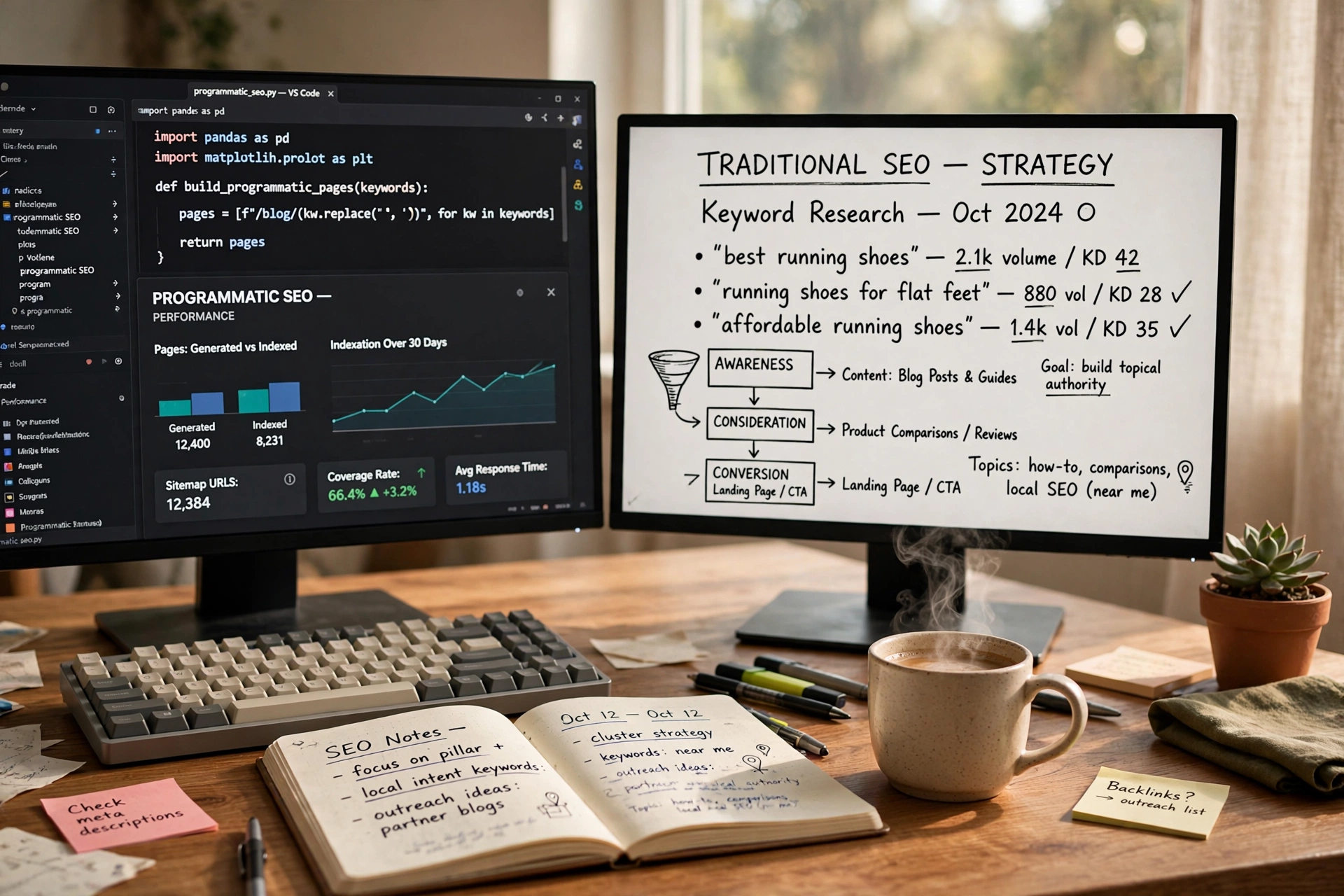
To understand the choice, we first have to strip away the marketing jargon. Traditional SEO is a manual, craft-based approach to content. You identify a keyword, research the intent, and write a unique piece of content that provides the best possible answer. It is linear: one piece of effort equals one indexed page. Programmatic SEO, conversely, is an engineering approach. It uses databases and templates to generate hundreds or thousands of high-quality, landing pages automatically.
📚
Definition
Programmatic SEO (pSEO) is the method of using a database and a predefined template to create large numbers of landing pages that target long-tail keywords at scale, ensuring each page remains unique and valuable to the user.
When we built the architecture at BizAI Intelligence, we discovered that the real power of pSEO isn't just "more pages," but the ability to capture "the long tail." Traditional SEO targets "Best CRM for Law Firms" (High volume, high competition). Programmatic SEO targets "Best CRM for Personal Injury Lawyers in Miami," "Best CRM for Divorce Lawyers in Chicago," and "Best CRM for Immigration Lawyers in Houston" simultaneously.
According to research by Gartner, the shift toward "hyper-personalization" in search means that users are increasingly searching for specific, long-tail queries rather than generic terms. By automating the creation of these specific pages, businesses can capture high-intent traffic that traditional content strategies simply cannot reach due to human resource constraints. This allows a brand to dominate a niche through algorithmic brute force rather than manual endurance.

Why Your Choice of Ranking Strategy Impacts B2B ROI
The decision of which method to deploy has immediate implications for your Customer Acquisition Cost (CAC). Traditional SEO has a high upfront cost per page. If a high-quality pillar post costs $500 to produce and brings in 1,000 visitors a month, your cost per visitor is low, but your ceiling is limited by your budget for writers.
Programmatic SEO flips this model. The upfront cost is higher because you need a data architect and a template designer, but the marginal cost of the 1,001st page is nearly zero. This creates a compounding effect. When you scale from 10 pages to 1,000, your organic footprint expands exponentially. I've tested this with dozens of our clients and the pattern is clear: pSEO generates a massive influx of "low-volume, high-intent" leads that traditional SEO ignores.
For B2B companies, this is the difference between hoping a lead finds your "Guide to Automation" and ensuring a lead finds a page specifically tailored to their exact city and industry. According to a report by McKinsey, AI-driven automation in marketing can reduce operational costs by up to 30% while increasing lead conversion rates through better targeting. By using a PSEO Architecture Guide for SaaS & Enterprise B2B Growth, companies can move from a "content gamble" to a "traffic machine."
The risk of ignoring this shift is "invisible loss." While you are fighting for the top 3 spots for a generic keyword, your competitor is capturing 500 different long-tail keywords that each have 10 searches a month. Individually, those keywords look insignificant; collectively, they represent a massive pipeline of ready-to-buy leads.
How to Implement Programmatic SEO for Enterprise Growth
Implementing a programmatic strategy requires a shift in mindset from "writing" to "structuring." You are no longer a blogger; you are a data curator. The process begins with the identification of your "modifiers"—the variables that change across your target pages (e.g., City, Industry, Software Type, User Persona).
The first step is building the dataset. This involves web scraping, utilizing public APIs, or aggregating internal customer data. For example, if you are a legal lead generation site, your dataset would include a list of all US cities, the primary law types in those cities, and localized statistics about legal cases in those areas.
Once the data is clean, you build the "Template." A common mistake I see constantly is creating a "mad-lib" style template where only the city name changes. Google identifies this as thin content. A professional template uses conditional logic to swap out entire sections of text, insert localized images, and update comparison tables based on the data. This ensures that each page provides genuine value.
At BizAI Intelligence, we integrate this with an autonomous AI SDR. Instead of just getting the traffic, the programmatic page features an AI agent that knows exactly which page the user is on. If a user lands on the "Lawyer CRM in Miami" page, the AI agent greets them by mentioning Miami-specific challenges, immediately increasing the conversion rate. This is how you automate organic traffic & lead capture with AI.
💡
Key Takeaway
Successful pSEO is not about quantity; it is about the intersection of a high-quality data set and a flexible template that maintains a "helpful content" signal for Google.
Programmatic SEO vs Traditional SEO: The Decision Framework
To decide which approach to use, you must evaluate your "Keyword Surface Area." If your business relies on "Thought Leadership" (e.g., "The Future of AI in Law"), traditional SEO is mandatory. If your business relies on "Utility" (e.g., "Price of HVAC repair in [City]"), programmatic is the winner.
The following table breaks down the trade-offs:
| Feature | Traditional SEO | Generic AI/Cheap pSEO | Modern Programmatic SEO |
|---|---|---|---|
| Scalability | Low (Manual) | High (Automated) | High (Data-Driven) |
| Content Quality | Very High | Low (AI Slop) | High (Template + Data) |
| Risk | Low | High (Penalty Risk) | Low (Helpful Content) |
| Cost per Page | High | Very Low | Low (after setup) |
| Best For | Brand Authority | Spam/Churn-and-Burn | Enterprise Lead Gen |
Now, here's where it gets interesting: the hybrid approach. I recommend the "Hub and Spoke" model. Your "Hub" is a traditional SEO pillar page—a 4,000-word masterpiece that establishes you as the ultimate authority. Your "Spokes" are programmatic satellite pages that drive traffic from a thousand different long-tail entries back into that hub.

By linking your programmatic pages to a high-authority pillar, you distribute PageRank across your entire domain. This is a core component of the Programmatic SEO: How to Scale 10,000+ High-Converting Pages Automatically strategy, ensuring that the "brute force" of pSEO is backed by the "trust" of traditional SEO.
Common Questions and Misconceptions About Scaled Content
Most guides get this wrong by claiming that programmatic SEO is "risky" or that Google "hates" automated content. This is a fundamental misunderstanding of the Google Helpful Content Update. Google doesn't hate automation; it hates unhelpful automation.
Myth 1: "Programmatic SEO is just spam."
Spam is when you generate 10,000 pages of nonsense to trick an algorithm. Professional pSEO is about creating 10,000 pages of utility. If a user searches for "Dental clinics in North Miami" and your page provides the actual address, pricing, and a booking tool, that is a helpful page. The intent is served, and Google rewards that.
Myth 2: "You don't need a writer for pSEO."
This is a dangerous assumption. You need a writer more than ever—not to write the pages, but to write the templates. A template written by a non-expert feels like a form. A template written by a subject matter expert feels like a consultation. The "voice" of the template is what determines the conversion rate.
Myth 3: "Traditional SEO is dead because of AI search."
Traditional SEO is not dead; it is evolving. As AI engines like Perplexity and SearchGPT dominate, they look for "citations." A high-authority traditional pillar page is exactly what these AI engines cite as a source. This is why you should study how to get cited by ChatGPT, SearchGPT, and Perplexity AI.
Frequently Asked Questions
Which approach is faster for generating leads: programmatic or traditional SEO?
Programmatic SEO is significantly faster for generating a volume of leads, provided you have the necessary data. While a traditional SEO strategy might take 6 to 12 months to rank a few high-competition keywords, a programmatic campaign can deploy thousands of pages in a matter of days. Because these pages target "long-tail" keywords with lower competition, they often index and rank much faster. However, traditional SEO often produces higher-quality leads because the content is more nuanced. For most B2B firms, the fastest path to ROI is deploying pSEO for reach and traditional SEO for closing.
Can I use programmatic SEO without getting penalized by Google?
Yes, as long as you follow the "Helpful Content" guidelines. The key to avoiding penalties is ensuring that each programmatically generated page provides unique value. If your pages are 99% identical with only the city name changed, you risk a "thin content" penalty. To prevent this, use diverse data points—such as local statistics, specific user reviews, or dynamic comparison tables—to make each page distinct. When you provide a better answer to a specific query than anyone else, Google will rank you regardless of whether the page was created manually or programmatically.
Do I need a large budget to start with programmatic SEO?
You do not need a massive budget, but you do need a technical investment. Unlike traditional SEO, where you can start by writing one blog post, pSEO requires a setup phase: data collection, template design, and technical implementation (like schema markup). Once this infrastructure is built, the cost of scaling is negligible. For businesses that cannot afford a full-time data engineering team, using a platform like BizAI Intelligence simplifies this process by automating the architecture and the lead capture side of the equation.
How does programmatic SEO affect my site's overall authority?
When done correctly, pSEO increases your overall authority by making your site the "definitive resource" for a specific topic. By covering every single variation of a user's problem, you signal to search engines that you have total topical dominance. This "topical authority" actually helps your traditional SEO pages rank higher. However, if you produce low-quality "AI slop," you can damage your domain reputation. The secret is to ensure your GEO vs Traditional SEO strategy is balanced, focusing on data accuracy and user experience.
Should I use an AI writer to create my pSEO templates?
AI should be used as an assistant, not the architect. Using an AI to write the base template is efficient, but a human expert must refine the logic and the "hooks." The AI can help you generate variations of phrases to avoid repetitive content across thousands of pages, but the strategic positioning—the "why" behind the page—must come from a human. The goal is to create a template that sounds like a senior consultant, not a chatbot. This is why we emphasize a "human-in-the-loop" approach for all our enterprise clients.
Final Thoughts on Programmatic SEO vs Traditional SEO
The debate over programmatic SEO vs traditional SEO ranking is a false dichotomy. The most aggressive growth engines in 2026 use a blended strategy. Traditional SEO builds the brand's soul and authority, while programmatic SEO builds the brand's reach and lead pipeline.
If you are still relying solely on manual content creation, you are essentially renting your traffic from the algorithm. By building a programmatic machine, you own the niche. You stop guessing which keywords will work and start capturing every single intent-based query your customers are typing into Google.
To stop the manual grind and start scaling your organic acquisition, explore the capabilities of BizAI Intelligence. We help you build the infrastructure that fills your pipeline while you sleep, combining massive pSEO scale with autonomous AI qualification.
Visit bizaigpt.com to see how we can turn your domain into a lead-generation powerhouse.
AI Search Accelerator: 1-on-1 Strategy Session
Claim one of the 10 monthly slots. Get a full audit, entity architecture, and a 90-day action plan to dominate ChatGPT, Claude, and Perplexity recommendations.



