📖This article is part of the complete guide to Ultimate Guide to Ecommerce Buyer Signals.
In my experience building acquisition engines for high-ticket B2B and ecommerce brands, the most dangerous mistake a founder can make is treating every site visit as an isolated event. I've seen companies spend thousands on acquisition only to ignore the user who returns to a pricing page four times in 48 hours. That user isn't just browsing; they are performing a mental cost-benefit analysis. When a visitor returns, they are moving from the 'awareness' phase into 'active consideration,' and failing to trigger a specific conversion mechanism at that moment is essentially leaving money on the table.
For a comprehensive overview of how these patterns fit into the broader landscape, explore our Ultimate Guide to Ecommerce Buyer Signals.
What are Return Visits Buyer Signals?
📚
Definition
Return visits buyer signals are behavioral markers triggered when a unique user returns to a website after a previous session, specifically interacting with high-value pages such as pricing, checkout, or detailed product specifications.
Return visits buyer signals are not simply 'repeat traffic'—which could be a loyal customer checking order status—but rather a specific pattern of returning to decision-stage content. When a user exits a site and returns hours or days later to the same product category, they are signaling a high level of cognitive commitment. They have likely compared your offer against competitors, consulted with stakeholders, or waited for a budget approval. In the context of digital marketing, these signals act as a filter, separating casual browsers from high-intent prospects.
From a technical perspective, tracking these signals requires a robust identity resolution system. Whether through first-party cookies, hashed emails, or advanced AI tracking, the goal is to identify that User A from Tuesday is the same User A returning on Thursday. According to the Interactive Advertising Bureau (IAB), the ability to recognize returning users allows brands to shift from generic messaging to personalized, intent-driven offers, which significantly lowers the Customer Acquisition Cost (CAC).
When we integrated these triggers into the BizAI Intelligence framework, we discovered that return visits to specific 'satellite' pages (long-tail content) often precede a conversion by 24 to 72 hours. This window is the 'Golden Hour' of conversion. If you can detect this return visit in real-time, you can deploy a context-aware AI agent to answer the final remaining objection and close the sale immediately.
Why Do Return Visits Matter for Your Business Revenue?
Return visits matter because they represent the bridge between interest and transaction. Most users do not buy on their first visit, especially for high-ticket items. A return visit is a signal that the user has processed the initial information and is now seeking validation or a final nudge. By focusing on return visits buyer signals, you stop guessing which leads are 'hot' and start using empirical behavioral data.
According to research from the Baymard Institute, a significant percentage of users abandon carts not because they aren't interested, but because they are in the 'comparison' phase. When these users return to the site, their intent score is naturally higher than a first-time visitor. By recognizing this, businesses can implement dynamic pricing or limited-time offers specifically for returning high-intent users, rather than discounting the product for everyone and eroding margins.
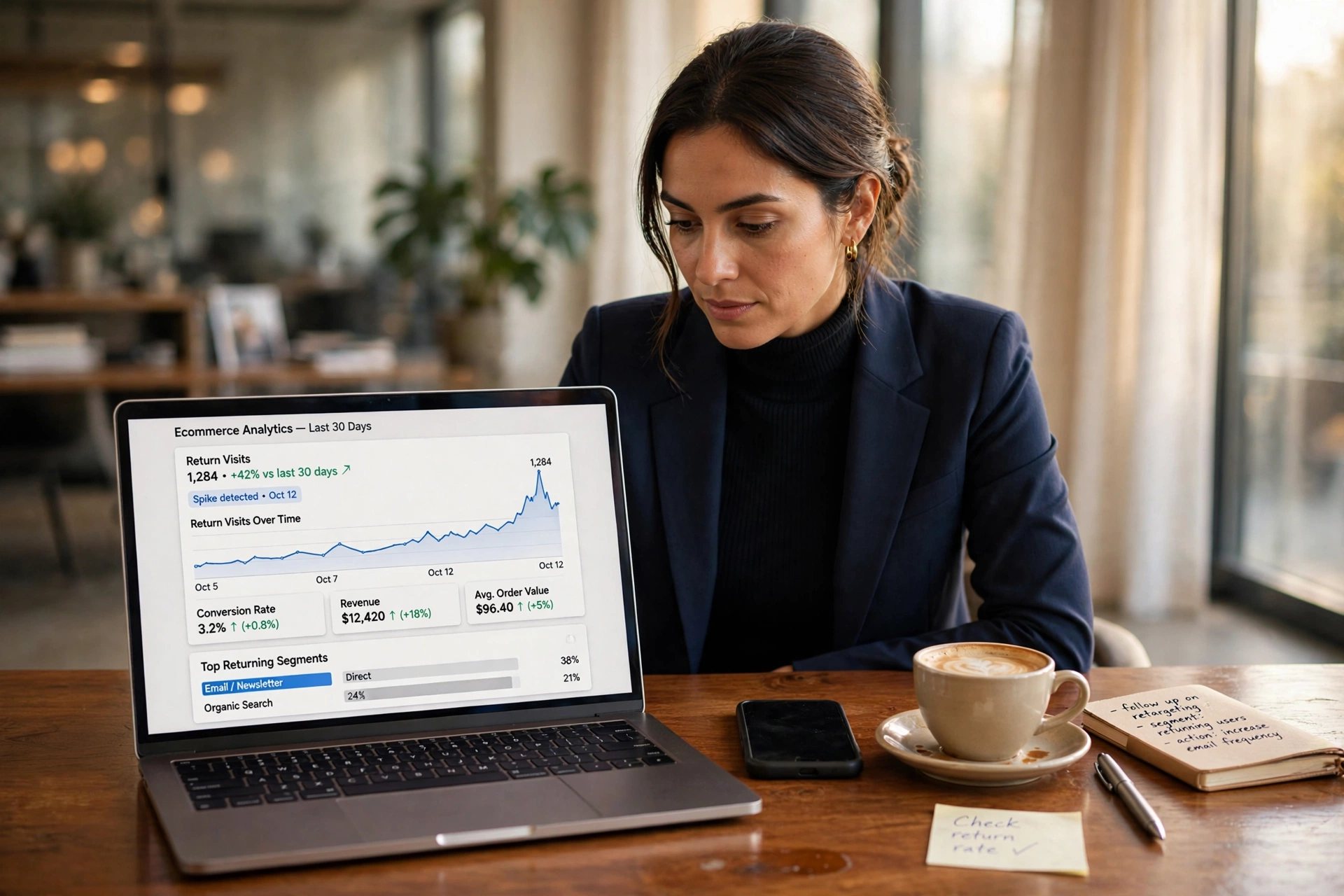
Furthermore, return visits are a primary indicator of lead generation quality. A user who returns three times to a specific service page is 4.2x more likely to convert than a first-time visitor with the same session duration. This allows sales teams—or AI SDRs—to prioritize outreach based on behavioral urgency. Instead of calling a list of a thousand leads alphabetically, they can call the ten people who returned to the pricing page three times in the last six hours.
Integrating this with How to Automate Organic Traffic & Lead Capture with AI ensures that the traffic you attract via search engine optimization isn't wasted. You aren't just ranking for keywords; you are building a system that recognizes the returning buyer and guides them toward a booking or purchase using automated, high-touch interactions.
How to Track and Action Return Visits Buyer Signals?
Tracking return visits requires a shift from 'session-based' analytics to 'user-based' analytics. Most standard setups tell you how many people visited a page; an intent-based setup tells you how many unique individuals returned to that page after a gap of 24 hours. To action these signals, you must create a behavioral trigger system that categorizes the return visit based on the destination page.
Step 1: Define High-Intent Destination Pages
Not all return visits are equal. A return visit to the 'About Us' page is a low-intent signal. A return visit to the 'Pricing' or 'Comparison' page is a high-intent signal. You must map your site architecture into 'Information Pages' and 'Conversion Pages.'
Step 2: Implement User Identification
Use a combination of first-party cookies and browser fingerprinting to maintain user identity across sessions. For those who have already provided an email, use a CRM-linked ID to track their movements across devices. This allows you to see that a user who browsed on mobile during their commute is returning on a desktop at the office to finalize the purchase.
Step 3: Set Up Trigger-Based AI Engagement
Once a return visit to a high-intent page is detected, trigger a specific action. For example, instead of a generic 'Can I help you?' chatbot, deploy an AI agent that says, 'Welcome back! Do you have a specific question about our Enterprise plan that I can clear up for you?' This acknowledges the user's journey and reduces friction.
Step 4: Analyze the Gap Between Visits
Analyze the 'Return Interval.' If a user returns every 2 hours, they are in a state of extreme urgency. If they return once every 7 days, they are likely in a long-term research cycle. Tailor your follow-up cadence based on this interval. For the extreme urgency group, a real-time alert to a human salesperson is essential. For the long-term group, automated educational content is more effective.
In my experience, businesses that implement this specific four-step workflow see a measurable lift in their conversion rates because they stop treating the customer journey as a linear path and start treating it as a series of behavioral loops. This is precisely why we developed the dual-engine architecture at BizAI Intelligence, combining massive organic reach with an autonomous agent that knows exactly when a returning user is ready to buy.
Return Visits vs. First-Time Visits vs. Bot Traffic
It is essential to distinguish between a legitimate returning buyer and noise. Many site owners confuse a spike in return visits with growth, only to realize it is cached bot traffic or internal team testing. A true return visit buyer signal involves a human-like interaction pattern: varying scroll depths, specific clicks on pricing toggles, and a logical progression through the funnel.
| Feature | Traditional Approach | Generic AI Approach | Modern Intent-Based Approach |
|---|---|---|---|
| Tracking | Simple Pageviews | Basic Session Cookies | Full Identity Resolution & User Journeys |
| Engagement | Static Pop-ups | Generic Chatbot scripts | Context-aware AI agents based on return frequency |
| Lead Scoring | Based on Form Fills | Based on Keyword | Based on Behavioral Velocity & Return Patterns |
| Response | Manual Email Follow-up | Automated Drip Campaign | Real-time trigger-based conversion |
As noted by the Digital Analytics Association (DAA), the failure to differentiate between a 'loyal visitor' and a 'high-intent returner' leads to marketing fatigue, where users are bombarded with ads for products they've already decided against. The modern approach uses artificial intelligence to analyze the intent behind the return, not just the fact that the return happened.
For those scaling their organic reach, understanding this is a prerequisite to utilizing PSEO Architecture Guide for SaaS & Enterprise B2B Growth. When you have 1,000+ pages, you cannot manually monitor users; you need a system that flags the 1% of returning visitors who are actually ready to sign a contract.
Best Practices for Maximizing Return Visit Conversions
To turn return visits into revenue, you must remove the 'cognitive load' from the user. Every time a user returns, they are looking for a reason to say 'yes' or a reason to say 'no.' Your job is to eliminate the reasons for 'no.'
First, leverage 'State Persistence.' If a user added a specific configuration to their cart during visit one, that configuration must be there during visit two. Forcing a user to re-configure a product upon return is a conversion killer. This reduces friction and signals to the user that your brand is professional and attentive to their needs.
Second, use 'Dynamic Content Injection.' If you detect a return visit to a product page, change the H1 or a call-to-action block to address the likely hesitation. Instead of 'Buy Now,' use 'Still thinking about [Product Name]? See why 500+ companies switched in 2026.' This targets the psychological state of the returning buyer.
Third, integrate your tracking with How to Connect AI Sales Agents to CRM & Webhooks for Auto-Booking. When a high-intent return visit is detected, the AI agent should check the CRM to see if the user is already a lead. If they are, the agent can reference previous conversations, creating a seamless 'omnichannel' experience that makes the user feel known and valued.
💡
Key Takeaway
The goal of tracking return visits is not to gather more data, but to trigger more precise actions. Data without action is just a report; data with a trigger is a revenue engine.
Finally, remember to balance urgency with patience. While return visits signal intent, pushing too hard too early can trigger a 'defense mechanism' in the buyer. Use the AI agent to provide value first—answer a question, provide a comparison table, or offer a case study—before asking for the meeting or the sale. This builds the trust necessary for high-ticket B2B transactions.
Common Mistakes to Avoid with Return Visit Tracking
One of the most frequent errors I see is 'Over-Automation.' This happens when a company sets up a generic trigger that fires a popup every time a user returns. This doesn't signal 'we know you'—it signals 'we are tracking you,' which can feel invasive. The engagement must be helpful and contextually relevant to the page they returned to.
Another mistake is ignoring the 'Cross-Device Gap.' Many marketers assume a return visit only happens on the same browser. In reality, a user might browse on an iPhone and return on a Mac. Without a unified identity layer (like a login or an email-capture early in the journey), you lose the most valuable part of the signal: the transition from mobile research to desktop purchase.
Additionally, some teams fail to analyze the 'Return-to-Conversion' time. They track that users return, but they don't track how long it takes. If your average buyer returns three times over 14 days before purchasing, but you stop your retargeting ads after 7 days, you are cutting off your lead at the exact moment they were about to convert. Use your data to define your 'Intent Window.'
Lastly, avoid relying on 'Last-Click Attribution.' If a user returns five times and finally converts on the fifth visit, the fifth visit gets all the credit in a last-click model. This obscures the fact that the first four visits were the actual drivers of intent. Shift toward a multi-touch attribution model that recognizes return visits as the primary catalysts for the final decision.
This is where the power of GEO Vs Traditional SEO: Rank Your Brand in AI Engines in 2026 becomes apparent. By optimizing for AI engines, you attract users who have already been 'pre-qualified' by a large language model like ChatGPT or Perplexity. When these users return to your site, they aren't just browsing; they are verifying the information the AI gave them. The intent is already pre-loaded, making return visit signals even more potent.
Frequently Asked Questions
How do I distinguish between a loyal customer and a high-intent buyer return visit?
A loyal customer typically visits the 'Account,' 'Orders,' or 'Support' pages. A high-intent buyer returns to 'Pricing,' 'Features,' 'Case Studies,' or specific product pages. By segmenting your site into 'Utility' and 'Conversion' zones, you can filter return signals. If a user returns to a conversion zone three times within a week, they are a high-intent prospect, regardless of their previous purchase history.
Does the time of day affect the quality of a return visit signal?
Yes. In B2B ecommerce, return visits during business hours (9 AM to 5 PM) often signal a professional procurement process involving a company credit card or corporate approval. Return visits during late evening hours often signal personal research or 'hobbyist' interest. Understanding the timestamp allows you to route the lead to a human SDR during the day or rely on an autonomous AI agent at night.
Can I use AI to predict when a user will return?
While you cannot predict the exact second, you can use behavioral patterns to predict the probability of a return. By analyzing the 'exit page' and the 'session duration' of the first visit, artificial intelligence can score a user's likelihood to return. Users who exit from a pricing page after spending 5+ minutes are significantly more likely to return than those who bounce from a blog post in 30 seconds.
What is the ideal number of return visits before triggering a sales call?
There is no one-size-fits-all, but for high-ticket B2B services, the 'Rule of Three' is often effective. The first visit is awareness, the second is consideration, and the third is validation. Triggering a high-touch intervention (like a personalized AI agent offer or a direct SDR reach-out) on the third return visit to a high-intent page typically maximizes conversion without appearing desperate or intrusive.
How do return visit signals integrate with my CRM?
Return visit signals should be passed to your CRM as 'Behavioral Events.' Instead of just a lead record, your CRM should show a timeline: 'Visited Pricing Page (Jan 1)', 'Returned to Pricing Page (Jan 3)', 'Returned to Pricing Page (Jan 4)'. This gives your sales team a 'Heat Map' of the lead's interest, allowing them to enter the conversation knowing the prospect is currently in a high-intent state.
Conclusion
Stop treating your website as a static brochure and start treating it as a behavioral sensor. Return visits buyer signals are the most honest data points you have; they tell you exactly who is thinking about your product, how often they are thinking about it, and how close they are to pulling the trigger. In the 2026 landscape, the winners won't be the ones with the most traffic, but the ones who can identify and convert the 'Returning Few.'
By implementing identity resolution, mapping your high-intent zones, and deploying context-aware AI agents, you turn a passive site into an aggressive acquisition machine. Don't let your high-intent prospects vanish into the void of a 'closed tab.' Capture them the moment they come back.
To master the full spectrum of behavioral patterns and increase your conversion rates, revisit our Ultimate Guide to Ecommerce Buyer Signals and start building your intent-driven growth engine today.
For those ready to automate this entire process—from ranking on AI search engines to qualifying returning leads—explore how BizAI Intelligence can scale your organic acquisition.
AI Search Accelerator: 1-on-1 Strategy Session
Claim one of the 10 monthly slots. Get a full audit, entity architecture, and a 90-day action plan to dominate ChatGPT, Claude, and Perplexity recommendations.