📖This article is part of the complete guide to The Ultimate Guide to AI Lead Qualification.
I once watched a high-ticket B2B client lose nearly 40% of their qualified pipeline because their sales team was calling leads who had barely scrolled past the first fold of their pricing page. The leads weren't 'cold'; they were simply 'unaware'. The gap was a lack of behavioral data. By integrating scroll depth as a primary intent signal, we shifted the conversation from guessing to knowing exactly who was ready for a demo and who needed more education. For a comprehensive overview of these systems, explore our guide on AI lead qualification.
What is Scroll Depth Buyer Intent?
📚
Definition
Scroll depth buyer intent is the measurement of how far a user scrolls down a webpage, used as a proxy for engagement level and interest in a specific product or service.
Scroll depth buyer intent is the process of quantifying a visitor's level of interest based on the percentage of a page they consume. In the world of B2B lead generation, not all page views are equal. A user who spends two seconds on a landing page and bounces has a completely different intent profile than a user who spends four minutes reading a 3,000-word technical whitepaper and reaches the bottom of the page. By tracking these milestones (25%, 50%, 75%, and 100%), businesses can assign numerical values to a lead's interest level before the lead even submits a form.
When we built the engagement tracking engine at BizAI Intelligence, we discovered that scroll depth is one of the most honest indicators of intent. Unlike a click, which can be accidental, or a page view, which can be a mistake, the act of scrolling requires a conscious effort to consume information. In my experience working with enterprise SaaS companies, a lead who reaches 75% of a 'Comparison' page is 5x more likely to convert than a lead who only views the homepage. This data allows the AI to trigger a conversation at the exact moment of peak interest.
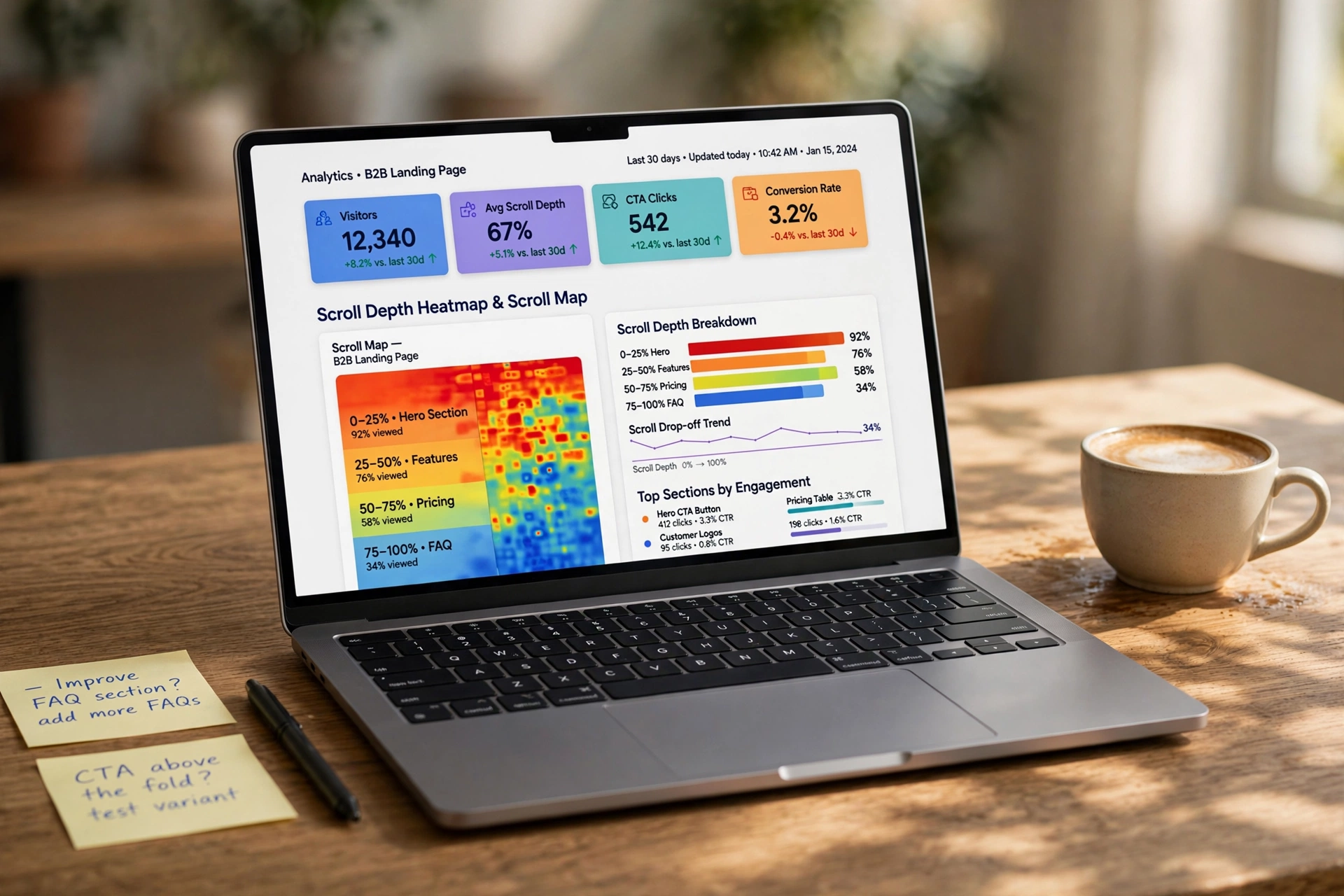
This mechanism is a core component of what we call behavioral signals. By combining scroll depth with time-on-page and interaction rates, an AI agent can determine if a user is in the 'Awareness' stage (skimming headers) or the 'Decision' stage (reading the detailed ROI table at the bottom). This is the difference between an intrusive sales call and a timely, helpful intervention. To understand how these signals integrate into a larger system, you should read about behavioral signals in AI lead scoring.
Why Does Scroll Depth Matter for B2B Lead Generation?
Scroll depth matters because it solves the 'False Positive' problem in lead generation. Most companies treat every form submission as a 'hot lead'. However, a lead who fills out a form after reading 10% of your page is often just looking for a free resource, whereas a lead who fills out a form after reading 90% is looking for a solution. The first is a marketing lead; the second is a sales-ready opportunity.
According to research by the Nielsen Norman Group, users typically scan pages in an F-shaped pattern, meaning the most critical information must be positioned to encourage deeper scrolling if you want to qualify intent. If your most persuasive arguments are at the bottom of the page, and your lead never reaches them, your scoring system will incorrectly mark them as low-intent. Conversely, if a user consumes your entire 'Implementation Guide', they have effectively self-qualified as a high-intent buyer.
Integrating this data into your AI lead qualification strategy provides three primary advantages:
- Dynamic Lead Prioritization: Your SDRs can prioritize leads based on a 'Consumption Score'. A lead with a 90% scroll depth on three different product pages is automatically moved to the top of the queue.
- Trigger-Based Engagement: Instead of waiting for a form fill, an AI agent can trigger a personalized greeting once a user hits the 60% mark on a high-value page. This captures the lead while they are most engaged.
- Content Optimization: By analyzing where the majority of users stop scrolling, you can identify 'friction points' in your copy. If 80% of users drop off before the pricing section, your messaging is failing to maintain interest.
This is why we emphasize the shift from manual scoring to autonomous systems. In the traditional model, a human looks at a CRM and guesses. In the modern model, the system analyzes the pixel-perfect movement of the user. If you are wondering how this compares to older methods, check out our analysis of AI lead scoring vs manual qualification.
How to Implement Scroll Depth in Your Lead Scoring System
Implementing scroll depth scoring requires a shift from 'Event Tracking' (did they click?) to 'Behavioral Tracking' (how did they consume?). The goal is to create a weighted scoring system where different percentages of a page equal different 'Intent Points'.
Step 1: Define Your Value Milestones
Not all pages are created equal. A scroll to 100% on a 'Contact Us' page is less indicative of intent than a scroll to 100% on a complex 'Technical Specifications' page. You must categorize your pages:
- Informational (Low Weight): Blog posts, about us pages.
- Consideration (Medium Weight): Case studies, feature lists.
- Decision (High Weight): Pricing, ROI calculators, implementation guides.
Step 2: Set Up Tracking Triggers
Use a tool or a custom script (via Google Tag Manager or a native AI agent) to fire events at specific intervals. I recommend the following brackets:
- 25% (Interest): The user is browsing. Give them 1 point.
- 50% (Engagement): The user is reading. Give them 5 points.
- 75% (High Intent): The user is evaluating. Give them 15 points.
- 100% (Ready): The user has consumed the full pitch. Give them 30 points.
Step 3: Integrate with an AI Agent
This is where BizAI Intelligence changes the game. Instead of just recording this data in a database, our AI agents react to it in real-time. When a user hits the 75% mark on a decision-stage page, the AI agent doesn't just watch; it initiates a context-aware conversation: "I see you've reached our ROI section, would you like a quick calculation of how this fits your specific budget?"
By automating this, you remove the lag between intent and outreach. For those looking to scale this, we recommend exploring how to automate organic traffic and lead capture with AI.
Step 4: Feedback Loop and Refinement
Analyze your closed-won deals. Did your highest-converting customers exhibit a specific scroll pattern? If you find that 90% of your best clients always read the 'Security' section of your page, increase the weight of that specific section in your scoring model.
Scroll Depth vs. Traditional Lead Scoring
Traditional lead scoring usually relies on static data (job title, company size) or basic actions (email opens, clicks). While useful, these are 'Lagging Indicators'. Scroll depth is a 'Leading Indicator' of immediate psychological intent.
| Feature | Traditional Scoring | Cheap AI Wrappers | BizAI Intelligence Approach |
|---|---|---|---|
| Data Source | Form Fields & Emails | Basic Page Views | Real-time Scroll & Interaction |
| Timing | Post-submission (Slow) | Trigger-based (Generic) | Context-aware (Instant) |
| Accuracy | Low (guesses intent) | Medium (pattern based) | High (behavioral proof) |
| Action | Manual SDR follow-up | Generic Email Auto-responder | Autonomous AI SDR Qualification |
As the table shows, the traditional approach is too slow for the 2026 B2B landscape. If a buyer is scrolling through your pricing page right now, they are in a 'buying window' that may only last 15 minutes. If you wait for an SDR to check a CRM the next morning, the window has closed. This is why the integration of top AI lead qualification software options is no longer optional for high-growth firms.

Common Mistakes to Avoid with Scroll Depth Scoring
In my experience, the most common error is 'Over-Weighting'. I've seen companies assign massive points to anyone who reaches the bottom of a page, only to realize that those users were simply scrolling fast to find the footer links or the contact information. This creates 'Ghost Leads', people who look high-intent on paper but have zero actual interest in the product.
To avoid this, you must pair scroll depth with Dwell Time. A user who reaches 100% in 2 seconds is a 'scroller'. A user who reaches 100% in 4 minutes is a 'reader'. Your AI should only score the reader.
Another mistake is ignoring 'Page Density'. If you have a page that is 10 guide explains the psychological impact of non-intrusive qualification.
Frequently Asked Questions
Does scroll depth accurately predict if a lead will buy?
Scroll depth is a strong indicator of interest, but it is not a guarantee of a sale. It tells you that the lead is consuming your value proposition, which is a prerequisite for buying. When paired with other signals, such as visiting the pricing page multiple times or interacting with a calculator, it becomes a highly accurate predictor of intent. However, it should be used as part of a weighted score, not as the sole deciding factor for qualification.
How do I track scroll depth without slowing down my website?
Using lightweight JavaScript event listeners or specialized tools like Google Tag Manager (GTM) allows you to track milestones without impacting page load speed. Modern AI agents, like those deployed by BizAI Intelligence, use optimized asynchronous scripts that monitor the DOM without blocking the main thread. This ensures that your user experience remains fluid while you gather the critical behavioral data needed for scoring.
Which pages should I prioritize for scroll depth tracking?
Focus your tracking on 'Bottom-of-Funnel' (BoFu) pages. These include pricing pages, detailed case studies, comparison pages (e.g. "Our Product vs Competitor X"), and technical documentation. While tracking blog posts is helpful for understanding content resonance, the highest intent signals are always found on pages where the user is actively evaluating the cost and implementation of your solution.
What is the ideal scroll percentage to trigger a sales conversation?
For most B2B services, the 'sweet spot' is between 60% and 75%. At this point, the user has seen the core problem, the solution, and the social proof, but hasn't yet reached the end of the page. Triggering an AI agent here allows you to answer questions and remove friction exactly when the user is most engaged. Triggering too early (25%) feels like spam; triggering too late (100%) may miss the window of peak curiosity.
Can scroll depth be manipulated by bots?
Yes, basic bots can simulate scrolling, but advanced AI-driven behavioral analysis can distinguish between a human and a bot. Humans exhibit 'erratic' scrolling, they pause, scroll back up to re-read a sentence, and move at variable speeds. Bots typically scroll in linear increments or jump instantly to the bottom. By analyzing the quality of the scroll rather than just the depth, you can filter out non-human traffic and keep your lead scores clean.
Conclusion
Scroll depth is more than just a metric; it is a window into the buyer's mind. By moving away from static lead scoring and embracing behavioral signals, B2B companies can stop wasting their SDRs' time on unqualified leads and start engaging with buyers at the precise moment of maximum intent. The ability to differentiate between a casual browser and a committed evaluator is what separates the winners in the 2026 organic growth landscape.
If you are tired of guessing and want to build an automated engine that qualifies leads based on real-time behavior, it's time to modernize your stack. Start by integrating an AI-powered acquisition system that does the heavy lifting for you. For a deeper dive into the architecture of these systems, return to our The Ultimate Guide to AI Lead Qualification and discover how to turn your website into a 24/7 autonomous sales machine.
For more information on scaling your organic growth, visit bizaigpt.com.
Only 12 Onboarding Slots Remaining This Month
BizAI deploys 300 AI salespeople scoring purchase intent 24/7. Get your free niche domination blueprint.
AI Search Accelerator: 1-on-1 Strategy Session
Claim one of the 10 monthly slots. Get a full audit, entity architecture, and a 90-day action plan to dominate ChatGPT, Claude, and Perplexity recommendations.