📖This article is part of the complete guide to Ultimate Guide to AI Lead Generation Tools.
Most B2B companies waste 70% of their content budget on 'random acts of content'—articles that target isolated keywords without a strategic connection. In my experience working with high-ticket service providers, the companies that actually dominate their niche aren't the ones writing the most; they are the ones building the most coherent topical maps. When we implemented programmatic structures at BizAI Intelligence, we found that interconnected clusters outperform isolated posts by over 400% in terms of lead conversion because they mirror the actual buyer's journey.
For a comprehensive overview of the tech stack needed to scale this, explore our guide on AI lead generation tools.
What are SEO Content Clusters for Lead Generation?
📚
Definition
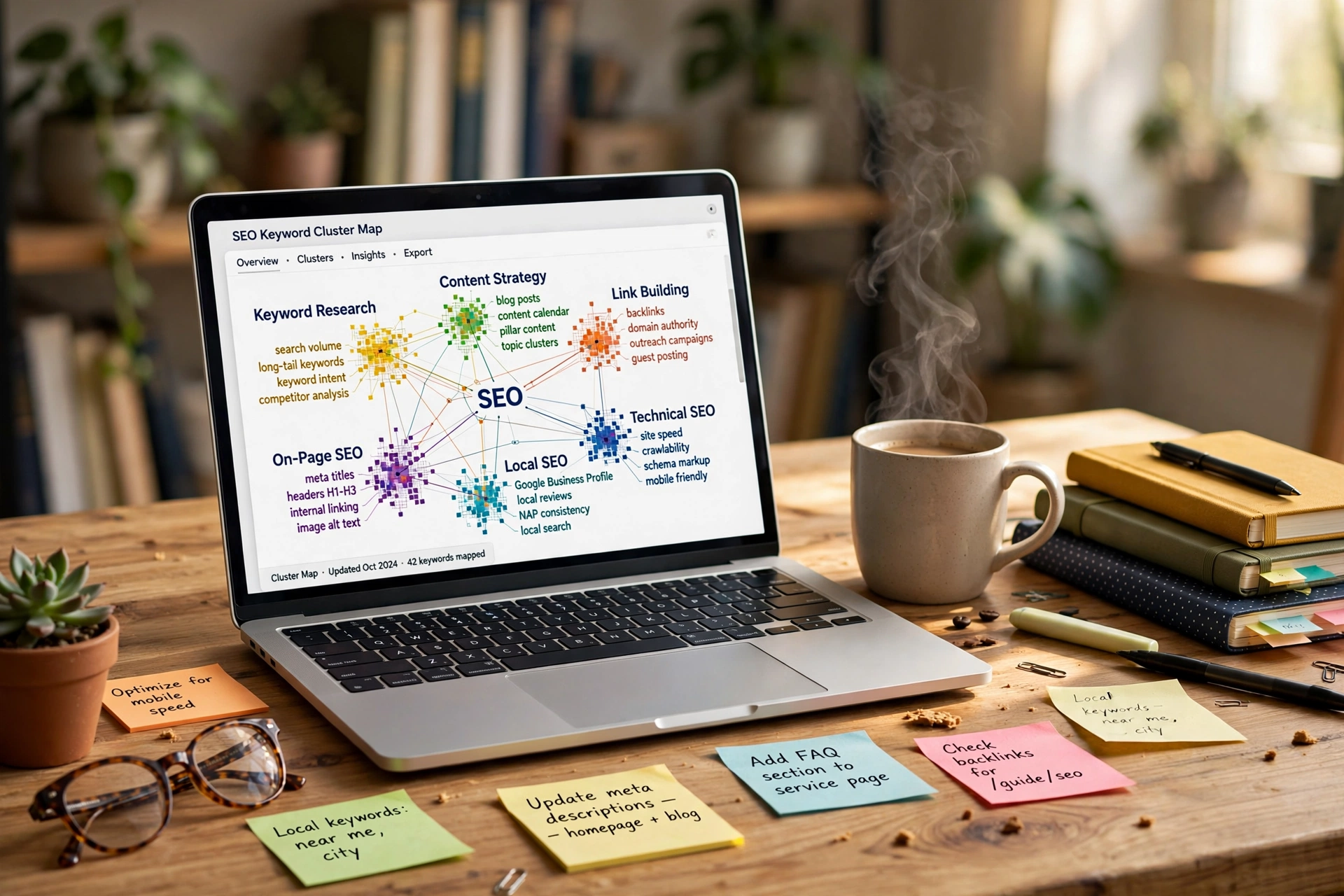
SEO content clusters are a strategic grouping of related content pieces organized around a central, high-authority "Pillar Page," connected by internal links to establish topical authority for a specific subject.
SEO content clusters for lead generation are not just about organizing a blog; they are about creating a semantic web that signals to Google and other AI search engines that your brand is the definitive expert on a topic. Instead of targeting a single keyword, you target a "topic." The structure consists of one comprehensive pillar page (the hub) and multiple satellite pages (the spokes) that dive deep into specific long-tail queries.
In 2026, this is no longer optional. With the rise of Generative Engine Optimization (GEO), AI search engines like Perplexity and SearchGPT do not look for a single matching keyword; they look for a "knowledge graph." If you have one page about "lead generation" but nothing about "lead scoring," "buyer intent," or "SDR automation," the AI perceives a gap in your expertise and will likely cite a competitor who has a complete cluster. By building a cluster, you force the search engine to associate your brand with every nuance of that industry.

Why Do Content Clusters Matter for Lead Generation in 2026?
Content clusters matter because they solve the "Trust Gap" in B2B sales. High-ticket buyers rarely convert on their first visit. They research, they compare, and they validate. If a prospect lands on a satellite page regarding behavioral lead scoring and then sees a link to a broader guide on AI tools, they are effectively being led through a curated education path that builds trust.
According to research by Gartner, B2B buyers are now 60% more likely to purchase from a vendor that provides a comprehensive educational experience during their self-guided research phase. When you organize your content into clusters, you are essentially automating the role of a consultant. You are answering the question they have now, and the three questions they will have next.
Furthermore, this architecture significantly boosts your PageRank distribution. When a high-authority external site links to one of your specific satellite pages, that "link juice" doesn't just stay on that page; it flows through the internal links back to the pillar page and out to other satellites. This lifts the entire cluster's ranking potential simultaneously. For those scaling rapidly, utilizing programmatic SEO architecture for SaaS allows you to deploy these clusters at a volume that would be impossible for a human editorial team to manage manually.
💡
Key Takeaway
Content clusters transition your website from a collection of articles to a structured authority hub, increasing both organic reach and lead quality.
How to Build an SEO Content Cluster That Actually Converts
Building a lead-generating cluster requires a shift from "writing for traffic" to "writing for intent." The goal is not to get 10,000 random visitors; it is to get 100 visitors who are ready to book a demo. Here is the professional framework I use at BizAI Intelligence:
1. Identify the Core Pillar Topic
Your pillar should be a broad, high-volume term that represents a primary solution your business provides. For example, if you sell an AI-powered sales tool, your pillar is "AI Lead Generation Tools." This page should be exhaustive—covering what they are, why they matter, and how to choose them—but it should not go into extreme detail on every single sub-topic. Instead, it serves as the directory.
2. Map Out the Satellite "Spokes"
Satellites should target the specific pain points and questions that a buyer has during the consideration phase. If the pillar is the "What," the satellites are the "How."
- Technical Queries: "How to integrate AI agents with a CRM?"
- Comparison Queries: "AI SDR vs Human SDR ROI"
- Problem-Solving Queries: "Why is my lead scoring inaccurate?"
By linking to articles like real-time lead scoring with AI explained, you capture the user at the exact moment they are experiencing a specific friction point in their workflow.
3. Implement a Strict Internal Linking Silo
This is where most marketers fail. To maintain topical authority, satellites must link back to the pillar, and the pillar must link to the satellites. However, satellites should rarely link to other pillars. This "silo" effect tells Google that all this information belongs to one specific bucket of expertise.
4. Embed Conversion Hooks (The AI Layer)
Traffic is a vanity metric; leads are a sanity metric. Every page in your cluster must have a clear conversion path. In the modern 2026 stack, this isn't just a "Contact Us" form. We implement context-aware AI sales agents that recognize which satellite page the user is on. If a user is reading about buyer intent tools, the AI agent should start the conversation by asking about their current intent detection challenges, not a generic "How can I help you?"
5. Optimize for GEO (Generative Engine Optimization)
Ensure your clusters use structured data (Schema.org). Use FAQ blocks and clear, definition-based paragraphs. This makes your cluster "readable" for LLMs, increasing the chance that your brand is cited as the source in a ChatGPT or Perplexity answer.
| Strategy Element | Traditional Blogging | Generic AI Content | BizAI Cluster Approach |
|---|---|---|---|
| Structure | Random / Chronological | Keyword Stuffing | Semantic Topic Clusters |
| Intent | General Traffic | Volume / Low Quality | High-Intent Lead Capture |
| Linking | Occasional / Random | None or Broken | Strict Hierarchical Silos |
| Conversion | Static PDF/Form | Generic Bot | Context-Aware AI SDR |
| Authority | Slow / Luck-based | Temporary/Low | Compounding Topical Authority |
Common Mistakes to Avoid When Clustering Content
In my years of auditing B2B sites, I see the same three mistakes repeated. Avoiding these will put you ahead of 90% of your competition.
Mistake 1: Keyword Cannibalization
This happens when you create three different satellite pages that all essentially answer the same question. For example, having one page for "AI lead scoring" and another for "Lead scoring with AI." Google will struggle to decide which one to rank, and often, neither will reach the top 3. Ensure every satellite page has a unique, distinct intent.
Mistake 2: The "Ghost Town" Pillar
Many companies build a massive pillar page but forget to build the satellites. A pillar page without supporting satellites is just a long article. It lacks the "proof of depth" that search engines require to grant topical authority. If you have a pillar, you must have at least 5-10 high-quality satellites supporting it.
Mistake 3: Ignoring the User Experience (UX)
If you have 50 pages in a cluster, navigating them can be overwhelming. Use a "Table of Contents" on the pillar page and "Related Reading" sections on the satellites. If a user gets lost, they leave. If they are guided, they convert. This is why we emphasize how to automate organic traffic and lead capture with AI, ensuring the journey from discovery to booking is seamless.
Mistake 4: Writing for Robots, Not Humans
With the proliferation of LLMs, there is a temptation to produce "AI slop"—content that is grammatically perfect but provides zero new insight. Google's 2026 algorithms heavily penalize content that doesn't provide "Information Gain." To win, your cluster must include original data, first-hand experience, and unique perspectives. Don't just summarize what is already on the web; tell the reader what you've discovered in the trenches.

Deep Dive: The ROI of Topical Authority
When you shift from a keyword-centric approach to a cluster-centric approach, your ROI doesn't grow linearly; it grows exponentially. This is due to the compounding nature of organic trust.
Consider a scenario where a prospect is searching for "how to improve B2B lead quality." They find your satellite page on AI sales agents. They see the value, then click a link to your pillar on lead generation tools, then another link to your guide on lead scoring. By the time they reach your "Book a Demo" button, they have spent 15 minutes consuming your expert content. You have already completed 80% of the sales process before the first meeting even starts.
According to a study by the Content Marketing Institute, organizations that use a structured content strategy see a 30% higher conversion rate from organic traffic compared to those using a fragmented approach. This is because you are reducing the cognitive load for the buyer. You aren't asking them to find the information; you are presenting it in a logical sequence.
For companies that want to scale this without hiring a 20-person editorial team, the solution is a hybrid of human strategy and programmatic execution. By using PSEO architecture guide for SaaS, businesses can deploy hundreds of these satellites across different verticals (e.g., "Lead Generation for Law Firms," "Lead Generation for HVAC") while maintaining a single, powerful pillar of authority.
Frequently Asked Questions
How many satellite pages do I need for one pillar page?
There is no magic number, but for most B2B niches, a minimum of 5 to 15 satellite pages is required to establish a baseline of topical authority. The goal is to cover every significant question a buyer would have. If you can identify 20 unique pain points related to your core topic, you should have 20 satellite pages. Quality always beats quantity, but in the world of SEO content clusters for lead generation, a comprehensive map is what triggers the search engine's "authority" signal.
Should my satellite pages link to each other?
Yes, but with caution. Satellites should link to each other only if it provides genuine value to the reader's journey. For example, if a reader is learning about lead intent, it is logical to link them to a page about lead scoring. However, do not over-link. If every page links to every other page, you create a "link soup" that confuses search engines. Keep the primary flow as Satellite $
ightarrow$ Pillar $
ightarrow$ Other Satellites.
How do I know which keywords to use for my satellites?
Stop looking at search volume alone. Instead, look at "informational intent." Use tools like AnswerThePublic or analyze the "People Also Ask" section of Google Search. Look for phrases like "how to," "what is the difference between," and "best way to." These are the queries that indicate a user is in the research phase and is the perfect entry point for your cluster.
Does a content cluster help with AI search engines like ChatGPT?
Absolutely. LLMs are trained on patterns. When an AI crawls your site and finds a highly structured cluster of interlinked, expert content, it identifies your site as a high-confidence source for that topic. This increases the likelihood that the AI will recommend your brand or cite your content when a user asks a complex question about your industry.
How long does it take to see results from a content cluster?
Unlike paid ads, clusters are a compounding asset. You will typically see an increase in rankings for satellite pages within 4-8 weeks, but the "lifting effect" on the pillar page and overall domain authority usually takes 3-6 months. The benefit is that once the cluster is established, it requires significantly less maintenance than a constant stream of individual blog posts.
Recommended Readings
To deepen your understanding of these topics, we recommend reading the following articles:
- Ultimate Guide to Sales Ops Tools for Scaling Teams
- Best Service Automation Tools
- Key Sales Ops Metrics and KPIs to Track
- Scaling Sales Ops with Automated Workflows
Conclusion
Building SEO content clusters for lead generation is the only sustainable way to dominate a B2B niche in 2026. By moving away from fragmented content and embracing a structured, semantic approach, you stop renting traffic from Google and start owning an authority hub that converts. The synergy between a powerful pillar page and strategic satellites creates a lead-capture machine that works 24/7, educating your prospects and qualifying them before they ever speak to your sales team.
If you are ready to stop the guesswork and start scaling your organic acquisition with precision, it is time to integrate the right technology. For a comprehensive guide on the tools that make this level of scale possible, return to our Ultimate Guide to AI Lead Generation Tools. Stop chasing algorithms and start building a machine that fills your pipeline while you sleep.
Explore more at bizaigpt.com.
AI Search Accelerator: 1-on-1 Strategy Session
Claim one of the 10 monthly slots. Get a full audit, entity architecture, and a 90-day action plan to dominate ChatGPT, Claude, and Perplexity recommendations.