📖This article is part of the complete guide to Programmatic Seo Vs Traditional Seo.
Which Strategy Wins: Programmatic SEO vs Traditional SEO?
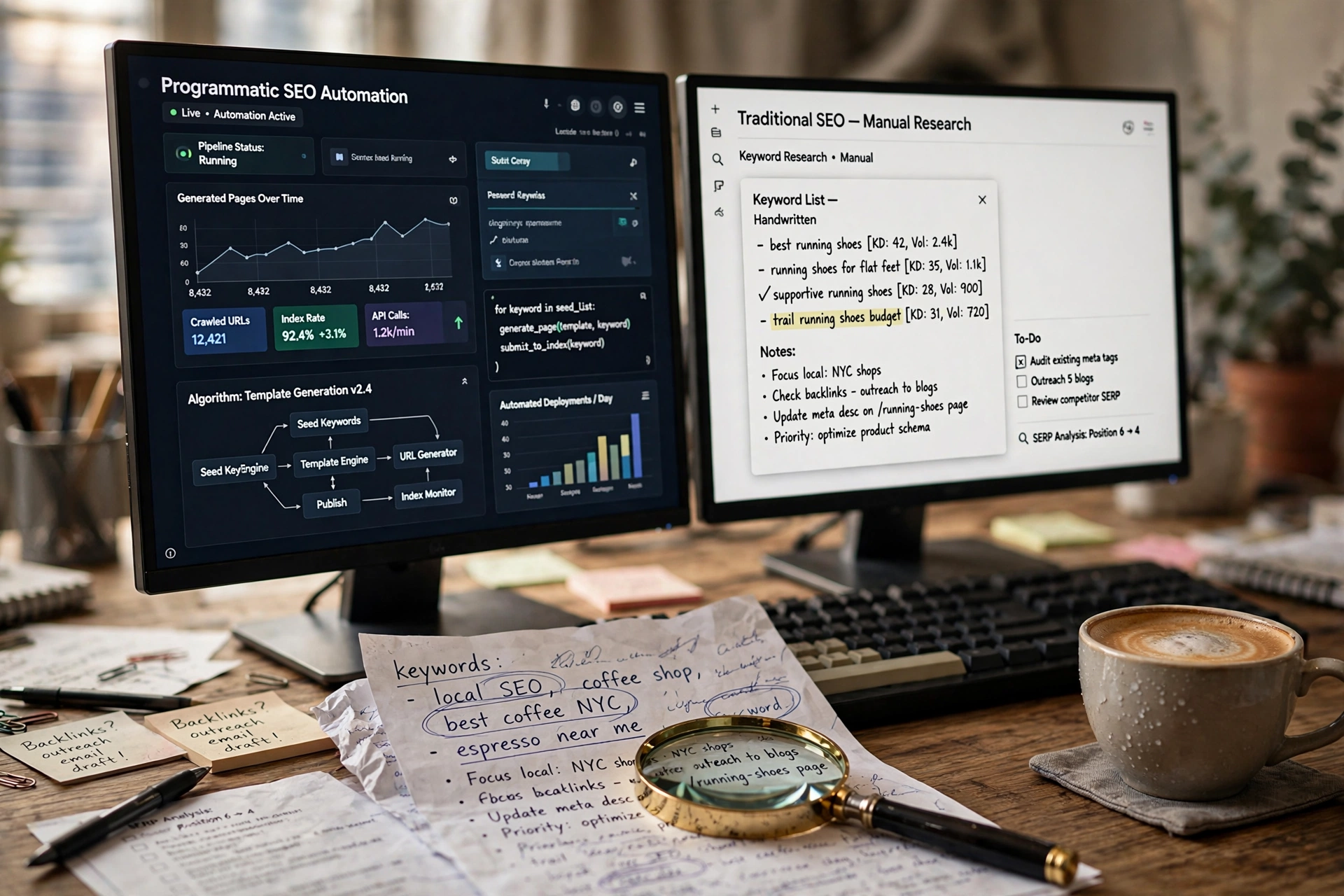
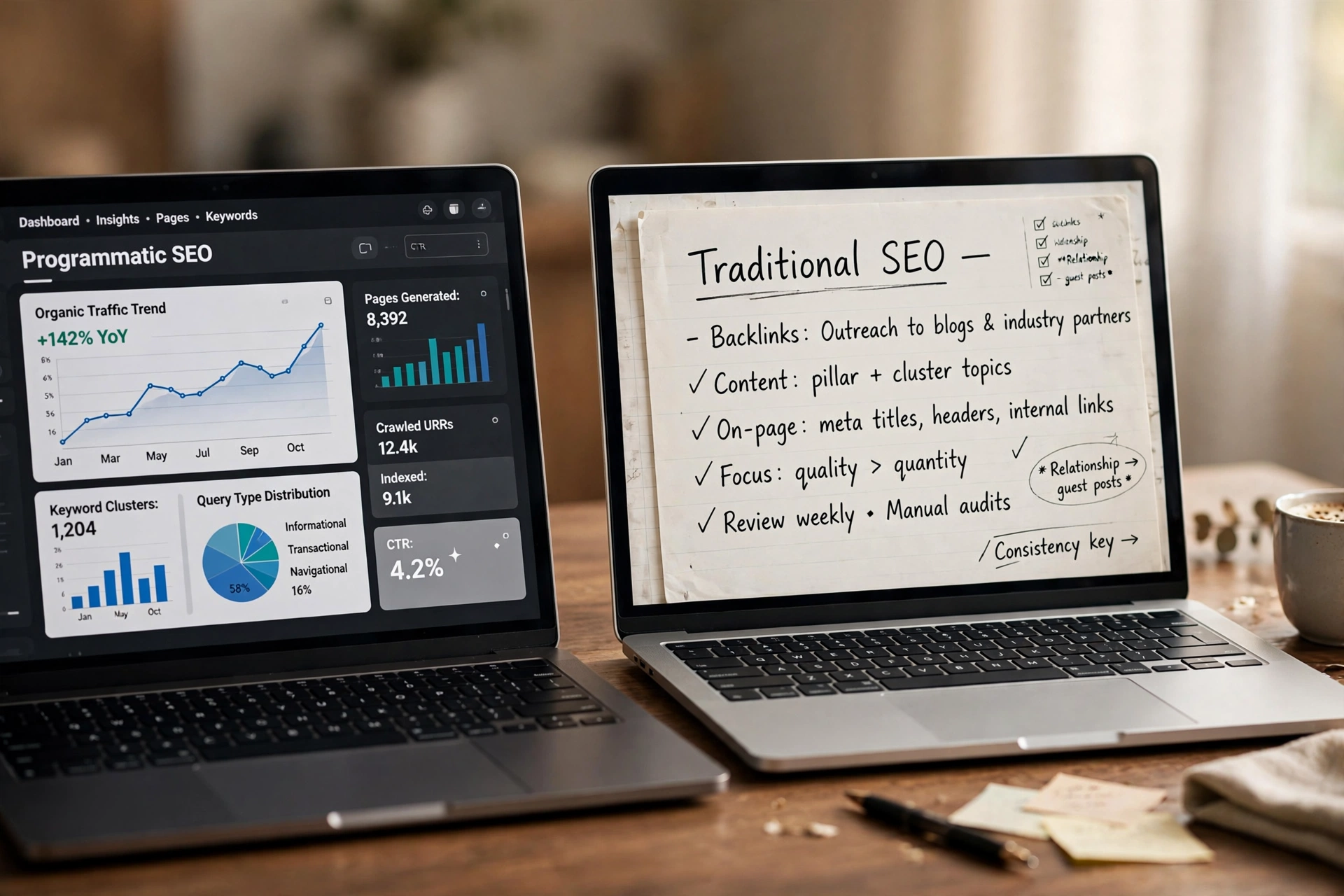
Scaling organic traffic in 2026 is no longer about who can write the most "high-quality" blog posts, but who can build the most efficient acquisition engine. When evaluating programmatic seo vs traditional seo, the choice depends entirely on your data availability and your growth targets: Traditional SEO is for building deep brand authority on a few high-stakes keywords, while Programmatic SEO is for dominating thousands of long-tail, high-intent queries through algorithmic scale. For most high-ticket B2B firms, the answer isn't one or the other, but using Traditional SEO for the "brand pillar" and Programmatic SEO for the "lead capture net."
In my experience working with enterprise SaaS and professional service firms, the biggest mistake I see is treating programmatic SEO as a "shortcut" to low-quality content. The firms that actually win are those that apply rigorous data engineering to their PSEO pages, ensuring every single one of the 1,000+ generated pages solves a specific user problem. If you have a dataset, such as city-specific service data, software integration lists, or industry benchmarks, Traditional SEO is actually a waste of resources because it's too slow.
To understand how to scale these systems, it is essential to look at the PSEO Architecture Guide for SaaS & Enterprise B2B Growth, as the structural foundation determines whether Google sees your pages as helpful content or algorithmic spam.
Understanding the Mechanics of Scalable Growth
To make an informed decision, we must first define the two methodologies. Traditional SEO is a manual, craftsmanship-led approach. It involves a writer researching a keyword, drafting a 2,000-word article, and optimizing it for a specific intent. It is a linear process: one article equals one target keyword.
📚
Definition
Programmatic SEO (PSEO) is the practice of using databases, templates, and variables to generate thousands of high-quality, search-optimized landing pages automatically to capture long-tail search demand.
Unlike the manual approach, PSEO is an exponential process. Instead of writing "Best HVAC Repair in New York," "Best HVAC Repair in Miami," and "Best HVAC Repair in Chicago" separately, you create one highly optimized template and plug in a database of 500 cities. This allows a business to capture "near me" and location-specific intent at a scale that would take a traditional content team years to execute.
According to a 2024 report by Gartner, the shift toward Generative Engine Optimization (GEO) is forcing brands to move away from generic content. AI-driven search engines now prioritize structured data and specific, factual answers over fluff. This makes PSEO particularly powerful because it relies on hard data points rather than adjective-heavy prose. When you use a Programmatic SEO platform guide to structure your data, you aren't just ranking on Google; you are providing the exact data points that LLMs like ChatGPT and Perplexity use to cite your business as an authority.

Why the Choice Between Programmatic and Traditional SEO Matters Now
The stakes for choosing the wrong strategy have never been higher. In the current era of "helpful content" updates, Google is aggressively demoting sites that produce AI-generated slop, content that looks like it was written by a bot but provides no real value. If you attempt to do "Traditional SEO" using cheap AI writers, you get the worst of both worlds: the slow speed of manual publishing with the low quality of automated content.
The business impact of choosing PSEO for the right use case is staggering. For instance, a B2B service provider targeting 100 different niches across 50 states can move from 10 organic leads per month to 1,000 leads per month in a matter of weeks if they deploy a programmatic architecture. This is because most "high-intent" buyers don't search for generic terms like "B2B Marketing"; they search for "B2B Marketing for Medical Device Manufacturers in Texas."
Research from McKinsey indicates that companies adopting AI-driven automation in their marketing operations see an average increase in lead conversion rates by 20% to 30% because they are meeting the user's specific intent more accurately. By deploying a massive web of satellite pages, you create a "topical authority hub" that signals to search engines that you are the definitive source for that entire category.
If you are struggling to decide which to prioritize, consider the GEO Vs Traditional SEO framework. Traditional SEO helps you win the "What is..." and "Why..." queries, but Programmatic SEO wins the "Which [X] for [Y] in [Z]..." queries, which are typically the highest-converting leads in the sales funnel.
Practical Application: Implementing the Hybrid Engine
The most successful growth engines I've built for clients at BizAI Intelligence utilize a hybrid approach. We don't pick one; we use Traditional SEO to build the "Pillar" and Programmatic SEO to build the "Satellites."
Here is the step-by-step execution framework for a high-ticket B2B service:
- The Authority Pillar (Traditional): Create a comprehensive, 4,000-word guide on your core service. This page is designed for high-volume keywords and establishes your brand's philosophy and expertise.
- The Data Set (Programmatic): Identify the variables that matter to your customers. If you are a law firm, this might be "Practice Area" + "City" + "State." If you are a SaaS company, it might be "Integration" + "Competitor" + "Use Case."
- Template Engineering: Build a page template that isn't just a "fill-in-the-blank" form. It must include dynamic tables, unique FAQs based on the data set, and localized social proof.
- Automated Deployment: Use a system like BizAI Intelligence to deploy 300 to 900 pages instantly. Each page must be programmatically linked back to the Authority Pillar to distribute PageRank.
- AI-Driven Capture: Because you are now attracting thousands of visitors to specific long-tail pages, you cannot handle the leads manually. Integrate an AI appointment setter for B2B on every programmatic page to qualify leads in real-time.
💡
Key Takeaway
Traditional SEO builds the trust; Programmatic SEO builds the volume. The magic happens when you link your high-volume programmatic pages back to your high-trust pillar pages.
By using this system, you stop renting traffic from Google Ads and start owning a compounding asset. In my experience, the "mistake" most agencies make is trying to write 50 blog posts a month. Instead, write 2 incredible pillar posts and launch 500 programmatic pages. The ROI is exponentially higher.

Comparing Your Options: Decision Framework
To decide which path to take, you must analyze your resources. If you have a small team of elite writers and a very narrow niche, Traditional SEO is your best bet. If you have a database of information and a desire for aggressive scale, PSEO is the only logical choice.
| Feature | Traditional SEO | Generic AI Content | BizAI Programmatic Approach |
|---|---|---|---|
| Speed of Scale | Slow (Linear) | Fast (Random) | Instant (Algorithmic) |
| Quality Control | High (Manual) | Low (Hallucinations) | High (Data-Driven) |
| Keyword Coverage | Limited (Few) | Broad (Generic) | Massive (Long-Tail) |
| Resource Cost | High (Human Hours) | Low (Cheap Credits) | Medium (Systems Setup) |
| Conversion Rate | Medium | Low | High (Hyper-Specific) |
| Best For | Brand Storytelling | Filler Content | Lead Generation Machines |
Now, here is where it gets interesting: many businesses try a "middle ground" by using AI to write "traditional" posts. This is a trap. If you want the benefits of scale, you must lean into the programmatic architecture. Using top AI search optimization tools allows you to automate the research and structure, but the "magic" is in the data set you feed the engine.
Common Questions & Misconceptions
Most guides on this topic get it wrong by claiming that Programmatic SEO is "risky" or "black hat." This is a fundamental misunderstanding of how Google works in 2026.
Myth 1: "Programmatic SEO will get my site penalized for duplicate content."
This is only true if you are using the same text for every page. Real PSEO uses "dynamic variables." If your page for "Lawyer in Dallas" has different stats, different local laws, and different client testimonials than your page for "Lawyer in Houston," it is not duplicate content, it is highly relevant, localized content.
Myth 2: "You need to be a coder to do PSEO."
While the early days of PSEO required heavy Python and SQL knowledge, the modern landscape has shifted. Platforms like BizAI Intelligence abstract the technical layer, allowing business owners to focus on the data and the offer rather than the code.
Myth 3: "Traditional SEO is 'safer' for long-term brand building."
Actually, relying solely on a few high-volume keywords is the riskiest strategy. If Google changes the algorithm for one specific "head term," you could lose 80% of your traffic overnight. A programmatic approach diversifies your traffic across thousands of keywords. If one page drops, the other 999 keep the engine running.
Frequently Asked Questions
Which is better for a new website with zero authority?
For a new site, start with Traditional SEO to build a foundation of "Expertise, Experience, Authoritativeness, and Trustworthiness" (E-E-A-T). Create 3 to 5 deep-dive pillar pages that prove you know your industry. Once you have established that core authority, layer in Programmatic SEO to capture the long-tail traffic. If you launch 1,000 pages on a brand-new domain without a pillar, Google may view you as a "thin affiliate" site. By linking your programmatic pages to a high-quality pillar, you tell Google: "I have the deep expertise (Pillar) and I have the breadth of service (Programmatic)."
How do I know if my business is a good fit for Programmatic SEO?
You are a perfect fit for PSEO if your business offers a service that varies by location, industry, or integration. Ask yourself: "Do I have a list of 100+ variations of my service that people search for?" For example, if you provide "Payroll Software," you can target "Payroll Software for Construction," "Payroll Software for Dentists," and "Payroll Software for Accountants." Each of these is a unique intent. If your product is a one-of-a-kind luxury item with only one target buyer, stick to Traditional SEO.
Can I use AI to write the content for my programmatic pages?
Yes, but with a major caveat: you cannot use "generic" AI. The content must be "data-augmented." Instead of asking an AI to "write a page about Dallas lawyers," you provide the AI with a CSV file containing the specific number of cases won in Dallas, the local court addresses, and the specific Texas statutes. This turns "AI slop" into "AI-powered precision." This is exactly how we approach how to automate organic traffic and lead capture with AI, ensuring that every page provides actual value to the user.
How long does it take to see results from a programmatic campaign?
Traditional SEO often takes 6 to 12 months to gain traction. Programmatic SEO can see results much faster because long-tail keywords have significantly lower competition. When you target a hyper-specific query (e.g. "B2B lead generation for HVAC companies in Atlanta"), you can often rank on page one within weeks because no one else is targeting that specific combination. However, the "compounding" effect happens over 3 to 6 months as Google recognizes the topical authority of your entire cluster.
Is programmatic SEO compatible with AI search engines like Perplexity?
Not only is it compatible, but it is actually the most effective way to rank in AI search. LLMs are trained to look for structured data and specific factual associations. By creating thousands of pages that explicitly link your brand to specific niches and locations, you are essentially "feeding" the AI the associations it needs to recommend you. For a deeper dive on this, see our guide on how to get cited by ChatGPT, SearchGPT, and Perplexity AI.
Final Thoughts on Programmatic SEO vs Traditional SEO
The debate over programmatic seo vs traditional seo is a false dichotomy. The real winner in 2026 is the "Hybrid Growth Engine." By using Traditional SEO to establish your brand's soul and Programmatic SEO to establish your brand's reach, you create an acquisition machine that is both prestigious and prolific.
The goal is to stop fighting for the few "head terms" that every single competitor is bidding on and start owning the "long-tail" where the actual buying intent lives. When you combine this massive organic reach with an AI SDR that qualifies leads instantly, you no longer have a marketing budget, you have a revenue generator.
If you are ready to stop writing individual blog posts and start building a scalable organic machine, visit BizAI Intelligence to see how we automate the entire process from data set to booked appointment.
Only 12 Onboarding Slots Remaining This Month
BizAI deploys 300 AI salespeople scoring purchase intent 24/7. Get your free niche domination blueprint.
AI Search Accelerator: 1-on-1 Strategy Session
Claim one of the 10 monthly slots. Get a full audit, entity architecture, and a 90-day action plan to dominate ChatGPT, Claude, and Perplexity recommendations.