
Which Internal Linking Automation Strategy Should You Choose for SEO Scaling?
Managing a site with 50 pages is a manual task; managing a site with 5,000 pages is a data engineering problem. When high-growth B2B companies attempt to scale, they quickly hit a "link equity ceiling" where new content fails to rank because it lacks the internal signals necessary to prove its importance to search engines. Implementing internal linking automation for seo scaling is the only way to break this ceiling, and the right choice depends on whether you need precise semantic control, algorithmic brute force, or a hybrid programmatic approach.
For most enterprise B2B firms, the most effective path is a programmatic architecture that combines automated "satellite-to-pillar" mapping with AI-driven semantic anchor text optimization. This ensures that PageRank flows logically from high-intent long-tail pages to your core service pages without triggering "over-optimization" penalties.

What Exactly is Internal Linking Automation?
At its core, this process involves using software or scripts to programmatically create hyperlinks between pages on the same domain. Rather than a human editor manually hunting for related posts, the system uses a set of predefined rules or machine learning models to identify topical relevance and insert links automatically.
📚
Definition
Internal Linking Automation is the use of algorithmic rules, Large Language Models (LLMs), or programmatic database queries to establish hyperlinks between pages on a single domain to distribute link equity and improve crawlability.
In my experience working with high-ticket B2B service providers, the biggest mistake companies make is treating internal links as an afterthought. They build massive content hubs and then rely on a "Related Posts" widget at the bottom of the page. This is a critical failure. Widgets are often ignored by users and given lower weight by search engines compared to "contextual links"—links embedded naturally within the body of the text.
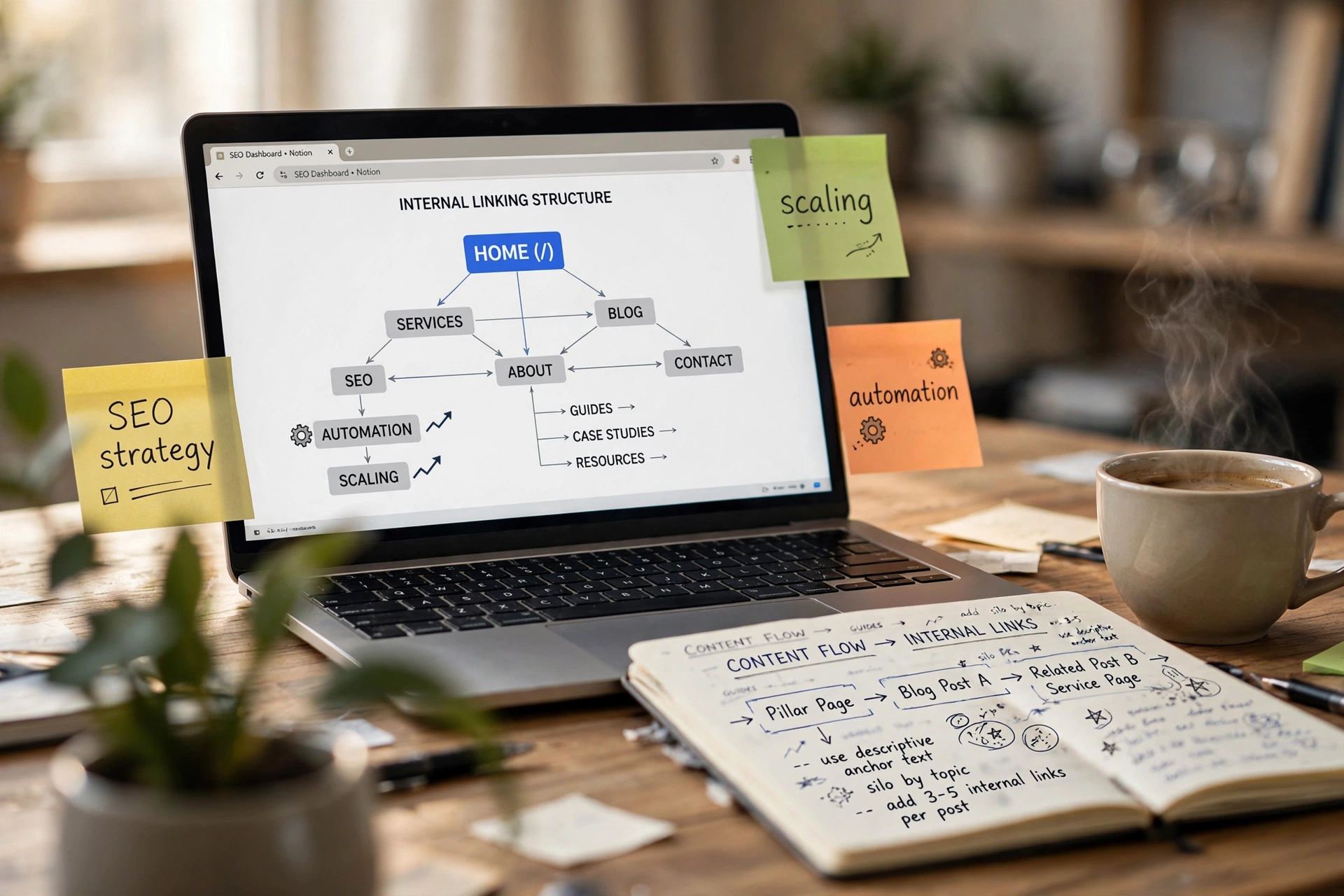
To truly scale, you need a system that understands the relationship between a "Satellite Page" (targeting a specific, long-tail query) and a "Pillar Page" (your main service offering). According to a study by Gartner on search engine visibility, structured internal architectures can significantly reduce the "crawl depth" of a site, ensuring that search bots discover and index deep-level pages up to 40% faster. By automating this, you shift from a manual, fragmented approach to a systemic growth engine, which is a core component of a broader PSEO Architecture Guide for SaaS & Enterprise B2B Growth.
Why Automation is Mandatory for Modern SEO Scaling
The sheer volume of content required to dominate a niche in 2026 makes manual linking impossible. If you are deploying 300 pages a month, a human editor would spend nearly 100% of their time just managing links rather than improving content quality. The business impact of failing to automate this process is a stagnant "Time to Rank."
When a page is published without internal links, it is an "orphan page." Orphan pages rarely rank because they provide no signals of authority. By utilizing internal linking automation for seo scaling, you create a "topical web" that tells Google: "This site is not just a collection of articles; it is a comprehensive authority on this subject."
The data reflects this necessity. Research from the Harvard Business Review on digital transformation highlights that companies utilizing automated data-driven marketing structures experience a significantly higher rate of organic lead acquisition compared to those relying on manual processes. In the B2B space, this translates to a lower Customer Acquisition Cost (CAC) because you are "renting" less traffic from Google Ads and "owning" more of the organic search landscape.
Furthermore, the rise of AI Search (SGE, Perplexity, SearchGPT) has changed the game. These engines don't just look for keywords; they look for entities and relationships. If your internal linking structure explicitly connects "AI Lead Qualification" to "CRM Integration" and "B2B Sales Automation," the LLM perceives your site as a structured knowledge graph. This is exactly why companies are moving toward GEO Vs Traditional SEO: Rank Your Brand in AI Engines in 2026 to ensure their brand is cited as the definitive source of truth.
Practical Application: How to Implement Automated Linking
Depending on your technical stack, there are three primary ways to execute this. The goal is to ensure that every single page on your site is reachable within three clicks from the homepage.
1. The Rule-Based Template Approach (Programmatic)
This is the most stable method for B2B sites. You define "link buckets" in your database. For example, any page tagged as "Personal Injury Lawyer" automatically receives a link to the "Main Law Firm Pillar" using a set of rotated anchor texts.
2. The Semantic AI approach
Using LLMs to analyze the text of a new page and suggest the most relevant internal links. The AI identifies a phrase like "automated appointment booking" and cross-references it with your existing content library to insert a link to your AI appointment setter for B2B guide.
3. The Algorithmic "Hub and Spoke" Model
This is the architecture we implement at BizAI Intelligence. We build a massive array of satellite pages that all feed link equity back to a central pillar. This creates a "power surge" of authority that pushes the pillar page to the top of the SERPs for high-volume keywords.
💡
Key Takeaway
Avoid "link dumping" where you place 20 links at the bottom of a page. Instead, prioritize "contextual injection" where links appear within the first. By automating the link structure, you ensure that as your site grows from 100 to 10,000 pages, the authority of your homepage is distributed efficiently to every new piece of content.

Comparing Your Automation Options: Which One Wins?
Choosing the wrong automation method can lead to "link bloat" or, worse, a manual action from Google for unnatural linking patterns. You must decide based on your scale and technical resources.
| Option | Pros | Cons | Best For |
|---|---|---|---|
| Manual/Semi-Auto | High precision, zero risk of spam | Non-scalable, high labor cost | Small blogs (< 100 pages) |
| Rule-Based PSEO | Predictable, extremely fast, stable | Can feel repetitive if not varied | Enterprise B2B, Local SEO hubs |
| AI-Semantic Linking | High user experience, natural flow | Risk of "hallucinated" anchors | Content-heavy publishers, SaaS |
| BizAI Architecture | Max authority, automated lead capture | Requires structural overhaul | High-ticket B2B scaling rapidly |
Now, here's where it gets interesting: the most successful sites don't pick just one. They use Rule-Based PSEO for their foundational architecture and AI-Semantic Linking for their blog and educational content. This hybrid approach prevents the "robotic" feel of purely programmatic sites while maintaining the raw power of a structured silo. This is a key reason why we recommend the Programmatic SEO: How to Scale 10,000+ High-Converting Pages Automatically framework for those seeking aggressive growth.
Common Questions and Misconceptions
Most SEO guides get internal linking wrong by focusing on the number of links rather than the intent of the link.
Myth 1: "More links are always better."
This is fundamentally false. If you have 100 links on a page, the "link juice" (PageRank) is diluted. It is far more effective to have five highly relevant, contextually placed links than fifty generic ones. The focus should be on "topical density," not link volume.
Myth 2: "You should always use exact-match anchor text."
Using "best lawyer in New York" as the anchor text for every single internal link is a fast track to a Google penalty. In my experience, a mix of brand anchors, descriptive phrases, and LSI (Latent Semantic Indexing) keywords is the only safe way to scale.
Myth 3: "Internal linking doesn't matter if you have great backlinks."
Backlinks bring authority to your domain, but internal links determine where that authority goes. Without a proper automation strategy, your homepage might have a Domain Rating of 70, but your money pages stay at a DR of 10 because the authority isn't flowing down the funnel.
Frequently Asked Questions
How does internal linking automation affect crawl budget?
Internal linking automation directly optimizes your crawl budget by eliminating "dead ends" on your website. When a search engine bot enters your site, it follows links to discover new content. If your links are automated and structured—specifically using a silo or hub-and-spoke model—the bot can traverse your entire site more efficiently. This means your new pages get indexed in hours rather than weeks. For high-volume sites, this is the difference between ranking for a trending keyword and missing the window entirely.
Can AI-generated internal links lead to SEO penalties?
The risk of a penalty doesn't come from the AI itself, but from the quality of the output. If an AI tool inserts links that are irrelevant or uses "spammy" anchor text, Google will flag the content as unhelpful. However, when using a controlled system like the one at BizAI Intelligence, the AI is constrained by a brand book and a keyword map. This ensures that the links are semantically relevant and provide genuine value to the reader, which aligns with Google's "Helpful Content" guidelines.
What is the ideal ratio of internal links per page for B2B sites?
While there is no "magic number," the general benchmark for B2B scaling is 3 to 7 internal links per 1 and 2 to 4 "Supporting" links (to related satellites). Overloading a page with links increases the bounce rate, as users feel they are being pushed away from the answer they sought.
How do I automate internal links without using a plugin?
For those with a development team, the best way to automate internal links is at the database level. By creating a "Relation Table" in your SQL database that maps keywords to specific URLs, you can use a simple script to scan your content for those keywords and wrap them in a hyperlink during the rendering process. This is significantly faster than using WordPress plugins, which can slow down your site's load time—a critical factor for Core Web Vitals.
Does internal linking help with AI search engine rankings?
Yes, absolutely. AI engines like Perplexity and SearchGPT rely on "graph-based" understanding. They don't just see pages; they see the relationships between concepts. By automating a tight web of internal links, you are essentially building a "Knowledge Graph" for the AI to crawl. When the AI sees that your "B2B Lead Gen" page is linked to "AI SDRs," "CRM Automation," and "Programmatic SEO," it identifies you as a topical authority, making you far more likely to be cited in an AI-generated answer.
Final Thoughts on Internal Linking Automation for SEO Scaling
Scaling your organic presence in 2026 is no longer about writing more content; it is about organizing that content more intelligently. Internal linking automation for seo scaling is the bridge between having a large library of information and having a high-converting acquisition machine.
Whether you choose a rule-based programmatic approach or a semantic AI system, the goal remains the same: distribute authority, reduce crawl depth, and guide the user toward a conversion. If you are tired of manual updates and want to build a self-sustaining SEO engine, it is time to move away from manual editing and toward a programmatic framework.
For businesses ready to stop guessing and start dominating their niche through algorithmic brute force, explore how we do it at BizAI Intelligence. Our system doesn't just create pages; it builds a fully automated inbound acquisition engine that qualifies leads while you sleep. For a deeper dive into the tools we use, check out our guide on the Top Programmatic SEO Tools & Software Compared for 2026.
AI Search Accelerator: 1-on-1 Strategy Session
Claim one of the 10 monthly slots. Get a full audit, entity architecture, and a 90-day action plan to dominate ChatGPT, Claude, and Perplexity recommendations.



