📖This article is part of the complete guide to The Ultimate Guide to Automated SEO Agents.
I've spent the last 15 years building distributed platforms, and the most common failure I see in B2B growth is the 'manual content trap.' Companies hire a copywriter to write one blog post per week and a junior SEO to track keywords, then wonder why their lead flow is stagnant. In my experience working with high-ticket service providers, the only way to achieve true scale is to move away from human-linear production toward algorithmic distribution. This is where the shift to autonomous systems becomes non-negotiable.
For a comprehensive overview, explore our guide on automated SEO agents.
What Are Automated SEO Agents?
📚
Definition
Automated SEO agents are autonomous AI systems that combine programmatic content generation, real-time search engine optimization (SEO), and an embedded AI sales layer to attract, qualify, and convert organic traffic without human intervention.
Automated SEO agents are not simply 'AI writers' or basic chatbots; they are integrated engines designed to dominate specific topical clusters by deploying hundreds of high-intent pages that serve both the search engine and the prospective buyer. While traditional SEO focuses on the slow process of keyword research and manual drafting, these agents utilize large language models (LLMs) and structured data to build massive networks of pillar and satellite pages that signal absolute authority to Google Search and AI engines like Perplexity or SearchGPT.
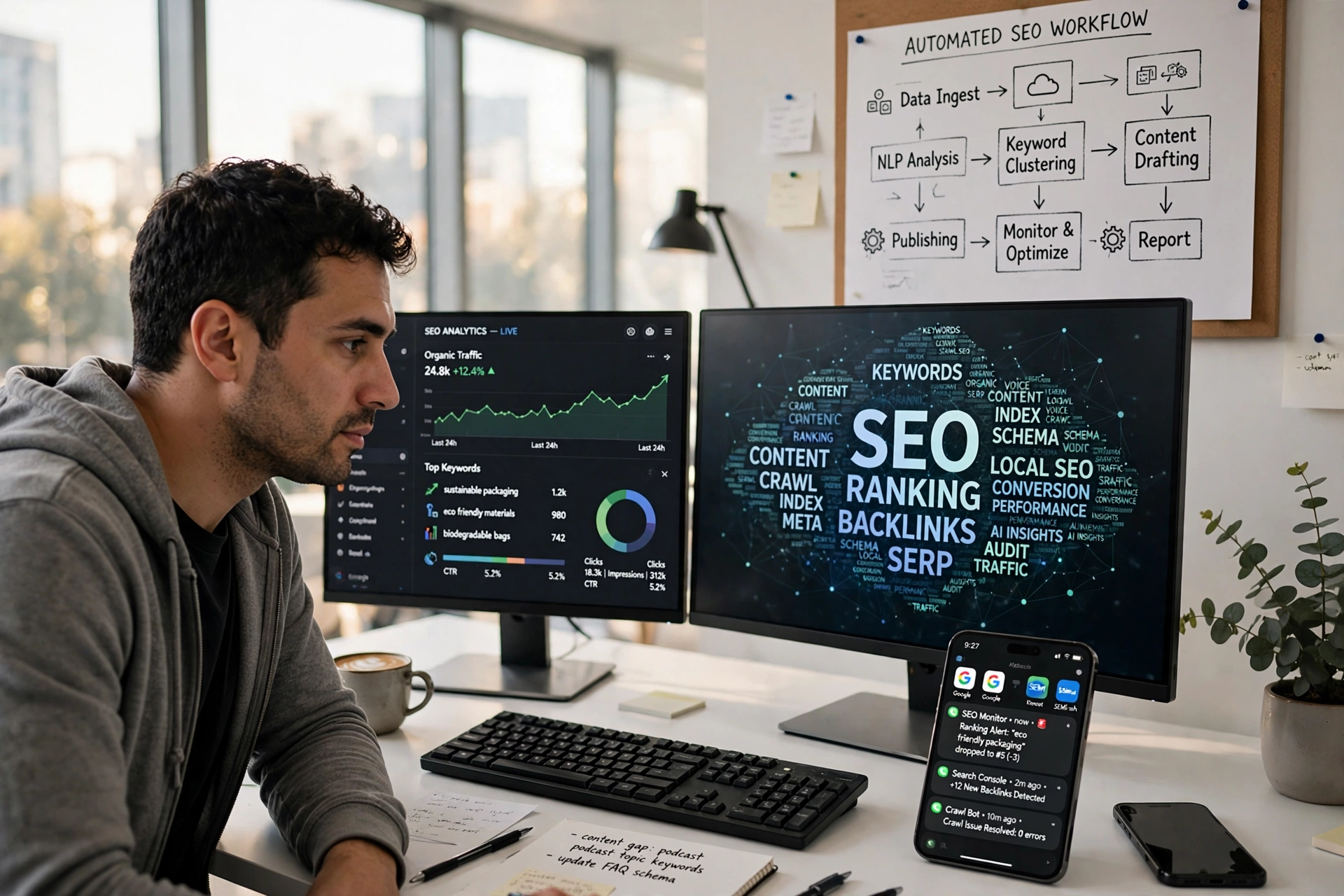
At its core, an automated SEO agent operates on a loop: it identifies high-intent buyer queries, generates an optimized landing page targeting that specific long-tail keyword, and embeds a context-aware sales agent to capture the lead. This creates a self-sustaining lead generation machine. When we built the architecture at BizAI Intelligence, we discovered that the real power lies not in the quantity of pages, but in the precision of the intent mapping. By aligning every page with a specific decision-stage query, the system effectively replaces an entire team of SDRs and content marketers.

Why Do Automated SEO Agents Matter for Your Business?
Automated SEO agents matter because the cost of customer acquisition (CAC) via paid ads has become unsustainable for most B2B firms. According to research from the Content Marketing Institute, businesses that prioritize organic authority over paid clicks see a significant increase in lifetime value (LTV) because organic leads typically enter the funnel with higher trust. When your brand appears as the definitive answer in an AI Overview or a top-three Google result, you aren't just getting a click; you are inheriting the trust of the platform.
One of the most fundamental benefits is the ability to achieve 'topical dominance' in a timeframe that was previously impossible. In a traditional setup, publishing 300 high-quality, interconnected pages would take a team of writers a year. An automated agent can deploy this entire architecture in 30 days. This speed allows a business to capture long-tail traffic that competitors are ignoring, creating a moat of organic visibility that is incredibly difficult to disrupt.
Furthermore, these agents solve the 'conversion gap.' Most organic traffic is wasted because the visitor lands on a page and then has to navigate a complex menu or fill out a static form. By integrating how AI appointment setters automate B2B demo booking 24/7, the agent engages the user based on the specific page they are reading. If a user lands on a page about 'HVAC installation costs in Miami,' the AI agent doesn't ask a generic 'How can I help?'; it asks, 'Would you like a custom quote for your Miami property?' This level of personalization increases conversion rates by orders of magnitude.
According to the 2025 B2B Buyer Report from Gartner, 70% of B2B buyers prefer a remnant-free, self-service research experience before ever speaking to a salesperson. Automated SEO agents provide this research experience while simultaneously qualifying the lead in the background. By the time the prospect books a meeting, the AI has already scored their intent and captured their primary pain points, meaning your sales team only spends time on high-probability deals.
How to Use Automated SEO Agents to Scale Organic Traffic?
Implementing these agents requires a shift from 'content creation' to 'system architecture.' The goal is no longer to write a 'great article' but to build a 'high-converting asset network.' The first step is the deployment of a Programmatic SEO (PSEO) structure. This involves creating a central pillar page, a comprehensive resource on a broad topic, and surrounding it with hundreds of satellite pages. These satellites target specific, low-competition keywords that indicate high buyer intent, such as 'best [service] for [specific industry] in [city].'
Once the pages are live, the second step is the integration of the AI Sales Agent. This is the 'brain' of the operation. The agent must be programmed with the business's unique value proposition, pricing, and qualification criteria. As the user interacts with the content, the agent monitors behavioral signals, such as scroll depth and time on page, to determine when to trigger a conversational qualification screen. If you are interested in the technical side of this, you should look into how to connect AI sales agents to CRM & webhooks for auto-booking to ensure a seamless handoff to your sales team.
Thirdly, the system must be optimized for Generative Engine Optimization (GEO). This means going beyond meta tags and using structured Schema.org markup to tell LLMs exactly what the business does. By implementing
/llms.txt files and speakable specifications, you ensure that when a user asks ChatGPT, 'Who is the best B2B agency for scale?', the AI has a clear, structured data path to cite your brand as the answer. You can find more on this in our guide on GEO vs traditional SEO.Finally, the process requires a feedback loop of continuous optimization. Automated agents can analyze which satellite pages are attracting the most high-intent traffic and then automatically generate more content around those winning patterns. This creates a compounding effect: the more the agent learns about what your buyers are searching for, the more precise its targeting becomes, and the lower your overall CAC drops.
Automated SEO Agents vs Traditional SEO Approaches
To understand the leap in efficiency, we must compare the legacy approach with the modern AI-driven engine. Most businesses are still stuck in the 'manual era,' where growth is tied to the number of hours a human can work.
| Feature | Traditional SEO (Manual) | Generic AI Tools (Low-Quality) | BizAI Intelligence Approach |
|---|---|---|---|
| Scale | 2-4 articles per month | High volume, low quality | 300+ optimized pages/month |
| Conversion | Static contact forms | Basic FAQ chatbots | Autonomous AI SDRs (Booking) |
| Strategy | Keyword-based blogging | Prompt-based generation | Programmatic Topical Authority |
| AI Visibility | Minimal/Accidental | High hallucination risk | Structured GEO & Schema mapping |
| Lead Qual | Manual follow-up | No qualification | Real-time intent scoring |
As the table demonstrates, the traditional approach is simply too slow for the 2026 market. Generic AI tools, on the other hand, often produce 'AI slop', content that looks correct but lacks the depth and expertise required to rank in Google's helpful content system. The modern approach focuses on 'algorithmic brute force' combined with technical rigor, ensuring every page is not only discoverable but designed to close a deal.
Common Mistakes to Avoid When Deploying AI Agents
One of the most frequent errors I see is the 'set and forget' mentality. Some business owners believe that because the system is automated, it requires zero oversight. In reality, an automated SEO agent requires a strong strategic foundation. If you feed the system generic prompts or vague business goals, it will produce generic results. The secret to success is providing the agent with a detailed 'Brand Positioning Book' that defines exactly who the customer is and what the unique mechanism of the service is.
Another mistake is neglecting the internal linking architecture. Many firms generate 1,000 pages but fail to connect them. Without a strict silo structure, where satellites link back to the main pillar, Google's crawlers cannot establish the thematic relationship between the pages. This leads to 'orphan pages' that never rank. To avoid this, follow a strict cluster model. You can learn more about this in our PSEO architecture guide for SaaS & Enterprise B2B growth.
Furthermore, avoid the temptation to target high-volume, low-intent keywords. Many marketers chase 'vanity metrics' by trying to rank for broad terms like 'what is marketing.' This brings traffic, but not buyers. The power of automated SEO agents lies in the long-tail. Target queries like 'B2B lead generation for dental clinics in Texas', these have lower volume but nearly 100% buyer intent. This shift in focus is what separates companies that get 'hits' from companies that get 'revenue.'
Lastly, do not ignore the transition from Search to Answer engines. If your content is written only for a human to read on a screen, you are missing the opportunity to be cited by AI. As noted by the IEEE standards for data interoperability, structured data is becoming the primary language for machine-to-machine communication. If your site lacks a comprehensive Schema graph, you are invisible to the LLMs that are now directing 40% of B2B research traffic. I recommend reading our piece on how to get cited by ChatGPT, SearchGPT, and Perplexity AI to fix this.

Frequently Asked Questions
How do automated SEO agents differ from standard chatbots?
Automated SEO agents are purpose-built for acquisition, whereas standard chatbots are designed for support. A chatbot typically waits for a user to ask a question; an SEO agent is proactive. It lives on an optimized landing page, understands the context of why the user is there, and uses that context to lead the user through a qualification funnel. While a chatbot answers questions, an SEO agent books meetings and qualifies leads based on specific business criteria.
Can automated SEO agents lead to Google penalties for AI content?
Not if they are built with a 'helpful content' framework. Google does not penalize AI content simply because it is AI-generated; it penalizes low-value, unoriginal content that provides no utility to the user. Automated agents at BizAI Intelligence use deep research integration and programmatic structures to ensure every page solves a specific user problem. By focusing on E-E-A-T (Experience, Expertise, Authoritativeness, and Trustworthiness), these agents create assets that Google views as highly valuable.
How long does it take to see results from an automated agent setup?
Because of the massive scale of programmatic deployment, results typically appear much faster than manual SEO. While a manual strategy might take six months to see a lift in a few keywords, a programmatic approach can see hundreds of long-tail keywords indexing within the first 30 days. This is achieved through the use of the Google Indexing API and a high-density internal linking structure, which forces crawlers to discover and rank new assets rapidly.
Do I need a large budget to implement these autonomous systems?
Actually, these systems are designed to reduce the overhead associated with large content teams and expensive paid ad spend. Instead of paying for a monthly retainer for an agency that produces four blogs a month, you are investing in a piece of software that produces a permanent asset network. The ROI is usually realized through the reduction of CAC and the increase in the volume of qualified inbound leads that enter the CRM automatically.
Which industries benefit most from automated SEO agents?
High-ticket B2B services with a clear geographic or niche-based demand are the primary beneficiaries. This includes law firms, healthcare networks, HVAC and home service contractors, and enterprise SaaS platforms. Any business where a single lead can be worth thousands of dollars in lifetime value will find the most success here, as the high LTV justifies the technical setup and allows for aggressive scaling of organic authority.
Conclusion
The era of manual content production is over. For any B2B company looking to scale in 2026, the choice is simple: either continue renting your traffic from Google Ads at an ever-increasing cost, or build a self-owned organic machine that compounds in value every day. Automated SEO agents provide the only viable path to this scale by combining the raw power of programmatic SEO with the precision of AI-driven lead qualification.
By deploying a network of high-intent satellite pages and anchoring them to a strong pillar, you stop guessing what your customers want and start dominating the queries they are actually typing into search bars. This is not about 'tricking' the algorithm; it is about providing the most comprehensive, structured, and accessible answers to your buyers' most pressing questions.
If you are ready to stop the manual grind and start building a predictable inbound engine, we invite you to dive deeper into our The Ultimate Guide to Automated SEO Agents to see the full blueprint for 2026 growth. Visit bizaigpt.com to start your transition to an autonomous acquisition system today.
Only 12 Onboarding Slots Remaining This Month
BizAI deploys 300 AI salespeople scoring purchase intent 24/7. Get your free niche domination blueprint.
AI Search Accelerator: 1-on-1 Strategy Session
Claim one of the 10 monthly slots. Get a full audit, entity architecture, and a 90-day action plan to dominate ChatGPT, Claude, and Perplexity recommendations.