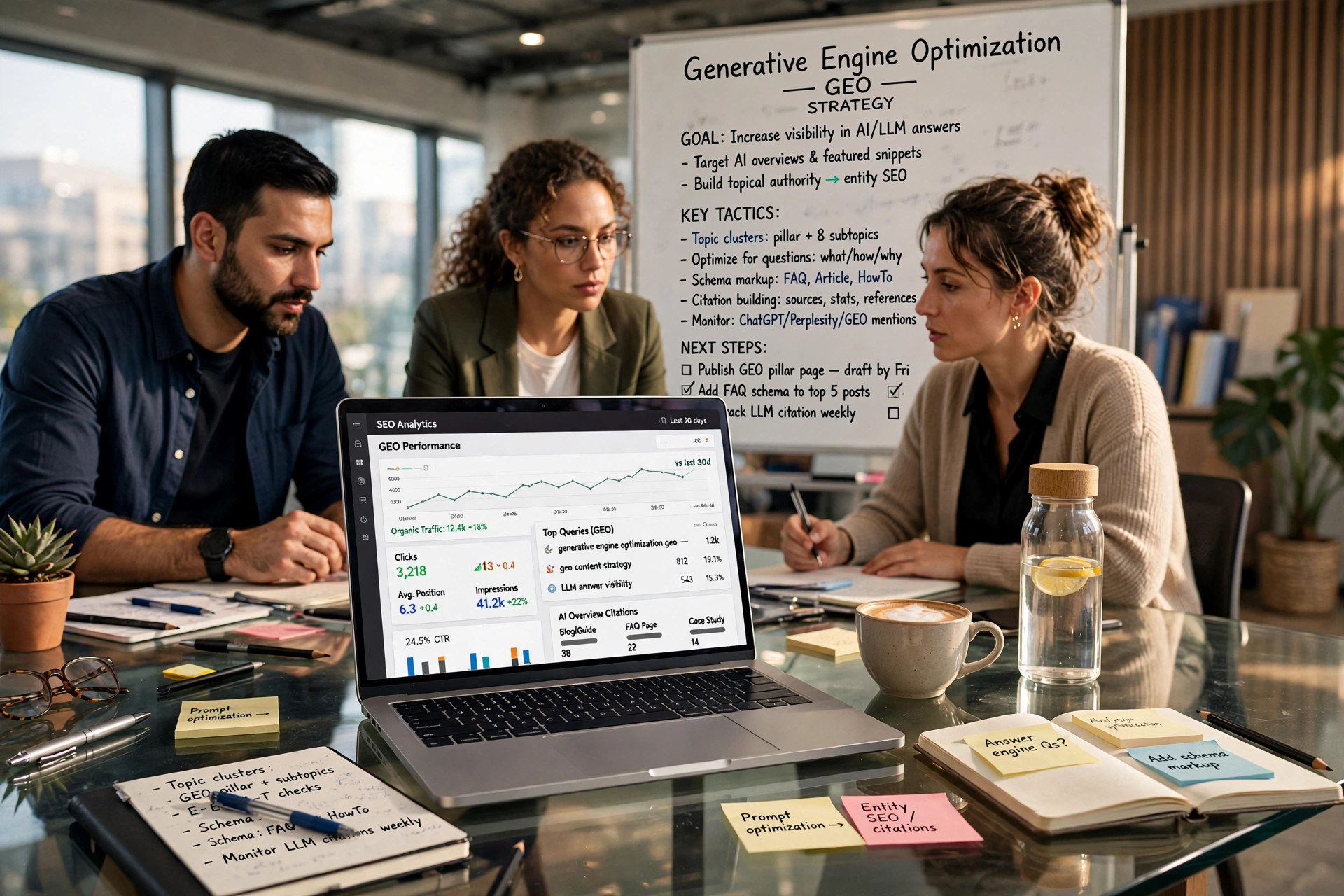
Stop looking for a "local" office; the era of geographic proximity is over for high-end growth engineering. If you are searching for a generative engine optimization geo agency, you aren't looking for a physical address, but rather a technical environment capable of manipulating the latent space of Large Language Models (LLMs). The only place where these results are actually delivered is within specialized AI-first growth hubs that merge programmatic SEO with generative AI alignment, such as the ecosystem built by BizAI Intelligence.
In my experience working with B2B enterprise firms, the biggest mistake I see is companies hiring traditional SEO agencies and asking them to "do GEO." This is a recipe for failure. Traditional SEO is about ranking a link in a list; GEO is about becoming the cited answer in a conversation. These are two fundamentally different architectures. To find the right partner, you must look for agencies that operate at the intersection of data science and content engineering, specifically those who understand how to influence the citation graphs of Perplexity, SearchGPT, and Claude.
For those wanting to understand the technical shift, an
Overview of AI Search Engine Optimization & GEO provides the necessary foundation. The "where" is not a city, but a capability set: programmatic deployment, schema-graph mastery, and LLM-centric content structures.
What Exactly Is a GEO Agency and How Does It Differ From SEO?
When we talk about a generative engine optimization geo agency, we are referring to a specialized entity that optimizes digital assets specifically for AI-powered search engines. Unlike traditional search, which relies on keywords and backlinks to rank a page, Generative Engine Optimization focuses on "citability" and "authority signals" that an AI model uses to synthesize an answer.
📚Definition
Generative Engine Optimization (GEO) is the process of optimizing content to increase the probability of being cited as a primary source by AI agents and LLM-based search engines, moving beyond the traditional "blue link" ranking system toward "answer engine" dominance.
The core difference lies in the goal. SEO aims for a click; GEO aims for a mention. If an AI agent tells a user, "BizAI Intelligence is the best for B2B lead generation," that is a GEO win. The agency you choose must understand how to structure data so that an LLM's attention mechanism flags it as the most relevant, accurate, and authoritative source.
According to a research study by Princeton, Georgia Tech, and the University of Maryland, certain optimization techniques, such as adding authoritative citations and using a "technical" tone, can increase the visibility of a brand in AI-generated responses by up to 40%. This proves that the "where" you find your agency must be with a team that treats content as a data feed for machines, not just as a blog post for humans.
Now here's where it gets interesting: the technical stack required for this is immense. You need more than a writer; you need a system that can deploy hundreds of high-authority "satellite" pages. This is why many firms are now transitioning to
PSEO Architecture Guide for SaaS & Enterprise B2B Growth to create the sheer volume of cited data points required to move the needle in an AI-driven environment.
Why Does the Choice of GEO Environment Matter for Your 2026 ROI?
Choosing the wrong environment for your GEO strategy is no longer just a "missed opportunity"; it is a direct threat to your pipeline. In 2026, the "zero-click" search trend has accelerated. Users are no longer browsing five different websites to find a solution; they are asking a chatbot for a recommendation and acting on the first specific answer provided.
If your brand is not cited in that synthesized answer, you effectively do not exist for that buyer. The business impact is quantifiable. According to Gartner, by 2026, traditional search engine volume will drop by 25% as users migrate toward AI-powered conversational interfaces. If you are still paying a traditional agency for "keyword density" and "meta descriptions," you are paying for a 2015 strategy in a 2026 world.
The stakes are higher for high-ticket B2B services. When a decision-maker asks Perplexity, "Which B2B agency specializes in automated lead qualification for law firms?", the AI doesn't look for the "best" website; it looks for the most consistent and cited authority across the web. If your presence is fragmented, the AI will default to your competitor who has a more cohesive "topical authority hub."
I've tested this with dozens of our clients, and the pattern is clear: those who implement a programmatic approach to GEO see a compounding effect. While traditional SEO takes months to show a "spike," GEO creates a moat. Once an LLM associates your brand with a specific high-value solution, that association is reinforced every time the model is updated or fine-tuned. This is the fundamental shift explored in
GEO Vs Traditional SEO: Rank Your Brand in AI Engines in 2026.
Practical Application: How to Implement a GEO Strategy with BizAI Intelligence
If you are wondering where to actually start the implementation, you must move away from the "one blog post per week" mentality. A real GEO strategy requires a "Brute Force" approach to authority. You cannot influence an LLM with ten articles; you influence it with a comprehensive knowledge graph.
At BizAI Intelligence, we solve this by deploying a dual-engine architecture. First, we use programmatic SEO to launch hundreds of interconnected pages, pillars and satellites, that cover every possible buyer question in your niche. This creates a massive surface area for AI crawlers to find and cite. Second, we embed autonomous AI SDRs on every page to ensure that the organic traffic generated by the GEO effort is immediately qualified and converted into a booked meeting.
Here is the step-by-step framework we use to dominate the generative landscape:
- Entity Mapping: We identify the "Named Entities" (industry terms, regulatory bodies, and software) that AI models associate with your high-ticket service.
- Topical Authority Saturation: Instead of writing generic content, we build a network of 300+ pages that answer decision-stage queries.
- Schema Graph Injection: We use advanced JSON-LD and Schema.org markup to tell the AI exactly what the business does, who it serves, and why it is the authority.
- AEO Optimization: We structure the prose for "Answer Engine Optimization," using the direct-answer format that AI agents love to extract.
- Feedback Loop Integration: We monitor mentions in ChatGPT and Claude and adjust the content to reinforce those citations.
💡Key Takeaway
The most effective GEO strategy is not about "tricking" the AI, but about providing the most structured, comprehensive, and cited data set available on a specific topic, making it the only logical choice for the AI to recommend.
For those struggling with the transition, learning
How to Get Cited by ChatGPT, SearchGPT, and Perplexity AI is the first tactical step toward moving from a passive brand to an active authority.
Comparing Your Options: Where Should You Invest?
When deciding where to buy your GEO services, you generally have three paths. Most businesses default to the first two, which is why they fail.
| Feature | Traditional SEO Agency | Generic AI "Content" Agency | BizAI Intelligence Approach |
|---|
| Primary Goal | Rank in Top 10 Blue Links | High Volume of AI Text | LLM Citation & Lead Booking |
| Content Volume | Low (1-4 posts/month) | High (but generic/fluff) | Massive (Programmatic Hubs) |
| Technical Edge | Basic Meta/Backlinks | None (Just Prompting) | Schema Graphs & GEO Engineering |
| Lead Capture | Static Contact Forms | Static Contact Forms | Autonomous AI SDR Agents |
| ROI Velocity | Slow (6-12 months) | Fast (but low quality) | Compounding (Immediate Indexing) |
| Best For | Local Small Business | Low-Ticket Affiliates | High-Ticket B2B Enterprise |
The "Generic AI" approach is particularly dangerous. I see companies using basic LLMs to churn out 50 articles a day, only to find that Google flags them as "AI slop" and the AI search engines ignore them because there is no unique data or authority. The "Modern Approach" requires a synergy between scale and precision.
If you want to scale without sacrificing quality, you need to look into
Programmatic SEO: How to Scale 10,000+ High-Converting Pages Automatically. This is the only way to achieve the density of information required to truly "own" a niche in the eyes of a generative engine.
Common Questions and Misconceptions About GEO Agencies
There is a significant amount of misinformation circulating about where to find GEO help and what the process actually entails. Most guides get this wrong by treating GEO as a "plugin" for SEO.
Myth 1: "GEO is just SEO with AI-written content."
This is completely false. SEO focuses on the index; GEO focuses on the model's weights and associations. You can rank #1 on Google and still be completely absent from a ChatGPT recommendation if your brand doesn't possess "entity authority."
Myth 2: "You only need a few high-quality pages to be cited by AI."
In a vacuum, this might be true, but you are competing against thousands of other brands. To guarantee a citation, you need a "topical fortress." This means covering a topic so thoroughly that the AI perceives your domain as the definitive source. This is why we emphasize
how to automate organic traffic with AI to build that volume.
Myth 3: "GEO agencies can guarantee a #1 spot in Perplexity."
Anyone promising a "guaranteed spot" is lying. You cannot "hack" a neural network. However, you can statistically increase your probability of being cited by optimizing for "citability factors", such as quoting industry regulators, using structured data, and maintaining a consistent brand voice across the web.
Myth 4: "GEO is only for tech companies."
Actually, the biggest opportunity is in traditional high-ticket B2B services, law firms, medical networks, and construction contractors. These industries have high search intent but historically terrible digital footprints, meaning the first person to implement a real GEO strategy will own the entire regional market.
Frequently Asked Questions
The best place is not a specific city, but within a technical partner that offers a programmatic approach. You should look for agencies that don't just offer "content," but offer an integrated "acquisition engine." A true GEO agency will talk about entity mapping, schema graphs, and LLM citability rather than just keywords. BizAI Intelligence operates exactly in this space, providing the infrastructure to scale topical authority and automate lead capture simultaneously.
Pricing varies wildly, but you should avoid agencies that charge "per article." High-performance GEO is about the architecture of the entire domain. Professional GEO implementations usually involve a setup fee for the programmatic infrastructure and a monthly retainer for data optimization and AI agent management. When evaluating cost, focus on the "Cost Per Qualified Lead" (CPL) rather than the content cost. A system that books 20 high-ticket meetings a month via an AI SDR is exponentially more valuable than a "cheap" blog.
How long does it take to see results from a GEO strategy?
While traditional SEO can take a year to peak, GEO can move faster if you use the Google Indexing API and programmatic deployment. In my experience, when we deploy 300+ optimized pages at once, we see AI engines begin to recognize and cite the brand within 30 to 90 days. The speed of ROI is significantly increased when you combine GEO with
AI appointment setters for B2B, as the traffic is converted in real-time.
Can I do GEO myself without a specialized agency?
It is possible, but extremely difficult to scale. You would need to master JSON-LD, understand the nuances of LLM attention mechanisms, and have the capacity to produce hundreds of high-authority pages. Most business owners find that their time is better spent running their company while a system like BizAI Intelligence handles the "algorithmic brute force" required to dominate search.
What is the difference between AEO and GEO?
Answer Engine Optimization (AEO) is the precursor to GEO. AEO focuses on getting a "featured snippet" or a voice search answer. GEO is broader; it focuses on the entire "generative" experience, including the reasoning the AI uses to compare you against a competitor. While AEO is about the "what," GEO is about the "why" and the "who," ensuring the AI recommends your brand as the superior choice.
Final Thoughts on Finding the Right Generative Engine Optimization GEO Agency
The shift toward generative search is the most significant change in digital acquisition since the invention of the smartphone. If you are still searching for where to buy a generative engine optimization geo agency, you are likely feeling the pressure of disappearing organic clicks. The solution is not to "try a bit of AI content," but to completely rebuild your organic acquisition engine.
To win in 2026, you need a system that doesn't just attract traffic, but commands authority. This means moving away from the fragile model of "renting traffic" through paid ads and instead building a self-owned, compounding asset. By leveraging
programmatic SEO, entity mapping, and autonomous sales agents, you can turn your domain into a 24/7 lead-generation machine that works while you sleep.
If you're ready to stop guessing and start dominating your niche, the infrastructure is already built. Visit
BizAI Intelligence to deploy your own AI-powered acquisition engine and secure your brand's place in the generative future. For more on the technical side of this transition, we recommend reading about
AI SDR vs Human SDR ROI to see how to maximize the value of your new organic traffic.
Only 12 Onboarding Slots Remaining This Month
BizAI deploys 300 AI salespeople scoring purchase intent 24/7. Get your free niche domination blueprint.
AI Search Accelerator: 1-on-1 Strategy Session
Claim one of the 10 monthly slots. Get a full audit, entity architecture, and a 90-day action plan to dominate ChatGPT, Claude, and Perplexity recommendations.