
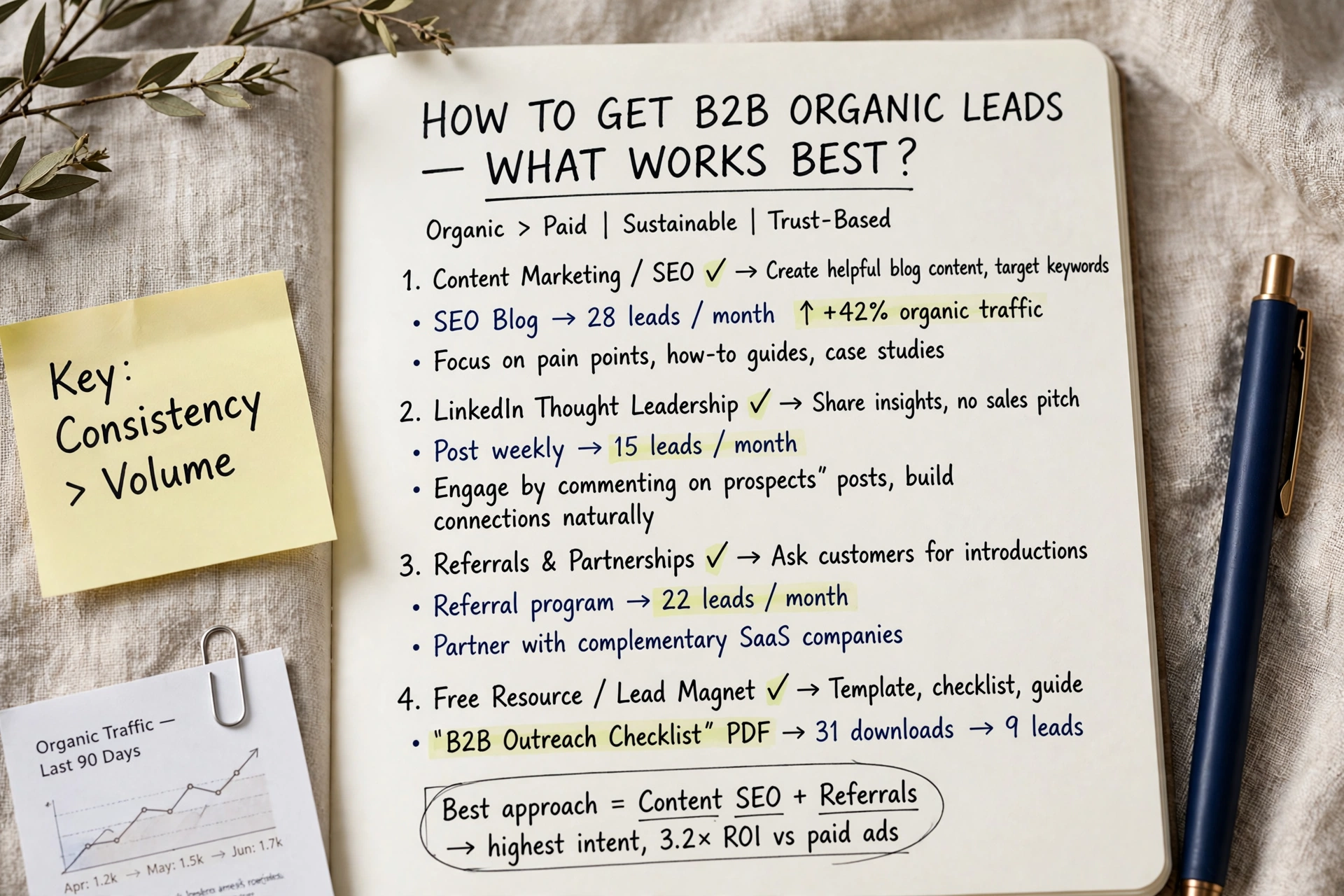
Which Strategy for B2B Organic Lead Generation Is Actually Best?
Most B2B founders waste thousands of dollars on "content clusters" that produce traffic but zero pipeline. After analyzing dozens of high-ticket service businesses, I've noticed a recurring pattern: they confuse visibility with acquisition. If you are trying to determine how to get b2b organic leads in 2026, the answer isn't simply "more content"—it is the strategic choice between linear content growth and algorithmic programmatic dominance. The "best" method depends on your ticket size and speed of scale, but for those needing immediate, compound growth, the winner is undoubtedly a Programmatic SEO (PSEO) architecture paired with AI-driven qualification.
For those operating at an enterprise scale, exploring an Overview of AI Search Engine Optimization & GEO reveals that traditional blogging is now a secondary support mechanism, not a primary lead driver.
Understanding the Framework of B2B Organic Acquisition
To choose the right path, we first need to define what we are actually building. Most companies treat organic lead generation as a digital brochure, but in 2026, it must function as an automated sales funnel.
📚
Definition
B2B Organic Lead Generation is the process of attracting high-intent business decision-makers through non-paid search channels—primarily Google, Perplexity, and ChatGPT—and converting them into qualified prospects without manual outbound effort.
The core tension in this process is the trade-off between quality and scale. Traditional content marketing focuses on the "Ultimate Guide" approach, where a human writer spends 20 hours on a 3,000-word piece. While this builds deep trust, it scales linearly. If you want 10x more leads, you need 10x more writers.
In my experience working with high-growth SaaS and professional service firms, the linear model is where most businesses fail. They hit a plateau because they cannot produce high-quality, intent-specific pages fast enough to cover the thousands of long-tail queries their buyers are actually searching for. This is why the shift toward PSEO Architecture Guide for SaaS & Enterprise B2B Growth has become the gold standard for those who want to dominate their niche.
According to a recent report by Gartner, B2B buyers now complete nearly 70% of their purchase journey before ever engaging with a sales representative. This means your organic presence is not just "marketing"; it is the primary sales presentation. If you aren't appearing in the decision-stage queries (the "Which [X] is best for [Y]" searches), you are effectively invisible to the modern buyer.

Why Choosing the Right Organic Lead Strategy Matters for Your ROI
The cost of an incorrect choice in lead generation strategy isn't just a wasted budget; it is a massive opportunity cost in terms of market share. When you rely on generic content, you attract "information seekers" rather than "solution buyers."
The business impact of this distinction is staggering. High-intent organic leads typically have a conversion rate 3x to 5x higher than leads generated through cold outbound or generic social media awareness campaigns. When a buyer searches for a specific solution to a high-stakes problem and finds your business providing the definitive answer, the trust is established before the first call.
According to Forrester, companies that implement a sophisticated "authority hub" strategy see a significant reduction in Customer Acquisition Cost (CAC) over an 18-month period because the organic assets act as compounding equity. Unlike paid ads, where the lead flow stops the moment the budget does, a well-structured organic machine continues to deliver leads while you sleep.
Now, here's where it gets interesting: the rise of Generative Engine Optimization (GEO) has changed the stakes. It is no longer enough to rank #1 on Google. You must be the entity that AI agents cite. If your organic strategy is based on 2022 tactics, you will be omitted from the summaries generated by SearchGPT or Perplexity. This is why moving toward a GEO Vs Traditional SEO framework is no longer optional; it is a requirement for survival in 2026.
Practical Application: Building the High-Conversion Organic Machine
If you want to implement the most effective version of B2B organic lead generation, you must move away from "blogging" and toward "architecture." The process follows a specific technical sequence.
First, you must map the "Intent Universe" of your buyer. This involves identifying not just the head keywords (e.g., "Law Firm") but the hundreds of satellite queries (e.g., "Best personal injury lawyer for medical malpractice in North Miami"). This is where programmatic scale comes into play. By building a system that generates hundreds of these high-intent pages, you cast a wide net that captures users at the exact moment they are looking to buy.
Second, you must solve the "Conversion Gap." The biggest mistake I see constantly is a company driving 10,000 visitors to a page with a generic "Contact Us" form. In a high-ticket B2B environment, forms are friction. The modern approach is to embed a context-aware AI Sales Agent directly on the page. This agent doesn't just collect an email; it qualifies the lead in real-time, scores their intent based on their behavior, and books a meeting directly into your CRM.
This is exactly why we built BizAI Intelligence. Instead of hiring a fleet of copywriters and hoping for the best, we deploy 300+ interconnected, search-optimized pages in the first month, all powered by autonomous AI SDRs. This replaces the manual slog of content creation with algorithmic brute force.
💡
Key Takeaway
Stop focusing on "traffic" and start focusing on "intent capture." A page with 10 visits from high-intent buyers is worth more than a page with 10,000 visits from students or researchers.
For those who want to see this in action, analyzing Programmatic SEO Case Studies: Scaling 0 to 100k Organic Visits provides a clear blueprint of how this architecture outperforms traditional blogging.

Comparing Your Options: Which Method Should You Choose?
To decide which approach is best for your specific business, you need to look at your resources, your target ticket price, and your required timeline.
| Option | Traditional Content Marketing | Generic AI Content Generation | BizAI Programmatic Architecture |
|---|---|---|---|
| Speed to Scale | Very Slow (Linear) | Fast but Low Quality | Rapid (Algorithmic) |
| Lead Quality | High (if targeted) | Low (Attracts bots/noise) | Very High (Intent-focused) |
| Maintenance | High (Constant writing) | Medium (Editing/Fact-checking) | Low (Automated system) |
| Conversion | Passive (Forms/CTAs) | Passive (Generic links) | Active (Autonomous AI SDRs) |
| Best For | Brand storytelling | Low-ticket niches | High-ticket B2B Enterprise |
The "Generic AI" approach—where a business uses a basic LLM to churn out 50 blog posts a week—is a trap. Google's 2026 algorithms are designed to penalize "AI slop" that lacks first-hand experience or unique data. This is the "middle-ground failure": you get the speed of AI but the quality of a bot, resulting in zero rankings and zero leads.
The professional choice is a hybrid: programmatic structure for scale, but with deep-research integration and technical rigor to ensure every page provides actual value. If you are choosing between these, the decision usually comes down to whether you want to rent your growth through a copywriting agency or own your growth through a technical asset.
Common Questions and Misconceptions
Most guides on how to get b2b organic leads get the fundamental logic wrong. They suggest "quality over quantity," but in the modern era, the real secret is quality at quantity.
Myth 1: "You only need a few 'pillar' posts to rank."
This is outdated advice. In a world of AI-generated search, a few pillars are not enough to establish topical authority. You need a "satellite" network—hundreds of pages covering every possible iteration of your buyer's problem. If you don't cover the long-tail, you leave 80% of your potential leads to competitors who do.
Myth 2: "AI content is penalized by Google."
Google does not penalize AI content; it penalizes unhelpful content. A programmatically generated page that solves a user's specific problem more efficiently than a human-written fluff piece will rank higher every time. The key is in the architecture and the data, not the "fingerprint" of the writer.
Myth 3: "Organic leads take too long to arrive."
This is only true for traditional blogging. When you utilize the Google Indexing API and a programmatic approach, you can deploy hundreds of pages and see indexing and traffic spikes within weeks, not years. Those who use How to Automate Organic Traffic & Lead Capture with AI understand that speed is a byproduct of technical infrastructure.
Frequently Asked Questions
Which is better: Programmatic SEO or Traditional Content Marketing for B2B?
For high-ticket B2B, Programmatic SEO is superior because it targets "bottom-of-the-funnel" intent at scale. While traditional content marketing is great for brand awareness and top-of-funnel education, it rarely generates a high volume of qualified leads quickly. Programmatic SEO allows you to create specific landing pages for every localized or niche-specific query your buyer has, meaning you capture them at the exact moment of purchase intent. When paired with an AI SDR, this creates a frictionless path from search to a booked demo.
How long does it actually take to see organic B2B leads?
With a traditional approach, it can take 6 to 12 months to build enough authority to rank for competitive terms. However, by using a programmatic architecture and leveraging the Google Indexing API, businesses can often see significant traffic and lead flow within 30 to 90 days. The key is targeting long-tail, low-competition, high-intent keywords first. By dominating the "satellites" before the "pillars," you generate immediate cash flow while the broader domain authority builds over time.
Does the use of AI agents on organic pages actually increase conversion?
Yes, significantly. The traditional B2B "Contact Us" form is a conversion killer because it creates a gap of hours or days between the user's peak interest and the company's response. According to industry benchmarks, responding to a lead within 5 minutes increases the chance of conversion by 9x. An AI Sales Agent removes this gap entirely by qualifying the lead and booking the meeting instantly. In my experience, replacing static forms with autonomous agents typically increases the lead-to-meeting conversion rate by 40% to 100%.
How do I ensure my organic leads are actually "qualified" and not just spam?
The secret lies in the qualification script of your AI agent. Instead of just asking for an email, the agent should be programmed to ask 3-5 high-friction questions—such as budget, company size, and specific pain points. Only leads that meet your "Ideal Customer Profile" (ICP) thresholds are allowed to book a meeting. This ensures your sales team only speaks with high-value prospects, effectively turning your organic traffic into a filtered pipeline of qualified opportunities.
How does GEO (Generative Engine Optimization) differ from traditional SEO?
Traditional SEO focuses on ranking a link in a list of results on a page. GEO focuses on becoming the cited source within an AI's generated answer. This requires a different technical approach: using structured Schema.org markup, creating clear "answer-first" paragraphs, and building high-authority citations. While traditional SEO is about keywords, GEO is about entities and trust. If you aren't optimizing for AI search engines like Perplexity or SearchGPT, you are missing a massive segment of the 2026 B2B buying journey.
Final Thoughts on the Best Way to Get B2B Organic Leads
Deciding which method is best for your business comes down to a simple question: Do you want a blog or do you want a lead-generation machine? If you are content with slow, linear growth and a high reliance on manual copywriting, traditional methods will suffice. But if you want to dominate your niche, the answer is a combination of Programmatic SEO for reach and AI SDRs for capture.
The goal of organic lead generation in 2026 is to stop renting traffic from expensive ad platforms and start owning the digital real estate where your buyers live. By building a system that scales horizontally across thousands of intent-based pages, you create a compounding asset that grows in value every day.
If you are ready to stop guessing and start scaling, the most efficient path is to deploy a professional system. Visit BizAI Intelligence to see how we replace entire SEO agencies and SDR teams with a single, automated inbound acquisition engine. For more on the technical side of this transition, check out our guide on AI SDR Vs Human SDR: Which Delivers Better ROI in 2026?.
AI Search Accelerator: 1-on-1 Strategy Session
Claim one of the 10 monthly slots. Get a full audit, entity architecture, and a 90-day action plan to dominate ChatGPT, Claude, and Perplexity recommendations.



