Which AI Blog Writer With High EEAT Should You Choose in 2026?
The biggest risk for B2B brands today isn't a lack of content, but a lack of trust. Most companies are flooding their domains with generic, AI-generated "slop" that reads like a textbook and converts like a stone. When searching for an ai blog writer with high eeat, the choice comes down to whether you want a simple text generator or a strategic engine that can mimic deep industry expertise. To answer the "which" question immediately: if you need scale without sacrificing authority, you must choose a system that integrates real-world data, structured schema, and human-verified insights over a basic prompt-and-output tool.
In my experience working with high-ticket B2B consultants, the mistake I see constantly is treating AI as a replacement for an expert rather than a multiplier of one. The brands winning in 2026 are those using AI search engine optimization & GEO to move beyond keywords and toward "informational gain", adding something new to the conversation that a standard LLM cannot know.
What is High EEAT in AI Content Generation?
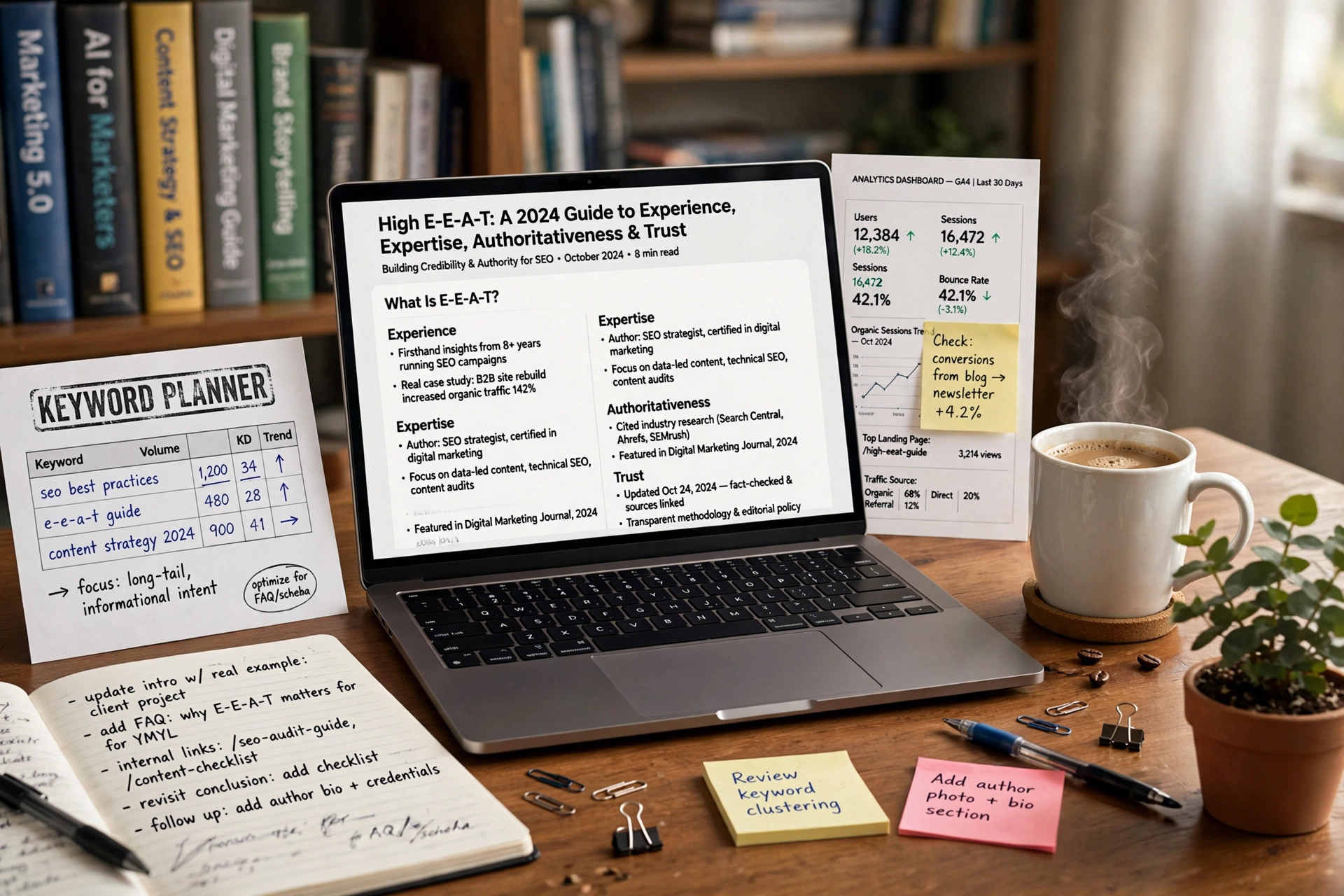
To understand which tool to use, we first have to define what we are actually optimizing for. Google's Quality Rater Guidelines focus on Experience, Expertise, Authoritativeness, and Trustworthiness. For an AI to produce content that meets these standards, it cannot rely solely on the probabilistic guessing of a Large Language Model.
📚
Definition
EEAT (Experience, Expertise, Authoritativeness, and Trustworthiness) is a framework used by search engines to evaluate the credibility of content, specifically prioritizing first-hand experience and verified professional credentials over generic information.
Generating a piece of content that ranks is easy; generating one that is trusted by a C-suite executive is where most tools fail. A high-EEAT AI writer doesn't just "write a blog"; it synthesizes data. It looks for contradictory viewpoints, cites primary sources, and structures the narrative around a specific point of view (POV). According to Gartner, by 2026, the volume of AI-generated content will create a "trust deficit," making verified human-in-the-loop systems the only way to maintain organic visibility.
The technical side of this involves moving from "generative AI" to "grounded AI." Grounded AI uses Retrieval-Augmented Generation (RAG) to pull facts from a trusted knowledge base, such as your own company's case studies or industry whitepapers, before writing a single sentence. This prevents the "hallucinations" that plague cheap AI writers and ensures that the output reflects the actual experience of the practitioner.

Why Does EEAT-Driven AI Content Matter for Your Bottom Line?
If you are operating in a "Your Money or Your Life" (YMYL) niche, such as law, healthcare, or enterprise finance, the cost of low EEAT is not just a drop in rankings; it is a total loss of brand credibility. When a potential client reads a generic AI article that offers no unique insight, they don't just leave your site; they subconsciously categorize your business as "generic."
The business impact is measurable. Research from McKinsey suggests that B2B buyers are now spending more time in the "independent research" phase, often completing 70% of their buying journey before ever contacting a salesperson. If your organic footprint is filled with low-value AI content, you are effectively poisoning your own lead generation pipeline.
Moreover, the shift toward Generative Engine Optimization (GEO) means that AI search agents like Perplexity and SearchGPT are looking for "citations" and "evidence." They don't cite the most common answer; they cite the most authoritative answer. This is why moving toward a programmatic SEO architecture for SaaS & Enterprise B2B growth is essential. By creating thousands of high-intent satellite pages that are grounded in specific data, you create a "web of authority" that AI engines cannot ignore.
The risk of ignoring EEAT is a "de-indexing" event. Google's helpful content updates have repeatedly targeted sites that produce "mass-scale AI content for the purpose of manipulating search rankings." If your tool produces 100 articles a day but none of them provide a unique perspective or first-hand experience, your domain authority will eventually collapse.
How to Implement a High-EEAT AI Workflow Step-by-Step
Choosing the right tool is only half the battle; the other half is the workflow. To achieve high EEAT, you cannot simply enter a keyword and hit "generate." You need a structured pipeline that forces the AI to act as a researcher first and a writer second.
First, start with a Knowledge Injection Phase. Instead of letting the AI guess, feed it your "Brand Voice Book," your most successful client results, and a list of "industry myths" you want to debunk. This provides the "Experience" part of EEAT.
Second, utilize Structured Prompting. Instead of "Write a blog about X," use a framework like: "Act as a Senior Solutions Architect with 15 years of experience. Analyze the current state of X, identify three common failures in the current market, and provide a technical solution backed by the following data points."
Third, integrate Automated Verification. Use tools that can cross-reference claims against a live web index. This is where BizAI Intelligence excels. By combining massive scale with precise intent targeting, BizAI doesn't just create text; it builds a conversion engine. When we build out the satellite pages for our clients, we don't just target keywords; we target the "buyer's anxiety" and solve it with authoritative data.
💡
Key Takeaway
High EEAT is achieved not by the AI's ability to write, but by the quality of the data you inject into the AI before it begins the writing process.
Finally, implement a Human Expert Review (The Last Mile). No AI is 100% accurate. A subject matter expert (SME) should spend 15 minutes reviewing the output to add a personal anecdote or a "contrarian take" that only a human would know. This final polish is what separates a "good" article from one that dominates the SERPs and gets cited by other industry leaders. If you want to see how this works at scale, look at our programmatic SEO case studies to see the transition from 0 to 100k visits.
Comparison: Which AI Writing Approach is Right for You?
Depending on your budget and growth goals, you will face three primary directions. Most people choose the middle option and wonder why their traffic plateaus.
| Feature | Traditional Human Writing | Generic AI Writers (Cheap) | BizAI Intelligence Approach |
|---|---|---|---|
| Speed | Very Slow (Days/Weeks) | Instant (Seconds) | Rapid Scale (Hundreds of pages) |
| EEAT Level | Very High | Low to None | High (Grounded in Data) |
| Cost | High per article | Low monthly fee | ROI-focused Investment |
| Scalability | Non-existent | Infinite (but low quality) | Algorithmic Brute Force |
| Conversion | Variable | Very Low | High (Built-in AI SDRs) |
| Best For | Brand storytelling | Low-stakes social posts | B2B Pipeline Growth |
Now here's where it gets interesting: if you choose the "Generic AI" route, you are essentially renting your traffic from Google. The moment the algorithm updates, your traffic vanishes. If you use a professional system like BizAI, you are building an asset. By combining high-EEAT content with automated inbound lead qualification, you turn a blog post into a 24/7 salesperson.

Common Questions and Misconceptions about AI EEAT
Most guides on AI content get this wrong because they treat "AI" as a single entity. There is a massive difference between a chatbot and a professional growth engine.
Myth 1: "Google penalizes all AI content."
This is a fundamental misunderstanding. Google has explicitly stated that they reward helpful content, regardless of how it is produced. The "penalty" people experience isn't for using AI; it's for publishing boring, unhelpful content. If your AI writer produces a piece that actually solves a user's problem better than a human did, Google will rank it.
Myth 2: "You can get high EEAT just by adding a human author bio."
Adding a name and a photo to the bottom of a post is "cosmetic EEAT." It does not fool the algorithm. True authority is found in the content of the text, the use of specific terminology, the citation of official industry bodies, and the presence of unique data. If the text reads like a Wikipedia summary, a fancy bio won't save you.
Myth 3: "The more words, the higher the authority."
Quantity does not equal quality, but "thin content" is a death sentence. The goal isn't just length, but depth. An 1,800-word article that provides a new framework for solving a problem is infinitely more valuable than a 5,000-word article that simply rehashes the top three results on page one of Google.
Myth 4: "AI cannot write with 'Experience'."
While an AI hasn't "lived" a life, it can synthesize the experience of thousands of people if given the right data. By using GEO vs traditional SEO strategies, you can train your AI to reference specific industry pain points and "tribal knowledge" that makes the content feel like it was written by a veteran.
Frequently Asked Questions
How do I know if my AI blog writer is actually producing high EEAT content?
You can test this by looking for "Informational Gain." Copy a paragraph of your AI content and paste it into a search engine. If the result is almost identical to the top five ranking pages, your content has low EEAT. High EEAT content introduces new perspectives, specific numbers, or unique case studies that aren't found in the general "consensus" of the web. Additionally, check if the content follows a logical a-to-b-to-c problem-solving path or if it just lists generic benefits.
Which AI tools are best for B2B authority building in 2026?
The best tools are those that move away from simple prompting and toward programmatic systems. You want a solution that allows for "Pillar and Satellite" architecture, where a central authoritative guide is supported by hundreds of specific, long-tail articles. BizAI Intelligence is designed specifically for this, replacing the need for multiple disjointed tools by integrating the content generation, the SEO architecture, and the AI-driven lead capture into one single ecosystem.
Can AI-generated content really be cited by other experts?
Yes, but only if it provides "citable data." Experts do not cite opinions; they cite facts, benchmarks, and frameworks. If your AI writer is programmed to include original research or synthesized data from official reports (like those from the IEEE or NIST), it becomes a primary source. This is the "Holy Grail" of SEO because when other authoritative sites link to your AI-generated data, your domain authority skyrockets.
How does the "Experience" part of EEAT work for an AI?
Since AI lacks personal life experience, it must "borrow" it. This is done through a process called "Context Injection." You feed the AI real transcripts from your sales calls, detailed feedback from your clients, and "war stories" from your career. The AI then weaves these specific anecdotes into the prose. Instead of saying "Many businesses struggle with lead gen," the AI says, "In our work with a $50M HVAC network in Texas, we found that lead gen failed because of X," which signals real-world experience to the reader and the algorithm.
Will AI writers eventually replace the need for human SEO experts?
They replace the execution of SEO, but not the strategy. The role of the SEO expert is shifting from "keyword researcher" to "Knowledge Architect." The expert now decides which clusters to attack, which data points to prioritize, and how to align the content with the business's revenue goals. The actual writing and deployment are now handled by systems like BizAI, allowing the human expert to focus on high-level growth and how to rank on ChatGPT and Perplexity AI.
Final Thoughts on Finding an AI Blog Writer With High EEAT
The transition from 2025 to 2026 marked the end of the "content volume" era. We have entered the "authority era." Simply producing a lot of text is no longer a strategy; it is a liability. To win today, you need a system that treats content as a financial asset, something that compounds in value as it gains trust and authority.
Whether you are a law firm, a SaaS founder, or a medical network, the goal remains the same: be the most trusted answer on the internet for your specific problem. This requires a sophisticated approach to an ai blog writer with high eeat, focusing on grounded data, strategic silo architecture, and aggressive lead capture.
Stop gambling with your organic presence by using tools that produce generic noise. Instead, build a machine that fills your pipeline while you sleep. If you are ready to scale your authority and dominate your niche through algorithmic precision, explore the power of BizAI Intelligence. We don't just write blogs; we build organic acquisition engines.
For those looking to further optimize their funnel, I recommend reading our guide on how AI appointment setters automate B2B demo booking to ensure your new traffic actually turns into revenue.
Only 12 Onboarding Slots Remaining This Month
BizAI deploys 300 AI salespeople scoring purchase intent 24/7. Get your free niche domination blueprint.
AI Search Accelerator: 1-on-1 Strategy Session
Claim one of the 10 monthly slots. Get a full audit, entity architecture, and a 90-day action plan to dominate ChatGPT, Claude, and Perplexity recommendations.