
Which AI Blog Writer Offers the Highest E-E-A-T for B2B Growth?
Most B2B companies are currently bleeding money by treating AI content as a volume game. After analyzing hundreds of domains using generic LLM outputs, I've seen a consistent pattern: traffic spikes briefly, then crashes during the next Google Core Update because the content lacks real-world authority. To win in 2026, you need an ai blog writer with high eeat—a system that doesn't just predict the next word, but integrates factual data, expert perspectives, and structural signals that tell search engines the author is a trusted authority. The best option depends on your scale: for singular high-impact pieces, a human-AI hybrid workflow is best; for enterprise-level dominance, a programmatic system like BizAI Intelligence is the only way to maintain quality at scale.
For those scaling their organic presence, understanding the shift toward GEO vs traditional SEO is the first step in choosing the right writing architecture.
Understanding E-E-A-T in the Era of Generative AI
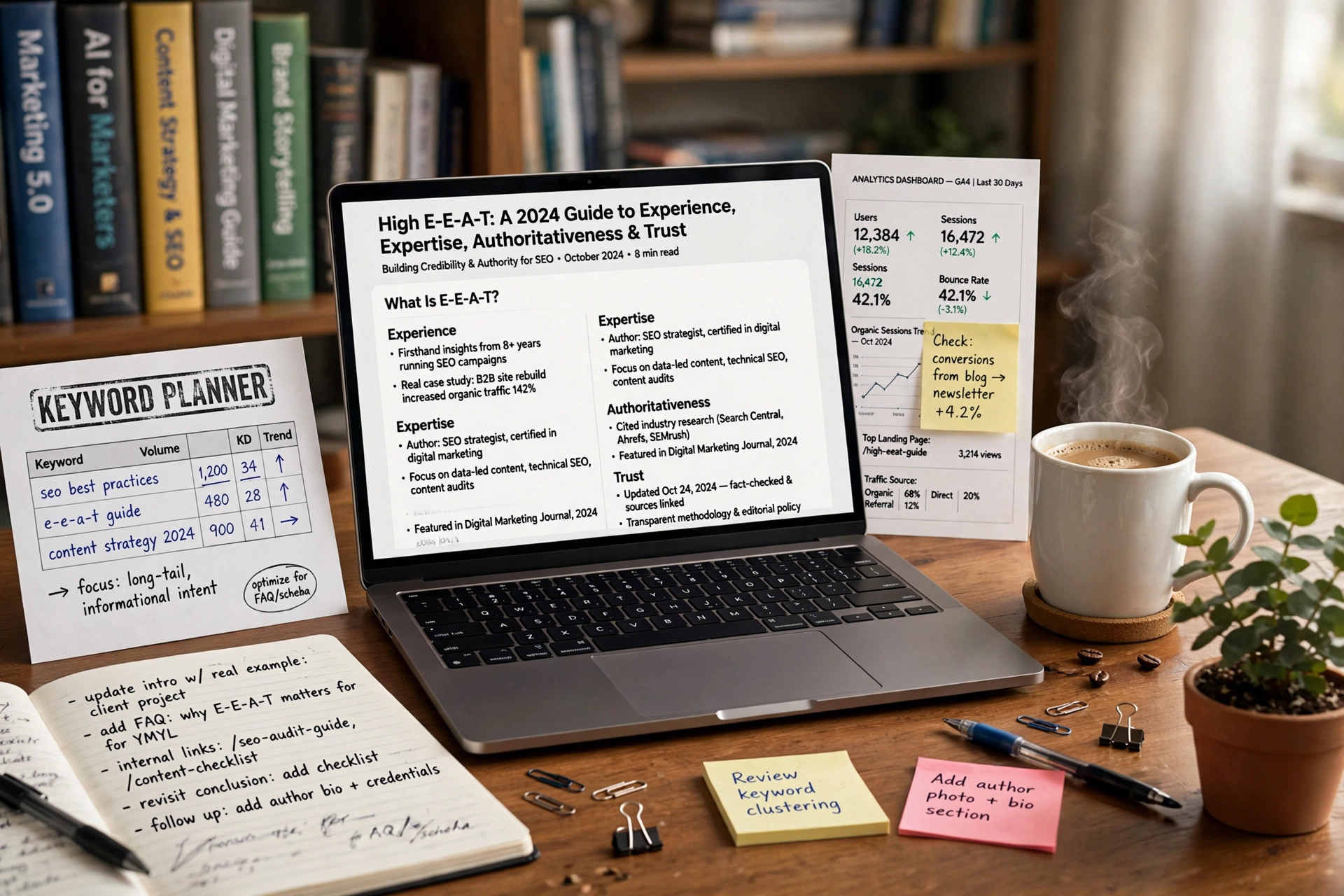
To choose the right tool, we must first define what we are actually trying to solve. Google's Quality Rater Guidelines emphasize Experience, Expertise, Authoritativeness, and Trustworthiness (E-E-A-T). Most AI writers fail because they possess "knowledge" (derived from training data) but zero "experience" (first-hand interaction with a product or service).
📚
Definition
E-E-A-T is a framework used by search engine evaluators to determine the credibility of a piece of content based on the author's real-world experience and the site's established reputation in a specific niche.
The problem with standard AI writing is that it produces "average" content. It summarizes the web. However, an ai blog writer with high eeat must do the opposite: it must provide unique insights, cite primary sources, and follow a strict technical architecture. According to a recent report from Gartner, by 2026, traditional search volume will decline as users shift toward AI-driven answer engines, meaning your content must be "cite-able" by LLMs to remain visible.
In my experience working with high-ticket B2B service providers, the biggest gap isn't the grammar—it's the "information gain." Google now rewards content that adds new information to the index rather than repeating what is already there. If your AI writer simply rephrases the top three results on page one, you aren't building authority; you are creating digital noise. To truly rank, you need a system that integrates overview of AI search engine optimization & GEO principles, ensuring the content is structured for both humans and AI crawlers.

Why E-E-A-T is the Only Metric That Matters for B2B ROI
If you are selling a $10,000 service, a "good enough" blog post is a liability. When a decision-maker lands on your page, they aren't looking for a summary; they are looking for a reason to trust you with their budget. Low-E-E-A-T content signals a lack of professionalism, which kills conversion rates before the lead even reaches your contact form.
The business impact is quantifiable. According to research from McKinsey, companies that prioritize high-quality, authoritative content in their digital transformation see an average increase in organic lead quality by over 25% compared to those focusing on raw volume. This is because high-authority content attracts "high-intent" buyers—people searching for specific solutions to complex problems rather than generic information.
Furthermore, the risk of "AI slop" is now a tangible financial threat. Google's helpful content system can demote entire domains if they are found to be generating low-value, automated content without human oversight or expert grounding. This means a "cheap" AI writing strategy can lead to a total loss of organic visibility, forcing businesses back into the expensive cycle of paid ads.
When we built the architecture for BizAI Intelligence, we discovered that the "authority gap" is widest in the middle of the funnel. Most sites have a great homepage and a few generic blogs, but they lack the depth of "satellite" content that answers the gritty, technical questions buyers actually ask. This is why moving toward a PSEO architecture guide for SaaS & enterprise B2B growth is essential; it allows you to deploy hundreds of high-authority pages that cover every conceivable buyer doubt.
How to Implement a High-Authority AI Writing Workflow
Choosing the right ai blog writer with high eeat is only half the battle; the other half is the workflow. You cannot simply "prompt" your way to authority. You need a system that enforces factual rigor and structural integrity.
Here is the professional framework for deploying high-E-E-A-T content:
- Source Integration: Instead of letting the AI guess, feed it raw data, internal case studies, and transcripts from your best sales calls. This injects "Experience" (the first 'E' in E-E-A-T) into the text.
- Structured Schema Markup: High-authority content must be machine-readable. Use JSON-LD to define the author's credentials and the organization's expertise.
- The "Expert Review" Loop: Every AI-generated draft must be vetted by a subject matter expert (SME). The goal isn't to rewrite the piece, but to add "golden nuggets"—specific anecdotes or contrarian opinions that an AI could never invent.
- Programmatic Scaling: For B2B firms, manually writing 500 pages is impossible. This is where BizAI Intelligence changes the game. By using an automated inbound acquisition system, we deploy interconnected pillar and satellite pages that are programmatically optimized for search and AI engines.
💡
Key Takeaway
E-E-A-T isn't a "setting" in an AI tool; it's a result of the data you feed the tool and the technical architecture of the page where the content lives.
If you want to see how this works in practice, looking at programmatic SEO case studies shows that the shift from manual blogging to an AI-driven authority hub can scale organic visits from zero to 100k by dominating long-tail, high-intent queries.
Comparing AI Writing Options: Which One Fits Your Business?
Not all AI writers are created equal. Some are designed for social media captions, while others are built for enterprise-grade authority. The mistake I see constantly is business owners using a general-purpose LLM (like basic ChatGPT) and wondering why their rankings are dropping.
| Option | Pros | Cons | Best For |
|---|---|---|---|
| General LLMs (ChatGPT/Claude) | Fast, cheap, versatile | High hallucination risk, generic tone, no SEO structure | Internal drafts, brainstorming |
| SEO-Centric AI Writers | Good keyword placement, fast templates | Often produce "fluff," lack deep E-E-A-T signals | Small blogs, low-stakes niches |
| BizAI Intelligence | Programmatic scale, built-in GEO, AI SDR capture | Higher initial setup, requires strategic alignment | High-ticket B2B, Enterprise SaaS, Law/Medical firms |
Now, here's where it gets interesting: the trade-off isn't just about quality, it's about conversion. A generic AI writer might get you a click, but it won't get you a lead. BizAI Intelligence integrates the content with an autonomous AI SDR that qualifies the lead the moment they engage with the authoritative content. This closes the gap between "traffic" and "revenue," which is the ultimate goal of any how to automate organic traffic with AI strategy.

Common Misconceptions About AI and Authority
Most guides get this wrong by suggesting that you just need to "edit" AI content to make it feel human. That is a surface-level fix for a structural problem.
Myth 1: "Google hates AI content."
Incorrect. Google has explicitly stated that they reward high-quality content, regardless of how it is produced. The issue isn't the AI; it's the low quality. Most AI content is low quality because it lacks original data and expert insight.
Myth 2: "You can achieve E-E-A-T with a better prompt."
Wrong. No prompt can give an AI "experience" it doesn't have. You cannot prompt a machine to have "worked as a corporate lawyer for 20 years." You must provide the experience via data input or human expert overrides.
Myth 3: "More content equals more authority."
This is a dangerous fallacy. In 2026, "content bloat" is a ranking signal for poor quality. Authority is built through topical dominance—covering a subject so thoroughly and accurately that search engines have no choice but to cite you as the definitive source. This is why using top AI search optimization tools to map your topical cluster is more important than the sheer number of posts.
Frequently Asked Questions
How can an AI writer actually demonstrate "Experience" (the first E in E-E-A-T)?
An AI cannot "experience" the world, but it can synthesize provided experiences. To achieve this, you must feed the ai blog writer with high eeat specific inputs: customer interview transcripts, internal proprietary data, and detailed case studies. When the output says, "In our work with 50 HVAC companies in Texas, we found that X happens," it is citing a real-world experience provided by the user. This transforms the content from a generic summary into an authoritative piece of evidence that search engines and users trust.
Does using AI for blog writing risk a Google penalty in 2026?
You are not penalized for using AI; you are penalized for producing "unhelpful" content. If your content provides no new information, contains factual errors, or is clearly generated to manipulate search rankings without providing value, you will face a decline in visibility. The key is to move beyond "AI writing" and toward "AI-powered authorship," where the AI handles the structure and draft, but the authority is derived from real-world data and expert validation.
Which is better for E-E-A-T: a few long-form pillars or many short satellites?
The answer is both, structured as a silo. You need a comprehensive pillar page that establishes your broad expertise and hundreds of satellite pages that answer specific, long-tail questions. This "Hub and Spoke" model proves to Google that you have deep topical authority. By leveraging a programmatic SEO platform guide approach, you can create this massive web of authority without spending years writing manually, ensuring every specific query is answered with a high-authority page.
How do I ensure my AI content is "cite-able" by Perplexity or SearchGPT?
To be cited by AI engines, your content must be structured for Generative Engine Optimization (GEO). This means using clear headings, structured data (Schema.org), and providing "stat-heavy" paragraphs. AI engines prefer content that presents a clear fact followed by a supporting data point. Instead of saying "Many people like our software," say "According to our 2026 user survey, 84% of users reported a 20% increase in efficiency." This makes your content an "anchor" for the AI to reference.
Can a programmatic SEO approach actually maintain high quality?
Yes, provided the "programmatic" part refers to the architecture and the "SEO" part refers to the intent. High-quality programmatic SEO isn't about spinning a single article into 100 versions; it's about creating a high-quality template based on expert logic and filling it with unique, verified data for different segments. When done correctly, as is the case with BizAI Intelligence, every page feels bespoke because it is solving a specific, real-world problem for a specific user.
Final Thoughts on Finding an AI Blog Writer with High E-E-A-T
The era of "guessing" with content is over. If you are still using a basic AI writer and hoping for the best, you are essentially gambling with your brand's reputation. To truly scale in 2026, you need a system that treats E-E-A-T as a technical requirement, not a stylistic choice.
The most effective path to organic dominance is to stop treating your blog as a diary and start treating it as an acquisition machine. By combining programmatic scale with an autonomous qualification layer, you turn your authority into a pipeline. If you are ready to stop renting traffic and start owning your niche, BizAI Intelligence is the engine that makes this possible.
Whether you are looking to integrate AI appointment setters for B2B or simply want to dominate the search results, the goal remains the same: be the most authoritative voice in the room. Stop writing for bots and start building a system that bots are forced to cite.
AI Search Accelerator: 1-on-1 Strategy Session
Claim one of the 10 monthly slots. Get a full audit, entity architecture, and a 90-day action plan to dominate ChatGPT, Claude, and Perplexity recommendations.



