📖This article is part of the complete guide to The Ultimate Guide to AI Sales Coaching.
Most sales managers are flying blind, relying on anecdotal evidence from weekly 1-on-1s to judge rep performance. In my experience building scalable growth systems, the gap between a top performer and a struggling rep isn't talent, it's the feedback loop. When coaching exists in a vacuum, separate from the CRM, the insights are useless because they aren't tied to actual deal outcomes. For a comprehensive overview of the broader landscape, explore our guide on AI sales coaching.
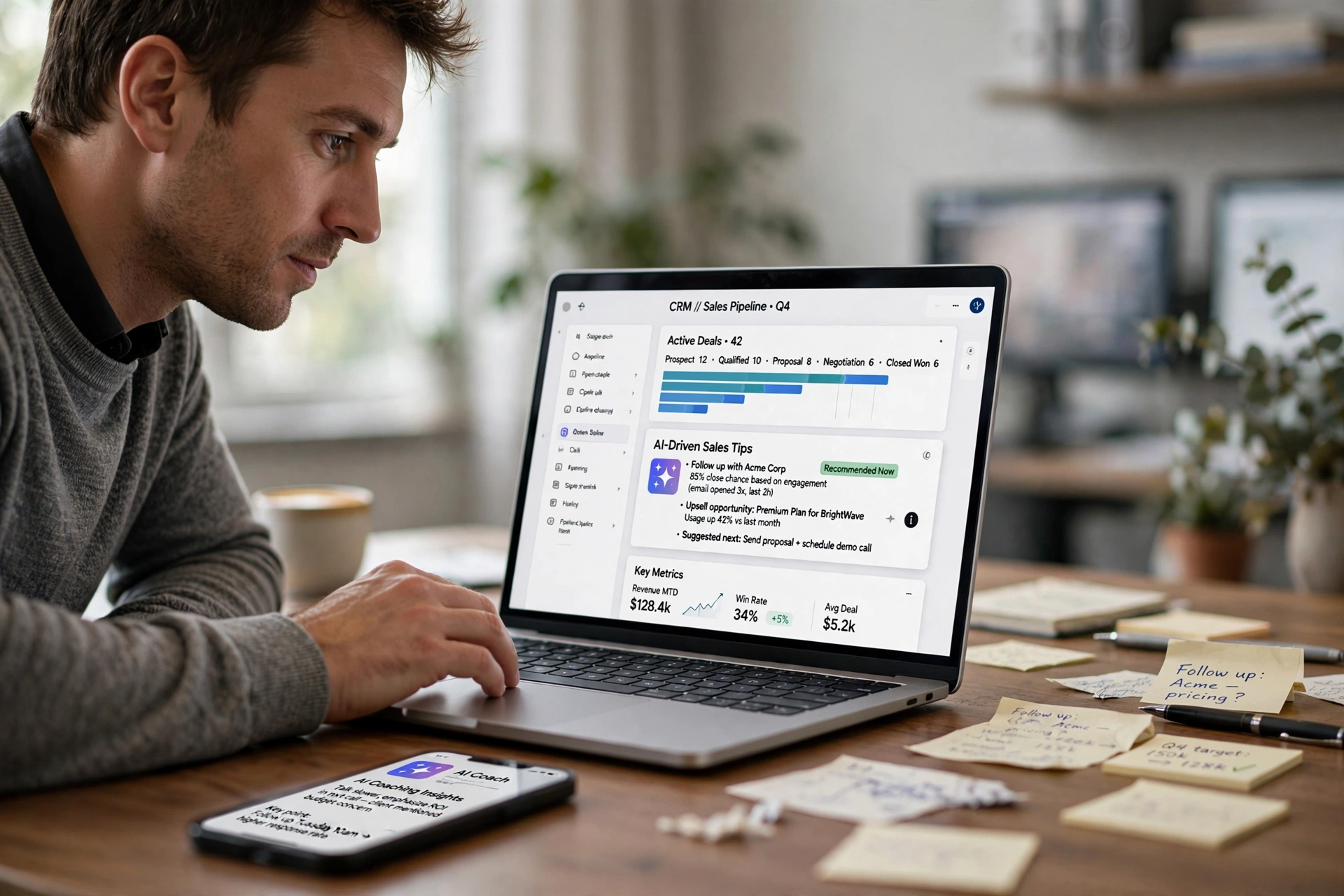
Integrating your coaching layer directly into your customer relationship management system transforms your CRM from a static database into a dynamic performance engine. Instead of manually reviewing call recordings, the system analyzes the data in real-time, identifies a pattern of failure in a specific deal stage, and delivers a micro-coaching module to the rep before they open their next lead. This is the difference between lagging indicators and leading indicators.

What Exactly is AI Sales Coaching CRM Integration?
📚
Definition
AI sales coaching CRM integration is the technical and operational synchronization between an artificial intelligence coaching layer and a CRM (like Salesforce or HubSpot), allowing coaching insights to be triggered by specific CRM data points and outcomes to be tracked against coaching interventions.
At its core, this integration ensures that the artificial intelligence has full visibility into the sales pipeline. Without this connection, an AI coach can tell you how a rep sounds on a call, but it cannot tell you if that specific tone led to a closed-won deal. When integrated, the system maps coaching behaviors to conversion rates. If the AI notices that reps who use a specific discovery framework have a 20% higher progression rate from Stage 2 to Stage 3 in the CRM, it can automatically push that framework to the rest of the team.
This is not about simply pushing a transcript into a note field. True integration involves bidirectional data flow. The CRM provides the context (deal size, industry, lead source, historical touchpoints), and the AI provides the prescriptive action (suggested rebuttals, tone adjustment, or timing for the next follow-up). When we developed the architecture for BizAI Intelligence, we focused on this exact synergy; an AI agent is only as good as the data it can access. If it can't see the CRM, it's just a chatbot; if it can, it's a strategic asset.
By leveraging a large language model (LLM) connected to your CRM API, the system can perform "gap analysis." It compares the current state of a deal in the pipeline against the "Golden Path", the sequence of actions taken by your top 5% of performers. When a rep deviates from this path, the AI flags it and provides an immediate coaching tip. This creates a self-correcting sales organization where the CRM acts as the source of truth and the AI acts as the real-time navigator.
Why Does Integrating Coaching with Your CRM Matter for Business Growth?
The primary reason this integration is fundamental is the elimination of the "coaching lag." In traditional environments, a manager reviews a call on Friday, identifies a mistake made on Monday, and gives feedback the following Tuesday. By then, the rep has already made the same mistake on ten other calls. According to research from the Harvard Business Review, real-time feedback loops can increase employee performance by up to 23% compared to delayed reviews.
Beyond speed, this integration allows for hyper-personalization at scale. You cannot manually coach 50 reps on 500 different deals. However, an integrated AI system can. It can identify that a rep is struggling specifically with "Price Objections" in the "Enterprise Healthcare" vertical and serve a targeted coaching module based on successful historical deals in that exact CRM segment. This level of granularity is impossible without a deep CRM link.
Furthermore, the integration provides an objective audit trail for ROI. Many companies invest in best AI sales coaching tools but struggle to prove the investment worked. When integrated, you can run A/B tests: Group A receives AI coaching synced to their CRM, while Group B uses traditional methods. You can then measure the direct impact on the average deal size and sales cycle length within the CRM itself.
Integrating AI into your workflow also supports better lead generation strategies. When the AI identifies that specific qualifying questions (captured in the CRM) correlate with higher win rates, it doesn't just coach the rep; it informs the marketing team to refine the lead qualification criteria. This creates a virtuous cycle where the organic traffic generated by your programmatic SEO architecture is met by a sales team that is being coached in real-time to convert those specific high-intent leads.
| Feature | Traditional Coaching | Generic AI Approach | Integrated AI Coaching (Modern) |
|---|---|---|---|
| Feedback Loop | Weekly/Monthly (Slow) | Immediate but Contextless | Immediate & Data-Driven |
| Data Source | Manager's Memory | Call Transcripts only | Full CRM History + Call Data |
| Scaling | Low (1:5 ratio) | Medium (Automation) | High (Automated Personalization) |
| ROI Tracking | Subjective/Anecdotal | Based on "Usage" | Based on Closed-Won Revenue |
| Implementation | Manual | Plugin/Extension | API-Deep Integration |
How to Successfully Integrate AI Sales Coaching into Your CRM
Implementing this system requires a shift from "tool adoption" to "workflow engineering." The goal is to make the coaching invisible and frictionless. If a rep has to log into a separate dashboard to see their coaching tips, they won't do it. The coaching must live where the work happens: inside the CRM.
First, establish your "Golden Path." Analyze your CRM data to identify the characteristics of your most successful deals. What were the commonalities in the discovery phase? How many touchpoints occurred before the demo? This baseline is what the AI will use to measure other reps. Without a defined success pattern, the AI has nothing to coach toward.
Second, set up automated triggers based on CRM stage changes. For example, when a lead moves from "Qualified" to "Proposal Sent," the AI should trigger a check: "Did the rep confirm the budget and decision-maker in the last call?" If the CRM field is empty or the AI analysis of the call says no, the system sends a nudge to the rep to clarify those points before the proposal meeting.
Third, implement a bidirectional feedback loop. The AI should not only push data into the CRM but also pull from it. Use webhooks to notify the AI coaching engine when a deal is marked as "Closed-Lost." The AI can then instantly analyze the final three calls to determine if the loss was due to a coaching gap (e.g. poor objection handling) or a product gap (e.g. missing feature). This allows you to refine your AI for sales performance coaching strategy based on empirical evidence.

For those looking to scale this rapidly, integrating an AI SDR or an autonomous appointment setter can further streamline the process. By using AI appointment setters for B2B, you ensure that the leads entering the CRM are already pre-qualified via the same logic the AI uses for coaching. This means the rep starts the call with a high-probability lead and a set of AI-generated talking points based on the lead's specific pain points recorded during the automated booking process.
Common Mistakes to Avoid When Syncing AI Coaching and CRM
One of the most frequent errors I see is "Alert Fatigue." Companies set up too many AI triggers, resulting in a rep receiving 20 "coaching tips" per day. When the AI screams everything, the rep hears nothing. The solution is to prioritize interventions based on deal value. An AI nudge for a $100k enterprise deal is essential; a nudge for a $1k lead is noise. Set thresholds in your CRM to ensure the AI only intervenes on high-impact opportunities.
Another critical mistake is treating the AI as a "policeman" rather than a "coach." If the integration is used primarily for managers to spy on reps or penalize them for missing a step, the reps will find ways to game the system. They might start using specific keywords just to satisfy the AI's checklist without actually building a relationship with the buyer. The culture must shift toward growth. The AI should be positioned as a tool to help the rep make more money, not a tool to help the manager find mistakes.
Furthermore, neglecting data hygiene is a recipe for failure. If your reps aren't updating their CRM fields, the AI is coaching based on hallucinations or outdated information. You cannot layer sophisticated AI on top of a messy database. I always recommend a "CRM Cleanup Phase" before deploying AI coaching. Ensure that your pipeline stages are clearly defined and that mandatory fields are enforced. As noted by the Salesforce Professional Services guidelines, the quality of AI output is directly proportional to the structured nature of the input data.
Finally, avoid the "Set it and Forget it" mentality. The market changes, and so do buyer objections. A coaching script that worked in 2025 might be obsolete by mid-2026. You must regularly review the AI's "Golden Path" and update it. This requires a monthly sync between the top performers, the sales manager, and the AI configuration to ensure the coaching remains relevant to current market dynamics.
💡
Key Takeaway
AI coaching is a multiplier. If you multiply a messy process, you just get a messier process at scale. Fix the CRM workflow first, then apply the AI layer.
Frequently Asked Questions
Does AI sales coaching replace the need for human managers?
No, it evolves the role of the manager. Instead of spending 80% of their time auditing calls to find problems, managers can spend 80% of their time solving the problems the AI has already identified. The AI handles the "what" and the "where," while the human manager focuses on the "how" and the emotional intelligence required to motivate a rep. It shifts the manager from a quality controller to a strategic coach.
Which CRMs are best for AI coaching integration?
Any CRM with a robust, open API can be integrated. HubSpot and Salesforce are the industry standards because they offer extensive webhook capabilities and deep integration ecosystems. However, the key isn't the CRM brand, but the flexibility of the API. For an integration to be effective, the CRM must allow the AI to not only read data but also write notes and trigger notifications in real-time within the user interface.
How long does it take to see a ROI from this integration?
Typically, businesses see an improvement in "ramp-up time" for new hires within the first 30 to 60 days. Because the AI provides immediate guardrails, new reps don't have to wait for their first monthly review to correct mistakes. In terms of revenue, most organizations see a lift in win rates within one full sales cycle, as the consistency of the sales process increases across the entire team.
Is my customer data safe when using AI coaching tools?
Security depends on the architecture. Enterprise-grade integrations use "Zero Data Retention" (ZDR) APIs and SOC2-compliant environments. This ensures that the AI analyzes the data to provide coaching but does not "learn" from your proprietary customer data to train public models. Always ensure your provider uses a private instance of the LLM and encrypts data both in transit and at rest.
Can AI coaching help with lead qualification in the CRM?
Absolutely. By analyzing the interaction data and syncing it with CRM fields, AI can score leads based on "intent signals" rather than just demographic data. It can tell a rep, "This lead mentioned a competitor three times and expressed urgency regarding their Q3 budget," and then automatically update the lead score in the CRM, prioritizing it for immediate follow-up.
Conclusion
Integrating AI sales coaching with your CRM is no longer a luxury for the elite 1% of sales organizations; it is a requirement for survival in the 2026 B2B landscape. The ability to turn raw CRM data into actionable, real-time coaching is the only way to scale excellence without linearly increasing your management overhead. When you bridge the gap between what happened (CRM) and how to do it better (AI Coaching), you create an autonomous growth engine that optimizes itself with every single call.
If you are still relying on manual call reviews and anecdotal feedback, you are leaving revenue on the table. The transition to a data-driven coaching culture starts with the right technical foundation. For a deeper dive into how to build this entire ecosystem from the ground up, return to our The Ultimate Guide to AI Sales Coaching.
To implement a system that not only coaches your team but also automates your inbound acquisition, visit BizAI Intelligence. We specialize in building the infrastructure that allows B2B firms to dominate their niche through a combination of programmatic SEO and AI-powered lead qualification.
AI Search Accelerator: 1-on-1 Strategy Session
Claim one of the 10 monthly slots. Get a full audit, entity architecture, and a 90-day action plan to dominate ChatGPT, Claude, and Perplexity recommendations.