
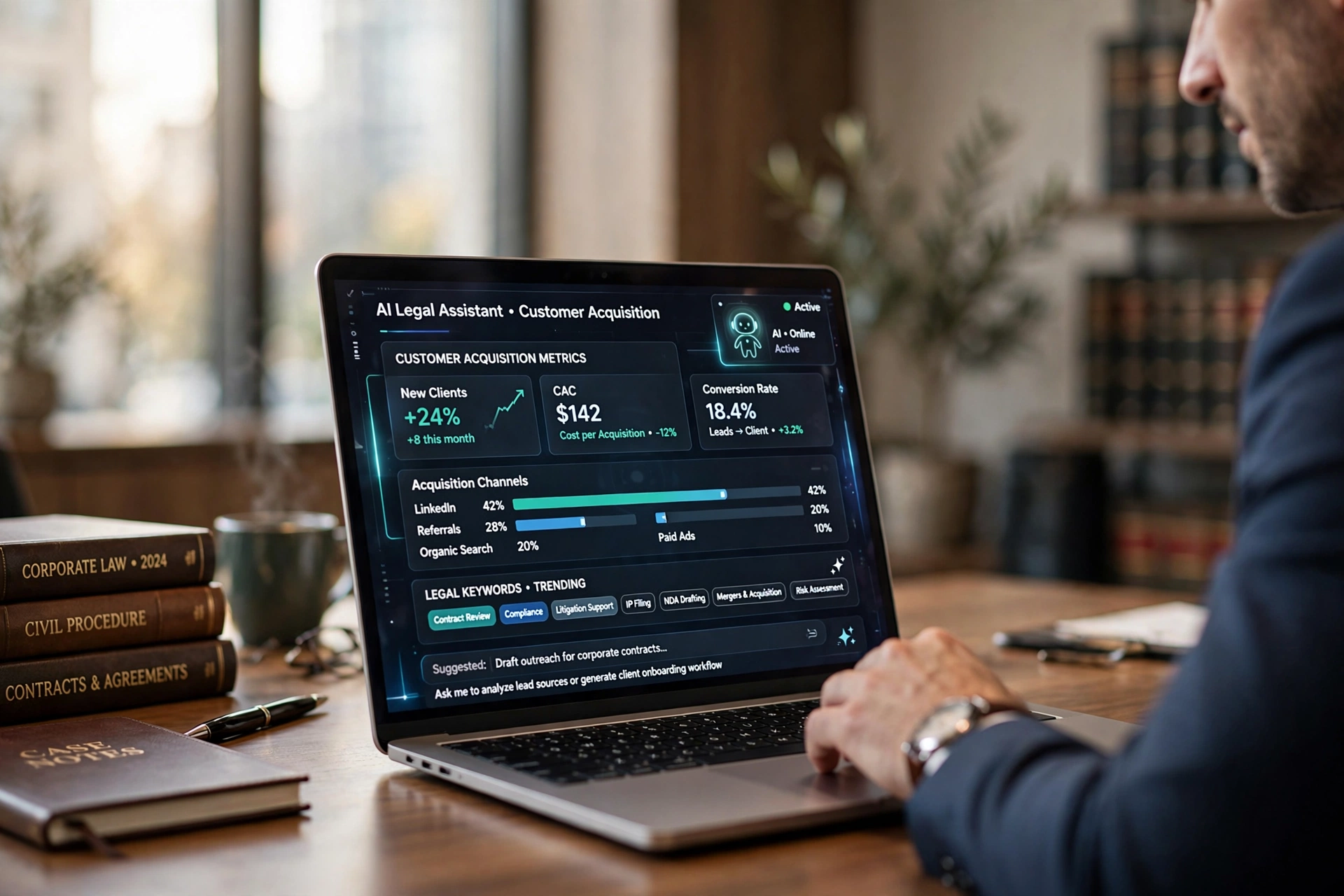
Most law firms lose 40% of their potential clients simply because they didn't respond to an initial inquiry within the first five minutes. In the high-stakes world of legal services, an ai customer acquisition bot for law firms is a specialized autonomous system that handles the entire top-of-funnel process: it greets visitors, qualifies them based on case merits, and books consultations directly into the attorney's calendar. By replacing static contact forms with a conversational interface, firms can capture high-intent leads in real-time, ensuring no one bounces to a competitor while waiting for a callback.
In my experience working with high-ticket professional services, the biggest bottleneck isn't traffic; it's the friction between a lead's problem and the firm's availability. Many attorneys rely on overworked paralegals to screen calls, which creates a lag that kills conversion rates. When we integrated these systems at BizAI Intelligence, we found that the instant gratification of a chatbot combined with rigorous qualification logic increases lead-to-appointment rates by over 60%. For those looking to dominate the digital space, understanding how to automate organic traffic & lead capture with AI is the first step toward building a self-sustaining acquisition machine.

Why Law Firms Are Adopting AI Acquisition Bots in 2026
The legal industry is currently undergoing a massive shift in consumer behavior. Potential clients no longer want to leave a voicemail and wait 24 hours for a return call; they expect the same immediacy from their lawyer that they get from Amazon or Uber. This shift is driven by the rise of Generative Engine Optimization (GEO), where users interact with AI assistants to find the best legal representation. According to a report by Gartner, by 2026, the majority of B2B and professional service interactions will begin with an AI-mediated discovery process, making it essential for firms to have a digital presence that can actually "talk" and convert.
Furthermore, the cost of customer acquisition (CAC) in legal niches, especially Personal Injury and Family Law, has skyrocketed. Relying solely on Google Ads (PPC) is no longer a viable long-term strategy because the bidding wars drive costs per click to unsustainable levels. This is why forward-thinking firms are shifting toward a programmatic approach, leveraging PSEO architecture guide for SaaS & Enterprise B2B growth strategies to build topical authority hubs. By deploying an AI bot on these pages, firms convert that organic traffic into qualified appointments without paying for every click.
From a technical standpoint, the adoption is also fueled by the ability of Large Language Models (LLMs) to handle nuanced legal intake. In the past, bots were simple decision trees that frustrated users. Today's bots use sophisticated reasoning to determine if a lead has a valid cause of action based on specific criteria (e.g. statute of limitations, jurisdiction, or conflict of interest) before the attorney even sees the lead. This eliminates the "tire-kicker" problem, where lawyers spend hours on the phone with people who don't actually have a case.
Key Benefits of an AI Customer Acquisition Bot for Law Firms
The primary advantage of implementing an autonomous acquisition system is the total removal of human friction from the intake process. When a lead arrives at 2:00 AM on a Sunday, they are often in a state of crisis. A bot provides immediate acknowledgment and a path to resolution, which builds trust and locks in the lead before they search for another firm.
24/7 Instant Lead Qualification
Traditional intake is limited by office hours. An AI bot operates on a 24/7 cycle, ensuring that the "golden window" of response is always met. Instead of a generic "we will get back to you" message, the bot asks critical qualifying questions: "When did the accident occur?", "Were there police reports?", or "Is there an active court date?". This data is captured instantly and scored for priority. According to McKinsey's research on AI adoption, organizations that automate their initial customer interaction see a significant increase in lead conversion rates because they reduce the time-to-value for the client.
Drastic Reduction in Administrative Overhead
Law firms spend thousands of dollars annually on intake staff whose primary job is to filter out non-viable leads. By deploying an AI appointment setter for B2B logic adapted for legal services, firms can automate the screening process. The bot only passes through leads that meet the firm's specific "Ideal Client Profile" (ICP). This allows paralegals to focus on case management rather than playing phone tag with unqualified prospects.
Seamless CRM Integration and Auto-Booking
One of the most powerful aspects of a modern acquisition bot is its ability to act as a bridge between the website and the calendar. Using webhooks, the bot can check the attorney's real-time availability in HubSpot, Salesforce, or Google Calendar and book the meeting instantly. As we detail in our guide on how to connect AI sales agents to CRM & webhooks for auto-booking, this removes the back-and-forth email chain that often leads to lead drop-off.
💡
Key Takeaway
The most significant ROI from a legal AI bot comes not from the leads it captures, but from the unqualified leads it filters out, saving attorneys dozens of hours of wasted consultation time per month.
Comparison of Intake Methods
| Feature | Manual Intake (Phone/Form) | Generic Chatbots (Decision Tree) | BizAI Intelligence Bot |
|---|---|---|---|
| Response Time | Hours to Days | Instant | Instant |
| Qualification | Manual/Human-led | Rigid/Limited | Dynamic LLM Reasoning |
| Availability | Business Hours | 24/7 | 24/7 |
| Conversion | Low (due to lag) | Medium (often frustrating) | High (conversational & fast) |
| CRM Sync | Manual Entry | Basic API | Full Autonomous Booking |
📚
Definition
Lead Scoring is the process of assigning a numerical value to a prospect based on their fit and intent, allowing the firm to prioritize high-value cases over low-probability ones.
Real Examples: Transforming Legal Intake
To understand the impact, let's look at two distinct scenarios based on patterns I've seen across dozens of client implementations. These aren't just theoretical gains; they are the result of replacing friction with automation.
Case Study 1: The Personal Injury Firm (High Volume)
Before: A mid-sized personal injury firm in a competitive urban market was spending $15,000/month on PPC. They used a standard contact form. Their lead-to-appointment rate was 22% because by the time a staff member called the lead back (average 4 hours), the lead had already contacted three other firms.
After: They implemented an AI customer acquisition bot for law firms that handled initial screening for "accident date" and "injury type." The bot immediately booked consultations for any lead with a valid injury within the statute of limitations. Their lead-to-appointment rate jumped to 58% within 30 days. Because the bot worked 24/7, they captured a 30% increase in leads that previously arrived after-hours and vanished.
Case Study 2: The Corporate Law Boutique (High Ticket)
Before: This firm targeted high-net-worth individuals for estate planning. Their intake process was highly manual, requiring a series of emails to determine if the client's assets met their minimum threshold. This created a "clunky" first impression for wealthy clients who value efficiency.
After: They deployed a sophisticated AI agent trained on their specific qualification criteria. The bot conducted a polite, professional discovery conversation and only offered booking links to clients who confirmed assets over $2M. This reduced the attorney's wasted time by 12 hours per week and increased the average case value because the firm could now spend more time on high-value prospects. This is a perfect example of how AI SDRs and autonomous sales appointment setters can be pivoted for professional services.

How to Get Started with an AI Acquisition System
Implementing an AI system in a legal environment requires more than just "plugging in a chatbot." Because legal work is regulated, the system must be precise and professional. If you want to scale your firm's growth, you need a strategy that combines traffic generation with a high-converting capture mechanism.
Step 1: Define Your Qualification Logic
Before touching the software, list every "deal-breaker" question. If you are a criminal defense lawyer, you need to know the charge, the jurisdiction, and if the client is currently incarcerated. This logic becomes the "brain" of your bot.
Step 2: Build Topical Authority Hubs
A bot is useless if no one sees it. You must deploy a network of high-value pages targeting specific legal questions (e.g. "How to file for divorce in [City, State]" or "What to do after a car accident in [City, State]"). This is where programmatic SEO: how to scale 10,000+ high-converting pages becomes a game-changer. By creating hundreds of satellite pages, you cast a wide net that feeds leads directly into your bot.
Step 3: Deploy the BizAI Intelligence Engine
Instead of building this from scratch, we recommend the BizAI Intelligence framework. Our system doesn't just provide a bot; it provides the entire infrastructure. We deploy the programmatic pages (Engine A) and the AI Sales Agents (Engine B) simultaneously. This means you aren't just getting a tool, but a complete inbound acquisition machine that tracks engagement signals and books meetings while you sleep.
Step 4: Integrate and Iterate
Connect your bot to your CRM. Monitor the conversation logs to see where leads drop off. If 20% of leads stop responding at the "income level" question, tweak the phrasing to be more empathetic. The goal is a frictionless path from "I have a problem" to "I have a meeting scheduled."
Common Objections and the Data-Backed Reality
Many attorneys are hesitant to adopt AI due to misconceptions about quality and ethics. Let's address the most common ones with a contrarian perspective.
Objection 1: "AI bots feel impersonal and will alienate my clients."
Actually, the opposite is true. In practice, a client in crisis feels more "cared for" by a bot that gives them an immediate answer and a confirmed appointment than by a human who takes two days to call them back. Data from Forrester indicates that consumers now prioritize speed of resolution over the perceived "humanity" of the initial touchpoint. The bot isn't replacing the lawyer; it's removing the obstacle between the client and the lawyer.
Objection 2: "I'm worried about the accuracy of the information the bot gives."
Most people assume AI just "guesses" answers. However, a professionally configured bot, like those built by BizAI Intelligence, operates on a grounded knowledge base. It is programmed not to give legal advice, but to perform intake. By strictly limiting the bot's scope to qualification and scheduling, you eliminate the risk of "hallucinations" while still reaping the efficiency gains. This is why understanding GEO vs traditional SEO is vital; you want the AI to drive the lead to you, not replace your expertise.
Objection 3: "It's too expensive or complex to set up."
Compared to the cost of a full-time intake specialist (salary, benefits, training), an AI bot is a fraction of the cost. Moreover, the cost of lost leads is the hidden expense. If you lose just two high-value cases a year because of a slow response, that's a loss of tens of thousands of dollars. The ROI on an AI SDR vs human SDR is clear when you factor in the 24/7 availability and zero-latency response.
Frequently Asked Questions
Does an AI customer acquisition bot for law firms provide legal advice?
No, and it absolutely should not. A professionally designed bot is configured as an intake and qualification tool, not a legal consultant. Its purpose is to gather necessary facts, determine if the lead meets the firm's criteria, and facilitate a booking. By using a grounded knowledge base and strict system prompts, the bot is instructed to redirect any requests for specific legal opinions to the scheduled consultation with the licensed attorney. This ensures compliance with ethical guidelines and prevents the unauthorized practice of law.
How does the bot handle lead qualification for different practice areas?
The bot uses dynamic branching logic based on the specific practice area. For a personal injury case, the bot will focus on the date of the incident and the nature of the injuries. For a corporate law lead, it may focus on company size, annual revenue, and the specific legal need (e.g. M&A or IP). This level of specificity allows the firm to automatically categorize leads and assign them to the appropriate partner or associate, ensuring that the right expert handles the right case from the first single touchpoint.
Can the AI bot integrate with my existing calendar and CRM?
Yes. Modern acquisition bots use API integrations and webhooks to connect with platforms like HubSpot, Clio, Salesforce, and Google Calendar. When a lead is qualified, the bot checks the attorney's real-time availability and allows the lead to select a time slot. Once the appointment is booked, the bot automatically creates a new contact record in the CRM, attaches the full transcript of the qualification conversation, and sends a confirmation email to both the client and the lawyer, eliminating all manual data entry.
Will using an AI bot affect my law firm's SEO ranking?
Actually, it can improve it. Google and other search engines reward sites with high engagement metrics and low bounce rates. When a user interacts with a conversational bot, they stay on the page longer (increased dwell time) and are more likely to convert. Furthermore, by pairing the bot with a programmatic SEO architecture, you create a high-authority ecosystem that signals to Google that your firm is the definitive expert in your niche, which can push your rankings higher in organic search and AI overviews.
What happens if a lead has an emergency and cannot wait for a scheduled time?
Advanced bots can be programmed with "emergency triggers." If the bot detects keywords such as "arrested," "emergency hearing," or "immediate deadline," it can be configured to trigger an immediate notification to the firm's staff via SMS or email. Instead of a standard booking link, the bot can provide an emergency phone number or a high-priority contact method, ensuring that critical cases are escalated instantly while routine inquiries continue to follow the automated qualification path.
Final Thoughts on AI Customer Acquisition Bot for Law Firms
The gap between the "traditional" law firm and the "AI-powered" firm is widening. In 2026, the winners in the legal market will not be the ones with the most billboards, but the ones who own the most digital real estate and convert that traffic with the least amount of friction. An ai customer acquisition bot for law firms is no longer a luxury, it is a fundamental requirement for scaling a modern practice without burning out your staff.
If you are tired of paying for expensive leads that never pick up the phone or spending your weekends screening unqualified inquiries, it's time to build a machine. At BizAI Intelligence, we specialize in the dual-engine approach: dominating the search results and capturing those leads autonomously. Stop renting your traffic from Google and start owning your pipeline. Explore how we can transform your firm's acquisition at bizaigpt.com.
Only 12 Onboarding Slots Remaining This Month
BizAI deploys 300 AI salespeople scoring purchase intent 24/7. Get your free niche domination blueprint.
AI Search Accelerator: 1-on-1 Strategy Session
Claim one of the 10 monthly slots. Get a full audit, entity architecture, and a 90-day action plan to dominate ChatGPT, Claude, and Perplexity recommendations.



