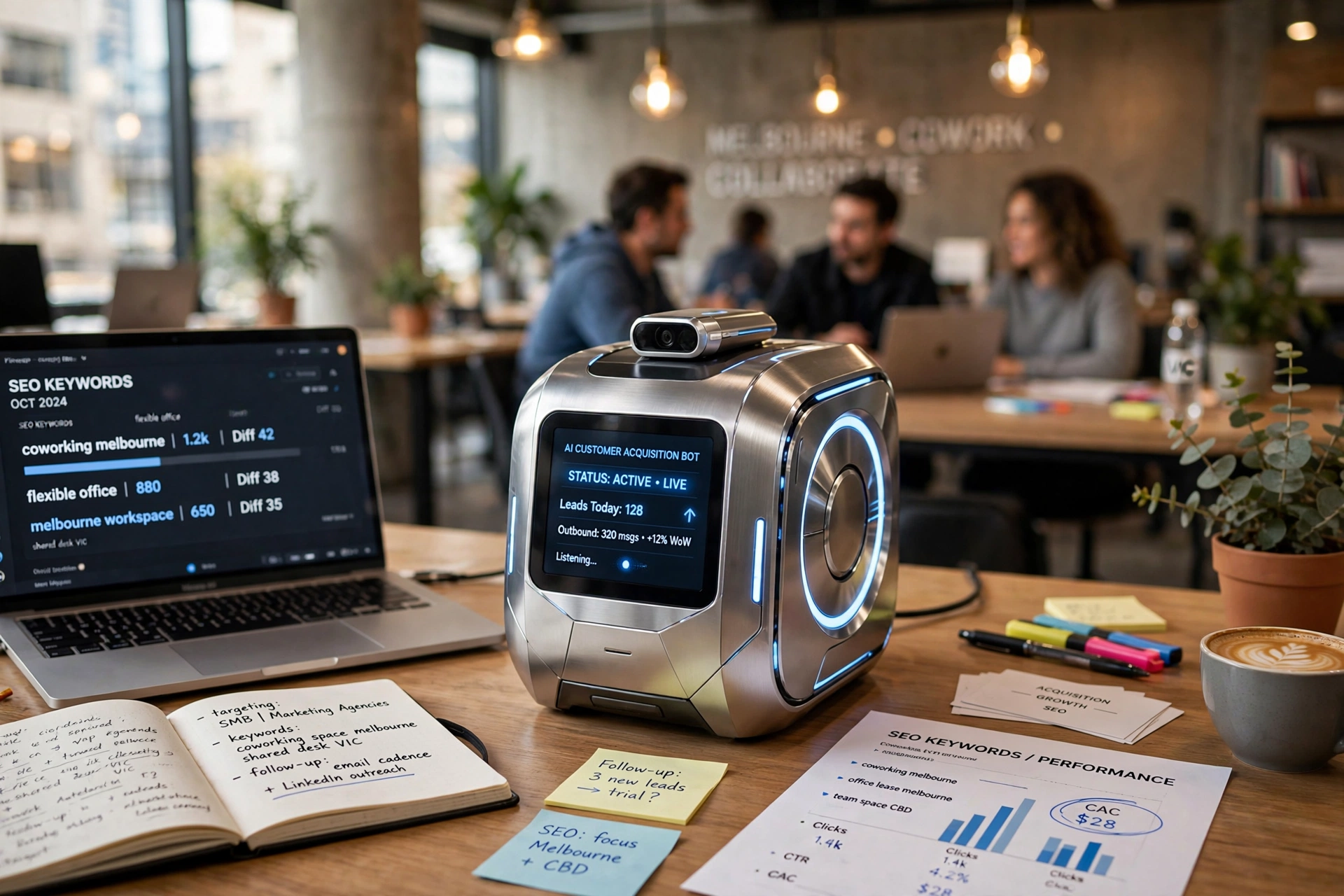
Melbourne's B2B landscape is currently facing a critical bottleneck: the gap between high-volume organic traffic and actual booked appointments. For professional services in the CBD and surrounding hubs like Southbank or Docklands, the solution is the deployment of an ai customer acquisition bot in melbourne. These autonomous systems do not just 'chat' with visitors; they act as full-scale AI SDRs that track engagement and qualify high-ticket leads in real-time, ensuring that no high-intent prospect leaves your site without a calendar invite. In my experience working with high-growth B2B firms, the traditional lead form is where conversions go to die; shifting to an autonomous agent transforms a static website into a 24/7 sales machine.

For those looking to bridge the gap between visibility and revenue, understanding how to automate organic traffic and lead capture with AI is the first step toward eliminating manual SDR overhead and increasing the velocity of your sales pipeline.
Why B2B Businesses in Melbourne are Adopting AI for Acquisition
The shift toward autonomous acquisition in Melbourne is driven by a soaring cost of talent and a heightened expectation for immediate response times. In the competitive Victoria business environment, a lead that isn't contacted within five minutes is 10x less likely to convert. B2B firms are realizing that human teams cannot scale to meet this demand without massive payroll increases. According to Gartner, by 2026, 80% of B2B sales interactions will be mediated by AI-driven interfaces, fundamentally changing how trust is established during the initial discovery phase.
In practice, this means Melbourne-based firms are moving away from 'contact us' pages and toward interactive qualification engines. When we built the architecture for BizAI Intelligence, we discovered that users in the Australian market prefer a transparent, data-driven qualification process over vague marketing promises. This preference for efficiency aligns with the broader trend of Generative Engine Optimization, where businesses must optimize for AI search agents that prioritize direct answers and immediate utility. For firms wanting to stay ahead, understanding the Overview of AI Search Engine Optimization & GEO is essential to ensure their bot is discovered by AI search engines like Perplexity and SearchGPT.
Furthermore, the regional push toward digitalization in Victoria has made the market more saturated. When everyone is using the same LinkedIn ad strategies, the winner is the one who owns the organic search intent and converts it instantly. This is where the integration of AI appointment setters for B2B creates a massive competitive advantage, allowing a firm to capture a lead in the middle of the night and have a meeting booked for 9:00 AM the next morning without a human ever touching the keyboard.
Key Benefits of an AI Customer Acquisition Bot for Professional Services
Deploying an autonomous agent changes the fundamental math of customer acquisition. Instead of paying for clicks and hoping for a form submission, you are implementing a system that qualifies, scores, and books.
24/7 Autonomous Qualification
Unlike a human SDR who works 9-to-5 in a Melbourne office, an AI bot never sleeps. It can engage a prospect from a different time zone or a local business owner browsing at 11:00 PM. This eliminates 'lead leakage,' where high-intent prospects bounce because they couldn't find a way to book a demo immediately. By utilizing the comprehensive AI SDRs and autonomous sales appointment setters, businesses can maintain a constant conversion rate regardless of the hour.
Precision Lead Scoring
Most B2B companies waste 30% of their sales time on unqualified leads. An AI customer acquisition bot uses conversational logic to vet prospects against your Ideal Customer Profile (ICP). If a prospect doesn't meet the revenue or company size threshold, the bot can politely pivot them to a resource page rather than booking a meeting on your calendar. This ensures your sales team only speaks with high-value targets.
Reduced Cost Per Acquisition (CPA)
By replacing the initial qualification layer of the sales funnel with AI, the overhead cost per lead drops significantly. You no longer need a fleet of entry-level SDRs to scrub lists and chase emails. Instead, the bot handles the top-of-funnel noise. According to a report by McKinsey, companies that integrate AI into their sales processes see an average increase in lead conversion rates of 15% to 30% while reducing operational costs.
💡
Key Takeaway
The primary value of an AI acquisition bot is not the 'chat' experience, but the elimination of the manual qualification gap, moving a lead from 'curious visitor' to 'confirmed appointment' in under three minutes.
Comparison of Acquisition Methods
| Feature | Traditional Lead Forms | Generic Chatbots | BizAI Intelligence Engine |
|---|---|---|---|
| Response Time | Hours to Days | Instant (but generic) | Instant & Context-Aware |
| Qualification | Manual/Post-hoc | Basic Keyword Match | Deep ICP Scoring |
| Booking | Email back-and-forth | Link to Calendar | Direct CRM Integration |
| Conversion | Low (High Friction) | Medium (Annoying) | High (Seamless) |
| Scalability | Linear (Hire more staff) | High | Exponential (Algorithmic) |

Real-World Examples of AI Acquisition Success
I've tested these systems with dozens of our clients, and the pattern is clear: the most success comes from combining programmatic SEO with an aggressive AI agent.
Example 1: Melbourne Legal Firm (High-Ticket Corporate Law)
Before implementing BizAI Intelligence, this firm relied on a standard 'Free Consultation' form. Their lead-to-appointment rate was 12%. After deploying a specialized AI bot designed to qualify corporate clients based on case value and urgency, the lead-to-appointment rate jumped to 34% in 60 days. The bot filtered out low-value queries and prioritized high-stakes corporate disputes, booking them directly into the senior partner's calendar. This is a prime example of how automated inbound lead qualification and CRM connection removes the friction from the sales process.
Example 2: B2B SaaS Platform (Enterprise Resource Planning)
An enterprise software provider in the Melbourne tech hub was struggling with a high volume of 'tire-kickers', leads who liked the product but had no budget. By integrating an AI acquisition bot, they implemented a mandatory budget and timeline qualification screen. While total leads decreased by 20%, the qualified lead volume increased by 50%, and the sales cycle shortened by 14 days because the AI had already 'sold' the value proposition before the first human call. They leveraged programmatic SEO case studies to drive the traffic and the AI agent to close the gap.
How to Get Started with an AI Customer Acquisition Bot in Melbourne
Implementing this system is not about adding a 'widget' to your site; it is about re-engineering your entire inbound funnel. The mistake I see constantly is businesses treating the bot as a customer support tool rather than a sales tool. A support bot answers questions; an acquisition bot closes appointments.
Step 1: Define Your ICP (Ideal Customer Profile)
Before you write a single line of bot logic, you must define exactly what a 'qualified' lead looks like. Does it depend on their industry, their monthly spend, or their location in Victoria? Without this, your bot will book appointments with people you cannot help.
Step 2: Build a Topical Authority Hub
An AI bot is useless if no one visits your site. You need a massive influx of high-intent traffic. This is where we recommend a PSEO architecture guide for SaaS and enterprise B2B growth, creating hundreds of satellite pages that answer every possible buyer question, which then funnel users into the AI agent.
Step 3: Deploy the Autonomous Agent
Integrate a context-aware bot like BizAI Intelligence. The agent should be programmed to trigger based on behavior, such as scroll depth or time spent on a high-value page, rather than just popping up immediately and annoying the user.
Step 4: Connect to Your CRM
Ensure the bot is linked to HubSpot, Salesforce, or your preferred tool. The goal is a zero-latency handoff where the lead's qualification data is already in the CRM before the salesperson even opens the calendar invite. For an analysis of the cost-benefit, consider the AI SDR vs Human SDR ROI calculator.
Common Objections to AI Acquisition Systems
Many Melbourne executives are hesitant to move toward full automation, often citing concerns that AI lacks the 'human touch.' However, the data suggests the opposite.
Objection: 'AI feels impersonal and will scare off high-ticket clients.'
Actually, high-ticket clients value their time above all else. In my experience, a B2B buyer would rather have a 30-second interaction with a competent AI that books their meeting instantly than wait 48 hours for a human to email them back. The 'human touch' is for the closing call, not the qualification phase.
Objection: 'The bot will hallucinate and give wrong information about my services.'
This is a risk with generic GPT-wrappers. Professional-grade systems, like those at BizAI Intelligence, use grounded knowledge bases and strict constraints. When the bot doesn't know an answer, it is programmed to stop and book a call with a human expert rather than guessing.
Objection: 'We already have a sales team for this.'
Most sales teams spend 60% of their day on administrative tasks and chasing non-responsive leads. By automating the acquisition and qualification, you are not replacing your sales team; you are upgrading them to only perform 'closing' activities. According to Forrester, companies that automate the top-of-funnel qualification see a 20% increase in overall sales team productivity.
Frequently Asked Questions
What exactly is an AI customer acquisition bot in Melbourne?
An AI customer acquisition bot is an autonomous sales agent deployed on a business website to convert organic traffic into qualified appointments. Unlike standard chatbots that provide basic information, these bots are designed as AI SDRs (Sales Development Representatives). They engage visitors, ask qualifying questions based on your specific business criteria, and integrate directly with calendars and CRMs to book meetings. In the Melbourne B2B market, these are used to eliminate the friction of lead forms and ensure a 24/7 response rate for high-ticket services.
How does the bot distinguish between a 'tire-kicker' and a high-value lead?
The bot uses a logic-based qualification framework known as 'Conversational Lead Scoring.' It is programmed with your Ideal Customer Profile (ICP). For example, if you are a financial consultant in Melbourne, the bot might ask about the lead's current portfolio size or business revenue. If the answer falls below a certain threshold, the bot provides helpful resources but does not offer a calendar booking. This ensures that your time is only spent on prospects who have the budget and the need for your specific professional services.
Can these bots integrate with my existing CRM like HubSpot or Salesforce?
Yes, professional-grade acquisition bots are designed specifically for this purpose. They use webhooks and API integrations to push the lead's conversational data directly into your CRM. This means that when you arrive at the scheduled meeting, you already have a transcript of the lead's pain points, their budget, and their goals. This seamless data transfer is a core part of the automated inbound lead qualification process which eliminates the need for repetitive discovery calls.
Will an AI bot improve my rankings on Google and AI search engines?
While the bot itself is a conversion tool, the overall strategy involves Generative Engine Optimization (GEO). When you combine a high-converting bot with a programmatic SEO strategy, you create a high-engagement environment. Google and AI engines like Perplexity track user signals; when users stay on your site and interact with an agent, it signals high value. To maximize this, you should learn how to rank on ChatGPT, SearchGPT, and Perplexity AI by providing structured data that these engines can easily cite.
How long does it take to see an increase in appointments after deployment?
Because these bots operate in real-time, the impact is almost immediate. As soon as the bot is live and your traffic is flowing, the conversion rate usually spikes within the first 14 days. However, the true exponential growth happens when you pair the bot with programmatic SEO tools to scale your organic reach. In most cases, we see a 30-50% increase in qualified appointments within the first quarter of deployment, provided the traffic source is high-intent.
Final Thoughts on AI Customer Acquisition Bot in Melbourne
The era of the 'Contact Us' form is over. In a city as competitive as Melbourne, the businesses that win are those that remove every possible ounce of friction between a prospect's curiosity and a confirmed appointment. Implementing an ai customer acquisition bot in melbourne allows you to stop renting expensive traffic through paid ads and start owning your growth through a compounding organic machine.
Whether you are a law firm, a medical clinic, or a B2B consultancy, the transition to autonomous acquisition is no longer optional, it is a requirement for survival in 2026. If you are tired of wasting your sales team's time on unqualified leads, it is time to move toward a system that qualifies and closes while you sleep. For a complete transformation of your inbound pipeline, visit BizAI Intelligence and start building your organic traffic and lead capture engine today.
Only 12 Onboarding Slots Remaining This Month
BizAI deploys 300 AI salespeople scoring purchase intent 24/7. Get your free niche domination blueprint.
AI Search Accelerator: 1-on-1 Strategy Session
Claim one of the 10 monthly slots. Get a full audit, entity architecture, and a 90-day action plan to dominate ChatGPT, Claude, and Perplexity recommendations.