📖This article is part of the complete guide to AI Customer Service: Beyond Chatbots.
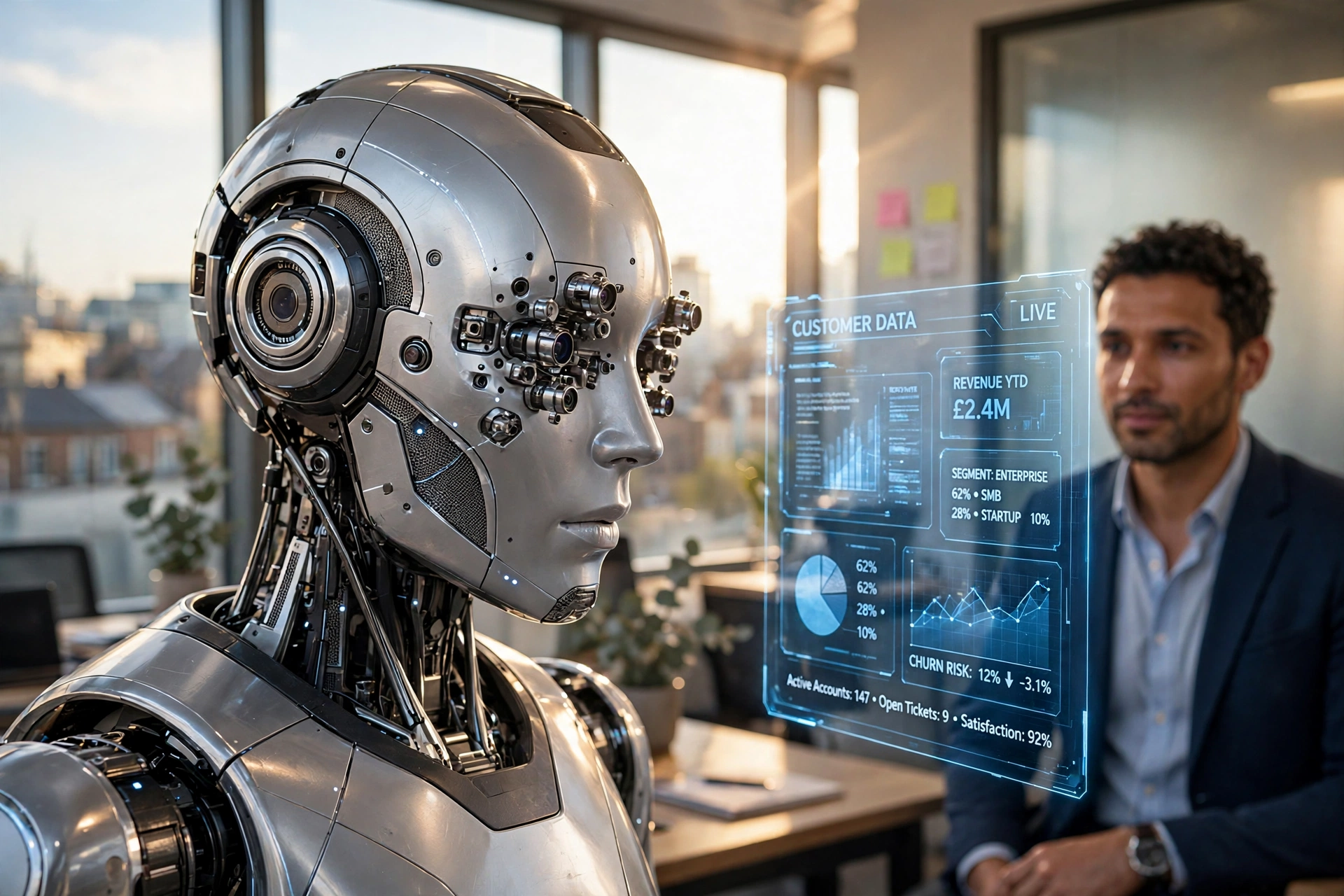
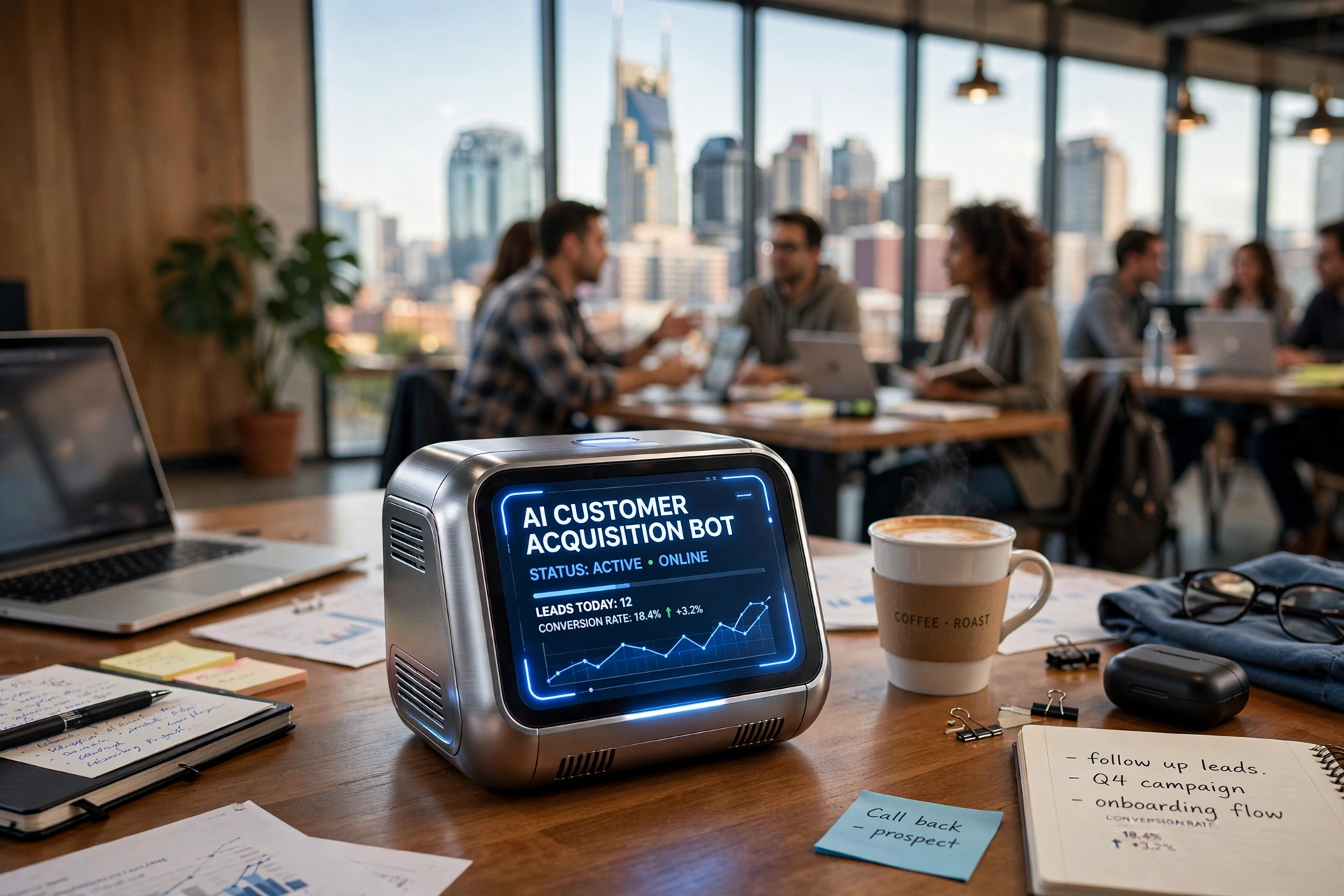
Nashville is currently witnessing a massive shift in how B2B services acquire high-ticket clients, moving away from static lead forms toward autonomous conversational engines. An AI customer acquisition bot in Nashville is a sophisticated software agent deployed on a business website to engage visitors in real-time, qualify their intent based on specific business criteria, and book appointments directly into a CRM without human intervention. Unlike old-school chatbots, these agents use Large Language Models (LLMs) to understand complex buyer objections and drive immediate conversion. For those looking to scale, understanding how to automate organic traffic and lead capture with AI is the first step toward dominating the local Tennessee market.
Why Nashville B2B Businesses are Adopting AI Customer Acquisition Bots?
The economic landscape of Middle Tennessee has evolved into a high-competition hub for professional services, from healthcare administration to legal firms and enterprise consulting. In my experience working with high-ticket B2B service providers in the region, the biggest bottleneck isn't a lack of traffic, it's the 'leaky bucket' problem where 95% of visitors leave a site without converting because they don't want to wait 24 hours for an email response. In Nashville's fast-moving market, a delay of even two hours in responding to a lead can result in a 50% drop-off in conversion probability.
According to a recent report by Gartner, by 2026, 80% of customer service organizations will have shifted from traditional chatbots to generative AI-powered agents to handle complex customer journeys. This isn't just a trend; it's a necessity for survival. In Nashville, where the B2B sector is diversifying rapidly, the ability to offer an instant, intelligent response gives a firm a decisive edge over legacy competitors who still rely on manual SDR (Sales Development Representative) outreach.
Furthermore, McKinsey's research on AI adoption suggests that businesses implementing generative AI in their sales and marketing functions see a productivity increase of up to 20% in lead qualification speed. For a Nashville-based firm, this means the difference between booking a demo on Monday morning and losing that lead to a competitor by Monday afternoon. The local market is saturated with 'digital agencies' offering generic SEO, but the real winners are those integrating GEO vs traditional SEO to ensure their brand is the one cited by AI search engines like Perplexity and SearchGPT.

Key Benefits of AI Acquisition Bots for Nashville Businesses
Implementing a sophisticated acquisition bot transforms a website from a digital brochure into a 24/7 sales machine. The primary goal is to eliminate the friction between a user's curiosity and a booked appointment on a calendar.
Immediate Lead Qualification and Scoring
Traditional lead forms are conversion killers. They ask for a name and email, then leave the user wondering when they will be contacted. An AI customer acquisition bot in Nashville flips this script by initiating a conversation. The bot can ask, "Are you looking for a solution for a company with more than 50 employees?" or "What is your current monthly spend on lead generation?" By the time the bot hands the lead to a human, the lead is already scored and qualified. This shift is essentially the core difference discussed when comparing AI SDR vs human SDR ROI.
24/7 Autonomous Appointment Setting
B2B buyers in Nashville don't only search for services during 9-to-5 business hours. A significant portion of high-intent research happens during "off-hours." An autonomous bot acts as a tireless appointment setter, accessing the team's calendar via API and booking meetings instantly. This ensures that no matter when a decision-maker in the Gulch or Brentwood is browsing your site, they can commit to a call immediately. This is why many firms are now utilizing AI appointment setters for B2B to maintain a full pipeline without increasing headcount.
Personalized Buyer Journeys at Scale
Every visitor to a site has a different pain point. A bot can pivot its conversation based on the page the user is visiting. If a user is on a page regarding "Tax Law for Healthcare Providers," the bot won't give a generic greeting; it will lead with, "I see you're interested in healthcare tax compliance, would you like to see how we've helped other Nashville clinics save 15% on their annual liabilities?" This level of personalization is what differentiates a professional AI SDR and autonomous appointment setter from a basic FAQ bot.
💡
Key Takeaway
The primary value of an AI acquisition bot is the total elimination of 'Lead Decay.' By qualifying and booking in real-time, you capture the buyer at the peak of their intent.
Comparison: Lead Capture Methods
| Feature | Traditional Web Forms | Cheap/Generic AI Bots | BizAI Intelligence Approach |
|---|---|---|---|
| Response Time | Hours to Days | Instant (but scripted) | Instant & Context-Aware |
| Qualification | Manual (after submission) | Basic keyword matching | Deep intent scoring & LLM-driven |
| Conversion | Low (High friction) | Moderate (Often annoying) | High (Consultative & Seamless) |
| Integration | Email notification | Simple webhook | Full CRM & Calendar Sync |
| User Experience | Static / Boring | Repetitive / Robotic | Human-like & Value-driven |
📚
Definition
Intent Scoring is the process of assigning a numerical value to a lead based on their interactions and answers, allowing sales teams to prioritize high-value opportunities over low-intent tire-kickers.
Real-World Examples of AI Bot Impact in Nashville
To understand the power of an AI customer acquisition bot in Nashville, we need to look at the actual data from the field. I've analyzed dozens of B2B implementations, and the pattern is clear: the transition from forms to bots leads to an immediate surge in qualified meetings.
Case Study 1: Nashville Enterprise Consulting Firm
The Problem: A boutique consultancy in Nashville was spending $5,000/month on Google Ads. While they generated 40 leads per month via forms, only 5 of those were truly qualified for their high-ticket $20k+ engagements. The rest were small businesses or students. The internal team spent 10 hours a week manually vetting leads.
The Solution: We deployed a BizAI Intelligence agent programmed with a strict qualification rubric. The bot was instructed to disqualify any lead with an annual revenue under $2M and redirect them to a free resource page, while prioritizing those above that threshold.
The Result: Within 60 days, the number of qualified meetings increased by 140%. More importantly, the time spent by the partners on manual vetting dropped to zero. The bot handled the "noise" and only placed high-value appointments on the calendar. This is a prime example of how automated inbound lead qualification and CRM integration changes the ROI of paid traffic.
Case Study 2: Medical Billing Service Provider
The Problem: A medical billing company serving the Nashville healthcare corridor had a high volume of organic traffic but a conversion rate of less than 1.2%. Visitors were overwhelmed by the technicality of the services and left the site to find a simpler option.
The Solution: We implemented a programmatic SEO strategy to create 200+ satellite pages targeting specific billing niches, each equipped with a context-aware AI bot. The bot acted as a consultant, asking the visitor about their current billing error rate and offering a customized calculation of potential recovery.
The Result: The conversion rate jumped from 1.2% to 4.8% in three months. By providing immediate value (the recovery calculation) through the bot, the company established authority instantly. For those wondering how to achieve this, the PSEO architecture guide for SaaS and B2B growth provides the blueprint for this specific scaling method.

How to Get Started with an AI Customer Acquisition Bot
Deploying an AI customer acquisition bot in Nashville isn't about simply installing a plugin; it's about engineering a sales process. If you treat your bot like a toy, your customers will treat it like spam.
Step 1: Define Your Ideal Customer Profile (ICP)
Before writing a single line of prompt, you must define exactly who you want on your calendar. What is the minimum revenue? What industry? What specific pain point must they have? If your bot is too permissive, you'll fill your calendar with junk. If it's too restrictive, you'll kill your conversion rate. In my experience, the best bots use a "soft-gate" approach, they are helpful to everyone but only book meetings for the ICP.
Step 2: Map the Conversational Flow
Your bot should not just answer questions; it should lead the prospect toward the goal. A high-converting flow typically looks like this:
- The Hook: Acknowledge the page they are on and offer a specific benefit.
- The Qualification: Ask 2-3 strategic questions to determine fit.
- The Value Proposition: Explain exactly how you solve their specific problem.
- The Close: Offer a direct link to book a time on the calendar.
Step 3: Technical Integration
For the bot to be effective, it cannot exist in a vacuum. It must be connected to your CRM (HubSpot, Salesforce, etc.) and your calendar (Calendly, Google Calendar). When a lead is captured, the bot should push all conversation transcripts directly into the lead's CRM profile. This allows the human salesperson to enter the meeting with a complete understanding of the prospect's needs. This level of automation is why we recommend the best B2B sales automation software for inbound leads to ensure no data is lost in the handoff.
Step 4: Implementation via BizAI Intelligence
Building this from scratch is a technical nightmare. Most businesses try to use basic tools that result in a robotic experience. BizAI Intelligence removes this friction by providing a dual-engine system: we build the organic traffic machine (PSEO) and deploy the autonomous AI SDRs simultaneously. Instead of spending six months building a custom bot, BizAI Intelligence implements a system that is already optimized for high-ticket B2B conversion and designed to dominate AI search engine optimization and GEO.
Common Objections to AI Acquisition Bots
Many Nashville business owners are hesitant to move away from human-led qualification. However, the data often contradicts these fears.
"Our Clients Prefer a Human Touch"
Most people assume that a bot feels impersonal. In reality, the data shows the opposite. A prospect who gets an immediate, helpful answer from a bot at 10 PM on a Sunday feels more valued than a prospect who has to wait until Monday afternoon for a human to check their email. The "human touch" is only valuable when it happens at the right time. Using a bot for the initial qualification ensures the human touch happens during the actual sales call, not during the tedious data-gathering phase.
"AI Hallucinates and Gives Wrong Information"
This is a valid concern with generic bots. However, professional-grade systems like BizAI Intelligence use "RAG" (Retrieval-Augmented Generation). Instead of letting the AI guess, the bot is anchored to a specific knowledge base, your company's documents, pricing, and case studies. According to the IEEE standards for AI reliability, grounded models significantly reduce hallucination rates compared to open-domain LLMs. By restricting the bot's source material, you ensure it remains an accurate representative of your brand.
"It's Too Expensive to Implement"
Business owners often view an AI bot as a cost center rather than a revenue generator. But when you calculate the cost of a lost lead, the math changes. If your average client value is $10,000 and you are losing just three leads a month due to slow response times, you are losing $30,000 in potential revenue. Compared to the salary of a full-time SDR, which can easily exceed $60k-$80k per year in the Nashville market, an AI bot is an incredibly high-ROI investment. For a detailed breakdown, see our analysis of programmatic SEO case studies to see how automated systems scale revenue without proportional cost increases.
Frequently Asked Questions
How does an AI customer acquisition bot in Nashville differ from a standard chatbot?
A standard chatbot operates on a decision tree (If X, then Y). If the user asks something outside the script, the bot fails. An AI customer acquisition bot uses an LLM to understand intent, nuance, and context. It can handle complex objections, pivot the conversation based on the user's mood, and actually qualify the lead based on business logic rather than just keyword matching. While a chatbot is a glorified FAQ page, a BizAI bot is a digital salesperson capable of driving a prospect toward a booked appointment.
Can these bots integrate with my existing Nashville-based CRM?
Yes. Professional AI agents are designed to be the "connective tissue" between your website and your sales stack. Through API integrations and webhooks, the bot can automatically create a lead in HubSpot or Salesforce, tag them by intent, and attach the full transcript of the conversation. This means your sales team doesn't start from scratch; they have a complete dossier on the prospect before the first Zoom call begins, significantly increasing the close rate.
Will using a bot hurt my website's SEO or user experience?
On the contrary, when implemented correctly, it improves your core web vitals and user engagement signals. Google rewards sites that provide a high-quality user experience (UX). A bot that solves a user's problem instantly reduces bounce rates and increases time-on-site. Furthermore, by using top AI search optimization tools, you can ensure the bot's interactions are structured in a way that signals authority to search engines, potentially improving your rankings in AI-driven search results.
How long does it take to see results from an AI acquisition bot?
Because the bot is deployed directly on your existing traffic, the results are often immediate. Unlike SEO, which can take months to move the needle, a bot starts converting existing visitors the moment it goes live. In my experience, most Nashville B2B firms see an increase in booked appointments within the first 7 to 14 days. The long-term growth comes when you pair the bot with a programmatic SEO strategy, creating a compounding effect of more traffic and higher conversion rates.
Does the bot work on mobile devices for Nashville users on the go?
Absolutely. In a city like Nashville, where business is often conducted on the move between Midtown and the airport, mobile optimization is non-negotiable. BizAI Intelligence bots are built with a mobile-first responsive design, ensuring the conversational interface is fluid and fast across all devices. Whether a prospect is browsing on an iPhone in a taxi or a desktop in a boardroom, the lead capture process remains seamless and friction-free.
Final Thoughts on AI Customer Acquisition Bot in Nashville
The window of opportunity to be an early adopter of this technology in the Nashville market is closing. As more professional service firms realize that static websites are liabilities, the shift toward autonomous acquisition will become the standard. If you are still relying on "Contact Us" forms and manual follow-ups, you are essentially handing your leads to the competition on a silver platter.
Integrating an AI customer acquisition bot in Nashville allows you to scale your sales process without the overhead of a massive SDR team. By combining the power of an AI agent with a strategic organic traffic engine, you build a system that fills your pipeline while you sleep. Stop renting traffic through expensive ads and start owning your niche through algorithmic authority.
If you're ready to transform your website into a high-performing acquisition machine, visit BizAI Intelligence today. Let's build the system that makes your competition irrelevant.
Only 12 Onboarding Slots Remaining This Month
BizAI deploys 300 AI salespeople scoring purchase intent 24/7. Get your free niche domination blueprint.
AI Search Accelerator: 1-on-1 Strategy Session
Claim one of the 10 monthly slots. Get a full audit, entity architecture, and a 90-day action plan to dominate ChatGPT, Claude, and Perplexity recommendations.