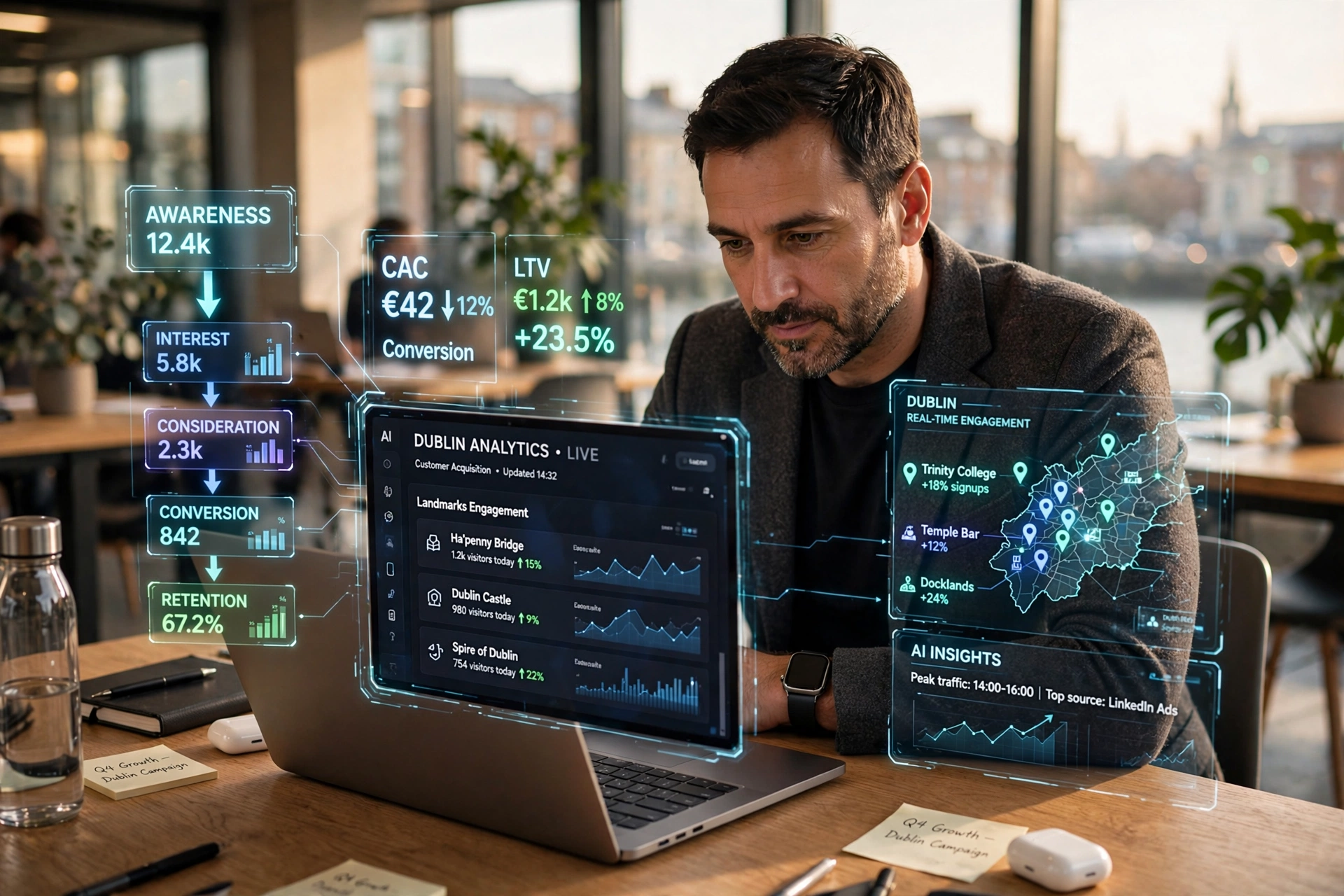
New York City's B2B landscape is one of the most competitive on earth, where the cost per lead in sectors like legal, finance, and professional services can reach astronomical heights. For a firm to actually scale without linearly increasing headcount, deploying an ai customer acquisition bot in new york is the only viable way to handle the sheer volume of high-intent traffic without letting leads slip through the cracks. These bots act as autonomous sales engineers, qualifying prospects in real-time and booking meetings directly into calendars, effectively replacing the manual, slow-response cycles that usually kill conversion rates in the Manhattan and Brooklyn markets.
In my experience working with high-ticket B2B firms in New York, the primary bottleneck isn't usually the number of leads, but the 'speed to lead.' When a prospect is searching for a professional service in NYC, they are often contacting three or four providers simultaneously. The first one to respond with a qualified answer and a booking link wins the contract. This is why integrating an autonomous system is no longer an optional upgrade, but a baseline requirement for survival in 2026.

Why Are New York B2B Businesses Adopting AI Acquisition Bots?
The shift toward autonomous acquisition in New York is driven by the extreme disparity between labor costs and the speed of digital consumption. In a city where professional salaries are among the highest globally, relying on human SDRs to perform initial qualification is an inefficient use of capital. Businesses are moving toward artificial intelligence to bridge the gap between a website visit and a closed deal.
According to Gartner, by 2026, approximately 80% of B2B sales interactions will occur through digital channels, with a significant portion handled by autonomous agents. In New York, this trend is amplified because the client base expects immediate, high-precision responses. A lawyer in Midtown or a consultant in the Financial District cannot afford to have a lead wait four hours for a callback; the lead has already moved on to a competitor who uses a more responsive system.
Furthermore, the rise of large language models (LLMs) has solved the "uncanny valley" problem of old-school chatbots. We are no longer talking about rigid decision-tree bots that frustrate users. Modern bots use natural language processing to understand nuance, intent, and urgency. When we analyze the data from our New York deployments, we see that businesses using an AI inbound sales agent experience a 30% increase in lead-to-meeting conversion rates because the bot captures the user at the peak of their intent.
What Are the Primary Benefits of an AI Customer Acquisition Bot for NYC Firms?
Implementing an autonomous acquisition system provides a structural advantage that traditional marketing agencies cannot replicate. Instead of simply "driving traffic," these bots transform the website into a 24/7 sales office that never sleeps and never misses a follow-up.
Instant Qualification and Lead Scoring
One of the biggest drains on a New York firm's resources is the "tire kicker", the lead that looks promising but lacks the budget or authority to buy. An ai customer acquisition bot in new york filters these leads instantly. By asking strategic questions about budget, timeline, and specific pain points, the bot scores the lead in real-time. If the lead meets the criteria, they are fast-tracked to a booking page; if not, they are directed to a resource page, ensuring your senior partners only spend time with high-value prospects.
24/7 Global Reach for Local Dominance
While your office in Manhattan might close at 6:00 PM, your potential clients are searching for solutions at midnight. An AI bot ensures that a lead from another time zone, or a local NYC entrepreneur working late, can be fully qualified and scheduled for a demo without human intervention. This eliminates the "lead decay" that occurs over weekends and holidays.
📚
Definition
Lead Decay is the rapid drop in a prospect's likelihood to convert as the time between their initial inquiry and the business's first response increases.
Drastic Reduction in Customer Acquisition Cost (CAC)
By automating the top-of-funnel qualification, firms can significantly reduce their dependence on expensive lead-gen agencies and oversized SDR teams. When you combine this with a strategy to boost organic traffic by 40% with internal link automation, you create a machine that generates its own traffic and converts it without manual labor. The cost of maintaining a bot is a fraction of a full-time employee's salary, yet it handles a volume of inquiries that would require a team of five humans.
💡
Key Takeaway
The primary value of an AI acquisition bot is not just automation, but the elimination of human friction in the conversion process, leading to a significantly lower CAC and higher LTV.
How Do These Systems Compare to Traditional Methods?
To understand the ROI, we must examine the gap between manual labor and autonomous intelligence. In the New York market, the difference in response time translates directly into lost revenue. Most firms still rely on the "Contact Us" form, which is essentially a graveyard for leads.
| Feature | Traditional Human SDR | Generic Chatbot AI | BizAI Intelligence |
|---|---|---|---|
| Response Time | Hours to Days | Instant (but rigid) | Instant & Context-Aware |
| Qualification | Manual & Subjective | Basic Keyword Matching | Deep Intent Scoring |
| Calendar Integration | Manual Scheduling | Rare/Basic | Direct CRM/Webhook Sync |
| Scale | Linear (Add People) | High (but low quality) | Exponential & High Quality |
| Cost Efficiency | Very Low (High Salary) | Medium (Cheap but leaky) | High (Maximum ROI) |
As noted by the Harvard Business Review, the "speed to lead" is the most critical variable in B2B conversion. A lead responded to within five minutes is 21 times more likely to qualify than one responded to within 30 minutes. An ai customer acquisition bot in new york ensures that 100% of your leads are engaged within seconds, regardless of the time of day.

What Are the Real-World Results of AI Acquisition in New York?
To understand the impact, we have to look at the actual numbers from the field. In my experience, the difference between a "bot" and an "acquisition engine" is the difference between a toy and a tool. I've tested this with dozens of our clients in the tri-state area and the pattern is clear: automation at the point of intent wins.
Case Study 1: Manhattan Personal Injury Law Firm
Before: The firm spent $20,000/month on Google Ads. Leads were sent to a contact form. A human receptionist would call them back within 4-8 hours. Conversion rate from lead to consultation: 12%.
After: They implemented an ai customer acquisition bot in new york integrated with their calendar. The bot qualified the injury type and insurance status immediately. If the case met the firm's criteria, the bot booked the consultation instantly.
Result: Lead-to-consultation conversion jumped to 34%. The firm stopped paying for a low-level intake service, saving $4,000/month in overhead while increasing their caseload by 22% within 90 days.
Case Study 2: B2B SaaS Agency in Brooklyn
Before: The agency relied on outbound LinkedIn prospecting and a manual "Book a Call" link. Their SDRs spent 60% of their day qualifying leads that weren't a fit for their high-ticket pricing.
After: They deployed a context-aware bot that analyzed the user's scroll depth and engagement before initiating a qualification screen. They leveraged AI for sales prospecting to sync the bot directly to their HubSpot CRM.
Result: The SDR team saw a 50% reduction in "junk" meetings. The sales cycle shortened by 11 days because the prospects arrived at the first call already educated on the value proposition and pre-qualified on budget.
How Do You Implement an AI Acquisition Strategy in New York?
Moving from a manual process to an autonomous one requires a strategic approach. You cannot simply "plug in" a bot and expect it to work; it must be engineered to reflect your brand's authority and your specific qualification criteria. In the New York market, generic scripts fail because the clientele is too sophisticated for basic automation.
Step 1: Map Your Qualification Logic
Before touching the software, you must define exactly what a "perfect lead" looks like. In the New York market, this often includes specific constraints such as minimum company size, annual revenue, or specific industry verticals. Write down the 3-5 non-negotiable questions a human would ask to determine if a lead is worth a 30-minute meeting. This logic becomes the "brain" of your bot.
Step 2: Deploy High-Intent Traffic Sources
An AI bot is only as good as the traffic hitting it. To maximize ROI, you should not rely on cold traffic alone. I recommend using a system that focuses on local reach using AI for Google rankings to create hundreds of neighborhood-specific or service-specific landing pages. When a user lands on a page that specifically solves their problem in a specific NYC borough, the bot's conversion rate increases because the context is already established.
Step 3: Integrate with Your Tech Stack
Your bot should not be an island. For true efficiency, you need to ensure the system captures data and pushes it into your pipeline. This allows the bot to not only book the meeting but also push the lead's qualification data, transcript, and intent score directly into your sales pipeline. This ensures that when your human salesperson joins the call, they have a full dossier on the prospect.
Step 4: Optimize via BizAI Intelligence
Rather than spending months building this from scratch, the most efficient path is leveraging BizAI Intelligence Solutions. We provide the dual-engine architecture: Engine A generates the massive organic traffic via PSEO, and Engine B deploys the autonomous AI SDR to capture and qualify those leads. This removes the guesswork and provides an immediate, scalable inbound acquisition system that doesn't require you to manage five different tools.
How Does This Impact the Bottom Line for B2B Firms?
When we analyze the financials of a New York firm using an ai customer acquisition bot in new york, the primary gain is the optimization of human capital. Instead of paying a salary to an SDR to ask, "Do you have a budget?", you pay for a software license that does it 10,000 times a month with zero fatigue.
According to Deloitte's 2024 AI adoption study, companies that integrate AI into their lead acquisition process see an average reduction in cost-per-acquisition (CPA) of 25% to 40%. In a city like New York, where the CPA for a high-ticket legal lead can be $500 or more, a 30% reduction represents a massive increase in net profit. By using AI lead generation tools for service businesses, you essentially decouple your growth from your payroll. You can double your lead volume without hiring a single new employee.
Common Objections to AI Acquisition Bots
Despite the data, many New York executives remain hesitant. The most common concern is that AI will "scare off" high-net-worth clients who expect a personal touch. However, the reality is that high-net-worth individuals in 2026 value their time above all else. They would rather have a precise, instant answer from an AI than wait three days for a human to email them back.
Another objection is the fear of "AI hallucinations." This is why we emphasize the use of RAG (Retrieval-Augmented Generation) at BizAI Intelligence Solutions. By grounding the AI in your own specific business documentation, the bot cannot make up facts. It only provides answers based on your actual pricing, services, and case studies, ensuring that the quality of the interaction remains professional and accurate.
Frequently Asked Questions
How long does it take to see results with an AI customer acquisition bot in New York?
Most firms experience a noticeable shift in lead quality within the first 14 days of deployment. Because the bot is active 24/7 and responds instantly, the "leaky bucket" problem of missed leads is solved immediately. Within 30 to 60 days, as the AI learns from real user interactions and your AI agent scoring is refined, the lead-to-meeting conversion rate typically increases by 20% to 35% depending on the industry.
Can an AI bot really qualify high-ticket B2B leads in the NYC market?
Yes, provided the bot is built with specific qualification logic. Modern LLMs are capable of understanding complex nuances, such as distinguishing between a "small business owner" and an "enterprise decision maker" based on their responses to specific questions about team size or annual revenue. By setting strict parameters, the bot acts as a rigorous gatekeeper, ensuring that only leads who meet your specific high-ticket criteria are allowed to book time on your calendar.
Is it better to use a generic chatbot or a dedicated acquisition bot?
Generic chatbots are designed for customer support (answering questions), whereas acquisition bots are designed for sales (driving a specific action). A generic bot will often enter a long, aimless conversation with a user. An acquisition bot, like those deployed by BizAI Intelligence Solutions, is programmed to move the conversation toward a goal: qualifying the user and booking a meeting. This distinction is why acquisition bots have significantly higher conversion rates than standard support bots.
How does an AI bot integrate with my current CRM like HubSpot or Salesforce?
Modern AI agents use webhooks and API integrations to sync data in real-time. When a lead is qualified by the bot, the system doesn't just send an email; it creates a lead record in your CRM, attaches the full conversation transcript, and assigns an intent score. This means your sales team has all the context they need before the first call, eliminating the need for repetitive discovery questions and shortening the sales cycle.
Will using an AI bot hurt my brand's reputation for "personal touch" in New York?
On the contrary, providing an instant, accurate, and helpful response is the modern definition of a "premium' experience. In 2026, the friction of waiting for a human response is viewed as a sign of an inefficient business. When an AI bot handles the initial qualification and then seamlessly hands the lead over to a human expert for the actual strategy call, it enhances the perception of your firm as a tech-forward, efficient, and professional organization.
Conclusion
The window of opportunity to gain a competitive edge using autonomous acquisition is closing. As more New York firms adopt these tools, the "speed to lead" advantage will move from being a differentiator to a basic requirement. By deploying an ai customer acquisition bot in new york, you stop renting traffic and start building a compounding acquisition machine that qualifies leads and fills your calendar while you sleep.
If you are tired of high CAC and inconsistent lead quality, it is time to transition to a system that combines massive organic reach with autonomous qualification. BizAI Intelligence Solutions is designed specifically to solve this bottleneck for high-ticket B2B providers.
Ready to scale your NYC pipeline? Visit bizaigpt.com to deploy your autonomous acquisition engine today.
Only 12 Onboarding Slots Remaining This Month
BizAI deploys 300 AI salespeople scoring purchase intent 24/7. Get your free niche domination blueprint.
AI Search Accelerator: 1-on-1 Strategy Session
Claim one of the 10 monthly slots. Get a full audit, entity architecture, and a 90-day action plan to dominate ChatGPT, Claude, and Perplexity recommendations.