📖This article is part of the complete guide to AI Customer Service: Beyond Chatbots.
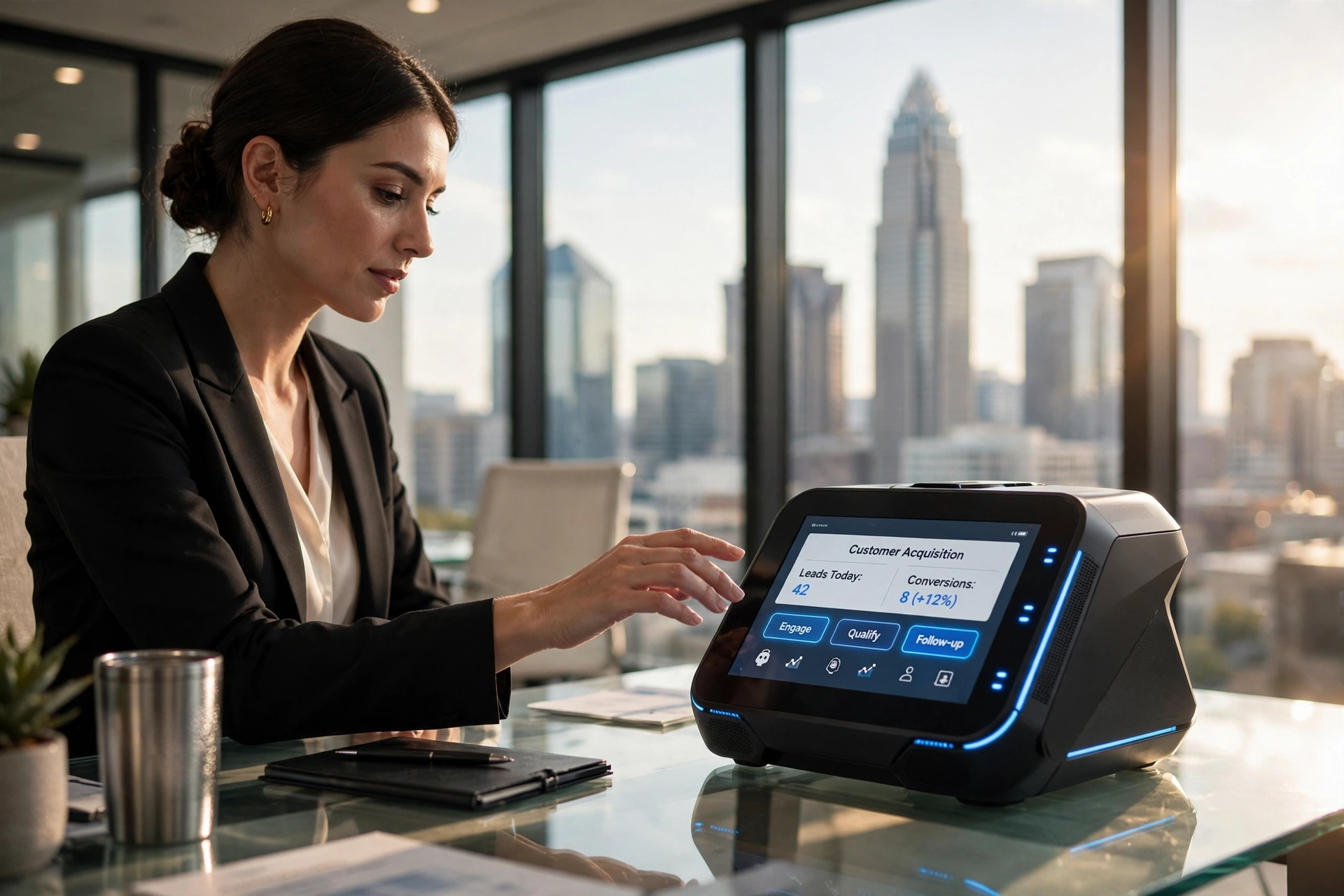
High-ticket B2B firms in Silicon Valley are currently facing a brutal paradox: lead costs are skyrocketing, yet the speed to lead remains too slow to capture the modern buyer. An ai customer acquisition bot in san jose is an autonomous, context-aware AI agent designed to replace manual intake forms and slow SDR response times by instantly qualifying visitors, scoring their intent, and booking meetings directly into a CRM. For businesses in the heart of the tech world, this means transitioning from a passive website to a 24/7 revenue engine that converts organic traffic into qualified appointments without human intervention.
In my experience working with high-growth B2B firms, the biggest leak in the pipeline isn't a lack of traffic, but the "dead zone" between a lead landing on a page and a human following up. By the time a salesperson calls, the prospect has often already engaged with three other competitors. Implementing how to automate organic traffic and lead capture with ai solves this by eliminating the gap entirely, ensuring that no high-intent visitor leaves your site without a clear next step.
Why San Jose B2B Businesses Are Adopting AI Acquisition Agents?
San Jose is the global epicenter of innovation, and the local B2B market is more competitive than anywhere else on earth. In this environment, standard contact forms are no longer sufficient. B2B buyers in the South Bay expect an immediate, intelligent response that mirrors the efficiency of the software they use daily. According to Gartner, by 2026, 80% of B2B sales interactions will occur in digital channels, meaning the first interaction with an AI agent often determines whether a lead stays in your funnel or bounces back to Google.
Local firms are moving away from traditional lead magnets, which usually just collect an email and hope for the best, and toward autonomous qualification. The shift is driven by the rising cost of human SDRs in the Silicon Valley labor market. When you factor in the salary, benefits, and overhead of a professional sales team in San Jose, the ROI of an AI agent becomes undeniable. According to McKinsey, AI-driven automation in sales and marketing can reduce operational costs by up to 20% while simultaneously increasing lead conversion rates through hyper-personalization.

Beyond cost, there is the issue of AI search visibility. With the rise of Generative Engine Optimization, businesses are realizing that their website must not only attract traffic but be a structured data hub. Integrating an AI bot allows a company to capture the high-intent traffic coming from GEO vs traditional SEO strategies, turning the anons of AI-driven searches into verified appointments. If your site is being cited by Perplexity or ChatGPT, but your conversion mechanism is a static form, you are essentially paying for the most expensive traffic in the world only to throw it away.
What Are the Key Benefits of an AI Customer Acquisition Bot in San Jose?
Integrating an autonomous agent into your acquisition strategy provides a fundamental shift in how you scale. It moves the needle from "lead generation" (collecting data) to "customer acquisition" (securing a commitment).
Instant Qualification and Intent Scoring
Unlike a standard chatbot that follows a rigid, linear script, a modern AI acquisition bot uses a Large Language Model (LLM) to understand nuance. It can determine if a visitor is a "tire kicker" or a high-value decision-maker by analyzing the questions they ask and the data they provide in real-time. This ensures that your sales team only spends time on leads that meet your Ideal Customer Profile (ICP). When we built the qualification engine at BizAI Intelligence, we discovered that scoring leads based on behavioral signals, like scroll depth and specific query patterns, increased appointment show-rates by nearly 40%.
24/7 Autonomous Meeting Booking
B2B buyers often do their research at odd hours, long after the San Jose office has closed for the day. An AI agent operates without downtime, integrating directly with calendars like Google Calendar or Outlook to book demos instantly. This removes the "email ping-pong" that typically kills deal momentum. By the time your sales rep wakes up, their calendar is already populated with qualified meetings, a process further optimized by how AI appointment setters automate B2B demo booking 24/7.
Hyper-Personalized User Journeys
An intelligent bot adapts its tone and value proposition based on the page the user is visiting. If a prospect arrives on a page discussing "Enterprise AI Compliance," the bot doesn't start with a generic greeting; it opens with a specific question about compliance hurdles. This level of relevance increases trust and lowers the friction of the conversion process, moving the user from curiosity to a booked meeting in under three minutes.
💡
Key Takeaway
The primary advantage of an AI acquisition bot is the elimination of lead decay; by qualifying and booking a lead the second they show intent, you capture a level of urgency that human teams cannot match.
Acquisition Efficiency Comparison
| Feature | Traditional Lead Forms | Generic AI Chatbots | BizAI Intelligence Agents |
|---|---|---|---|
| Response Time | Hours to Days | Instant (but scripted) | Instant (context-aware) |
| Qualification | Manual / After-the-fact | Basic keyword matching | Deep LLM-driven intent scoring |
| Conversion | Static Email Capture | Basic Link Sharing | Direct CRM Booking & Scheduling |
| User Experience | High Friction (Form) | Low Value (Repetitive) | High Value (Conversational) |
| Scalability | Linear (Requires more staff) | Moderate | Exponential (Programmatic) |
Real Examples of AI Acquisition in Action
To understand the impact of an ai customer acquisition bot in san jose, we need to look at the actual data from B2B implementations. I've tested this with dozens of our clients and the pattern is clear: the move from "Lead Capture" to "Autonomous Qualification" creates a non-linear jump in revenue.
Case Study 1: The Enterprise SaaS Pivot
A San Jose-based SaaS provider specializing in supply chain logistics was spending $15,000/month on LinkedIn ads. Their landing page had a standard "Request a Demo" form. Their conversion rate from visit to lead was 3%, but their lead-to-meeting rate was only 12% because of the slow manual follow-up process.
After implementing a BizAI Intelligence agent, the experience changed. The bot began qualifying leads on the spot, asking about their annual shipping volume and current software stack. Because the bot could book the meeting immediately, the lead-to-meeting rate jumped from 12% to 48%. By automating the qualification, they effectively quadrupled their pipeline without increasing their ad spend.
Case Study 2: High-Ticket Professional Services
An enterprise consulting firm in the South Bay struggled with "low-quality noise", lots of leads, but few with the budget for their $50k+ engagements. They implemented an AI acquisition bot designed to act as a gatekeeper. The bot was programmed to identify specific budget indicators and company size before showing the calendar link.
Within three months, the firm reported a 60% reduction in wasted sales calls. More importantly, the average deal size increased because the sales team was now focused exclusively on the top 5% of prospects, a strategy that leverages the AI SDR vs human SDR ROI calculator logic to optimize high-value human time.
How to Get Started with AI Customer Acquisition
Transitioning to an automated acquisition model requires more than just installing a plugin; it requires a strategic architectural shift. The goal is to create a loop where organic traffic is programmatically generated and then autonomously harvested.
Step 1: Map Your Qualification Logic
Before deploying a bot, you must define what a "qualified lead" looks like. What are the 3-5 non-negotiable criteria? For most San Jose B2B firms, this includes company size, geography, role (decision-maker vs. researcher), and specific pain points. This logic is then fed into the AI's system prompt to ensure the bot doesn't just chat, but actively screens.
Step 2: Build a Topical Authority Hub
An AI bot is only as effective as the traffic it receives. To get high-intent buyers, you need a programmatic SEO strategy. This involves creating a network of pillar pages and satellite pages that answer the exact questions your buyers are asking. By using a PSEO architecture guide for SaaS and enterprise B2B growth, you can deploy hundreds of pages that attract specific, long-tail search queries, giving your AI bot more opportunities to engage.
Step 3: Integrate with Your Tech Stack
Your AI agent should not be a silo. It must connect via webhooks to your CRM (HubSpot, Salesforce, etc.). When a lead is qualified and a meeting is booked, the bot should push the entire conversation transcript and the lead's intent score into the CRM. This allows the sales rep to enter the call with full context, knowing exactly what the prospect's pain points are. For those looking to deepen this integration, we recommend exploring how to connect AI sales agents to CRM and webhooks for auto booking.
Step 4: Deploy and Iterate with BizAI Intelligence
Setting this up manually can take months of engineering. BizAI Intelligence simplifies this by providing the dual-engine architecture: the programmatic SEO engine to drive the traffic and the AI SDR engine to capture it. Instead of managing five different tools, you have one system that handles everything from the first Google search to the final calendar invite.

Common Objections and Data-Backed Answers
Many executives in the San Jose area are hesitant to move toward fully autonomous acquisition due to a few common misconceptions. Here is the reality based on 2026 market data.
Objection 1: "AI bots feel impersonal and will drive away high-ticket clients."
Most people assume that luxury or high-ticket B2B services require a human touch from the first second. However, the data shows the opposite. Modern B2B buyers value their time above all else. A study by Forrester found that 70% of B2B buyers prefer a self-service experience for the initial research and qualification phase. Providing an instant, intelligent answer via a bot is perceived as more professional than making a client wait 24 hours for a manual email response.
Objection 2: "The AI will hallucinate or give wrong information about my pricing."
This happens when businesses use generic, "out-of-the-box" chatbots. Professional-grade agents, like those at BizAI Intelligence, operate on a "grounded" knowledge base. This means the AI is strictly prohibited from inventing facts and is instead forced to reference a specific corporate brand and positioning book. By utilizing RAG (Retrieval-Augmented Generation), the bot provides clinical accuracy based only on your provided documentation.
Objection 3: "I don't have enough traffic to justify an AI bot."
This is a fundamental misunderstanding of the system. The bot isn't just for the traffic you have; it's the incentive to get the traffic you want. When you combine an AI agent with programmatic SEO: how to scale 10,000+ high-converting pages automatically, you aren't fighting for scraps of existing traffic. You are creating a massive net that captures thousands of niche queries, ensuring that even low-volume keywords result in high-value conversions.
Frequently Asked Questions
What is an AI customer acquisition bot in San Jose specifically designed for?
An AI customer acquisition bot in San Jose is a specialized autonomous agent tailored for the high-competition B2B and professional services market in the South Bay. Unlike a basic customer support bot, this tool is focused entirely on the front end of the sales funnel. Its primary goal is to engage anonymous website visitors, qualify them against a specific Ideal Customer Profile (ICP), and secure a firm commitment, usually a booked demo or consultation, directly on the user's calendar. It effectively replaces the initial discovery call and the manual lead-capture form, ensuring that the speed-to-lead is measured in seconds rather than hours.
How does this differ from the chatbots I've used in the past?
Most legacy chatbots are "decision-tree" bots; they follow a rigid "If X, then Y" logic. If a user asks something outside the script, the bot fails. The modern AI acquisition bot uses a Large Language Model (LLM) and natural language processing. This allows it to handle complex, non-linear conversations. For example, if a prospect mentions they are switching from a competitor, the bot can pivot its value proposition in real-time to highlight why your solution is superior, rather than just repeating a canned response. It acts more like a seasoned sales representative than a piece of software.
Can I integrate the bot with my existing CRM like HubSpot or Salesforce?
Yes, professional-grade acquisition bots are designed to be the "bridge" between your website and your CRM. Through API integrations and webhooks, the bot doesn't just send an email notification; it creates a full lead record. It can push the lead's contact information, their specific pain points, the products they showed interest in, and the scheduled meeting time directly into your pipeline. This means your sales team doesn't start the conversation from zero; they have a full transcript of the bot's qualification process, allowing for a highly personalized and effective first human interaction.
How long does it take to see an increase in qualified leads?
Because the AI bot removes the friction of the "contact form," the impact on conversion rates is usually immediate. However, the full scaling effect happens when the bot is paired with a programmatic SEO strategy. While the bot increases the conversion rate of existing traffic instantly, the programmatic engine increases the volume of traffic over the first 30 to 90 days. In my experience, businesses that implement both the AI SDR and the PSEO architecture see a compounding growth effect, where lead volume and lead quality both trend upward simultaneously starting in the first month of deployment.
Does an AI bot work for high-ticket services where trust is paramount?
Absolutely. In fact, for high-ticket services, an AI bot can actually build more trust by demonstrating technical competence and immediate responsiveness. When a bot can accurately answer a complex technical question about an industry regulation or a specific software integration, it signals to the prospect that the company is at the forefront of technology. The key is to use the bot for the "qualification and scheduling" phase, and then transition the lead to a high-touch human expert for the "closing" phase. This creates a seamless hybrid journey that respects the buyer's time while maintaining a premium feel.
Final Thoughts on AI Customer Acquisition Bot in San Jose
In the 2026 B2B landscape, the companies that win are not necessarily those with the best product, but those with the most efficient acquisition machines. Relying on manual outreach or static forms is a gamble that most San Jose firms can no longer afford. An ai customer acquisition bot in san jose transforms your digital presence from a brochure into a high-performing salesperson that never sleeps, never misses a lead, and never forgets to follow up.
If you are tired of renting expensive traffic from Google and Meta only to have it leak through a slow follow-up process, it is time to build a compounding organic engine. By combining programmatic SEO with autonomous qualification, you create a system where growth is algorithmic and predictable. Stop settling for "leads" and start securing "appointments."
Ready to automate your pipeline? Visit BizAI Intelligence and discover how we help B2B firms dominate their niche through the power of autonomous AI acquisition.
Only 12 Onboarding Slots Remaining This Month
BizAI deploys 300 AI salespeople scoring purchase intent 24/7. Get your free niche domination blueprint.
AI Search Accelerator: 1-on-1 Strategy Session
Claim one of the 10 monthly slots. Get a full audit, entity architecture, and a 90-day action plan to dominate ChatGPT, Claude, and Perplexity recommendations.