
📖This article is part of the complete guide to AI Customer Service: The Complete Guide to 24/7 Automated Support.
I once audited a mid-sized B2B SaaS company that boasted a 90% deflection rate through their new AI chatbot, yet their churn rate was spiking. When we dug into the data, we found that while the AI was 'resolving' tickets by closing them, the actual customer satisfaction was plummeting because the AI was simply refusing to escalate complex issues. This is the danger of vanity metrics; if you measure the wrong things, your AI becomes a wall between you and your customers rather than a bridge. For a comprehensive overview, explore our guide on AI customer service.
What Are AI Customer Service Metrics and How Do They Differ From Human KPIs?
📚
Definition
AI customer service metrics are quantitative measurements used to evaluate the efficiency, accuracy, and impact of artificial intelligence agents in handling customer inquiries compared to human-led support.
AI customer service metrics CSAT and other performance indicators are not merely digitized versions of traditional KPIs; they represent a fundamental shift in how we perceive "support success." In a traditional human-centric model, we measure effort and time. In an AI-driven model, we measure accuracy, deflection quality, and the seamlessness of the handoff to a human agent. When you implement a large language model (LLM) into your support stack, the primary goal shifts from "handling the ticket" to "solving the problem with zero friction."
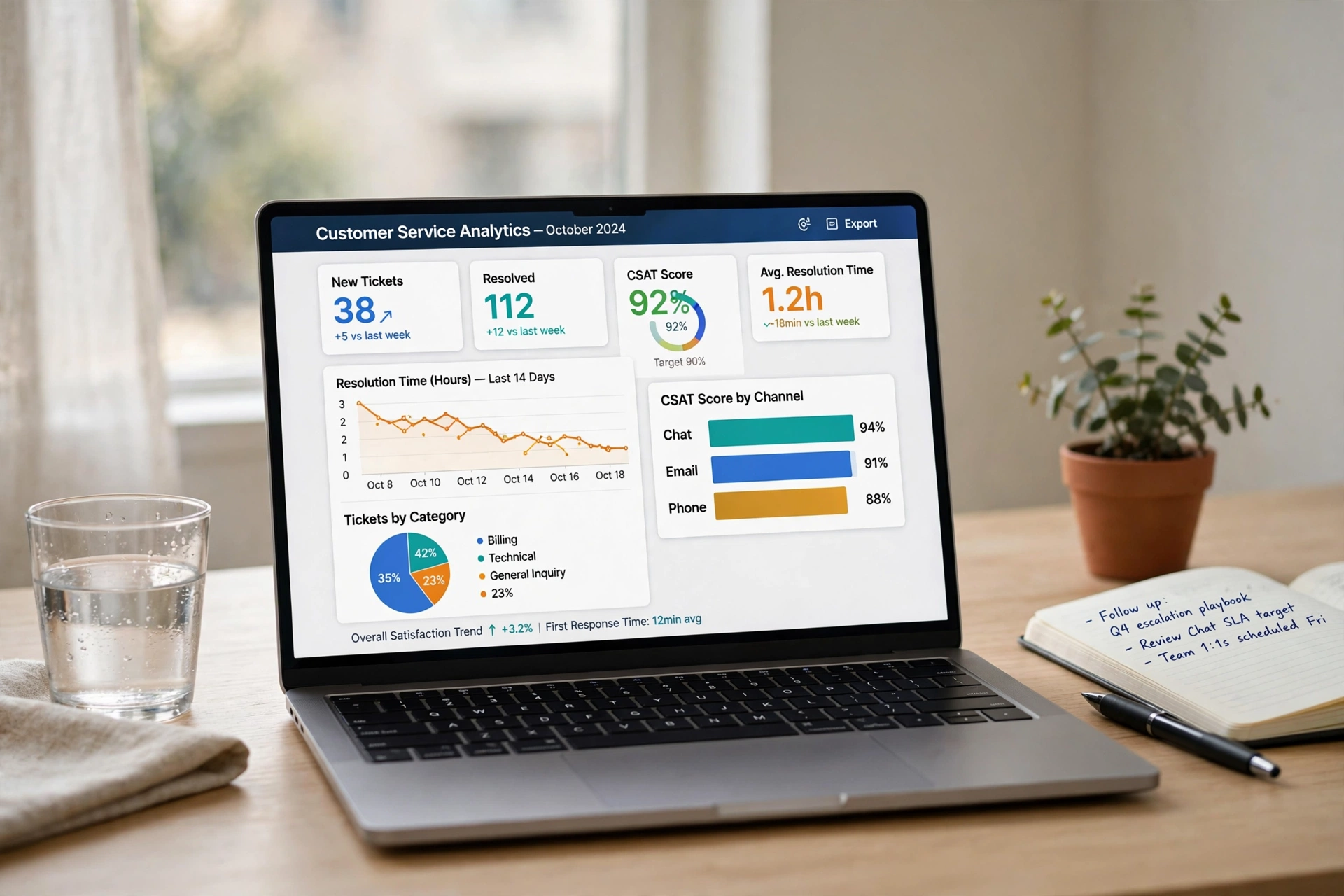
To understand these metrics, we must look at the three core pillars: Satisfaction (CSAT), Velocity (Resolution Time), and Efficiency (Cost per Ticket). While a human agent's performance is often judged by their availability and empathy, an AI's performance is judged by its ability to provide a correct answer instantly without causing customer frustration. This requires a deeper look at "Deflection Rate," which is often the most misused metric in the industry. True deflection isn't just a closed ticket; it is a resolved query where the customer did not feel the need to follow up with a human. If a customer asks three times and then gives up, that is a "deflection" in the data, but a failure in reality.
In my experience building automated systems at BizAI Intelligence, I've seen that the most successful companies track "Sentiment Shift." This involves using AI to analyze the tone of the user at the start of the interaction versus the end. If a user starts "Angry" and ends "Neutral" or "Happy," the AI has succeeded, regardless of whether the ticket was officially closed. This level of granularity is what separates a basic chatbot from a sophisticated AI SDR or support agent.
Why Tracking These Metrics is Essential for Business Growth in 2026
Tracking AI customer service metrics CSAT and resolution times is essential because AI can scale mistakes as easily as it scales successes. Without rigorous measurement, you are essentially flying blind while your brand reputation is being handled by an algorithm. According to research from Gartner, companies that prioritize AI-driven customer experience (CX) metrics over simple cost-cutting measures see a significantly higher increase in long-term customer loyalty.
First, the impact on CSAT (Customer Satisfaction Score) is profound. In 2026, customers no longer compare your AI to other bots; they compare it to the best digital experiences they have across the web. If your AI agent takes too long to process a request or provides a generic response, your CSAT will drop regardless of how "fast" the response was. High-quality AI support should actually drive CSAT higher than human support for simple queries because it eliminates wait times entirely.
Second, Resolution Time (TTR) is the ultimate competitive advantage. In a world of instant gratification, a resolution time of five minutes is considered slow if the solution is a simple password reset. By leveraging AI, companies can move toward "Zero-Minute Resolution," where the answer is provided the moment the query is typed. This drastic reduction in friction directly correlates with higher conversion rates for B2B companies, as prospects are more likely to commit when their technical doubts are cleared instantly.
Third, the Cost per Ticket allows you to quantify the actual ROI of your digital transformation. When you shift from a model where every ticket costs $15 in human labor to one where AI handles 80% of queries at a fraction of a cent, the capital freed up can be reinvested into growth. This is why understanding the AI customer service ROI is so critical; it transforms the support center from a cost center into a strategic asset.
| Metric | Traditional Human Approach | Generic AI Approach | Modern BizAI Approach |
|---|---|---|---|
| CSAT | Variable (Dependent on mood/skill) | Low (Frustration with "I don't understand") | High (Context-aware & accurate) |
| Resolution Time | Hours or Days | Seconds (but often wrong) | Seconds (Verified & Accurate) |
| Cost per Ticket | High (Salary, Benefits, Overhead) | Low (Software License) | Ultra-Low (Programmatic Scale) |
How to Implement and Optimize AI Customer Service Metrics
To effectively optimize your AI customer service metrics CSAT and efficiency, you need a closed-loop system where data informs the model's training. You cannot simply install a bot and check the dashboard once a month. You need a real-time feedback loop.
Step 1: Establish your Baseline. Before deploying AI, measure your current human-led CSAT and average resolution time. If your human team has a CSAT of 85% and a resolution time of 4 hours, your AI target should be a CSAT of 90% and a resolution time of < 30 seconds for the same category of queries.
Step 2: Implement Granular Tagging. Do not just track "Resolved vs. Unresolved." Use AI to tag tickets by intent. For example, "Billing Query," "Technical Bug," or "Feature Request." This allows you to see where the AI is struggling. If your CSAT is high for billing but low for technical bugs, you know exactly where your knowledge base needs strengthening.
Step 3: The "Human-in-the-Loop" Audit. Regularly sample 5% of your AI's "successful" resolutions. Have a senior human agent review them to ensure the AI didn't just provide a plausible-sounding but incorrect answer (hallucinations). This is where many companies fail; they trust the "Resolved" tag without auditing the quality of the resolution.
Step 4: Optimize the Handoff. Measure the "Handoff Friction." How many clicks or seconds does it take for a frustrated user to reach a human? If the AI keeps looping the user in a circle, your CSAT will crash. Use automated inbound lead qualification CRM integrations to ensure the human agent who takes over has the full transcript and context, so the customer doesn't have to repeat themselves.

If you are scaling these operations, consider how programmatic SEO architecture for SaaS can actually reduce your ticket volume. By creating high-authority satellite pages that answer the most common questions before they ever become tickets, you optimize your metrics by preventing the problem entirely. This is the essence of "Zero-Ticket Support."
Common Mistakes to Avoid When Measuring AI Support
One of the most frequent errors I see is the "Deflection Trap." Companies celebrate a 90% deflection rate, but they ignore the fact that their total ticket volume is increasing because the AI is so frustrating that users are returning to the phone lines or email with even higher levels of anger. Deflection is only a success if it results in a resolution. If a user leaves your site without an answer, that's not a deflection; it's a lost customer.
Another mistake is ignoring the "Cost of Error." In high-ticket B2B services, a single AI hallucination that gives a wrong price or a false promise about a feature can cost thousands of dollars in lost contracts or legal disputes. You must weigh the cost per ticket savings against the risk of a high-impact error. This is why we recommend a hybrid AI + human customer service model for complex industries; the AI handles the volume, but the human handles the risk.
Furthermore, many teams fail to track "Re-open Rates." If a ticket is marked as resolved by the AI, but the user re-opens it within 24 hours, the first resolution was a failure. A low initial resolution time is meaningless if the re-open rate is high. You should be optimizing for "First Contact Resolution" (FCR), ensuring the problem is solved correctly the first time.
Finally, avoid the mistake of using generic AI tools without a dedicated knowledge base. When you use a general-purpose LLM without grounding it in your company's specific documentation, you will see a volatile CSAT. The AI might be polite, but it won't be accurate. This is why the best AI customer service tools in 2026 are those that allow for deep integration with private company data and structured schema.
Frequently Asked Questions
How do I calculate AI CSAT accurately?
To calculate AI CSAT, you should trigger a micro-survey immediately after the AI marks a query as resolved. Use a simple 1-5 scale or a "thumbs up/down" mechanism. The formula is: (Number of satisfied customers / Total number of responses) x 100. To make this accurate, only count responses from users who actually interacted with the AI for more than 30 seconds to filter out accidental clicks. Compare this score specifically against the CSAT of your human agents to identify the "performance gap."
Does a high deflection rate always mean the AI is working?
No, a high deflection rate can be deceptive. It simply means the user didn't reach a human. This could be because the AI solved the problem, or because the user gave up in frustration. To validate your deflection rate, you must cross-reference it with your "Customer Effort Score" (CES) and your churn rate. If deflection is rising while CSAT is falling, your AI is acting as a barrier, not a solution, and you are likely damaging your brand equity.
How does AI impact the average Cost per Ticket?
AI drastically reduces the cost per ticket by automating repetitive tasks. While a human agent costs a certain amount per hour (including benefits and overhead), an AI agent handles thousands of queries simultaneously for a flat software cost. For example, if a human costs $15 per ticket and the AI reduces the volume hitting humans by 70%, your blended cost per ticket drops significantly. However, you must include the cost of AI maintenance and knowledge base updates in your final calculation.
What is a good Resolution Time for an AI agent?
For an AI agent, the expected resolution time is nearly instantaneous. For a simple query, the answer should be delivered in under 3 seconds. For a more complex query that requires searching a knowledge base, the "time to first response" should still be under 5 seconds. If your AI is taking 15-30 seconds to generate a response, the user experience degrades, and they will likely abandon the chat or perceive the tool as slow and inefficient.
Should I prioritize CSAT or Resolution Time?
In 2026, you must prioritize CSAT. Speed is a baseline requirement, but accuracy is the value driver. A fast, wrong answer is infinitely worse than a slightly slower, correct answer. If you optimize solely for resolution time, your AI will learn to give short, generic answers to close tickets quickly, which will inevitably crash your CSAT. The goal is to find the "efficiency frontier" where the AI is as fast as possible without compromising the quality of the resolution.
Conclusion
Measuring AI customer service metrics CSAT, resolution time, and cost per ticket is not just about reporting to management; it is about refining the engine of your customer experience. In the competitive landscape of 2026, the businesses that win will be those that use these metrics to eliminate friction and build trust. If you only track the cost savings, you are missing the bigger picture: the opportunity to create a frictionless journey that turns a support interaction into a loyalty-building event.
Stop treating your AI as a cost-cutting tool and start treating it as a growth engine. By focusing on the quality of resolution rather than the quantity of deflection, you ensure that your automation scales your reputation, not your mistakes. For those looking to master the entire ecosystem of automated support, we highly recommend returning to our AI Customer Service: The Complete Guide to 24/7 Automated Support for a full strategic blueprint.
If you're tired of fighting with generic bots that drive your customers away, it's time to move toward a professional, architected solution. At BizAI Intelligence, we build the infrastructure that replaces mediocre support with high-conversion acquisition engines. Visit bizaigpt.com to see how we can transform your support metrics into revenue drivers.
AI Search Accelerator: 1-on-1 Strategy Session
Claim one of the 10 monthly slots. Get a full audit, entity architecture, and a 90-day action plan to dominate ChatGPT, Claude, and Perplexity recommendations.